• Wyszukiwanie zaawansowane
  • Kategorie
  • Kategorie BISAC
  • Książki na zamówienie
  • Promocje
  • Granty
  • Książka na prezent
  • Opinie
  • Pomoc
  • Załóż konto
  • Zaloguj się

Allelopathy in Sustainable Agriculture and Forestry » książka


zaloguj się | załóż konto
Logo Krainaksiazek.pl

koszyk

konto

szukaj
topmenu
Księgarnia internetowa
Szukaj
Książki na zamówienie
Promocje
Granty
Książka na prezent
Moje konto
Pomoc
 
 
Wyszukiwanie zaawansowane
Pusty koszyk
Bezpłatna dostawa dla zamówień powyżej 20 złBezpłatna dostawa dla zamówień powyżej 20 zł

Kategorie główne

• Nauka
 [2950560]
• Literatura piękna
 [1849509]

  więcej...
• Turystyka
 [71097]
• Informatyka
 [151150]
• Komiksy
 [35848]
• Encyklopedie
 [23178]
• Dziecięca
 [617388]
• Hobby
 [139064]
• AudioBooki
 [1657]
• Literatura faktu
 [228597]
• Muzyka CD
 [383]
• Słowniki
 [2855]
• Inne
 [445295]
• Kalendarze
 [1464]
• Podręczniki
 [167547]
• Poradniki
 [480102]
• Religia
 [510749]
• Czasopisma
 [516]
• Sport
 [61293]
• Sztuka
 [243352]
• CD, DVD, Video
 [3414]
• Technologie
 [219456]
• Zdrowie
 [101002]
• Książkowe Klimaty
 [124]
• Zabawki
 [2311]
• Puzzle, gry
 [3459]
• Literatura w języku ukraińskim
 [254]
• Art. papiernicze i szkolne
 [8079]
Kategorie szczegółowe BISAC

Allelopathy in Sustainable Agriculture and Forestry

ISBN-13: 9780387773360 / Angielski / Twarda / 2008 / 412 str.
Rensen Zeng; Azim U. Mallik; Shiming Luo
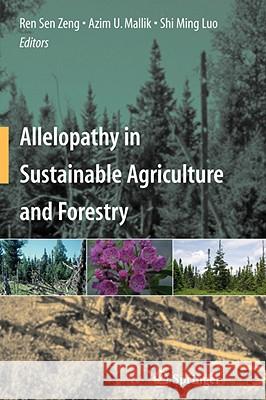
Allelopathy in Sustainable Agriculture and Forestry Rensen Zeng Azim U. Mallik Shiming Luo 9780387773360 Not Avail - książkaWidoczna okładka, to zdjęcie poglądowe, a rzeczywista szata graficzna może różnić się od prezentowanej.

Allelopathy in Sustainable Agriculture and Forestry

ISBN-13: 9780387773360 / Angielski / Twarda / 2008 / 412 str.

Rensen Zeng; Azim U. Mallik; Shiming Luo
cena 803,21
(netto: 764,96 VAT:  5%)

Najniższa cena z 30 dni: 771,08
Termin realizacji zamówienia:
ok. 22 dni roboczych
Dostawa w 2026 r.

Darmowa dostawa!

Simply put, allelopathy refers to an ecological phenomenon of plant-plant interference through release of organic chemicals (allelochemicals) in the environment. These chemicals can be directly and continuously released by the donor plants in their immediate environment as volatiles in the air or root exudates in soil or they can be the microbial degradation products of plant residues. The chemicals may interfere with survival and growth of neighboring or succeeding plants. Black walnut, eucalyptus, sunflower, sorghum, sesame and alfalfa are common examples of plants with allelopathic property as well as some staple crops such as rice, wheat, barley and sorghum. Plants can emit chemicals that also discourage insects and pathogens. To maintain sustained productivity, knowledge of this form of plant interference on other plants and on disease causing organisms has been used in agriculture since prehistoric time by manipulating cropping pattern and sequence such as mixed cropping and crop rotation. However, use of numerous agrochemicals including a wide range of herbicides, pesticides, fertilizers and genetically modified high yielding crops has become the characteristic feature of modern industrial agriculture. Not only the sustainability of crop yield is called into question in this form of agriculture, the extensive long-term and often irreversible environmental degradation including ground water contamination and food safety associated with industrial agriculture are now of serious concern worldwide. The objective is to report on the latest advances in allelopathy by inviting leading scientists to contribute in specific fields. The volume is organized under three major subsections: History of allelopathy, Allelochemicals, allelopathic mechanisms, and bioassays, and Application of allelopathy in agriculture and forestry. An emphasis is place on methodology and application, making it a truly practical reference.


Kategorie:
Nauka, Biologia i przyroda
Kategorie BISAC:
Science > Botanika
Science > Life Sciences - Ecology
Nature > Plants - Trees
Wydawca:
Not Avail
Język:
Angielski
ISBN-13:
9780387773360
Rok wydania:
2008
Wydanie:
2008
Ilość stron:
412
Waga:
0.77 kg
Wymiary:
23.39 x 15.6 x 2.39
Oprawa:
Twarda
Wolumenów:
01
Dodatkowe informacje:
Bibliografia
Wydanie ilustrowane

History.- Historical Examples of Allelopathy and Ethnobotany from the Mediterranean Region.- Allelopathy: Advances, Challenges and Opportunities.- Allelopathy in Chinese Ancient and Modern Agriculture.- Allelochemicals and Allelopathic Mechanisms.- Allelochemicals in Plants.- Allelopathy: Full Circle from Phytotoxicity to Mechanisms of Resistance.- Allelopathic Mechanisms and Experimental Methodology.- Indirect Effects of Phenolics on Plant Performance by Altering Nitrogen Cycling: Another Mechanism of Plant–Plant Negative Interactions.- Genomic Approaches to Understanding Allelochemical Effects on Plants.- Allelopathy from a Mathematical Modeling Perspective.- Application of Allelopathy in Agriculture and Forestry.- Progress and Prospect of Rice Allelopathy Research.- Rice Allelopathy Research in China.- Recent Advances in Wheat Allelopathy.- Sorghum Allelopathy for Weed Management in Wheat.- Allelochemicals in Pre-cowing Soils of Continuous Soybean Cropping and Their Autointoxication.- Autotoxicity in Agriculture and Forestry.- Black Walnut Allelopathy: Implications for Intercropping.- Plant Growth Promoting Rhizobacteria and Mycorrhizal Fungi in Sustainable Agriculture and Forestry.- Utilization of Stress Tolerant, Weed Suppressive Groundcovers for Low Maintenance Landscape Settings.- Allelopathy in Forested Ecosystems.

Allelopathy in Sustainable Agriculture and Forestry
Zeng, Ren Sen; Mallik, Azim U.; Luo, Shi Ming (Eds.)

Simply put, allelopathy refers to an ecological phenomenon of plant-plant interference through release of organic chemicals (allelochemicals) in the environment. These chemicals can be directly and continuously released by the donor plants in their immediate environment as water leachates volatiles in the air or root exudates in soil - or they can be the microbial degradation products of plant residues. Allelochemicals may interfere with survival and growth of neighboring or succeeding plants, and may also discourage insects and pathogens. Black walnut, eucalyptus, sunflower, sorghum, sesame and alfalfa are common examples of plants with allelopathic properties. Likewise, staple crops such as rice, wheat, barley and sorghum also exhibit allelopathic characteristics.

Knowledge of this form of plant interference on other plants and on disease causing organisms has been used in agriculture since prehistoric time. By manipulating cropping pattern and sequence through mixed cropping or crop rotation, farmers have been able to maintain sustained productivity. However, use of numerous agrochemicals - including a wide range of herbicides, pesticides, fertilizers and genetically modified high yielding crops - has become the characteristic feature of modern industrial agriculture. Not only is the sustainability of crop yield called into question in this form of agriculture, but the extensive long-term and often irreversible environmental degradation including ground water contamination and food safety associated with industrial agriculture are now serious concerns worldwide.

This book reports on the latest advances in allelopathy through the contributions of leading scientists in the field. The book addresses the history of allelopathy, the science of allelochemicals, and the application of allelopathy in agriculture and forestry. An emphasis on both methodology and application makes Allelopathy a truly practical reference for scientists, researchers and students of plant science, agriculture, forestry, terrestrial ecology and environmental science.

Ren Sen Zeng, Ph. D. is a Professor of Ecology and Director of the Research Center for Chemical Ecology at South China Agricultural University (SCAU) in Guangzhou, China. He received his Ph. D. in Ecology from SCAU in 2000. Professor Zeng was elected as New Century Excellent Talents in University of China. He serves in the Executive Council of International Allelopathy Society. His research focuses on allelopathy and chemical interactions between plants and other organisms.

Azim Mallik, Ph. D. is a Professor of Biology and Chair of Graduate Studies Program in Biology at Lakehead University, Ontario, Canada. He received his Ph. D. from the University of Aebrdeen, U.K. Professor Mallik is widely published in peer-reviewed journals on disturbance ecology and allelopathy. He jointly edited a book with Professor Inderjit on Chemical Ecology of Plants. He received the Grodzinsky Award of International Allelopathy Society (IAS). Professor Mallik is a founding Vice-President and immediate past President of IAS and currently treasurer & executive board member of INTECOL.

Shi Ming Luo, Ph. D. is a Professor of Ecology and Director of the Institute of Tropical and Subtropical Ecology at South China Agricultural University. He received his Masters in Agronomy from SCAU in 1982 and an honorary doctorate degree from Pennsylvania State University. He served as the President of SCAU for eleven years. Professor Luo is Vice-President of the Ecological Society of China. His research interests include allelopathy and ecological agriculture.


Udostępnij

Facebook - konto krainaksiazek.pl


Opinie o Krainaksiazek.pl na Opineo.pl

Partner Mybenefit

Krainaksiazek.pl w programie rzetelna firma Krainaksiaze.pl - płatności przez paypal

Czytaj nas na:

Facebook - krainaksiazek.pl
  • książki na zamówienie
  • granty
  • książka na prezent
  • kontakt
  • pomoc
  • opinie
  • regulamin
  • polityka prywatności

Zobacz:

  • Księgarnia czeska

  • Wydawnictwo Książkowe Klimaty

1997-2025 DolnySlask.com Agencja Internetowa

© 1997-2022 krainaksiazek.pl
     
KONTAKT | REGULAMIN | POLITYKA PRYWATNOŚCI | USTAWIENIA PRYWATNOŚCI
Zobacz: Księgarnia Czeska | Wydawnictwo Książkowe Klimaty | Mapa strony | Lista autorów
KrainaKsiazek.PL - Księgarnia Internetowa

Polityka prywatnosci - link
Krainaksiazek.pl - płatnośc Przelewy24
Przechowalnia Przechowalnia





