• Wyszukiwanie zaawansowane
  • Kategorie
  • Kategorie BISAC
  • Książki na zamówienie
  • Promocje
  • Granty
  • Książka na prezent
  • Opinie
  • Pomoc
  • Załóż konto
  • Zaloguj się

Algorithmic Learning in a Random World » książka


zaloguj się | załóż konto
Logo Krainaksiazek.pl

koszyk

konto

szukaj
topmenu
Księgarnia internetowa
Szukaj
Książki na zamówienie
Promocje
Granty
Książka na prezent
Moje konto
Pomoc
 
 
Wyszukiwanie zaawansowane
Pusty koszyk
Bezpłatna dostawa dla zamówień powyżej 20 złBezpłatna dostawa dla zamówień powyżej 20 zł

Kategorie główne

• Nauka
 [2949965]
• Literatura piękna
 [1857847]

  więcej...
• Turystyka
 [70818]
• Informatyka
 [151303]
• Komiksy
 [35733]
• Encyklopedie
 [23180]
• Dziecięca
 [617748]
• Hobby
 [139972]
• AudioBooki
 [1650]
• Literatura faktu
 [228361]
• Muzyka CD
 [398]
• Słowniki
 [2862]
• Inne
 [444732]
• Kalendarze
 [1620]
• Podręczniki
 [167233]
• Poradniki
 [482388]
• Religia
 [509867]
• Czasopisma
 [533]
• Sport
 [61361]
• Sztuka
 [243125]
• CD, DVD, Video
 [3451]
• Technologie
 [219309]
• Zdrowie
 [101347]
• Książkowe Klimaty
 [123]
• Zabawki
 [2362]
• Puzzle, gry
 [3791]
• Literatura w języku ukraińskim
 [253]
• Art. papiernicze i szkolne
 [7933]
Kategorie szczegółowe BISAC

Algorithmic Learning in a Random World

ISBN-13: 9783031066481 / Angielski / Twarda / 2022 / 476 str.
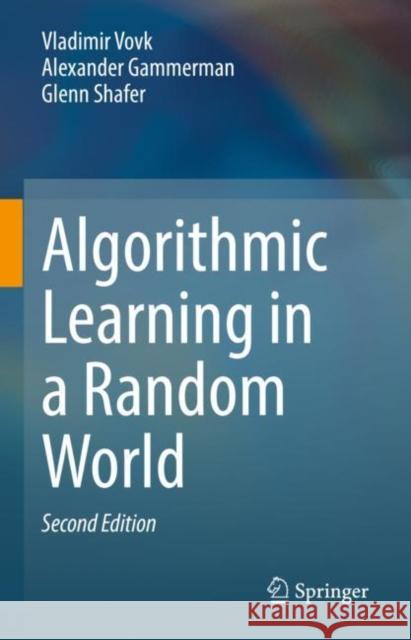
Vladimir Vovk; Alexander Gammerman; Glenn Shafer
Algorithmic Learning in a Random World Vladimir Vovk Alexander Gammerman Glenn Shafer 9783031066481 Springer - książkaWidoczna okładka, to zdjęcie poglądowe, a rzeczywista szata graficzna może różnić się od prezentowanej.

Algorithmic Learning in a Random World

ISBN-13: 9783031066481 / Angielski / Twarda / 2022 / 476 str.

Vladimir Vovk; Alexander Gammerman; Glenn Shafer
cena 685,93 zł
(netto: 653,27 VAT:  5%)

Najniższa cena z 30 dni: 655,41 zł
Termin realizacji zamówienia:
ok. 22 dni roboczych
Bez gwarancji dostawy przed świętami

Darmowa dostawa!
inne wydania

This book is about conformal prediction, an approach to prediction that originated in machine learning in the late 1990s. The main feature of conformal prediction is the principled treatment of the reliability of predictions. The prediction algorithms described — conformal predictors — are provably valid in the sense that they evaluate the reliability of their own predictions in a way that is neither over-pessimistic nor over-optimistic (the latter being especially dangerous). The approach is still flexible enough to incorporate most of the existing powerful methods of machine learning. The book covers both key conformal predictors and the mathematical analysis of their properties.Algorithmic Learning in a Random Worldcontains, in addition to proofs of validity, results about the efficiency of conformal predictors. The only assumption required for validity is that of "randomness" (the prediction algorithm is presented with independent and identically distributed examples); in later chapters, even the assumption of randomness is significantly relaxed. Interesting results about efficiency are established both under randomness and under stronger assumptions.Since publication of the First Edition in 2005 conformal prediction has found numerous applications in medicine and industry, and is becoming a popular machine-learning technique. This Second Edition contains three new chapters. One is about conformal predictive distributions, which are more informative than the set predictions produced by standard conformal predictors. Another is about the efficiency of ways of testing the assumption of randomness based on conformal prediction. The third new chapter harnesses conformal testing procedures for protecting machine-learning algorithms against changes in the distribution of the data. In addition, the existing chapters have been revised, updated, and expanded.


This book is about conformal prediction, an approach to prediction that originated in machine learning in the late 1990s. The main feature of conformal prediction is the principled treatment of the reliability of predictions. The prediction algorithms described — conformal predictors — are provably valid in the sense that they evaluate the reliability of their own predictions in a way that is neither over-pessimistic nor over-optimistic (the latter being especially dangerous). The approach is still flexible enough to incorporate most of the existing powerful methods of machine learning. The book covers both key conformal predictors and the mathematical analysis of their properties.Algorithmic Learning in a Random World contains, in addition to proofs of validity, results about the efficiency of conformal predictors. The only assumption required for validity is that of "randomness" (the prediction algorithm is presented with independent and identically distributed examples); in later chapters, even the assumption of randomness is significantly relaxed. Interesting results about efficiency are established both under randomness and under stronger assumptions.Since publication of the First Edition in 2005 conformal prediction has found numerous applications in medicine and industry, and is becoming a popular machine-learning technique. This Second Edition contains three new chapters. One is about conformal predictive distributions, which are more informative than the set predictions produced by standard conformal predictors. Another is about the efficiency of ways of testing the assumption of randomness based on conformal prediction. The third new chapter harnesses conformal testing procedures for protecting machine-learning algorithms against changes in the distribution of the data. In addition, the existing chapters have been revised, updated, and expanded.

Kategorie:
Informatyka, Bazy danych
Kategorie BISAC:
Computers > Artificial Intelligence - General
Computers > Mathematical & Statistical Software
Computers > Programming - Algorithms
Wydawca:
Springer
Język:
Angielski
ISBN-13:
9783031066481
Rok wydania:
2022
Dostępne języki:
Ilość stron:
476
Waga:
0.87 kg
Wymiary:
23.39 x 15.6 x 2.69
Oprawa:
Twarda
Dodatkowe informacje:
Wydanie ilustrowane

1. Introduction.- Part I Set prediction.- 2. Conformal prediction: general case and regression.- 3. Conformal prediction: classification and general case.- 4. Modifications of conformal predictors.- Part II Probabilistic prediction.- 5. Impossibility results.- 6. Probabilistic classification: Venn predictors.- 7. Probabilistic regression: conformal predictive systems.- Part III Testing randomness.- 8. Testing exchangeability.- 9. Efficiency of conformal testing.- 10. Non-conformal shortcut.- Part IV Online compression modelling.- 11. Generalized conformal prediction.- 12. Generalized Venn prediction and hypergraphical models.- 13. Contrasts and perspectives.

Vladimir Vovk is Professor of Computer Science at Royal Holloway, University of London. His research interests include machine learning and the foundations of probability and statistics. He was one of the founders of prediction with expert advice, an area of machine learning avoiding making any statistical assumptions about the data. Together with Glenn Shafer and with original inspiration from Philip Dawid, he developed game-theoretic foundations for probability and statistics.

Alexander Gammerman is Professor of Computer Science and co-Director of the Centre for Reliable Machine Learning at Royal Holloway, University of London. His research interests lie in machine learning and pattern recognition, where the majority of his research books, papers, and grants can be found. He is a Fellow of the Royal Statistical Society and has held visiting and honorary professorships from several universities in Europe and the USA.

Glenn Shafer is Professor and former Dean of the Rutgers Business School – Newark and New Brunswick. He is best known for his work in the 1970s and 1980s on the Dempster-Shafer theory, an alternative theory of probability that has been applied widely in engineering and artificial intelligence. Glenn is also known for his initiation, with Vladimir Vovk, of the game-theoretic framework for probability. Their first book on the topic was Probability and Finance: It's Only a Game! A new book on the topic, Game-Theoretic Foundations for Probability and Finance, published in 2019 (Wiley).

This book is about conformal prediction, an approach to prediction that originated in machine learning in the late 1990s. The main feature of conformal prediction is the principled treatment of the reliability of predictions. The prediction algorithms described — conformal predictors — are provably valid in the sense that they evaluate the reliability of their own predictions in a way that is neither over-pessimistic nor over-optimistic (the latter being especially dangerous). The approach is still flexible enough to incorporate most of the existing powerful methods of machine learning. The book covers both key conformal predictors and the mathematical analysis of their properties.

Algorithmic Learning in a Random World contains, in addition to proofs of validity, results about the efficiency of conformal predictors. The only assumption required for validity is that of "randomness" (the prediction algorithm is presented with independent and identically distributed examples); in later chapters, even the assumption of randomness is significantly relaxed. Interesting results about efficiency are established both under randomness and under stronger assumptions.

Since publication of the First Edition in 2005 conformal prediction has found numerous applications in medicine and industry, and is becoming a popular machine-learning technique. This Second Edition contains three new chapters. One is about conformal predictive distributions, which are more informative than the set predictions produced by standard conformal predictors. Another is about the efficiency of ways of testing the assumption of randomness based on conformal prediction. The third new chapter harnesses conformal testing procedures for protecting machine-learning algorithms against changes in the distribution of the data. In addition, the existing chapters have been revised, updated, and expanded.




Udostępnij

Facebook - konto krainaksiazek.pl


Opinie o Krainaksiazek.pl na Opineo.pl

Partner Mybenefit

Krainaksiazek.pl w programie rzetelna firma Krainaksiaze.pl - płatności przez paypal

Czytaj nas na:

Facebook - krainaksiazek.pl
  • książki na zamówienie
  • granty
  • książka na prezent
  • kontakt
  • pomoc
  • opinie
  • regulamin
  • polityka prywatności

Zobacz:

  • Księgarnia czeska

  • Wydawnictwo Książkowe Klimaty

1997-2025 DolnySlask.com Agencja Internetowa

© 1997-2022 krainaksiazek.pl
     
KONTAKT | REGULAMIN | POLITYKA PRYWATNOŚCI | USTAWIENIA PRYWATNOŚCI
Zobacz: Księgarnia Czeska | Wydawnictwo Książkowe Klimaty | Mapa strony | Lista autorów
KrainaKsiazek.PL - Księgarnia Internetowa

Polityka prywatnosci - link
Krainaksiazek.pl - płatnośc Przelewy24
Przechowalnia Przechowalnia



