• Wyszukiwanie zaawansowane
  • Kategorie
  • Kategorie BISAC
  • Książki na zamówienie
  • Promocje
  • Granty
  • Książka na prezent
  • Opinie
  • Pomoc
  • Załóż konto
  • Zaloguj się

Air Pollution by Photochemical Oxidants: Formation, Transport, Control, and Effects on Plants » książka


zaloguj się | załóż konto
Logo Krainaksiazek.pl

koszyk

konto

szukaj
topmenu
Księgarnia internetowa
Szukaj
Książki na zamówienie
Promocje
Granty
Książka na prezent
Moje konto
Pomoc
 
 
Wyszukiwanie zaawansowane
Pusty koszyk
Bezpłatna dostawa dla zamówień powyżej 20 złBezpłatna dostawa dla zamówień powyżej 20 zł

Kategorie główne

• Nauka
 [2946912]
• Literatura piękna
 [1852311]

  więcej...
• Turystyka
 [71421]
• Informatyka
 [150889]
• Komiksy
 [35717]
• Encyklopedie
 [23177]
• Dziecięca
 [617324]
• Hobby
 [138808]
• AudioBooki
 [1671]
• Literatura faktu
 [228371]
• Muzyka CD
 [400]
• Słowniki
 [2841]
• Inne
 [445428]
• Kalendarze
 [1545]
• Podręczniki
 [166819]
• Poradniki
 [480180]
• Religia
 [510412]
• Czasopisma
 [525]
• Sport
 [61271]
• Sztuka
 [242929]
• CD, DVD, Video
 [3371]
• Technologie
 [219258]
• Zdrowie
 [100961]
• Książkowe Klimaty
 [124]
• Zabawki
 [2341]
• Puzzle, gry
 [3766]
• Literatura w języku ukraińskim
 [255]
• Art. papiernicze i szkolne
 [7810]
Kategorie szczegółowe BISAC

Air Pollution by Photochemical Oxidants: Formation, Transport, Control, and Effects on Plants

ISBN-13: 9783642701207 / Angielski / Miękka / 2011 / 348 str.
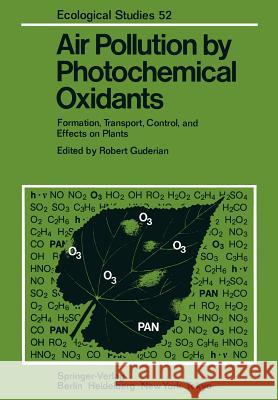
Robert Guderian; K. H. Becker; W. Fricke
Air Pollution by Photochemical Oxidants: Formation, Transport, Control, and Effects on Plants Guderian, Robert 9783642701207 Springer - książkaWidoczna okładka, to zdjęcie poglądowe, a rzeczywista szata graficzna może różnić się od prezentowanej.

Air Pollution by Photochemical Oxidants: Formation, Transport, Control, and Effects on Plants

ISBN-13: 9783642701207 / Angielski / Miękka / 2011 / 348 str.

Robert Guderian; K. H. Becker; W. Fricke
cena 402,53
(netto: 383,36 VAT:  5%)

Najniższa cena z 30 dni: 385,52
Termin realizacji zamówienia:
ok. 22 dni roboczych
Bez gwarancji dostawy przed świętami

Darmowa dostawa!

Photochemical oxidants are secondary air pollutants formed under the influence of sunlight by complex photochemical reactions in air which contains nitrogen oxides and reactive hydrocarbons as precursors. The most adverse components formed by photochemical reactions in polluted air are ozone (0 ) 3 and peroxyacetyl nitrate (PAN), among many other products such as aldehydes, ketones, organic and inorganic acids, nitrates, sulfates etc. An analysis and evaluation of the available knowledge has been used to characterize the relationships among emissions, ambient air concentrations, and effects, and to identify the important controlling influences on the formation and effects of photochemical oxidants. The biological activity of photochemical oxidants was first clearly manifested during the early 1940's, when vegetation injury was observed in the Los Angeles Basin in the United States. Since that time, as a consequence of the increasing emissions of photochemical oxidant precursors, the photochemical oxidants have become the most important air pollutants in North America. In other parts of the world, for example South and Central America, Asia, and Australia, photo- chemical oxidants threaten vegetation, particularly the economic and ecological performance of plant life. According to my knowledge, the first observations of ozone and PAN injury to vegetation in Europe were made by Dr. Ellis F. Darley (Statewide Air Pollution Research Center, University of California, Riverside, California) during a study visit (1963/64) to the Federal Republic of Germany.


Kategorie:
Nauka, Biologia i przyroda
Kategorie BISAC:
Technology & Engineering > Environmental - General
Science > Life Sciences - Ecology
Nature > Environmental Conservation & Protection - General
Wydawca:
Springer
Seria wydawnicza:
Ecological Studies
Język:
Angielski
ISBN-13:
9783642701207
Rok wydania:
2011
Wydanie:
Softcover Repri
Numer serii:
000007171
Ilość stron:
348
Waga:
0.63 kg
Wymiary:
24.4 x 17.0
Oprawa:
Miękka
Wolumenów:
01

1 Formation, Transport, and Control of Photochemical Oxidants.- 1.1 Introduction.- 1.2 Oxidants, Precursors, and Concomitant Species.- 1.2.1 Individual Compounds.- 1.2.2 Physieochemical Properties of Important Oxidants.- 1.2.2.1 Ozone.- 1.2.2.2 Peroxyacyl Nitrates.- 1.2.2.3 Hydrogen Peroxide.- 1.2.2.4 Nitrogen Dioxide.- 1.2.3 Physicochemical Properties of Important Precursors and Concomitant Species of Photochemical Oxidants.- 1.2.3.1 Nitric Oxide.- 1.2.3.2 Hydrocarbons.- 1.2.3.3 Aldehydes and Ketones.- 1.2.3.4 Aerosols.- 1.3 Emissions and Ambient Air Concentrations.- 1.3.1 Emissions.- 1.3.1.1 Transportation.- 1.3.1.2 Industry.- 1.3.1.3 Power Plants.- 1.3.1.4 Domestic Heating and Small Trade.- 1.3.1.5 Natural Sources.- 1.3.2 Immissions.- 1.3.2.1 Natural Background Concentrations.- 1.3.2.2 Measurements in Densely Populated and Peripheral Areas.- 1.3.2.2.1 Federal Republic of Germany.- 1.3.2.2.2 European Countries and Overseas.- 1.3.2.2.3 Mobile Measurements and Special Investigations.- 1.4 Air Chemistry and Dispersion.- 1.4.1 Physicochemical Basis of Atmospheric Chemistry.- 1.4.2 Simulation.- 1.4.2.2 Chemical Models.- 1.4.2.3 Isopleth Models.- 1.4.3 Effects of Meteorological Parameters on the Formation of Oxidants.- 1.4.4 Dispersion and Transport Modeling.- 1.4.4.1 Empirical Approach: Maximum Ozone Isopleths.- 1.4.4.2 Wind Tunnel Modeling.- 1.4.4.3 Meteorological Dispersion Models.- 1.4.4.4 Box Models.- 1.4.4.5 Eulerian Models.- 1.4.4.6 Lagrangian Models.- 1.4.4.7 Modeling Ozone Formation in Power Plant Plumes.- 1.5 Surveillance of Ambient Air Quality.- 1.5.1 Analytical Techniques.- 1.5.1.1 Determination of Precursors in Ambient Air.- 1.5.1.1.1 Nitrogen Oxides.- 1.5.1.1.2 Hydrocarbons.- 1.5.1.1.3 Aldehydes.- 1.5.1.2 Determination of Oxidants.- 1.5.1.2.1 Ozone.- 1.5.1.2.2 Peroxyacetyl Nitrate (PAN).- 1.5.1.2.3 Nitric Acid, Nitrous Acid, and Aerosol Nitrate.- 1.5.2 Monitoring Policy.- 1.5.2.1 Key Oxidants and Other Pollutants Which Should Be Monitored..- 1.5.2.2 Monitoring Sites and Monitoring Periods.- 1.5.2.3 Data Evaluation.- 1.6 Abatement Strategies.- 1.7 Summary and Final Conclusions.- 1.8 Appendix.- References.- 2 Effects of Photochemical Oxidants on Plants.- 2.1 Introduction.- 2.2 Mode of Action.- 2.2.1 Pollutant Uptake.- 2.2.1.1 Pollutant Uptake into Leaves.- 2.2.1.1.1 Gas Phase Conductance.- 2.2.1.2 Pollutant Uptake by Plant Canopies.- 2.2.2 Perturbation.- 2.2.3 Homeostasis.- 2.2.4 Injury.- 2.2.4.1 Ultrastructural Changes.- 2.2.4.2 Nitrogen Metabolism.- 2.2.4.3 Carbohydrate Metabolism.- 2.2.4.4 Stress Metabolism.- 2.2.4.5 Photosynthesis.- 2.2.4.6 Respiration.- 2.2.4.7 Senescence.- 2.2.5 Effects on Plant Communities and Ecosystems.- 2.2.5.1 Reactions of Plant Communities Related to Air Pollutant Concentrations.- 2.2.5.1.1 High Pollution Dosage.- 2.2.5.1.2 Intermediate Pollution Dosage.- 2.2.5.1.3 Low Pollution Dosage.- 2.2.5.2 Causes for Observed Responses in Plant Communities.- 2.2.5.3 Effects on Semi-Natural and Agro-Ecosystems.- 2.2.5.3.1 Damage Responses in Agriculture and Horticulture.- 2.2.5.3.2 Effects on Semi-Natural and Forest Ecosystems.- 2.2.5.3.3 Symbionts and Plant Pathogens.- 2.2.5.4 Community and Economic Consequences of Functional Disruptions in Ecosystems.- 2.2.6 Effects on Lower Plants and Microorganisms.- 2.2.6.1 Ferns.- 2.2.6.2 Mosses and Lichens.- 2.2.6.3 Algae.- 2.2.6.4 Fungi.- 2.2.6.5 Bacteria.- 2.3 Diagnosis, Surveillance, and Estimation of Effects.- 2.3.1 Methods of Diagnosis.- 2.3.1.1 Analysis of Visible Injury Symptoms.- 2.3.1.1.1 Symptoms of Ozone Injury.- 2.3.1.1.2 Symptoms of PAN Injury.- 2.3.1.2 Subtle Injury.- 2.3.1.3 Investigations of Species Specific Resistance Relationships….- 2.3.1.4 Air Monitoring.- 2.3.2 Bioindicator Plants.- 2.3.2.1 Bioindicator Methods.- 2.3.2.1.1 Passive Monitoring.- 2.3.2.1.2 Active Monitoring.- 2.3.2.2 Bioindicator Results from Yarious Countries.- 2.3.2.3 Comparison of Biological and Physicochemical Methods.- 2.3.2.4 Conclusions for the Use of Bioindicators.- 2.3.3 Classification and Evaluation of Effects.- 2.3.3.1 Classification of Effects.- 2.3.3.2 Evaluation of Effects.- 2.3.4 Experimental Approaches to Determine Air Pollution Effects.- 2.3.4.1 Criteria for Selecting Experimental Methods.- 2.3.4.2 Experimental Procedures.- 2.3.4.2.1 Studies Under Natural Conditions.- 2.3.4.2.2 Studies Under Semi-Natural Conditions.- 2.3.4.2.3 Studies in Managed and Controlled Conditions.- 2.3.4.3 Summary Evaluation.- 2.4 Factors Influencing Plant Responses.- 2.4.1 Concentration and Duration of Exposure.- 2.4.2 Significance of External Growth Factors on Plant Sensitivity.- 2.4.2.1 Climatic Factors.- 2.4.2.1.1 Light.- 2.4.2.1.2 Temperature.- 2.4.2.1.3 Relative Humidity.- 2.4.2.2 Soil and Nutrition.- 2.4.2.2.1 Soil Water Content.- 2.4.2.2.2 Elevated Salt Concentrations in the Soil Solution.- 2.4.2.2.3 Plant Nutrients.- 2.4.3 Significance of Internal Growth Factors on Plant Sensitivity.- 2.4.3.1 The Influence of Developmental Stage and Leaf Age.- 2.4.3.1.1 Leaf Age.- 2.4.3.1.2 Developmental Stage.- 2.4.3.2 Species, Cultivar, and Individual Plant Resistance.- 2.4.3.2.1 Criteria to Evaluate Resistance.- 2.4.3.2.2 Relative Ozone Sensitivity.- 2.4.3.2.3 Relative PAN Sensitivity.- 2.4.3.2.4 Differential Cultivar Sensitivity.- 2.4.4 Measures to Reduce Pollutant Effects in Plant Stands.- 2.4.4.1 Differential Resistance as a Basis for Remedial Measures.- 2.4.4.2 Fertilization, Irrigation, and Cultural Methods as Protective Measures.- 2.4.4.3 Protectants Against Photochemical Oxidants.- 2.4.4.3.1 Antioxidants.- 2.4.4.3.2 Biocides.- 2.4.4.3.3 Growth Regulators.- 2.4.4.3.4 Other Chemicals.- 2.4.4.3.5 Summary of the Practicality of Chemical Protectants.- 2.5 Effects of Pollutant Combinations.- 2.5.1 Pollutant Combinations.- 2.5.2 Ozone and Sulfur Dioxide.- 2.5.2.1 Mode of Action.- 2.5.2.1.1 Pollutant Uptake.- 2.5.2.1.2 Perturbation.- 2.5.2.1.3 Injury.- 2.5.2.2 Effects on Plants.- 2.5.2.2.1 Foliar Injury.- 2.5.2.2.2 Growth Effects.- 2.5.2.3 Diagnosis of Effects.- 2.5.2.4 Factors Influencing Plant Response.- 2.5.2.4.1 Concentration and Duration..- 2.5.2.4.2 Significance of External Growth Factors.- 2.5.2.4.3 Significance of Internal Growth Factors.- 2.5.3 Ozone and Other Pollutants.- 2.5.3.1 Ozone and Nitrogen Dioxide.- 2.5.3.2 Ozone and Hydrogen Sulfide.- 2.5.3.3 Ozone and Heavy Metals.- 2.5.4 PAN and Other Pollutants.- 2.5.5 Ozone, Sulfur Dioxide, and Acid Precipitation — the Cause of Forest Decline in Central Europe?.- 2.5.5.1 Symptoms, Intensity, and Distribution of Injury.- 2.5.5.1.1 Fir.- 2.5.5.1.2 Spruce.- 2.5.5.2 Investigations into the Cause of the Forest Injury.- 2.5.5.2.1 Natural and Silvicultural Influences as Factors in the Cause of Forest Injury and Tree Death.- 2.5.5.2.2 Air Pollutants as the Cause of the Injury.- 2.5.6 Summary.- 2.6 Dose-Response Relationships.- 2.6.1 Dose-Effect Values from Gas Exposure Studies and Surveys in Pollutant-Impacted Areas.- 2.6.1.1 Dose-Effect Values from Pollutant Exposures.- 2.6.1.2 Dose-Effect Values from Field Studies and Pollutant-Impacted Areas.- 2.6.2 Methods to Derive Limiting Factors.- 2.6.2.1 Determination of Limiting Values.- 2.6.2.2 Dose Values for Definite Injury Levels.- 2.6.2.3 Ozone — Maximum Acceptable Concentrations for the Protection of Vegetation.- References.


Udostępnij

Facebook - konto krainaksiazek.pl


Opinie o Krainaksiazek.pl na Opineo.pl

Partner Mybenefit

Krainaksiazek.pl w programie rzetelna firma Krainaksiaze.pl - płatności przez paypal

Czytaj nas na:

Facebook - krainaksiazek.pl
  • książki na zamówienie
  • granty
  • książka na prezent
  • kontakt
  • pomoc
  • opinie
  • regulamin
  • polityka prywatności

Zobacz:

  • Księgarnia czeska

  • Wydawnictwo Książkowe Klimaty

1997-2025 DolnySlask.com Agencja Internetowa

© 1997-2022 krainaksiazek.pl
     
KONTAKT | REGULAMIN | POLITYKA PRYWATNOŚCI | USTAWIENIA PRYWATNOŚCI
Zobacz: Księgarnia Czeska | Wydawnictwo Książkowe Klimaty | Mapa strony | Lista autorów
KrainaKsiazek.PL - Księgarnia Internetowa

Polityka prywatnosci - link
Krainaksiazek.pl - płatnośc Przelewy24
Przechowalnia Przechowalnia





