• Wyszukiwanie zaawansowane
  • Kategorie
  • Kategorie BISAC
  • Książki na zamówienie
  • Promocje
  • Granty
  • Książka na prezent
  • Opinie
  • Pomoc
  • Załóż konto
  • Zaloguj się

Agroecological Transitions: From Theory to Practice in Local Participatory Design » książka


zaloguj się | załóż konto
Logo Krainaksiazek.pl

koszyk

konto

szukaj
topmenu
Księgarnia internetowa
Szukaj
Książki na zamówienie
Promocje
Granty
Książka na prezent
Moje konto
Pomoc
 
 
Wyszukiwanie zaawansowane
Pusty koszyk
Bezpłatna dostawa dla zamówień powyżej 20 złBezpłatna dostawa dla zamówień powyżej 20 zł

Kategorie główne

• Nauka
 [2952079]
• Literatura piękna
 [1850969]

  więcej...
• Turystyka
 [71058]
• Informatyka
 [151066]
• Komiksy
 [35579]
• Encyklopedie
 [23181]
• Dziecięca
 [620496]
• Hobby
 [139036]
• AudioBooki
 [1646]
• Literatura faktu
 [228729]
• Muzyka CD
 [379]
• Słowniki
 [2932]
• Inne
 [445708]
• Kalendarze
 [1409]
• Podręczniki
 [164793]
• Poradniki
 [480107]
• Religia
 [510956]
• Czasopisma
 [511]
• Sport
 [61267]
• Sztuka
 [243299]
• CD, DVD, Video
 [3411]
• Technologie
 [219640]
• Zdrowie
 [100984]
• Książkowe Klimaty
 [124]
• Zabawki
 [2281]
• Puzzle, gry
 [3363]
• Literatura w języku ukraińskim
 [258]
• Art. papiernicze i szkolne
 [8020]
Kategorie szczegółowe BISAC

Agroecological Transitions: From Theory to Practice in Local Participatory Design

ISBN-13: 9783030019525 / Angielski / Twarda / 2019 / 335 str.
Bergez, Jacques-Eric
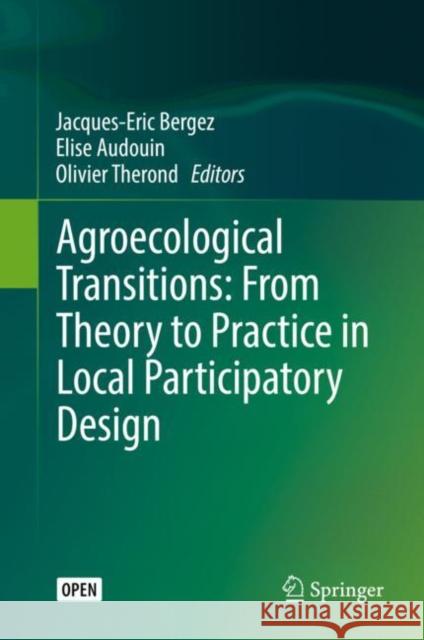
Agroecological Transitions: From Theory to Practice in Local Participatory Design Bergez, Jacques-Eric 9783030019525 Springer - książkaWidoczna okładka, to zdjęcie poglądowe, a rzeczywista szata graficzna może różnić się od prezentowanej.

Agroecological Transitions: From Theory to Practice in Local Participatory Design

ISBN-13: 9783030019525 / Angielski / Twarda / 2019 / 335 str.

Bergez, Jacques-Eric
cena 201,24
(netto: 191,66 VAT:  5%)

Najniższa cena z 30 dni: 192,74
Termin realizacji zamówienia:
ok. 22 dni roboczych.

Darmowa dostawa!

This open access book presents feedbacks from the TATA-BOX research project devoted to agroecological transition and its systemic, multi-scale and transdisciplinary issues. New conceptual and methodological frameworks and tools have to be developed to support local stakeholders into the design process of such a transition. The multidisciplinary and multi-organization research team led a four years action research process with two territories of France. The main project's results are (1) key analysis of the specifics of agroecological transitions regarding diversity of agriculture models, management of uncertainties, polycentric governance, autonomies and the role of actor network, (2) presentation of an operational and original participatory process and associated boundary tools, (3) analysis of the main effects on research organization and on stakeholders' development and application of the methodology, and (4) critical analysis of the main outcomes of TATA-BOX by external researchers.


Kategorie:
Nauka, Biologia i przyroda
Kategorie BISAC:
Technology & Engineering > Agriculture - General
Science > Environmental Science (see also Chemistry - Environmental)
Nature > Environmental Conservation & Protection - General
Wydawca:
Springer
Język:
Angielski
ISBN-13:
9783030019525
Rok wydania:
2019
Wydanie:
2019
Ilość stron:
335
Oprawa:
Twarda
Wolumenów:
01


Foreword; Dedieu Benoît
Chapter 1: General introduction; Jacques-Eric Bergez and Olivier Therond
Chapter 2: TATA-BOX at a glance; Jacques-Eric Bergez and Olivier Therond
Part I: Territorial Agroecological Transition at a concept crossroads
Chapter 3: Socio-economic characterisation of agriculture models; Gaël Plumecocq, Thomas Debril, Michel Duru, Marie-Benoît Magrini, Jean-Pierre Sarthou and Olivier Therond
Chapter 4: An integrated approach to livestock farming systems’ autonomy in designing and managing agroecological transition at the farm and territorial levels; Marie-Angélina Magne, Guillaume Martin, Marc Moraine, Julie Ryschawy, Vincent Thenard, Pierre Triboulet and Jean-Philippe Choisis
Chapter 5: Agroecological transition from farms to territorialised agri-food systems: issues and drivers; Marie-Benoît Magrini, Guillaume Martin, Marie-Angélina Magne, Michel Duru, Nathalie Couix, Laurent Hazard and Gaël Plumecocq
Chapter 6: A plurality of viewpoints regarding the uncertainties of the agroecological transition; Danièle Magda, Nathalie Girard, Valérie Angeon, Célia Cholez, Nathalie Raulet-Croset, Régis Sabbadin, Nicolas Salliou, Cécile Barnaud, Claude Monteil and Nathalie Peyrard
Chapter 7: Towards an integrated framework for the governance of a territorialised agroecological transition; Pierre Triboulet, Jean-Pierre Del Corso, Michel Duru, Danielle Galliano, Amélie Gonçalves, Catherine Milou and Gaël Plumecocq
Chapter 8: The key role of actors in the agroecological transition of farmers: a case-study in the Tarn-Aveyron Basin; Julie Ryschawy, Jean-Pierre Sarthou, Ariane Chabert and Olivier Therond
Part II: Support methodology for territorial agroecological transition design, and feedback from the TATA-BOX project experience
Chapter 9: Participatory methodology for designing an agroecological transition at local level; Elise Audouin, Jacques-Eric Bergez and Olivier Therond
Chapter 10: Towards a reflective approach to research project management; Lorène Prost, Marie Chizallet, Marie Taverne and Flore Barcellini
Chapter 11: Evaluation of the operationalisation of the TATA-BOX process; Marie Taverne, Sarah Clément, Lorène Prost and Flore Barcellini
Part III: New prospects and cross-cutting perspectives
Chapter 12: Information and communication technology (ICT) and the agroecological transition; Lola Leveau, Aurélien Bénel, Jean-Pierre Cahier, François Pinet, Pascal Salembier, Vincent Soulignac and Jacques -Eric Bergez
Chapter 13: TATA-BOX: A model for participatory processes?; Sylvie Lardon
Chapter 14: Review and Critique of the TATA-BOX Model; Charles A. Francis and Geir Lieblein
Chapter 15: Opening the TATA-BOX to raise new questions on agroecological transition; Jean-Marc Touzard, Jean-Marc Barbier, Laure Hossard

Jacques-Eric Bergez, is a PhD senior scientist, accredited to supervise research at INRA (French National Institute for Agricultural Research), unit AGIR (AGroecologies, Innovations & teRritories). His main interests are in systemic agronomy and modelling. His main research topic is the description and modelling of farmers’ practices in order to develop innovative crop management systems. He is the leader of the INRA AGIR research unit (90 persons). He is the scientific leader of the RECORD users’ network, RECORD being a modelling and simulation platform to develop and work with agroecosystem models. He coordinates (2014-2017) a research project on developing a methodology to help stakeholders to modify their agricultural practices in order to reach a more agroecological agriculture. He participated at the development and evaluation of a modelling framework to evaluate the contribution of innovative cropping systems to the overall sustainability (2005-2012). He is the (co)author of more than sixty research papers and managed eight theses.

Elise Audouin is an agroecologist within INRA (French National Institute for Agricultural Research), unit AGIR (AGroecologies, Innovations & teRritories). Her main expertise is on development and facilitation of participatory process for supporting stakeholders in designing agroecological transition. She specialized on the conception of participatory methods, representation modes, intermediary objects design and scientific mediation. She develop and facilitated 24 workshop so far with 412 participants in contrasted contexts (Europe, Central America and the Carribbean, Scandinavian countries; Africa); and on contrasted topics (specific agroecological farm pratices; organic consumption; chain impacts; holistic agroecological project) and scales (from farm to city, department to production chain).

Olivier Therond is a landscape agronomist within INRA, (French National Institute for Agricultural Research), unit LAE (Laboratory Agronomy and Environment). His main expertise is on methods for integrated assessment and modeling of social-ecological systems. Recent activities focus on analysis and assessment of agriculture models, development of the MAELIA multi-agent modeling and simulation platform, development of participatory methods and boundary objects (including models) for supporting stakeholders in designing agricultural landscapes to deal with water shortage issues, crop–livestock systems, and agroecological transitions at the local level. He is the (co)author of more than forty research papers and managed five theses.

There is wide agreement on the need to change the prevalent agricultural models, given their negative impacts and their incompatibility with current societal issues. Agroecological transition has been promoted as a potential solution to the ecological, social and economic problems generated by these models. It however involves a systemic, multi-scale and transdisciplinary process.

Due to this complexity, the overall picture of what farms and food systems “actually are” and “might be” may not be apparent at the individual level. Yet individuals’ knowledge and values provide complementary insights on how to proceed in deepening ecological modernisation. Expertise can also provide landmarks to be considered in that process.

Because local stakeholders’ experience and skills are key resources in the adaptation and adoption of agroecological transition, new conceptual and methodological frameworks and tools have to be developed to support them in the design process of such a complex transition.

This book presents feedback from the ‘Territorial Agroecological Transition in Action’- TATA-BOX research project, which was devoted to these specific issues. The multidisciplinary and multi-organisation research team steered a four-year action-research process in two territories of France.

This book presents:

i)  the key dimensions to be considered when dealing with agroecological transition: diversity of agriculture models, management of uncertainties, polycentric governance, autonomies, and role of actors’ networks;

ii)  an operational and original participatory process and associated boundary tools to support local stakeholders in shifting from a shared diagnosis to a shared action plan for transition, and in so doing developing mutual understanding and involvement;

iii)  an analysis of the main effects of the methodology on research organisation and on stakeholders’ development and application;

iv)  critical analysis and foresights on the main outcomes of TATA-BOX, provided by external researchers.”


Udostępnij

Facebook - konto krainaksiazek.pl


Opinie o Krainaksiazek.pl na Opineo.pl

Partner Mybenefit

Krainaksiazek.pl w programie rzetelna firma Krainaksiaze.pl - płatności przez paypal

Czytaj nas na:

Facebook - krainaksiazek.pl
  • książki na zamówienie
  • granty
  • książka na prezent
  • kontakt
  • pomoc
  • opinie
  • regulamin
  • polityka prywatności

Zobacz:

  • Księgarnia czeska

  • Wydawnictwo Książkowe Klimaty

1997-2026 DolnySlask.com Agencja Internetowa

© 1997-2022 krainaksiazek.pl
     
KONTAKT | REGULAMIN | POLITYKA PRYWATNOŚCI | USTAWIENIA PRYWATNOŚCI
Zobacz: Księgarnia Czeska | Wydawnictwo Książkowe Klimaty | Mapa strony | Lista autorów
KrainaKsiazek.PL - Księgarnia Internetowa

Polityka prywatnosci - link
Krainaksiazek.pl - płatnośc Przelewy24
Przechowalnia Przechowalnia





