• Wyszukiwanie zaawansowane
  • Kategorie
  • Kategorie BISAC
  • Książki na zamówienie
  • Promocje
  • Granty
  • Książka na prezent
  • Opinie
  • Pomoc
  • Załóż konto
  • Zaloguj się

Agenda Relevance: A Study in Formal Pragmatics: Volume 1 » książka


zaloguj się | załóż konto
Logo Krainaksiazek.pl

koszyk

konto

szukaj
topmenu
Księgarnia internetowa
Szukaj
Książki na zamówienie
Promocje
Granty
Książka na prezent
Moje konto
Pomoc
 
 
Wyszukiwanie zaawansowane
Pusty koszyk
Bezpłatna dostawa dla zamówień powyżej 20 złBezpłatna dostawa dla zamówień powyżej 20 zł

Kategorie główne

• Nauka
 [2949965]
• Literatura piękna
 [1857847]

  więcej...
• Turystyka
 [70818]
• Informatyka
 [151303]
• Komiksy
 [35733]
• Encyklopedie
 [23180]
• Dziecięca
 [617748]
• Hobby
 [139972]
• AudioBooki
 [1650]
• Literatura faktu
 [228361]
• Muzyka CD
 [398]
• Słowniki
 [2862]
• Inne
 [444732]
• Kalendarze
 [1620]
• Podręczniki
 [167233]
• Poradniki
 [482388]
• Religia
 [509867]
• Czasopisma
 [533]
• Sport
 [61361]
• Sztuka
 [243125]
• CD, DVD, Video
 [3451]
• Technologie
 [219309]
• Zdrowie
 [101347]
• Książkowe Klimaty
 [123]
• Zabawki
 [2362]
• Puzzle, gry
 [3791]
• Literatura w języku ukraińskim
 [253]
• Art. papiernicze i szkolne
 [7933]
Kategorie szczegółowe BISAC

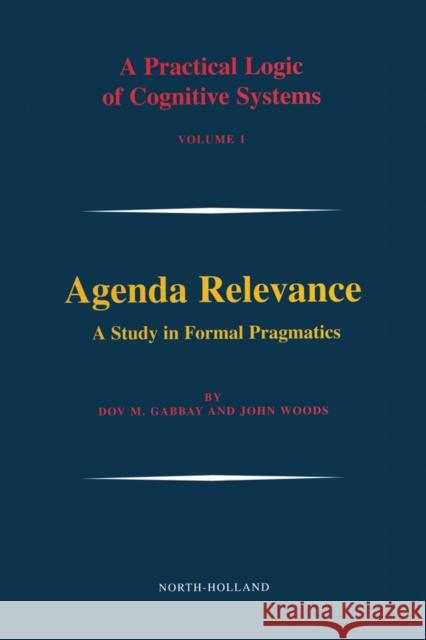
Agenda Relevance: A Study in Formal Pragmatics: Volume 1

ISBN-13: 9780444513854 / Angielski / Twarda / 2003 / 524 str.
Dov M. Gabbay; D. M. Gabbay;Unknown
Agenda Relevance: A Study in Formal Pragmatics: Volume 1 Gabbay, Dov M. 9780444513854 North-Holland - książkaWidoczna okładka, to zdjęcie poglądowe, a rzeczywista szata graficzna może różnić się od prezentowanej.

Agenda Relevance: A Study in Formal Pragmatics: Volume 1

ISBN-13: 9780444513854 / Angielski / Twarda / 2003 / 524 str.

Dov M. Gabbay; D. M. Gabbay;Unknown
cena 1055,44 zł
(netto: 1005,18 VAT:  5%)

Najniższa cena z 30 dni: 1049,71 zł
Termin realizacji zamówienia:
ok. 16-18 dni roboczych
Bez gwarancji dostawy przed świętami

Darmowa dostawa!

Agenda Relevance is the first volume in the authors' omnibus investigation of
the logic of practical reasoning, under the collective title, A Practical Logic
of Cognitive Systems. In this highly original approach, practical reasoning is
identified as reasoning performed with comparatively few cognitive assets,
including resources such as information, time and computational capacity. Unlike
what is proposed in optimization models of human cognition, a practical reasoner
lacks perfect information, boundless time and unconstrained access to
computational complexity. The practical reasoner is therefore obliged to be a
cognitive economizer and to achieve his cognitive ends with considerable
efficiency. Accordingly, the practical reasoner avails himself of various
scarce-resource compensation strategies. He also possesses neurocognitive
traits that abet him in his reasoning tasks. Prominent among these is the
practical agent's striking (though not perfect) adeptness at evading irrelevant
information and staying on task. On the approach taken here, irrelevancies are
impediments to the attainment of cognitive ends. Thus, in its most basic sense,
relevant information is cognitively helpful information. Information can then be
said to be relevant for a practical reasoner to the extent that it advances or
closes some cognitive agenda of his. The book explores this idea with a
conceptual detail and nuance not seen the standard semantic, probabilistic and
pragmatic approaches to relevance; but wherever possible, the authors seek to
integrate alternative conceptions rather than reject them outright. A further
attraction of the agenda-relevance approach is the extent to which its principal
conceptual findings lend themselves to technically sophisticated re-expression
in formal models that marshal the resources of time and action logics and
label led deductive systems.
Agenda Relevance is necessary reading for researchers in logic, belief
dynamics, computer science, AI, psychology and neuroscience, linguistics,
argumentation theory, and legal reasoning and forensic science, and will repay
study by graduate students and senior undergraduates in these same fields.

Key features:

- relevance
- action and agendas
- practical reasoning
- belief dynamics
- non-classical logics
- labelled deductive systems


Kategorie:
Nauka, Filozofia
Kategorie BISAC:
Computers > Computer Science
Philosophy > Logic
Computers > Artificial Intelligence - Natural Language Processing
Wydawca:
North-Holland
Język:
Angielski
ISBN-13:
9780444513854
Rok wydania:
2003
Ilość stron:
524
Waga:
0.92 kg
Wymiary:
22.86 x 16.38 x 2.72
Oprawa:
Twarda
Wolumenów:
01
Dodatkowe informacje:
Bibliografia

"This is the first jewel in a new and ambitious series." --Branislav Boricic (Belgrade). Mathematical Reviews, 2004.

"...not only a ground-breaking study in the logic of practical reasoning, it is first-rate philosophy as well." --ZENTRALBLATT MATH

Preface.


I. Logic.


1. Introduction


2. Practical Logic
2.1 PLCS and Cognitive Systems
2.2 Practical Reasoning
2.3 Practical Agency
2.4 Practical Logics
2.4.1 The Method of Intuitions
2.5 Allied Disciplines
2.6 Psychologism
2.6.1 Issues in Cognitive Science


3. Logical Agents
3.1 Heuristics and Limitations
3.2 Three Problems
3.2.1 The Complexity Problem
3.2.2 The Approximation Problem
3.2.3 The Consequence Problem
3.2.4 Truth Conditions, Rules and State Conditions
3.2.5 Rules Redux
3.2.6 Logics for Down Below


4. Formal Pragmatics
4.1 Pragmatics
4.2 Theoretical Recalcitrance
4.3 Analysis


II. Conceptual Models for Relevance


5. Propositional Relevance
5.1 Introductory Remark
5.2 Propositional Relevance
5.3 Legal Relevance
5.4 Topical Relevance
5.5 Topical Relevance and Computation
5.6 Targets for a Theory of Relevance
5.7 Freeman and Cohen
5.7.1 Freeman
5.7.2 Cohen


6. Contextual Effects
6.1 Introductory Remarks
6.2 Contextual Effects
6.3 In The Head
6.4 Inconsistency Management
6.4.1 Bounded Rationality
6.5 Is Inconsistency Pervasive?
6.5.1 A Case in Point: Mechanizing Cognition
6.6 Further Difficulties
6.7 Reclaiming SW-Relevance?
6.8 The Grice Condition
6.8.1 Relevance To and For


7. Agenda Relevance
7.1 Adequacy Conditions
7.2 The Basic Idea
7.2.1 Causality
7.3 Belief
7.4 Corroboration
7.5 Probability
7.6 Agendas: A First Pass
7.7 Cognitive Agency
7.8 Propositional Relevance Revisited


8. Agendas
8.1 Plans
8.2 Representation
8.3 Agendas Again
8.3.1 Agendas: Transparent and Tacit
8.4 MEM and KARO-agendas
8.4.1 MEM Agendas
8.5 A Formal Interlude


9. Adequacy Conditions Fulfilled?
9.1 Subjective Relevance
9.2 Meta-agendas
9.3 Comparative Relevance
9.4 Hyper-relevance
9.5 Hunches
9.6 Misinformation
9.7 Dialectical Relevance
9.7.1 Fallacies of Relevance
9.8 Semantic Distribution
9.9 Relevant Logic, Pittsburgh Style
9.10 Revision and Update
9.11 The Relevant Thing


10. Objective Relevance
10.1 Normative Theories
10.2 Relevance Naturalized?
10.2.1 Reflective Equilibrium
10.3 Objective Relevance
10.4 Modularity
10.5 Inference
10.6 Reconsidering Normative Relevance
10.7 Schizophrenia
10.8 Reprise


III. Formal Models for Relevance


11. A Logic for Agenda Relevance
11.1 Conceptual Analysis
11.1.1 Complexity, Approximation and Consequence
11.2 Formalization
11.3 Overview of the Model
11.4 How to Proceed
11.4.1 Bidirectional Coverage and Fit


12. A General Theory of Logical Systems
12.1 Introduction
12.2 Logical Systems
12.3 Examples of Logical Systems
12.4 Refining the Notion of a Logical System
12.4.1 Structured Consequence
12.4.2 Algorithmic Structured Consequence Relation
12.4.3 Mechanisms
12.4.4 Modes of Evaluation
12.4.5 TAR-Logics (Time, Action and Revision)


13. Labelled Deductive Systems
13.1 Introduction
13.2 Labelled Deduction
13.2.1 Labelled Deduction Rules
13.2.2 Non-classical Use of Labels
13.2.3 The Theory of Labelled Deductive Systems
13.2.4 Hunches and Guesses
13.2.5 Contextual Effects


14. Relevance Logics
14.1 Introduction
14.2 Anderson--Belnap Relevant Logic
14.3 Formulation of AB Relevance
14.4 Properties of the Goal Directed Formulation
14.5 Deductive Relevance
14.6 The Cut Rule for Deductive Relevance


15. Formal Model of Agenda Relevance
15.1 Introduction
15.2 The Simple Agenda Model
15.3 Intermediate Agenda Model
15.4 Case Studies


16. Conclusion
16.1 Introduction
16.2 Quantification
16.3 Some Tail Ends


Bibliography
Index


Udostępnij

Facebook - konto krainaksiazek.pl


Opinie o Krainaksiazek.pl na Opineo.pl

Partner Mybenefit

Krainaksiazek.pl w programie rzetelna firma Krainaksiaze.pl - płatności przez paypal

Czytaj nas na:

Facebook - krainaksiazek.pl
  • książki na zamówienie
  • granty
  • książka na prezent
  • kontakt
  • pomoc
  • opinie
  • regulamin
  • polityka prywatności

Zobacz:

  • Księgarnia czeska

  • Wydawnictwo Książkowe Klimaty

1997-2025 DolnySlask.com Agencja Internetowa

© 1997-2022 krainaksiazek.pl
     
KONTAKT | REGULAMIN | POLITYKA PRYWATNOŚCI | USTAWIENIA PRYWATNOŚCI
Zobacz: Księgarnia Czeska | Wydawnictwo Książkowe Klimaty | Mapa strony | Lista autorów
KrainaKsiazek.PL - Księgarnia Internetowa

Polityka prywatnosci - link
Krainaksiazek.pl - płatnośc Przelewy24
Przechowalnia Przechowalnia





