• Wyszukiwanie zaawansowane
  • Kategorie
  • Kategorie BISAC
  • Książki na zamówienie
  • Promocje
  • Granty
  • Książka na prezent
  • Opinie
  • Pomoc
  • Załóż konto
  • Zaloguj się

Adversarial Machine Learning: Attack Surfaces, Defence Mechanisms, Learning Theories in Artificial Intelligence » książka


zaloguj się | załóż konto
Logo Krainaksiazek.pl

koszyk

konto

szukaj
topmenu
Księgarnia internetowa
Szukaj
Książki na zamówienie
Promocje
Granty
Książka na prezent
Moje konto
Pomoc
 
 
Wyszukiwanie zaawansowane
Pusty koszyk
Bezpłatna dostawa dla zamówień powyżej 20 złBezpłatna dostawa dla zamówień powyżej 20 zł

Kategorie główne

• Nauka
 [2949965]
• Literatura piękna
 [1857847]

  więcej...
• Turystyka
 [70818]
• Informatyka
 [151303]
• Komiksy
 [35733]
• Encyklopedie
 [23180]
• Dziecięca
 [617748]
• Hobby
 [139972]
• AudioBooki
 [1650]
• Literatura faktu
 [228361]
• Muzyka CD
 [398]
• Słowniki
 [2862]
• Inne
 [444732]
• Kalendarze
 [1620]
• Podręczniki
 [167233]
• Poradniki
 [482388]
• Religia
 [509867]
• Czasopisma
 [533]
• Sport
 [61361]
• Sztuka
 [243125]
• CD, DVD, Video
 [3451]
• Technologie
 [219309]
• Zdrowie
 [101347]
• Książkowe Klimaty
 [123]
• Zabawki
 [2362]
• Puzzle, gry
 [3791]
• Literatura w języku ukraińskim
 [253]
• Art. papiernicze i szkolne
 [7933]
Kategorie szczegółowe BISAC

Adversarial Machine Learning: Attack Surfaces, Defence Mechanisms, Learning Theories in Artificial Intelligence

ISBN-13: 9783030997717 / Angielski / Twarda / 2023 / 300 str.
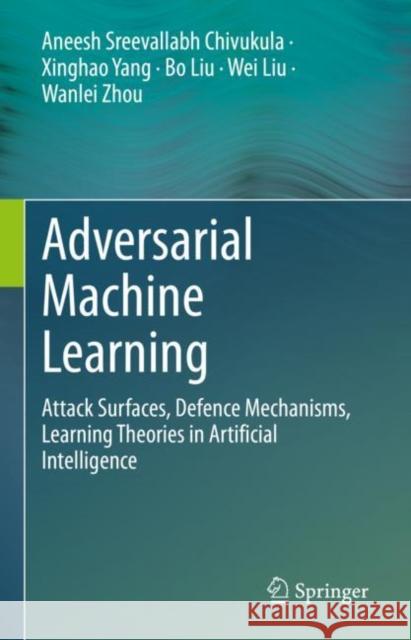
Aneesh Sreevallabh Chivukula; Xinghao Yang; Bo Liu
Adversarial Machine Learning: Attack Surfaces, Defence Mechanisms, Learning Theories in Artificial Intelligence Aneesh Sreevallab Xinghao Yang Bo Liu 9783030997717 Springer - książkaWidoczna okładka, to zdjęcie poglądowe, a rzeczywista szata graficzna może różnić się od prezentowanej.

Adversarial Machine Learning: Attack Surfaces, Defence Mechanisms, Learning Theories in Artificial Intelligence

ISBN-13: 9783030997717 / Angielski / Twarda / 2023 / 300 str.

Aneesh Sreevallabh Chivukula; Xinghao Yang; Bo Liu
cena 685,93
(netto: 653,27 VAT:  5%)

Najniższa cena z 30 dni: 655,41
Termin realizacji zamówienia:
ok. 22 dni roboczych
Bez gwarancji dostawy przed świętami

Darmowa dostawa!
inne wydania

A critical challenge in deep learning is the vulnerability of deep learning networks to security attacks from intelligent cyber adversaries. Even innocuous perturbations to the training data can be used to manipulate the behaviour of deep networks in unintended ways.  In this book, we review the latest developments in adversarial attack technologies in computer vision; natural language processing; and cybersecurity with regard to multidimensional, textual and image data, sequence data, and temporal data. In turn, we assess the robustness properties of deep learning networks to produce a taxonomy of adversarial examples that characterises the security of learning systems using game theoretical adversarial deep learning algorithms. The state-of-the-art in adversarial perturbation-based privacy protection mechanisms is also reviewed.We propose new adversary types for game theoretical objectives in non-stationary computational learning environments. Proper quantification of the hypothesis set in the decision problems of our research leads to various functional problems, oracular problems, sampling tasks, and optimization problems. We also address the defence mechanisms currently available for deep learning models deployed in real-world environments. The learning theories used in these defence mechanisms concern data representations, feature manipulations, misclassifications costs, sensitivity landscapes, distributional robustness, and complexity classes of the adversarial deep learning algorithms and their applications.In closing, we propose future research directions in adversarial deep learning applications for resilient learning system design and review formalized learning assumptions concerning the attack surfaces and robustness characteristics of artificial intelligence applications so as to deconstruct the contemporary adversarial deep learning designs. Given its scope, the book will be of interest to Adversarial Machine Learning practitioners and Adversarial Artificial Intelligence researchers whose work involves the design and application of Adversarial Deep Learning.


A critical challenge in deep learning is the vulnerability of deep learning networks to security attacks from intelligent cyber adversaries. Even innocuous perturbations to the training data can be used to manipulate the behaviour of deep networks in unintended ways.  In this book, we review the latest developments in adversarial attack technologies in computer vision; natural language processing; and cybersecurity with regard to multidimensional, textual and image data, sequence data, and temporal data. In turn, we assess the robustness properties of deep learning networks to produce a taxonomy of adversarial examples that characterises the security of learning systems using game theoretical adversarial deep learning algorithms. The state-of-the-art in adversarial perturbation-based privacy protection mechanisms is also reviewed. We propose new adversary types for game theoretical objectives in non-stationary computational learning environments. Proper quantification of the hypothesis set in the decision problems of our research leads to various functional problems, oracular problems, sampling tasks, and optimization problems. We also address the defence mechanisms currently available for deep learning models deployed in real-world environments. The learning theories used in these defence mechanisms concern data representations, feature manipulations, misclassifications costs, sensitivity landscapes, distributional robustness, and complexity classes of the adversarial deep learning algorithms and their applications. In closing, we propose future research directions in adversarial deep learning applications for resilient learning system design and review formalized learning assumptions concerning the attack surfaces and robustness characteristics of artificial intelligence applications so as to deconstruct the contemporary adversarial deep learning designs. Given its scope, the book will be of interest to Adversarial Machine Learning practitioners and Adversarial Artificial Intelligence researchers whose work involves the design and application of Adversarial Deep Learning.

Kategorie:
Informatyka, Bazy danych
Kategorie BISAC:
Computers > Artificial Intelligence - General
Computers > Security - General
Wydawca:
Springer
Język:
Angielski
ISBN-13:
9783030997717
Rok wydania:
2023
Dostępne języki:
Ilość stron:
300
Oprawa:
Twarda
Dodatkowe informacje:
Wydanie ilustrowane

Adversarial Machine Learning.- Adversarial Deep Learning.- Security and Privacy in Adversarial Learning.- Game-Theoretical Attacks with Adversarial Deep Learning Models.- Physical Attacks in the Real World.- Adversarial Defense Mechanisms.- Adversarial Learning for Privacy Preservation.

Dr. Aneesh Sreevallabh Chivukula is currently an Assistant Professor in the Department of Computer Science & Information Systems at the Birla Institute of Technology and Science (BITS), Pilani, Hyderabad Campus. He has a PhD in data analytics and machine learning from the University of Technology Sydney (UTS), Australia. He holds a Master Of Science by Research in computer science and artificial intelligence from the International Institute of Information Technology Hyderabad, India. His research interests are in Computational Algorithms, Adversarial Learning, Machine Learning, Deep Learning, Data Mining, Game Theory, and Robust Optimization. He has taught subjects on advanced analytics and problem solving at UTS. He has been teaching academic courses on computer science at BITS, Pilani. He has industry experience in engineering, R&D, consulting at research labs and startup companies. He has developed enterprise solutions across the value chains in the open source, Cloud, & Big Data markets.

Dr. Xinghao Yang
is currently an Associate Professor at the China University of Petroleum. He has a Ph.D. degree in advanced analytics from the University of Technology Sydney, Sydney, NSW, Australia. His research interests include multiview learning and adversarial machine learning with publications on information fusion and information sciences.

Dr. Wei Liu is the Director of Future Intelligence Research Lab, and an Associate Professor in Machine Learning, in the School of Computer Science, the University of Technology Sydney (UTS), Australia. He is a core member of the UTS Data Science Institute. Wei obtained his PhD degree in Machine Learning research at the University of Sydney (USyd). His current research focuses are adversarial machine learning, game theory, causal inference, multimodal learning, and natural language processing. Wei's research papers are constantly published in CORE A*/A and Q1 (i.e., top-prestigious) journals and conferences. He has received 3 Best Paper Awards. Besides, one of his first-authored papers received the Most Influential Paper Award in the CORE A Ranking conference PAKDD 2021. He was a nominee for the Australian NSW Premier's Prizes for Early Career Researcher Award in 2017. He has obtained more than $2 million government competitive and industry research funding in the past six years.

Dr. Bo Liu is currently a Senior Lecturer with the University of Technology Sydney, Australia. His research interests include cybersecurity and privacy, location privacy and image privacy, privacy protection and machine learning, wireless communications and networks. He is an IEEE Senior Member and Associate Editor of IEEE Transactions on Broadcasting.

Dr. Wanlei Zhou received the Ph.D. degree from Australian National University, Canberra, ACT, Australia, in 1991, all in computer science and engineering, and the D.Sc. degree from Deakin University, Melbourne, VIC, Australia, in 2002. He is currently a Professor and the Head of School of Computer Science at the University of Technology Sydney. He served as a Lecturer with the University of Electronic Science and Technology of China, a System Programmer with Hewlett Packard, Boston, MA, USA, and a Lecturer with Monash University, Melbourne, VIC, Australia, and the National University of Singapore, Singapore. He has published over 300 papers in refereed international journals and refereed international conferences proceedings. His research interests include distributed systems, network security, bioinformatics, and e-Learning. Dr. Wanlei was the General Chair/Program Committee Chair/Co-Chair of a number of international conferences, including ICA3PP, ICWL, PRDC, NSS, ICPAD, ICEUC, and HPCC.

A critical challenge in deep learning is the vulnerability of deep learning networks to security attacks from intelligent cyber adversaries. Even innocuous perturbations to the training data can be used to manipulate the behaviour of deep networks in unintended ways.  In this book, we review the latest developments in adversarial attack technologies in computer vision; natural language processing; and cybersecurity with regard to multidimensional, textual and image data, sequence data, and temporal data. In turn, we assess the robustness properties of deep learning networks to produce a taxonomy of adversarial examples that characterises the security of learning systems using game theoretical adversarial deep learning algorithms. The state-of-the-art in adversarial perturbation-based privacy protection mechanisms is also reviewed.

We propose new adversary types for game theoretical objectives in non-stationary computational learning environments. Proper quantification of the hypothesis set in the decision problems of our research leads to various functional problems, oracular problems, sampling tasks, and optimization problems. We also address the defence mechanisms currently available for deep learning models deployed in real-world environments. The learning theories used in these defence mechanisms concern data representations, feature manipulations, misclassifications costs, sensitivity landscapes, distributional robustness, and complexity classes of the adversarial deep learning algorithms and their applications.

In closing, we propose future research directions in adversarial deep learning applications for resilient learning system design and review formalized learning assumptions concerning the attack surfaces and robustness characteristics of artificial intelligence applications so as to deconstruct the contemporary adversarial deep learning designs. Given its scope, the book will be of interest to Adversarial Machine Learning practitioners and Adversarial Artificial Intelligence researchers whose work involves the design and application of Adversarial Deep Learning.




Udostępnij

Facebook - konto krainaksiazek.pl


Opinie o Krainaksiazek.pl na Opineo.pl

Partner Mybenefit

Krainaksiazek.pl w programie rzetelna firma Krainaksiaze.pl - płatności przez paypal

Czytaj nas na:

Facebook - krainaksiazek.pl
  • książki na zamówienie
  • granty
  • książka na prezent
  • kontakt
  • pomoc
  • opinie
  • regulamin
  • polityka prywatności

Zobacz:

  • Księgarnia czeska

  • Wydawnictwo Książkowe Klimaty

1997-2025 DolnySlask.com Agencja Internetowa

© 1997-2022 krainaksiazek.pl
     
KONTAKT | REGULAMIN | POLITYKA PRYWATNOŚCI | USTAWIENIA PRYWATNOŚCI
Zobacz: Księgarnia Czeska | Wydawnictwo Książkowe Klimaty | Mapa strony | Lista autorów
KrainaKsiazek.PL - Księgarnia Internetowa

Polityka prywatnosci - link
Krainaksiazek.pl - płatnośc Przelewy24
Przechowalnia Przechowalnia




