• Wyszukiwanie zaawansowane
  • Kategorie
  • Kategorie BISAC
  • Książki na zamówienie
  • Promocje
  • Granty
  • Książka na prezent
  • Opinie
  • Pomoc
  • Załóż konto
  • Zaloguj się

Advances in Stochastic Models for Reliablity, Quality and Safety » książka


zaloguj się | załóż konto
Logo Krainaksiazek.pl

koszyk

konto

szukaj
topmenu
Księgarnia internetowa
Szukaj
Książki na zamówienie
Promocje
Granty
Książka na prezent
Moje konto
Pomoc
 
 
Wyszukiwanie zaawansowane
Pusty koszyk
Bezpłatna dostawa dla zamówień powyżej 20 złBezpłatna dostawa dla zamówień powyżej 20 zł

Kategorie główne

• Nauka
 [2946600]
• Literatura piękna
 [1856966]

  więcej...
• Turystyka
 [72221]
• Informatyka
 [151456]
• Komiksy
 [35826]
• Encyklopedie
 [23190]
• Dziecięca
 [619653]
• Hobby
 [140543]
• AudioBooki
 [1577]
• Literatura faktu
 [228355]
• Muzyka CD
 [410]
• Słowniki
 [2874]
• Inne
 [445822]
• Kalendarze
 [1744]
• Podręczniki
 [167141]
• Poradniki
 [482898]
• Religia
 [510455]
• Czasopisma
 [526]
• Sport
 [61590]
• Sztuka
 [243598]
• CD, DVD, Video
 [3423]
• Technologie
 [219201]
• Zdrowie
 [101638]
• Książkowe Klimaty
 [124]
• Zabawki
 [2473]
• Puzzle, gry
 [3898]
• Literatura w języku ukraińskim
 [254]
• Art. papiernicze i szkolne
 [8170]
Kategorie szczegółowe BISAC

Advances in Stochastic Models for Reliablity, Quality and Safety

ISBN-13: 9781461274667 / Angielski / Miękka / 2011 / 382 str.
Jensen Kahle; Franz Collani
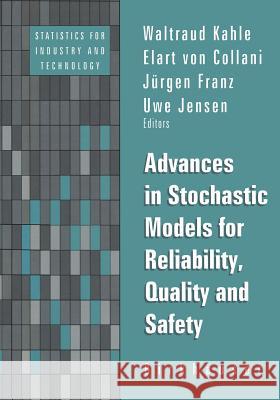
Advances in Stochastic Models for Reliablity, Quality and Safety Jensen Kahle Franz Collani 9781461274667 Springer - książkaWidoczna okładka, to zdjęcie poglądowe, a rzeczywista szata graficzna może różnić się od prezentowanej.

Advances in Stochastic Models for Reliablity, Quality and Safety

ISBN-13: 9781461274667 / Angielski / Miękka / 2011 / 382 str.

Jensen Kahle; Franz Collani
cena 201,72 zł
(netto: 192,11 VAT:  5%)

Najniższa cena z 30 dni: 192,74 zł
Termin realizacji zamówienia:
ok. 22 dni roboczych
Bez gwarancji dostawy przed świętami

Darmowa dostawa!

Fast technological development produces systems of ever-increasing complex- ity. The demand for reliable functioning of these systems has become more and more important. Thus, there is a need for highly reliable technical devices and systems, for monitoring and controlling their functioning and for planning maintenance and corrective actions to fulfill given requirements considering eco- nomic limitations. These tasks reflect the wide field of engineering activities that are accompa- nied by and based on a wide range of stochastical models. The book presents the main contributions to a workshop on Stochastic Models of Reliability, Qual- ity, and Safety held in Schierke near Magdeburg, Germany. This workshop was part of a series of meetings that take place every two years organized by the Society of Reliability, Quality and Safety. The basic idea of these workshops is to bring together theorists, applied statisticians, and practitioners to exchange experiences and ideas of common interest. The book contains recent results in reliability and related fields. The presentation aims at making at least a part of the results accessible to engineers.


Kategorie:
Nauka, Matematyka
Kategorie BISAC:
Mathematics > Essays
Mathematics > Prawdopodobieństwo i statystyka
Wydawca:
Springer
Seria wydawnicza:
Statistics for Industry and Technology
Język:
Angielski
ISBN-13:
9781461274667
Rok wydania:
2011
Wydanie:
Softcover Repri
Numer serii:
000050634
Ilość stron:
382
Waga:
0.77 kg
Wymiary:
25.4 x 17.8
Oprawa:
Miękka
Wolumenów:
01
Dodatkowe informacje:
Wydanie ilustrowane

I: Lifetime Analysis.- 1. The Generalized Linnik Distributions.- 1.1 Introductory Example and Preliminaries.- 1.2 Assembling Discrete Linnik and Discrete Stable Distributions.- 1.3 Calculation of Probabilities.- 1.4 Characterization via Survival Distributions.- 1.5 Asymptotic Behaviour.- References.- 2. Acceptance Regions and Their Application in Lifetime Estimation.- 2.1 Confidence Bounds Based on Acceptance Regions.- 2.1.1 Basic notations.- 2.1.2 Confidence bound and system of acceptance regions.- 2.1.3 The algorithm “System of lower ?-acceptance regions”.- 2.1.4 Quality of lower confidence bounds.- 2.1.5 Optimality of the algorithm.- 2.1.6 Quick determination vs. good quality.- 2.2 Confidence Bound for the Expectation of a Weibull Distribution.- 2.2.1 The model.- 2.2.2 Applying the algorithm “System of lower ?-acceptance regions”.- 2.2.3 Quality of lower confidence bounds for the expectation.- References.- 3. On Statistics in Failure-Repair Models Under Censoring.- 3.1 Introduction.- 3.2 Survival Data Analysis Under Censoring.- 3.3 Nonparametric Estimators for RT(t).- 3.4 The Failure-Repair Model Under Censoring.- 3.4.1 The general model.- 3.4.2 Model under Koziol-Green assumption.- References.- 4. Parameter Estimation in Renewal Processes with Imperfect Repair.- 4.1 Introduction.- 4.2 A General Model.- 4.3 Specifications.- 4.4 Parameter Estimation in the General Model.- 4.4.1 Estimation of the parameters of failure intensity.- 4.4.2 A simple model for estimating the degree of repair.- References.- 5. Investigation of Convergence Rates in Risk Theory in the Presence of Heavy Tails.- 5.1 A Model in Risk Theory.- 5.2 Limit Theorem.- 5.3 Rates of Convergence.- References.- 6. Least Squares and Minimum Distance Estimation in the Three-Parameter Weibull and Fréchet Models with Applications to River Drain Data.- 6.1 Introduction.- 6.2 Least Squares and Minimum Distance Methods.- 6.2.1 General.- 6.2.2 Least squares and minimum distance estimators for the three-parameter Weibull model.- 6.3 Modelling of River Drain Data.- 6.3.1 The data.- 6.3.2 General.- 6.3.3 Analysis of river Danube data.- 6.3.4 Analysis of river Main data.- References.- II: Reliability Analysis.- 7. Maximum Likelihood Estimation With Different Sequential k-out-of-n Systems.- 7.1 Introduction.- 7.2 Sequential k-out-of-n Systems With Unknown Model Parameters.- 7.3 Estimation in Specific Distributions.- 7.4 Sequential k-out-of-n Systems With Known Model Parameters and Underlying One-Parameter Exponential Family.- 7.5 Example: Sequential 2-out-of-4 System.- References.- 8. Stochastic Models for the Return of Used Devices.- 8.1 Introduction.- 8.2 Additive Models for Returns.- 8.3 Model Fit.- References.- 9. Some Remarks on Dependent Censoring in Complex Systems.- 9.1 Introduction and Summary.- 9.2 Dependence of the Components Within a Parallel System.- 9.2.1 Estimation of F by means of Fjk.- 9.2.2 Estimation of F by means of the Kaplan-Meier estimators of Fj.- 9.2.3 Estimation of F by means of multivariate Kaplan-Keier estimators.- 9.3 Dependence of the Lifelengths and their Censoring Variables.- References.- 10. Parameter Estimation in Damage Processes: Dependent Observations of Damage Increments and First Passage Time.- 10.1 Introduction.- 10.2 The Likelihood Function if Both Damage Increments and Failure Time are Observed.- 10.3 An Example.- 10.4 Appendix: Proof of Lemma 10.2.1.- References.- 11. Boundary Crossing Probabilities of Poisson Counting Processes with General Boundaries.- 11.1 Introduction.- 11.2 The Homogeneous Poisson Process.- 11.2.1 Upper boundary case.- 11.2.2 Lower boundary case.- 11.2.3 Two boundary case.- 11.3 The Nonhomogeneous Poisson Process.- 11.4 A Special Mixed Poisson Process.- References.- 12. Optimal Sequential Estimation for Markov-Additive Processes.- 12.1 Introduction.- 12.2 The Model and Sampling Times.- 12.3 Efficient Sequential Procedures.- 12.4 Minimax Sequential Procedures.- References.- 13. Some Models Describing Damage Processes and Resulting First Passage Times.- 13.1 Introduction.- 13.2 Basic Definitions.- 13.3 System Failure Time in the Case of Independent Marking.- 13.3.1 ML-Estimates for parameters in the distribution of the system failure time.- References.- 14. Absorption Probabilities of a Brownian Motion in a Triangular Domain.- 14.1 Introduction.- 14.2 A Random Walk Result and Some Used Limit Theorems.- 14.3 The Case of Equal Drifts.- 14.4 The Case of Opposite Drifts.- 14.5 Discussion of the Results.- References.- III: Network Analysis.- 15. A Simple Algorithm for Calculating Approximately the Reliability of Almost Arbitrary Large Networks.- 15.1 Introduction.- 15.2 Notations.- 15.3 The Approximation.- 15.3.1 Simple network.- 15.4 Algorithms.- 15.4.1 Compound system.- 15.5 Accuracy.- 15.5.1 Example 1: Network ARTI.- 15.5.2 Example 2: Network K6.- 15.5.3 Example 3: Network K7.- 15.5.4 Example 4: Network ALG.- 15.5.5 Example 5: LGR.- 15.5.6 Example 6: Network EVA.- 15.5.7 Example 7: Network DGN.- 15.5.8 Example 8: FNW.- 15.5.9 Example 9: Network TECL.- 15.5.10 Example 10: Network RCG.- 15.6 Conclusions.- References.- 16. Reliability Analysis of Flow Networks.- 16.1 Introduction.- 16.2 List of Used Symbols.- 16.3 Definitions.- 16.4 Flow Probability.- 16.5 Computation of the Flow Probability.- 16.5.1 The decomposition algorithm.- 16.5.2 Special values of the demanded flow.- 16.5.3 Special structures.- 16.5.4 Computation by a generating function.- References.- 17. Generalized Gram-Charlier Series A and C Approximation for Nonlinear Mechanical Systems.- 17.1 Introduction.- 17.2 Formulation of the Problem.- 17.3 Generalized Gram-Charlier-Series A Approximation.- 17.4 Generalized Gram-Charlier-Series C Approximation.- 17.5 Examples.- 17.6 Conclusions.- References.- 18. A Unified Approach to the Reliability of Recurrent Structures.- 18.1 Introduction.- 18.2 The Decomposition of a Graph.- 18.3 The All-Terminal Reliability of Recurrent Structures.- 18.4 Generalizations and Open Problems.- References.- IV: Process Control.- 19. Testing for the Existence of a Change-Point in a Specified Time Interval.- 19.1 Introduction.- 19.2 A Family of Tests.- 19.3 The Bootstrap-Test Family.- 19.4 The Proofs.- References.- 20. On the Integration of Statistical Process Control and Engineering Process Control in Discrete Manufacturing Processes.- 20.1 Introduction — Two Simple Examples.- 20.1.1 An example from statistical process control.- 20.1.2 An example from engineering process control.- 20.2 Comparison of SPC and EPC.- 20.2.1 History and range of application of SPC and EPC.- 20.2.2 Quality criteria in the parts and process industries.- 20.2.3 Technical properties of production processes in parts and process industries.- 20.2.4 Statistical tools of SPC and EPC.- 20.2.5 Process changes in SPC and EPC.- 20.2.6 Process monitoring in SPC and EPC.- 20.2.7 Actions on the production process in SPC and EPC.- 20.2.8 The structure of process models in SPC and EPC.- 20.3 Models of Process Changes in SPC and EPC.- 20.3.1 Process changes in SPC models.- 20.3.2 Process changes in EPC models.- 20.4 Process Control in SPC and EPC.- 20.4.1 Process control as process monitoring in SPC.- 20.4.2 Process control as process adjustment in EPC.- 20.5 Problems of the Integration of SPC and EPC.- 20.5.1 History of SPC/EPC integration.- 20.5.2 Models proposed in the literature for SPC/EPC integration.- 20.6 A General Model for the Integration of SPC and EPC.- 20.7 Special Models for the Integration of SPC and EPC.- 20.7.1 Additive disturbance and shift in drift parameter in the deterministic trend model.- 20.7.2 Additive disturbance and shift in drift parameter in the random walk with drift model.- 20.8 Discussion of SPC in the Presence of EPC.- 20.8.1 Effect of simple shifts on EPC controlled processes.- 20.8.2 Shifts occurring during production time.- 20.8.3 Effect of a biased drift parameter estimate.- 20.8.4 Effect of constraints in the compensatory variable.- 20.8.5 Effect of using a wrong model.- 20.9 Conclusion.- References.- 21. Controlling a Process with Three Different States.- 21.1 Introduction.- 21.2 Process Model.- 21.3 Control Model.- 21.4 Long Run Profit Per Item.- 21.5 Renewal-Strategy.- 21.6 Inspection-Strategy.- 21.7 Adjustment-Strategy.- 21.8 Numerical Examples.- References.- 22. CUSUM Schemes and Erlang Distributions.- 22.1 Introduction.- 22.2 Transition Kernel and Integral Equations.- 22.3 Solution of the Integral Equations.- 22.4 Numerical Example.- 22.5 Conclusions.- References.- 23. On the Average Delay of Control Schemes.- 23.1 Introduction.- 23.2 On the Average Delay of a Generalized Shewhart Chart.- 23.2.1 Bounds for the average delay.- 23.2.2 The average delay for exchangeable variables.- 23.3 A Comparison of Several Control Charts.- 23.4 Conclusions.- References.- 24. Tolerance Bounds and Cpk Confidence Bounds Under Batch Effects.- 24.1 Introduction and Overview.- 24.2 Effective Sample Size and its Estimation.- 24.3 Tolerance Bounds.- 24.3.1 No between batch variation.- 24.3.2 No within batch variation.- 24.3.3 The interpolation step.- 24.4 Confidence Bounds for CL, CU and Cpk.- 24.4.1 No between batch variation.- 24.4.2 No within batch variation.- 24.4.3 The interpolation step.- 24.5 Validation.- 24.6 Sample Calculation.- 24.7 Concluding Remarks.- References.


Udostępnij

Facebook - konto krainaksiazek.pl


Opinie o Krainaksiazek.pl na Opineo.pl

Partner Mybenefit

Krainaksiazek.pl w programie rzetelna firma Krainaksiaze.pl - płatności przez paypal

Czytaj nas na:

Facebook - krainaksiazek.pl
  • książki na zamówienie
  • granty
  • książka na prezent
  • kontakt
  • pomoc
  • opinie
  • regulamin
  • polityka prywatności

Zobacz:

  • Księgarnia czeska

  • Wydawnictwo Książkowe Klimaty

1997-2025 DolnySlask.com Agencja Internetowa

© 1997-2022 krainaksiazek.pl
     
KONTAKT | REGULAMIN | POLITYKA PRYWATNOŚCI | USTAWIENIA PRYWATNOŚCI
Zobacz: Księgarnia Czeska | Wydawnictwo Książkowe Klimaty | Mapa strony | Lista autorów
KrainaKsiazek.PL - Księgarnia Internetowa

Polityka prywatnosci - link
Krainaksiazek.pl - płatnośc Przelewy24
Przechowalnia Przechowalnia





