Advances in Computational Dynamics of Particles, Materials and Structures » książka





Advances in Computational Dynamics of Particles, Materials and Structures
ISBN-13: 9780470749807 / Angielski / Twarda / 2012 / 710 str.
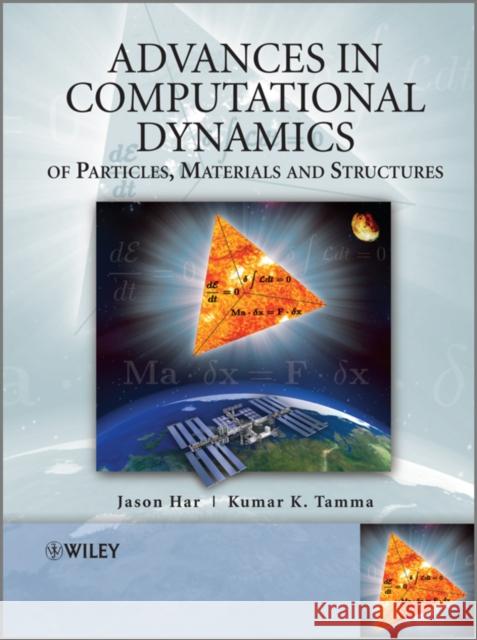
Advances in Computational Dynamics of Particles, Materials and Structures
ISBN-13: 9780470749807 / Angielski / Twarda / 2012 / 710 str.
(netto: 688,37 VAT: 5%)
Najniższa cena z 30 dni: 702,51
ok. 30 dni roboczych.
Darmowa dostawa!
This volume provides a comprehensive treatment of modern computational mechanics work in particle and continuum dynamics. The coverage encompasses classical Newtonian, Lagrangian, and Hamiltonian mechanics, as well as new and alternate contemporary approaches and their equivalences to address various problems in engineering sciences and physics.
PREFACE xv
ACKNOWLEDGMENTS xxi
ABOUT THE AUTHORS xxiii
1 INTRODUCTION 1
1.1 Overview 1
1.2 Applications 13
2 MATHEMATICAL PRELIMINARIES 15
2.1 Sets and Functions 15
2.2 Vector Spaces 18
2.3 Matrix Algebra 24
2.4 Vector Differential Calculus 28
2.5 Vector Integral Calculus 32
2.6 Mean Value Theorem 33
2.7 Function Spaces 34
2.8 Tensor Analysis 38
PART I N–BODY DYNAMICAL SYSTEMS
3 CLASSICAL MECHANICS 57
3.1 Newtonian Mechanics 57
3.2 Lagrangian Mechanics 60
3.3 Hamiltonian Mechanics 91
4 PRINCIPLE OF VIRTUAL WORK 108
4.1 Virtual Work in N–Body Dynamical Systems 108
4.2 Vector Formalism: Newtonian Mechanics in N–Body Dynamical Systems 114
4.3 Scalar Formalisms: Lagrangian and Hamiltonian Mechanics in N–Body Dynamical Systems 116
5 HAMILTON S PRINCIPLE AND HAMILTON S LAW OF VARYING ACTION 121
5.1 Introduction 121
5.2 Variation of the Principal Function 122
5.3 Calculus of Variations 125
5.4 Hamilton s Principle 129
5.5 Hamilton s Law of Varying Action 133
6 PRINCIPLE OF BALANCE OF MECHANICAL ENERGY 141
6.1 Introduction 142
6.2 Principle of Balance of Mechanical Energy 142
6.3 Total Energy Representations and Framework in the Differential Calculus Setting 144
6.4 Appendix: Total Energy Representations and Framework in the Variational Calculus Setting 156
7 EQUIVALENCE OF EQUATIONS 163
7.1 Equivalence in the Lagrangian Form of D Alembert s Principle/Principle of Virtual Work 163
7.2 Equivalence in Hamilton s Principle or Hamilton s Law of Varying Action 165
7.3 Equivalence in the Principle of Balance of Mechanical Energy 166
7.4 Equivalence Relations Between Governing Equations 167
7.5 Conservation Laws 171
7.6 Noether s Theorem 171
PART II CONTINUOUS–BODY DYNAMICAL SYSTEMS
8 CONTINUUM MECHANICS 175
8.1 Displacements, Strains and Stresses 175
8.2 General Principles 197
8.3 Constitutive Equations in Elasticity 206
8.4 Virtual Work and Variational Principles 220
8.5 Direct Variational Methods for Two–Point Boundary–Value Problems 237
9 PRINCIPLE OF VIRTUAL WORK: FINITE ELEMENTS AND SOLID/STRUCTURAL MECHANICS 267
9.1 Introduction 267
9.2 Finite Element Library 301
9.3 Nonlinear Finite Element Formulations 343
9.4 Scalar Formalisms: Lagrangian and Hamiltonian Mechanics and Finite Element Formulations in Continuous–Body Dynamical Systems 350
10 HAMILTON′S PRINCIPLE AND HAMILTON′S LAW OF VARYING ACTION: FINITE ELEMENTS AND SOLID/STRUCTURAL MECHANICS 364
10.1 Introduction 364
10.2 Hamilton s Principle and Hamilton s Law of Varying Action in Elastodynamics 365
10.3 Lagrangian Mechanics Framework and Finite Element Formulations 370
10.4 Hamiltonian Mechanics Framework and Finite Element Formulations 400
11 PRINCIPLE OF BALANCE OF MECHANICAL ENERGY: FINITE ELEMENTS AND SOLID/STRUCTURAL MECHANICS 426
11.1 Introduction 427
11.2 Total Energy Representations and Framework in the Differential Calculus Setting and Finite Element
Formulations 429
11.3 Lagrangian Mechanics Framework in the Differential Calculus Setting and Finite Element Formulations 449
11.4 Hamiltonian Mechanics Framework in the Differential Calculus Setting and Finite Element Formulations 454
11.5 Appendix: Total Energy Representations and Framework in the Variational Calculus Setting and Finite Element Formulations 458
12 EQUIVALENCE OF EQUATIONS 475
12.1 Equivalence in the Principle of Virtual Work in Dynamics 475
12.2 Equivalence in Hamilton s Principle or Hamilton s Law of Varying Action 478
12.3 Equivalence in the Principle of Balance of Mechanical Energy 482
12.4 Equivalence of Strong and Weak Forms for Initial Boundary–Value Problems 483
12.5 Equivalence of the Semi–Discrete Finite Element Equations of Motion 487
12.6 Equivalence of Finite Element Formulations 488
12.7 Conservation Laws 490
PART III THE TIME DIMENSION
13 TIME DISCRETIZATION OF EQUATIONS OF MOTION: OVERVIEW AND CONVENTIONAL PRACTICES 495
13.1 Introduction 495
13.2 Single–Step Methods for First–Order Ordinary Differential Equations 500
13.3 Linear Multistep Methods 505
13.4 Second–Order Systems and Single Step and/or Equivalent LMS Methods: Brief Overview of Classical
Methods from Historical Perspectives and Chronological Developments 507
13.5 Symplectic–Momentum Conservation and Variational Time Integrators 527
13.6 Energy–Momentum Conservation and Time Integration Algorithms 536
14 TIME DISCRETIZATION OF EQUATIONS OF MOTION: RECENT ADVANCES 553
14.1 Introduction 553
14.2 Time Discretization and the Total Energy Framework: Linear Dynamic Algorithms and Designs – Generalized Single Step Single Solve [GSSSS] Unified Framework Encompassing LMS Methods 555
14.3 Time Discretization and the Total Energy Framework: Nonlinear Dynamics Algorithms and Designs – Generalized Single Step Single Solve [GSSSS] Framework Encompassing LMS Methods 578
14.4 Time Discretization and Total Energy Framework: N–Body Systems 632
14.5 Time Discretization and Total Energy Framework: Nonconservative/Conservative Mechanical Systems with Holonomic–Scleronomic Constraints 649
14.5.1 General Formulations 650
Exercises 662
REFERENCES 669
INDEX 681
Dr. Kumar K. Tamma is Professor in the Dept. of Mechanical Engineering, Institute of Technology, at the University of Minnesota. He is also Director of the Laboratory for Multi–scale Physics, Mechanics, Materials and Modeling.He has published over 170 research papers in leading archival journals in the field, and over 225 in refereed conference proceedings/book chapters, and national/international conference abstracts. His primary areas of research include computational mechanics with emphasis on multi–scale/multi–physics and fluid–thermal–structural interactions; structural dynamics and contact–impact–penetration; computational aspects of microscale/nanoscale heat transfer; composites and manufacturing processes and solidification and computational development of finite element technology and time dependent algorithms.
Dr. Jason Har is a Research Associate working with Professor Tamma at the University of Minnesota. He received his Ph.D from Georgia Tech. His areas of research are finite element developments, computational structural dynamics and mechanics.
Computational methods for the modeling and simulation of the dynamic response and behavior of particles, materials and structural systems have had a profound influence on science, engineering and technology. Complex science and engineering applications dealing with complicated structural geometries and materials that would be very difficult to treat using analytical methods have been successfully simulated using computational tools. With the incorporation of quantum, molecular and biological mechanics into new models, these methods are poised to play an even bigger role in the future.
Advances in Computational Dynamics of Particles, Materials and Structures not only presents emerging trends and cutting edge state–of–the–art tools in a contemporary setting, but also provides a unique blend of classical and new and innovative theoretical and computational aspects covering both particle dynamics, and flexible continuum structural dynamics applications. It provides a unified viewpoint and encompasses the classical Newtonian, Lagrangian, and Hamiltonian mechanics frameworks as well as new and alternative contemporary approaches and their equivalences in [start italics]vector and scalar formalisms[end italics] to address the various problems in engineering sciences and physics.
Highlights and key features
- Provides practical applications, from a unified perspective, to both particle and continuum mechanics of flexible structures and materials
- Presents new and traditional developments, as well as alternate perspectives, for space and time discretization
- Describes a unified viewpoint under the umbrella of Algorithms by Design for the class of linear multi–step methods
- Includes fundamentals underlying the theoretical aspects and numerical developments, illustrative applications and practice exercises
The completeness and breadth and depth of coverage makes Advances in Computational Dynamics of Particles, Materials and Structures a valuable textbook and reference for graduate students, researchers and engineers/scientists working in the field of computational mechanics; and in the general areas of computational sciences and engineering.




Czytaj nas na:
1997-2026 DolnySlask.com Agencja Internetowa
KrainaKsiazek.PL - Księgarnia Internetowa


