• Wyszukiwanie zaawansowane
  • Kategorie
  • Kategorie BISAC
  • Książki na zamówienie
  • Promocje
  • Granty
  • Książka na prezent
  • Opinie
  • Pomoc
  • Załóż konto
  • Zaloguj się

Advances in Business Cycle Research: With Application to the French and Us Economies » książka

zaloguj się | załóż konto
Logo Krainaksiazek.pl

koszyk

konto

szukaj
topmenu
Księgarnia internetowa
Szukaj
Książki na zamówienie
Promocje
Granty
Książka na prezent
Moje konto
Pomoc
 
 
Wyszukiwanie zaawansowane
Pusty koszyk
Bezpłatna dostawa dla zamówień powyżej 20 złBezpłatna dostawa dla zamówień powyżej 20 zł

Kategorie główne

• Nauka
 [2946912]
• Literatura piękna
 [1852311]

  więcej...
• Turystyka
 [71421]
• Informatyka
 [150889]
• Komiksy
 [35717]
• Encyklopedie
 [23177]
• Dziecięca
 [617324]
• Hobby
 [138808]
• AudioBooki
 [1671]
• Literatura faktu
 [228371]
• Muzyka CD
 [400]
• Słowniki
 [2841]
• Inne
 [445428]
• Kalendarze
 [1545]
• Podręczniki
 [166819]
• Poradniki
 [480180]
• Religia
 [510412]
• Czasopisma
 [525]
• Sport
 [61271]
• Sztuka
 [242929]
• CD, DVD, Video
 [3371]
• Technologie
 [219258]
• Zdrowie
 [100961]
• Książkowe Klimaty
 [124]
• Zabawki
 [2341]
• Puzzle, gry
 [3766]
• Literatura w języku ukraińskim
 [255]
• Art. papiernicze i szkolne
 [7810]
Kategorie szczegółowe BISAC

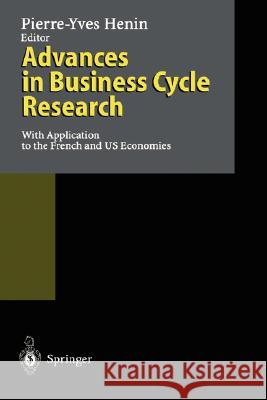
Advances in Business Cycle Research: With Application to the French and Us Economies

ISBN-13: 9783540592297 / Angielski / Twarda / 1995 / 412 str.
Pierre-Yves Henin
Advances in Business Cycle Research: With Application to the French and Us Economies Henin, Pierre-Yves 9783540592297 Springer - książkaWidoczna okładka, to zdjęcie poglądowe, a rzeczywista szata graficzna może różnić się od prezentowanej.

Advances in Business Cycle Research: With Application to the French and Us Economies

ISBN-13: 9783540592297 / Angielski / Twarda / 1995 / 412 str.

Pierre-Yves Henin
cena 401,58
(netto: 382,46 VAT:  5%)

Najniższa cena z 30 dni: 385,52
Termin realizacji zamówienia:
ok. 22 dni roboczych
Dostawa w 2026 r.

Darmowa dostawa!

This text presents a critical evaluation of the canonical RBC methods, new elements of empirical relevance and new specifications at the frontier of business cycle research, coping with non-walrasian features, contracts and nominal rigidities, unemployment and growth.


Kategorie:
Nauka, Ekonomia i biznes
Kategorie BISAC:
Business & Economics > Mikroekonomia
Business & Economics > Economics - Theory
Business & Economics > Ekonometria
Wydawca:
Springer
Język:
Angielski
ISBN-13:
9783540592297
Rok wydania:
1995
Wydanie:
1995
Ilość stron:
412
Waga:
0.77 kg
Wymiary:
23.39 x 15.6 x 2.39
Oprawa:
Twarda
Wolumenów:
01
Dodatkowe informacje:
Wydanie ilustrowane

On the Theoretical Relevance and Empirical Validity of Augmented Real Business Cycle Models: An Introduction.- 1 Why to Consider Augmented Real Business Cycle Models?.- 2 Walrasian ARBC Models.- 3 Non Walrasian Models and Other Developments.- 4 Looking at the Future : Beyond ARBC Models.- I Advances into RBC Framework.- 1 Presentation and Evaluation of the Real Business Cycles Approach.- 1.1 Presentation of the Canonical RBC Model.- 1.1.1 Exposition of the Model.- 1.1.2 The Resolution Method.- 1.1.3 The Economic Mechanisms at the Heart of RBC Models.- 1.2 The Evaluation of RBC Approach.- 1.2.1 The Stylized Facts of the French and US Fluctuations.- 1.2.2 Calibration.- 1.2.3 Cyclical Properties of the Model.- 1.3 Concluding Comments.- 1.4 Appendix : Solving the Linear System.- 2 A RBC Model for Explaining Cyclical Labor Market Features.- 2.1 Productivity, Labor Productivity and Business Cycle.- 2.1.1 The Solow Residual in RBC Models.- 2.1.2 Labor Productivity Cycle : a Stylized Fact.- 2.2 The Model.- 2.2.1 The Firms.- 2.2.2 The Households.- 2.2.3 The Government.- 2.2.4 The Planner’s Decision Rules.- 2.3 Solution Method and Calibration.- 2.4 Impulse Response Functions for Technological and Government Spending Shocks.- 2.4.1 Technological Shocks.- 2.4.2 Government Spending Shock.- 2.5 Simulation Results.- 2.5.1 The USA.- 2.5.2 France.- 2.5.3 Conclusion of the Quantitative Analysis.- 2.6 Concluding Comments.- 2.7 Appendix.- 3 Cash-In-Advance Constraint and the Business Cycle.- 3.1 The Model.- 3.1.1 The Neoclassical Growth Model with Cash-In-Advance.- 3.1.2 How to Solve the Model?.- 3.2 Dynamic Features of the Cash-In-Advance Constraint Model.- 3.2.1 Transitional Dynamics.- 3.2.2 Instantaneous Responses to a Technological Shock.- 3.2.3 Instantaneous Responses to a Monetary Shock.- 3.3 Can a Cash-In-Advance Constraint Account for the Role of Monetary Shocks in the Business Cycle?.- 3.3.1 Simulation Method and Calibration Issues.- 3.3.2 The Specific Role of Monetary Shocks in Cash-In-Advance Models.- 3.3.3 Monetary Shocks and Cash-In-Advance Constraint: a Counter-Factual Impulsion-Propagation Scheme.- 3.4 Concluding Comments.- 3.5 Appendix.- 4 The International Transmission of Real Business Cycles.- 4.1 A One-Sector, Two-Country Model.- 4.1.1 Preferences.- 4.1.2 Technology.- 4.1.3 Constraints.- 4.1.4 Model Resolution.- 4.2 Impulse Response to Productivity and Government Spending Shocks.- 4.2.1 Effects of Productivity Shock.- 4.2.2 Effects of Government Spending Shock.- 4.3 Model Predictions and International Business Cycles.- 4.3.1 The Stylized Facts.- 4.3.2 Model Predictions.- 4.4 Concluding Comments.- 4.5 Appendix.- 5 A Small Open Economy RBC Model: the French Economy Case.- 5.1 The RBC Model of the French Economy.- 5.1.1 Technology and Preferences.- 5.1.2 Optimal Behavior of Households and Firms.- 5.1.3 Competitive Equilibrium of the Economy.- 5.1.4 Stationarization and Linearization of the Model.- 5.2 Two Exercises of Model Validation.- 5.2.1 Parameter Calibration of the Benchmark Model.- 5.2.2 Traditional Validation by Moment Comparison.- 5.2.3 Impulse Response Functions of the RBC and VAR Models.- 5.3 Concluding Comments.- II Advances beyond RBC Framework.- 6 Nominal Rigidities and Monopolistic Competition: A New-Keynesian View.- 6.1 The Model.- 6.1.1 A Monopolistic Competition Model with Money in the Utility Function.- 6.1.2 Definition and Resolution of the Equilibrium.- 6.2 Monetary Disturbances and Business Cycle in France and the United States.- 6.2.1 Parameter Calibration.- 6.2.2 Estimation of the Exogenous Shocks Processes.- 6.2.3 The Effect of Monetary Shocks, Monopolistic Competition and Price Stickiness.- 6.2.4 The Effect of Increasing Returns.- 6.2.5 The Model and the Business Cycle on US and French Data.- 6.2.6 Impulse Responses to Technological and Monetary Shocks.- 6.3 Concluding Comments.- 6.4 Appendix.- 7 Nominal Wage Contracts and the Short-Run Dynamics of Real Wages.- 7.1 The Model.- 7.1.1 The Economic Environment.- 7.1.2 The Competitive Equilibrium of the Economy without Wage Contracts.- 7.1.3 The Equilibrium with Nominal Wage Contracts.- 7.2 The Mechanisms of the Model.- 7.2.1 Calibration.- 7.2.2 The Walrasian Model with Interrelated Adjustment Costs.- 7.2.3 The Model with Interrelated Adjustment Costs and Contracts.- 7.3 Validation.- 7.3.1 The Stylized Facts.- 7.3.2 Does the Model Match the Data?.- 7.3.3 Nominal Shocks and Short-Run Dynamics of Real Wages.- 8 Unemployment and Business Cycle : a General Equilibrium Matching Model.- 8.1 The Model.- 8.1.1 The Labor Market.- 8.1.2 The Firm.- 8.1.3 The Household.- 8.2 The Symmetric General Equilibrium.- 8.2.1 The Wage Bargaining Process and the Search Intensity Decision.- 8.2.2 Rational Expectations Equilibrium.- 8.2.3 Resolution Method.- 8.3 Results.- 8.3.1 Impulse Response Functions.- 8.3.2 Does the Model Match the U.S. Business Cycle?.- 8.3.3 Does the Model Match the French Business Cycle?.- 8.4 Concluding Comments.- 9 Business Cycle and Endogenous Growth : Learning by Doing versus Rationalizing.- 9.1 Presentation of the Model.- 9.1.1 The Households.- 9.1.2 The Government Expenditures.- 9.1.3 The Firms.- 9.1.4 Accumulation Processes.- 9.2 Solving the Model.- 9.2.1 The Representative Firm Problem.- 9.2.2 The Household Problem.- 9.2.3 The Competitive Equilibrium.- 9.2.4 Simulation Methodology.- 9.3 Analysis of the Dynamics.- 9.3.1 Transitional Dynamics.- 9.3.2 Responses to Stochastic Shocks.- 9.4 Cyclical Implications of the Sign of Persistence.- 9.4.1 Stochastic Simulation Methodology.- 9.4.2 Simulation Results.- 9.5 Concluding Comments.- 9.6 Appendix.- 10 Statistical Evaluation of the RBC Model.- 10.1 The Canonical Real Business Cycle Model.- 10.1.1 The Model.- 10.1.2 Solution Method.- 10.2 Estimation Method, Testing and Stochastic Simulation.- 10.2.1 Implementing the Generalized Method of Moments.- 10.2.2 Testing.- 10.2.3 Parameter Uncertainty and Stochastic Simulations.- 10.3 Empirical Results.- 10.3.1 Estimation of the Structural Parameters ?1.- 10.3.2 Statistical Tests of the RBC Propositions.- 10.4 Concluding Comments.- 10.5 Appendix.


Udostępnij

Facebook - konto krainaksiazek.pl


Opinie o Krainaksiazek.pl na Opineo.pl

Partner Mybenefit

Krainaksiazek.pl w programie rzetelna firma Krainaksiaze.pl - płatności przez paypal

Czytaj nas na:

Facebook - krainaksiazek.pl
  • książki na zamówienie
  • granty
  • książka na prezent
  • kontakt
  • pomoc
  • opinie
  • regulamin
  • polityka prywatności

Zobacz:

  • Księgarnia czeska

  • Wydawnictwo Książkowe Klimaty

1997-2025 DolnySlask.com Agencja Internetowa

© 1997-2022 krainaksiazek.pl
     
KONTAKT | REGULAMIN | POLITYKA PRYWATNOŚCI | USTAWIENIA PRYWATNOŚCI
Zobacz: Księgarnia Czeska | Wydawnictwo Książkowe Klimaty | Mapa strony | Lista autorów
KrainaKsiazek.PL - Księgarnia Internetowa

Polityka prywatnosci - link
Krainaksiazek.pl - płatnośc Przelewy24
Przechowalnia Przechowalnia







