• Wyszukiwanie zaawansowane
  • Kategorie
  • Kategorie BISAC
  • Książki na zamówienie
  • Promocje
  • Granty
  • Książka na prezent
  • Opinie
  • Pomoc
  • Załóż konto
  • Zaloguj się

Adaptive Modelling, Estimation and Fusion from Data: A Neurofuzzy Approach » książka


zaloguj się | załóż konto
Logo Krainaksiazek.pl

koszyk

konto

szukaj
topmenu
Księgarnia internetowa
Szukaj
Książki na zamówienie
Promocje
Granty
Książka na prezent
Moje konto
Pomoc
 
 
Wyszukiwanie zaawansowane
Pusty koszyk
Bezpłatna dostawa dla zamówień powyżej 20 złBezpłatna dostawa dla zamówień powyżej 20 zł

Kategorie główne

• Nauka
 [2946600]
• Literatura piękna
 [1856966]

  więcej...
• Turystyka
 [72221]
• Informatyka
 [151456]
• Komiksy
 [35826]
• Encyklopedie
 [23190]
• Dziecięca
 [619653]
• Hobby
 [140543]
• AudioBooki
 [1577]
• Literatura faktu
 [228355]
• Muzyka CD
 [410]
• Słowniki
 [2874]
• Inne
 [445822]
• Kalendarze
 [1744]
• Podręczniki
 [167141]
• Poradniki
 [482898]
• Religia
 [510455]
• Czasopisma
 [526]
• Sport
 [61590]
• Sztuka
 [243598]
• CD, DVD, Video
 [3423]
• Technologie
 [219201]
• Zdrowie
 [101638]
• Książkowe Klimaty
 [124]
• Zabawki
 [2473]
• Puzzle, gry
 [3898]
• Literatura w języku ukraińskim
 [254]
• Art. papiernicze i szkolne
 [8170]
Kategorie szczegółowe BISAC

Adaptive Modelling, Estimation and Fusion from Data: A Neurofuzzy Approach

ISBN-13: 9783642621192 / Angielski / Miękka / 2012 / 323 str.
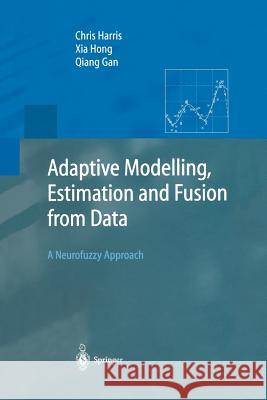
Chris Harris; Xia Hong; Qiang Gan
Adaptive Modelling, Estimation and Fusion from Data: A Neurofuzzy Approach Harris, Chris 9783642621192 Springer - książkaWidoczna okładka, to zdjęcie poglądowe, a rzeczywista szata graficzna może różnić się od prezentowanej.

Adaptive Modelling, Estimation and Fusion from Data: A Neurofuzzy Approach

ISBN-13: 9783642621192 / Angielski / Miękka / 2012 / 323 str.

Chris Harris; Xia Hong; Qiang Gan
cena 403,47 zł
(netto: 384,26 VAT:  5%)

Najniższa cena z 30 dni: 385,52 zł
Termin realizacji zamówienia:
ok. 22 dni roboczych
Bez gwarancji dostawy przed świętami

Darmowa dostawa!

In a world of almost permanent and rapidly increasing electronic data availability, techniques of filtering, compressing, and interpreting this data to transform it into valuable and easily comprehensible information is of utmost importance. One key topic in this area is the capability to deduce future system behavior from a given data input. This book brings together for the first time the complete theory of data-based neurofuzzy modelling and the linguistic attributes of fuzzy logic in a single cohesive mathematical framework. After introducing the basic theory of data-based modelling, new concepts including extended additive and multiplicative submodels are developed and their extensions to state estimation and data fusion are derived. All these algorithms are illustrated with benchmark and real-life examples to demonstrate their efficiency. Chris Harris and his group have carried out pioneering work which has tied together the fields of neural networks and linguistic rule-based algortihms. This book is aimed at researchers and scientists in time series modeling, empirical data modeling, knowledge discovery, data mining, and data fusion.


Kategorie:
Informatyka, Bazy danych
Kategorie BISAC:
Computers > Artificial Intelligence - Computer Vision & Pattern Recognition
Computers > Data Science - General
Mathematics > Prawdopodobieństwo i statystyka
Wydawca:
Springer
Seria wydawnicza:
Advanced Information Processing
Język:
Angielski
ISBN-13:
9783642621192
Rok wydania:
2012
Wydanie:
Softcover Repri
Numer serii:
000253025
Ilość stron:
323
Waga:
0.52 kg
Wymiary:
23.5 x 15.5
Oprawa:
Miękka
Wolumenów:
01

From the reviews:

"This is an account of a major development by a research group in Southampton University on the extension of adaptive techniques to nonlinear and nonstationary environments. ... There seems to be no doubt that this well-presented book is indispensable for anyone concerned with difficult nonlinear problems of control." (Alex M. Andrew, Robotica, Vol. 22, 2004)

"This book brings together for the first time the complete theory of data-based neurofuzzy modelling and the linguistic attributes of fuzzy logic in a single cohesive mathematical framework. ... This book is aimed at researchers and scientists in time series modelling, empirical data modelling, knowledge discovery, data mining, and data fusion." (Nikolay Yakovlevich Tikhonenko, Zentralblatt MATH, Vol. 1005, 2003)

1. An introduction to modelling and learning algorithms.- 1.1 Introduction to modelling.- 1.2 Modelling, control and learning algorithms.- 1.3 The learning problem.- 1.4 Book philosophy and contents overview.- 1.4.1 Book overview.- 1.4.2 A historical perspective of adaptive modelling and control.- 2. Basic concepts of data-based modelling.- 2.1 Introduction.- 2.2 State-space models versus input-output models.- 2.2.1 Conversion of state-space models to input-output models.- 2.2.2 Conversion of input-output models to state-space models.- 2.3 Nonlinear modelling by basis function expansion.- 2.4 Model parameter estimation.- 2.5 Model quality.- 2.5.1 The bias-variance dilemma.- 2.5.2 Bias-variance balance by model structure regularisation.- 2.6 Reproducing kernels and regularisation networks.- 2.7 Model selection methods.- 2.7.1 Model selection criteria.- 2.7.2 Model selection criteria sensitivity.- 2.7.3 Correlation tests.- 2.8 An example: time series modelling.- 3. Learning laws for linear-in-the-parameters networks.- 3.1 Introduction to learning.- 3.2 Error or performance surfaces.- 3.3 Batch learning laws.- 3.3.1 General learning laws.- 3.3.2 Gradient descent algorithms.- 3.4 Instantaneous learning laws.- 3.4.1 Least mean squares learning.- 3.4.2 Normalised least mean squares learning.- 3.4.3 NLMS weight convergence.- 3.4.4 Recursive least squares estimation.- 3.5 Gradient noise and normalised condition numbers.- 3.6 Adaptive learning rates.- 4. Fuzzy and neurofuzzy modelling.- 4.1 Introduction to fuzzy and neurofuzzy systems.- 4.2 Fuzzy systems.- 4.2.1 Fuzzy sets.- 4.2.2 Fuzzy operators.- 4.2.3 Fuzzy relation surfaces.- 4.2.4 Inferencing.- 4.2.5 Fuzzification and defuzzification.- 4.3 Functional mapping and neurofuzzy models.- 4.4 Takagi-Sugeno local neurofuzzy model.- 4.5 Neurofuzzy modelling examples.- 4.5.1 Thermistor modelling.- 4.5.2 Time series modelling.- 5. Parsimonious neurofuzzy modelling.- 5.1 Iterative construction modelling.- 5.2 Additive neurofuzzy modelling algorithms.- 5.3 Adaptive spline modelling algorithm (ASMOD).- 5.3.1 ASMOD refinements.- 5.3.2 Illustrative examples of.- 5.4 Extended additive neurofuzzy models.- 5.4.1 Weight identification.- 5.4.2 Extended additive model structure identification.- 5.5 Hierarchical neurofuzzy models.- 5.6 Regularised neurofuzzy models.- 5.6.1 Bayesian regularisation.- 5.6.2 Error bars.- 5.6.3 Priors for neurofuzzy models.- 5.6.4 Local regularised neurofuzzy models.- 5.7 Complexity reduction through orthogonal least squares.- 5.8 A-optimality neurofuzzy model construction (NeuDec).- 6. Local neurofuzzy modelling.- 6.1 Introduction.- 6.2 Local orthogonal partitioning algorithms.- 6.2.1 k-d Trees.- 6.2.2 Quad-trees.- 6.3 Operating point dependent neurofuzzy models.- 6.4 State space representations of operating point dependent neurofuzzy models.- 6.5 Mixture of experts modelling.- 6.6 Multi-input-Multi-output (MIMO) modelling via input variable selection.- 6.6.1 MIMO NARX neurofuzzy model decomposition.- 6.6.2 Feedforward Gram-Schmidt OLS procedure for linear systems.- 6.6.3 Input variable selection via the modified Gram-Schmidt OLS for piecewise linear submodels.- 7. Delaunay input space partitioning modelling.- 7.1 Introduction.- 7.2 Delaunay triangulation of the input space.- 7.3 Delaunay input space partitioning for locally linear models.- 7.4 The Bézier-Bernstein modelling network.- 7.4.1 Neurofuzzy modelling using Bézier-Bernstein function for univariate term fi(xi) and bivariate term fi1, j1(xi1, xj1).- 7.4.2 The complete Bézier-Bernstein model construction algorithm.- 7.4.3 Numerical examples.- 8. Neurofuzzy linearisation modelling for nonlinear state estimation.- 8.1 Introduction to linearisation modelling.- 8.2 Neurofuzzy local linearisation and the MASMOD algorithm.- 8.3 A hybrid learning scheme combining MASMOD and EM algorithms for neurofuzzy local linearisation.- 8.4 Neurofuzzy feedback linearisation (NFFL).- 8.5 Formulation of neurofuzzy state estimators.- 8.6 An example of nonlinear trajectory estimation.- 9. Multisensor data fusion using Kaiman filters based on neurofuzzy linearisation.- 9.1 Introduction.- 9.2 Measurement fusion.- 9.2.1 Outputs augmented fusion (OAF).- 9.2.2 Optimal weighting measurement fusion (OWMF).- 9.2.3 On functional equivalence of OAF and.- 9.2.4 On the decentralised architecture.- 9.3 State-vector fusion.- 9.3.1 State-vector assimilation fusion (SVAF).- 9.3.2 Track-to-track fusion (TTF).- 9.3.3 On the decentralised architecture.- 9.4 Hierarchical multisensor data fusion — trade-off between centralised and decentralised Architectures.- 9.5 Simulation examples.- 9.5.1 On functional equivalence of two measurement fusion methods.- 9.5.2 On hierarchical multisensor data fusion.- 10. Support vector neurofuzzy models.- 10.1 Introduction.- 10.2 Support vector machines.- 10.2.1 Loss functions.- 10.2.2 Feature space and kernel functions.- 10.3 Support vector regression.- 10.4 Support vector neurofuzzy networks.- 10.5 SUPANOVA.- 10.6 A comparison among neural network models.- 10.7 Conclusions.- References.

In a world of almost permanent and rapidly increasing electronic data availability, techniques of filtering, compressing, and interpreting this data to transform it into valuable and easily comprehensible information is of utmost importance. One key topic in this area is the capability to deduce future system behavior from a given data input. This book brings together for the first time the complete theory of data-based neurofuzzy modelling and the linguistic attributes of fuzzy logic in a single cohesive mathematical framework. After introducing the basic theory of data-based modelling, new concepts including extended additive and multiplicative submodels are developed and their extensions to state estimation and data fusion are derived. All these algorithms are illustrated with benchmark and real-life examples to demonstrate their efficiency. Chris Harris and his group have carried out pioneering work which has tied together the fields of neural networks and linguistic rule-based algortihms. This book is aimed at researchers and scientists in time series modeling, empirical data modeling, knowledge discovery, data mining, and data fusion.

Hong, Xia XIA HONG is on the editorial staff of "Film Art (D... więcej >


Udostępnij

Facebook - konto krainaksiazek.pl


Opinie o Krainaksiazek.pl na Opineo.pl

Partner Mybenefit

Krainaksiazek.pl w programie rzetelna firma Krainaksiaze.pl - płatności przez paypal

Czytaj nas na:

Facebook - krainaksiazek.pl
  • książki na zamówienie
  • granty
  • książka na prezent
  • kontakt
  • pomoc
  • opinie
  • regulamin
  • polityka prywatności

Zobacz:

  • Księgarnia czeska

  • Wydawnictwo Książkowe Klimaty

1997-2025 DolnySlask.com Agencja Internetowa

© 1997-2022 krainaksiazek.pl
     
KONTAKT | REGULAMIN | POLITYKA PRYWATNOŚCI | USTAWIENIA PRYWATNOŚCI
Zobacz: Księgarnia Czeska | Wydawnictwo Książkowe Klimaty | Mapa strony | Lista autorów
KrainaKsiazek.PL - Księgarnia Internetowa

Polityka prywatnosci - link
Krainaksiazek.pl - płatnośc Przelewy24
Przechowalnia Przechowalnia




