• Wyszukiwanie zaawansowane
  • Kategorie
  • Kategorie BISAC
  • Książki na zamówienie
  • Promocje
  • Granty
  • Książka na prezent
  • Opinie
  • Pomoc
  • Załóż konto
  • Zaloguj się

Adapting to Online and Blended Learning in Higher Education: Supporting the Retention and Success of the Expanded and Diversified Intake » książka


zaloguj się | załóż konto
Logo Krainaksiazek.pl

koszyk

konto

szukaj
topmenu
Księgarnia internetowa
Szukaj
Książki na zamówienie
Promocje
Granty
Książka na prezent
Moje konto
Pomoc
 
 
Wyszukiwanie zaawansowane
Pusty koszyk
Bezpłatna dostawa dla zamówień powyżej 20 złBezpłatna dostawa dla zamówień powyżej 20 zł

Kategorie główne

• Nauka
 [2949965]
• Literatura piękna
 [1857847]

  więcej...
• Turystyka
 [70818]
• Informatyka
 [151303]
• Komiksy
 [35733]
• Encyklopedie
 [23180]
• Dziecięca
 [617748]
• Hobby
 [139972]
• AudioBooki
 [1650]
• Literatura faktu
 [228361]
• Muzyka CD
 [398]
• Słowniki
 [2862]
• Inne
 [444732]
• Kalendarze
 [1620]
• Podręczniki
 [167233]
• Poradniki
 [482388]
• Religia
 [509867]
• Czasopisma
 [533]
• Sport
 [61361]
• Sztuka
 [243125]
• CD, DVD, Video
 [3451]
• Technologie
 [219309]
• Zdrowie
 [101347]
• Książkowe Klimaty
 [123]
• Zabawki
 [2362]
• Puzzle, gry
 [3791]
• Literatura w języku ukraińskim
 [253]
• Art. papiernicze i szkolne
 [7933]
Kategorie szczegółowe BISAC

Adapting to Online and Blended Learning in Higher Education: Supporting the Retention and Success of the Expanded and Diversified Intake

ISBN-13: 9789819908974 / Angielski
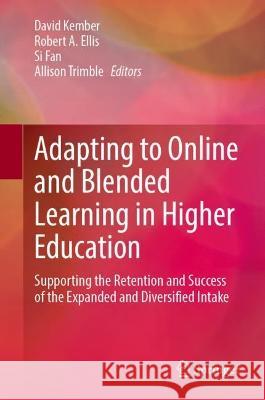
David Kember; Robert a. Ellis; Si Fan
Adapting to Online and Blended Learning in Higher Education: Supporting the Retention and Success of the Expanded and Diversified Intake David Kember Robert a. Ellis Si Fan 9789819908974 Springer - książkaWidoczna okładka, to zdjęcie poglądowe, a rzeczywista szata graficzna może różnić się od prezentowanej.

Adapting to Online and Blended Learning in Higher Education: Supporting the Retention and Success of the Expanded and Diversified Intake

ISBN-13: 9789819908974 / Angielski

David Kember; Robert a. Ellis; Si Fan
cena 645,58
(netto: 614,84 VAT:  5%)

Najniższa cena z 30 dni: 578,30
Termin realizacji zamówienia:
ok. 22 dni roboczych
Bez gwarancji dostawy przed świętami

Darmowa dostawa!
inne wydania

Higher education has undergone a massive transformation in teaching and learning in a very short period of time since the onset of Covid-19. Students, teachers and universities have had to adopt online and blended learning, often with little or no experience or models of good practice to draw upon. It is clear that blended and online learning are here to stay. This book draws on research from universities that have adopted online and blended learning to facilitate the expansion and diversification of their intake; which resulted in considerable experience and expertise in online and blended teaching. The book describes a model, tested with qualitative and quantitative data, which shows how teachers can support the retention and success of online and blended learners with four high-quality pedagogical elements: bite-sized videos of interest and relevance; learning materials that are well organised and provide a clear learning roadmap; discussion forums which are set up and moderated so as to result in lively student-student and student-teacher interaction; and, online teachers being approachable and responsive to communication with individual students through email, phone and online communication platforms. This model is explained and profusely illustrated with examples from the teaching of award-winning teachers.This book introduces the concept of a spectrum from traditional to contemporary models of admission and course delivery in higher education. It explains how universities which have adopted a contemporary model, with high levels of blended and online learning, have been able to expand their intake and markedly diversify the student body. It discusses how to support the retention and success of online and blended learners. Student support services are examined from the perspectives of service providers and online and blended learners and the case is made for support services being aligned with student needs. The book has a discussion of university management systems which utilise feedback at all levels to improve alignment between support service provision and student needs.


Higher education has undergone a massive transformation in teaching and learning in a very short period of time since the onset of Covid-19. Students, teachers and universities have had to adopt online and blended learning, often with little or no experience or models of good practice to draw upon. It is clear that blended and online learning are here to stay. This book draws on research from universities that have adopted online and blended learning to facilitate the expansion and diversification of their intake; which resulted in considerable experience and expertise in online and blended teaching. The book describes a model, tested with qualitative and quantitative data, which shows how teachers can support the retention and success of online and blended learners with four high-quality pedagogical elements: bite-sized videos of interest and relevance; learning materials that are well organised and provide a clear learning roadmap; discussion forums which are set up and moderated so as to result in lively student-student and student-teacher interaction; and, online teachers being approachable and responsive to communication with individual students through email, phone and online communication platforms. This model is explained and profusely illustrated with examples from the teaching of award-winning teachers. This book introduces the concept of a spectrum from traditional to contemporary models of admission and course delivery in higher education. It explains how universities which have adopted a contemporary model, with high levels of blended and online learning, have been able to expand their intake and markedly diversify the student body. It discusses how to support the retention and success of online and blended learners. Student support services are examined from the perspectives of service providers and online and blended learners and the case is made for support services being aligned with student needs. The book has a discussion of university management systems which utilise feedback at all levels to improve alignment between support service provision and student needs.

Kategorie:
Podręczniki
Kategorie BISAC:
Education > Schools - Levels - Higher
Wydawca:
Springer
Język:
Angielski
ISBN-13:
9789819908974

Chapter 1 Introduction.- Part A: Adopting a contemporary model of admission and course delivery to expand and diversify the student intake.- Chapter 2 Review of schemes for admitting a more diverse student body in higher education.- Chapter 3 Why Tasmania has a particular need to increase educational participation.- Chapter 4 Expanding and diversifying intakes through the adoption of open and online learning.- Chapter 5 Characteristics of the diverse student body and the multiple associated challenges they face.- Chapter 6 Catering for rural, regional and remote students with online learning.- Chapter 7 Coping mechanisms adopted by the diverse student body.- Part B: Supporting the retention and success of online and blended learners.- Chapter 8 Review of support provided by student support services.- Chapter 9 Review of literature on attrition.- Chapter 10 Modelling retention and success in traditional and contemporary universities.- Chapter 11 Comparison of student support services in four universities.- Chapter 12 Perceptions of support services by blended and online learners.- Part C: Implementing a model for the retention and success of online and blended learners.- Chapter 13 International perspectives on the transformation of teaching, learning and support in the new normal.- Chapter 14 Modelling the way teachers can support the retention and success of online students.- Chapter 15 Detailed characterisation of online teaching which optimises student support.- Chapter 16 Supporting blended learners in the new normal.- Chapter 17 Peer student support and the formation of learning communities.- Chapter 18 A teaching quality enhancement initiative which uses evaluation feedback to enable online and blended teaching to provide support to students.- Chapter 19 Practical implications of implementing a model of supporting retention and success for online and blended learners.- Chapter 20 Conclusion.


Professor David Kember has retired from university employment. His first involvement with distance education was at the University of the South Pacific. Next came roles at the University of Papua New Guinea and in Australia. David then spent 25 years in Hong Kong at the Polytechnic University, Chinese University and finally as a Professor in Higher Education at the University of Hong Kong. His final position was as a Professor in Curriculum Methods and Pedagogy at the University of Tasmania, Australia. During his career journey, David has had a recurring research interest in distance education, which has evolved through technological advancements into online and blended learning. Foci of this research have been on student learning and the retention and success of online and blended learners.

Professor Rob Ellis is Pro Vice-Chancellor (Learning and Teaching) at Griffith University, Australia, and works with the Griffith Executive on strategic learning and teaching leadership and outcomes across twenty one schools. Prior to Griffith University, Rob was the inaugural Director of eLearning at the University of Sydney for over a decade. To inform his academic practice, Rob researches the experiences of university students and teachers, physical and virtual learning environments and how changes in these shape education quality and innovation in universities and the higher education sector. He regularly publishes in quality education journals, and has been a co-ordinating editor for Springer Publishing for the journal Higher Education, and series co-editor for the book series ‘Understanding Teaching-Learning Practice’.

Dr Si Fan is a senior lecturer in the School of Education, University of Tasmania, Australia. She completed her PhD at the University of Tasmania in 2011, with a thesis on web-based technology supported teaching and learning in higher education. She has a broad research interest in higher education and online pedagogy, teacher education, early childhood education, and language education. Her research in online pedagogy has led to enhanced teaching practice and student learning experiences in higher education. She has been involved in a few research projects, including a national project involving four Australian Universities, which preceded this book.

Dr Allison Trimble is a researcher in the School of Education at the University of Tasmania, Australia. She has worked around online learning for the past few years. She collected and analysed the interview data which supports the UTAS case study highlighted in this book. Previously Allison has examined the area of Education Law in Australia, and particularly the impact of Education Law on the work of school principals.

Higher education has undergone a massive transformation in teaching and learning in a very short period of time since the onset of Covid-19. Students, teachers and universities have had to adopt online and blended learning, often with little or no experience or models of good practice to draw upon. It is clear that blended and online learning are here to stay. This book draws on research from universities that have adopted online and blended learning to facilitate the expansion and diversification of their intake; which resulted in considerable experience and expertise in online and blended teaching. The book describes a model, tested with qualitative and quantitative data, which shows how teachers can support the retention and success of online and blended learners with four high-quality pedagogical elements: bite-sized videos of interest and relevance; learning materials that are well organised and provide a clear learning roadmap; discussion forums which are set up and moderated so as to result in lively student-student and student-teacher interaction; and, online teachers being approachable and responsive to communication with individual students through email, phone and online communication platforms. This model is explained and profusely illustrated with examples from the teaching of award-winning teachers. 

This book introduces the concept of a spectrum from traditional to contemporary models of admission and course delivery in higher education. It explains how universities which have adopted a contemporary model, with high levels of blended and online learning, have been able to expand their intake and markedly diversify the student body. It discusses how to support the retention and success of online and blended learners. Student support services are examined from the perspectives of service providers and online and blended learners and the case is made for support services being aligned with student needs. The book has a discussion of university management systems which utilise feedback at all levels to improve alignment between support service provision and student needs.




Udostępnij

Facebook - konto krainaksiazek.pl


Opinie o Krainaksiazek.pl na Opineo.pl

Partner Mybenefit

Krainaksiazek.pl w programie rzetelna firma Krainaksiaze.pl - płatności przez paypal

Czytaj nas na:

Facebook - krainaksiazek.pl
  • książki na zamówienie
  • granty
  • książka na prezent
  • kontakt
  • pomoc
  • opinie
  • regulamin
  • polityka prywatności

Zobacz:

  • Księgarnia czeska

  • Wydawnictwo Książkowe Klimaty

1997-2025 DolnySlask.com Agencja Internetowa

© 1997-2022 krainaksiazek.pl
     
KONTAKT | REGULAMIN | POLITYKA PRYWATNOŚCI | USTAWIENIA PRYWATNOŚCI
Zobacz: Księgarnia Czeska | Wydawnictwo Książkowe Klimaty | Mapa strony | Lista autorów
KrainaKsiazek.PL - Księgarnia Internetowa

Polityka prywatnosci - link
Krainaksiazek.pl - płatnośc Przelewy24
Przechowalnia Przechowalnia




