Active Rules in Database Systems » książka





Active Rules in Database Systems
ISBN-13: 9780387985299 / Angielski / Twarda / 1998 / 439 str.
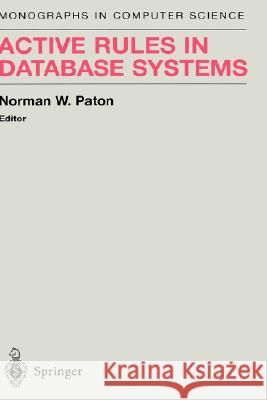
Active Rules in Database Systems
ISBN-13: 9780387985299 / Angielski / Twarda / 1998 / 439 str.
(netto: 591,26 VAT: 5%)
Najniższa cena z 30 dni: 578,30
ok. 16-18 dni roboczych.
Darmowa dostawa!
Active rules provide a new and important method for designing databases and the subject is seeing an increasing amount of attention from commercial database companies. This book provides a timely survey of the field from the point of view of some of the subject's most active researchers. The book is divided into several parts, organized by theme: the first, Fundamentals covers the underlying methodology reagrding active rules, next comes a collection of chapters which cover formal specification, rule analysis, performance analysis, and support tools, the third part is devoted to a number of chapters covering the implementation of active rules in a number of commercial systems. Finally, come sections on applications and future directions that research may take. All researchers in databases will find this provides a valuable overview of this topic.
Wydanie ilustrowane
I Fundamentals.- 1 Introduction.- 1.1 Introduction.- 1.2 Applications.- 1.2.1 Database System Extensions.- 1.2.2 Closed Database Applications.- 1.2.3 Open Database Applications.- 1.2.4 Example Application.- 1.2.5 Conclusions.- 1.3 Knowledge Model.- 1.3.1 Event.- 1.3.2 Condition.- 1.3.3 Action.- 1.4 Execution Model.- 1.5 Management.- 1.6 Conclusion.- 1.7 References.- 2 Architecture of Active Database Systems.- 2.1 Introduction.- 2.2 Degree of Integration.- 2.2.1 Layered Architecture.- 2.2.2 Integrated Architecture.- 2.3 Client-Server Architecture of the Underlying DBMS.- 2.4 Data Model and Programming Language Issues.- 2.5 Rule Specification and Registration.- 2.6 Rule Processing.- 2.6.1 Primitive Event Detector Architecture.- 2.6.2 Composite Event Detector Architecture.- 2.6.3 Event Consumption and Logging.- 2.6.4 Guarded Events, Light-Weight Vs. Heavy-Weight Events.- 2.6.5 Rule Scheduling.- 2.6.6 Transaction Models.- 2.6.7 Rule Execution.- 2.7 Recovery.- 2.8 Conclusion.- 2.9 References.- Advanced Topics.- 3 Rule Analysis.- 3.1 Introduction.- 3.2 Termination Analysis.- 3.2.1 Triggering and Activation Graphs.- 3.2.2 Building the Activation Graph.- 3.2.3 Termination with Priorities.- 3.3 Confluence Analysis.- 3.3.1 Analyzing Commutativity.- 3.3.2 Confluence with Priorities.- 3.4 Conclusion.- 3.5 References.- 4 Optimization.- 4.1 Introduction.- 4.2 Optimizing Single Rules.- 4.2.1 Exploiting Parameters.- 4.2.2 Moving Constraints.- 4.3 Optimizing Multiple Rules.- 4.4 Conclusion.- 4.5 Acknowledgments.- 4.6 References.- 5 Monitoring Complex Rule Conditions.- 5.1 Introduction.- 5.2 Incremental Evaluation Techniques.- 5.3 Differencing Relational Expressions.- 5.4 Monitoring Active Rule Conditions in AMOS.- 5.4.1 Rules in AMOSQL.- 5.4.2 Rule Compilation.- 5.5 Partial Differencing.- 5.5.1 Breadth-First Propagation.- 5.5.2 Differencing Base Relations.- 5.5.3 Partial Differencing of Views.- 5.6 Conclusion.- 5.7 References.- 6 Performance Assessment.- 6.1 Introduction.- 6.2 Performance-Critical Aspects of Active Database Systems.- 6.2.1 Performance of Active Database Applications.- 6.2.2 Performance-Critical Aspects of Active Database Management Systems.- 6.3 Performance Measurement of Active Database Management Systems.- 6.3.1 Benchmark Design.- 6.3.2 Factors and Modes.- 6.3.3 Results for SAMOS.- 6.3.4 Lessons and Observation.- 6.4 Steps Towards Performance Improvement of ADBMS’s.- 6.4.1 Optimizing ADBMS Implementations.- 6.4.2 Tuning ADBMS Applications.- 6.5 Related Work.- 6.6 Conclusion.- 6.7 Acknowledgments.- 6.8 References.- 7 Tool Support.- 7.1 Introduction.- 7.2 Analysis and Design Support.- 7.2.1 Graphical Description Tools.- 7.2.2 Validation Tools.- 7.2.3 Verification Tools.- 7.3 Implementation Support.- 7.3.1 Tracing Tools.- 7.4 Maintenance Support.- 7.4.1 Browsers.- 7.4.2 Evolution Support Tools.- 7.4.3 Explanation Tools.- 7.4.4 Measurement Tools.- 7.5 From Isolated Tools to Integrated Environments.- 7.6 Conclusion.- 7.7 References.- 8 ECA Functionality in a Distributed Environment.- 8.1 Introduction.- 8.1.1 Challenges.- 8.1.2 Dimensions Revisited.- 8.1.3 Outline of the Chapter.- 8.2 Two Views of the Networked Active Database System.- 8.3 Applications for ECA Rules in Distributed Environments.- 8.3.1 Service View.- 8.3.2 Communications Channel View.- 8.4 How Distribution Affects the Knowledge Model.- 8.5 How Distribution Affects the Execution Model.- 8.5.1 Architectural Model of the Network System.- 8.5.2 Event Detection.- 8.5.3 Scheduling.- 8.5.4 Condition Evaluation and Action Execution.- 8.6 Classification of Existing Approaches.- 8.7 Conclusion.- 8.8 References.- 9 Comparing Deductive and Active Databases.- 9.1 Introduction.- 9.1.1 Main Classes of Rule-Based Database Systems.- 9.1.2 Some Pragmatic Issues to Confront.- 9.1.3 Possible Directions for Unification Efforts.- 9.1.4 Main Requirements for Unification Efforts.- 9.2 Deductive Rules Compared with Active Rules.- 9.2.1 Semantic Dissimilarities.- 9.2.2 Syntactic Similarities.- 9.2.3 A Dimensional Analysis of Deductive Rule Sets.- 9.3 Bringing Deductive and Active Rules Together.- 9.3.1 Issues and Targets.- 9.3.2 Basic Research Stances.- 9.4 A Brief Survey of Proposals for Languages with Deductive and Active Capabilities.- 9.4.1 The Widom Spectrum.- 9.4.2 DDB-Oriented Proposals.- 9.4.3 ADB-Oriented Proposals.- 9.5 Conclusion.- 9.6 Acknowledgments.- 9.7 References.- III Systems.- 10 Active Database Features in SQL3.- 10.1 Introduction.- 10.2 Triggers in SQL3.- 10.2.1 Constraints in SQL3.- 10.2.2 Overview of SQL3 Triggers.- 10.2.3 Execution Model for Triggers in SQL3.- 10.2.4 Discussion of SQL3’s Execution Model.- 10.3 Examples.- 10.4 Comparison of SQL3 Triggers to the Active Database Framework.- 10.4.1 Knowledge Model.- 10.4.2 Execution Model.- 10.4.3 Management.- 10.5 Conclusion.- 10.6 References.- 11 Ariel.- 11.1 Introduction.- 11.2 The Ariel Query and Rule Languages.- 11.2.1 Semantics of Rule Execution.- 11.3 Examples.- 11.4 Architectural Overview.- 11.4.1 The Discrimination Network.- 11.4.2 The Rule Execution Monitor.- 11.5 System Properties and Relationship to Other Work.- 11.6 Conclusion.- 11.7 References.- 12 SAMOS.- 12.1 Introduction.- 12.2 ECA Rules in SAMOS.- 12.3 The SAMOS Prototype.- 12.3.1 Defining Rules and Events.- 12.3.2 Rule Processing.- 12.3.3 Evaluation of the SAMOS Prototype.- 12.3.4 An Example.- 12.4 Future Directions.- 12.5 Conclusion.- 12.6 Acknowledgments.- 12.7 References.- 13 EXACT: An Approach to Coping with Heterogeneous Rule Execution Models.- 13.1 Introduction.- 13.2 The Knowledge Model.- 13.3 The Execution Model.- 13.4 Some Examples.- 13.4.1 Dynamic Display Support.- 13.4.2 Relationship Semantic Support.- 13.4.3 Integrity Constraint Maintenance.- 13.5 Conclusion.- 13.6 References.- 14 REACH.- 14.1 Introduction.- 14.2 The OpenOODB Platform.- 14.3 REACH Goals, Design Principles, and Implementation Decisions.- 14.3.1 Event Detection and Composition.- 14.3.2 Rule Execution and Coupling Modes.- 14.3.3 Events: Scoping, Composition, and Parameter Passing.- 14.4 REACH Environment and Tools.- 14.4.1 Modeling Rules with OMT+.- 14.4.2 Rule Language REAL.- 14.4.3 Administration Tools.- 14.5 Summary of Features.- 14.6 Conclusion.- 14.7 Acknowledgments.- 14.8 References.- 15 NAOS.- 15.1 Introduction.- 15.2 Rules in NAOS.- 15.2.1 Rules and O2.- 15.2.2 Rule Definition.- 15.2.3 Event Part.- 15.2.4 Condition.- 15.2.5 Action.- 15.2.6 Event-Condition-Action Binding.- 15.2.7 Management of Rules.- 15.2.8 Conclusion.- 15.3 Event Types.- 15.3.1 Primitive Event Types.- 15.3.2 Composite Event Types.- 15.3.3 Validity Time Interval.- 15.3.4 With Clause.- 15.4 Rule Execution.- 15.4.1 Coupling Modes.- 15.4.2 Multiple Rule Execution.- 15.4.3 Cascading Execution.- 15.4.4 Net Effect Policy and Error Handling.- 15.4.4 Asynchronous Rule Execution.- 15.4.5 Conclusion.- 15.5 Implementation.- 15.5.1 Analyser.- 15.5.2 Constructor.- 15.5.3 Event Detectors and Event Manager.- 15.5.4 Executor.- 15.6 Conclusion.- 15.7 Acknowledgments.- 15.8 References.- 16 PFL: An Active Functional DBPL.- 16.1 Introduction.- 16.2 PFL.- 16.2.1 Types.- 16.2.2 Expressions and Functions.- 16.2.3 Bulk Data.- 16.2.4 Queries and Transactions.- 16.2.5 User-Defined Events.- 16.3 The Active Subsystem.- 16.3.1 Primitive Events.- 16.3.2 ECA rules.- 16.3.3 Execution Model.- 16.3.4 Abort Handling.- 16.4 Conclusion.- 16.5 Acknowledgments.- 16.6 References.- 17 Chimera: A Language for Designing Rule Applications.- 17.1 Introduction.- 17.2 The Chimera Model and Language.- 17.2.1 The Chimera Trigger Language.- 17.2.2 Events.- 17.2.3 Conditions.- 17.2.4 Actions.- 17.2.5 Execution Model.- 17.3 Chimera as a Conceptual Specification Language.- 17.3.1 Generation of Chimera Triggers from High-Level Declarative Specifications.- 17.3.2 Chimera Rule Analysis and Debugging.- 17.3.3 Implementation of Chimera on Top of Commercial Systems.- 17.4 Acknowledgments.- 17.5 References.- 18 RAP: The ROCK & ROLL Active Programming System.- 18.1 Introduction.- 18.2 ROCK & ROLL.- 18.2.1 Data Model.- 18.2.2 ROCK.- 18.2.3 ROLL.- 18.2.4 Queries.- 18.3 Knowledge Model.- 18.3.1 Event Language and Event Model.- 18.3.2 Condition Model.- 18.3.3 Action Model.- 18.4 Execution Model.- 18.5 Implementation.- 18.6 Conclusion.- 18.7 References.- IV Applications.- 19 Database Internal Applications.- 19.1 Introduction.- 19.2 ECA Rules for Integrity Maintenance.- 19.2.1 ECA Rules for Checking Constraints.- 19.2.2 ECA Rules for Constraint Repair.- 19.2.3 ECA Rules for Non Standard Constraint Checking.- 19.3 ECA Rules for Views and Data Integration.- 19.3.1 ECA Rules for Database Views.- 19.3.2 ECA Rules for Data Integration.- 19.4 ECA Rules for Advanced Transactions and Updates.- 19.5 Conclusion.- 19.6 References.- 20 Active Database Systems: Expectations, Commercial Experience, and Beyond.- 20.1 Introduction.- 20.2 Expectations of Active DBMS’s.- 20.2.1 Passive Vs. Active Database Applications.- 20.2.2 Advantages of Active Database Systems.- 20.2.3 Application Domains for Active DBMS’s.- 20.2.4 Applications Implementing System Extensions.- 20.2.5 Applications Implementing Business Rules.- 20.3 Realities of Active Database Systems.- 20.3.1 Limitations of SQL Trigger Systems.- 20.3.2 Administration Tools and Design Methodologies.- 20.3.3 Performance.- 20.4 Optimizing Active Applications.- 20.4.1 Relaxing of Constraints.- 20.4.2 Optimizing a Relational Schema.- 20.4.3 Select Lower Isolation Modes.- 20.4.4 Chopping Transactions.- 20.4.5 Choosing the Instants for Rule Processing.- 20.4.6 Detached Processing of Triggers.- 20.5 Perspectives.- 20.5.1 Extensions of SQL Trigger Systems.- 20.5.2 Administration Tools and Design Methodologies.- 20.5.3 Optimization of Triggers.- 20.6 Conclusion.- 20.7 Acknowledgments.- 20.8 References.- 21 Active Real-Time Database Systems.- 21.1 Introduction.- 21.2 Real-Time Database Systems.- 21.2.1 What Is a Real-Time System?.- 21.2.2 Categorization of Real-Time Systems.- 21.2.3 The Role of ARTDBS in Real-Time Systems.- 21.2.4 Real-Time Transaction Characteristics.- 21.2.5 Temporal Scope.- 21.3 Applications.- 21.3.1 Cooperative Distributed Navigation Systems.- 21.3.2 Network Management.- 21.4 System Aspects.- 21.4.1 Execution Model: Coupling Modes.- 21.4.2 Execution Model: Action Scheduling and Execution.- 21.4.3 Event Detection.- 21.4.4 Rule Triggering.- 21.4.5 Condition Evaluation.- 21.4.6 ARTDBS Prototypes and Platforms.- 21.5 Conclusion.- 21.6 Acknowledgments.- 21.7 References.- V Summary.- 22 Summary.- 22.1 Introduction.- 22.2 Topic-Based Summaries.- 22.2.1 Architectures.- 22.2.2 Event Detection.- 22.2.3 Specification of Active Systems.- 22.2.4 Rule Analysis.- 22.2.5 Rule Optimization.- 22.2.6 Condition Monitoring/Production Rule Algorithms.- 22.2.7 Performance Assessment/Improvement.- 22.2.8 Design Methods.- 22.2.9 Tool Support.- 22.2.10 Distribution.- 22.2.11 Applications.- 22.2.12 Standards.- 22.3 References.




Czytaj nas na:
1997-2026 DolnySlask.com Agencja Internetowa
KrainaKsiazek.PL - Księgarnia Internetowa


