• Wyszukiwanie zaawansowane
  • Kategorie
  • Kategorie BISAC
  • Książki na zamówienie
  • Promocje
  • Granty
  • Książka na prezent
  • Opinie
  • Pomoc
  • Załóż konto
  • Zaloguj się

Acoustics-A Textbook for Engineers and Physicists: Volume II: Applications » książka


zaloguj się | załóż konto
Logo Krainaksiazek.pl

koszyk

konto

szukaj
topmenu
Księgarnia internetowa
Szukaj
Książki na zamówienie
Promocje
Granty
Książka na prezent
Moje konto
Pomoc
 
 
Wyszukiwanie zaawansowane
Pusty koszyk
Bezpłatna dostawa dla zamówień powyżej 20 złBezpłatna dostawa dla zamówień powyżej 20 zł

Kategorie główne

• Nauka
 [2946912]
• Literatura piękna
 [1852311]

  więcej...
• Turystyka
 [71421]
• Informatyka
 [150889]
• Komiksy
 [35717]
• Encyklopedie
 [23177]
• Dziecięca
 [617324]
• Hobby
 [138808]
• AudioBooki
 [1671]
• Literatura faktu
 [228371]
• Muzyka CD
 [400]
• Słowniki
 [2841]
• Inne
 [445428]
• Kalendarze
 [1545]
• Podręczniki
 [166819]
• Poradniki
 [480180]
• Religia
 [510412]
• Czasopisma
 [525]
• Sport
 [61271]
• Sztuka
 [242929]
• CD, DVD, Video
 [3371]
• Technologie
 [219258]
• Zdrowie
 [100961]
• Książkowe Klimaty
 [124]
• Zabawki
 [2341]
• Puzzle, gry
 [3766]
• Literatura w języku ukraińskim
 [255]
• Art. papiernicze i szkolne
 [7810]
Kategorie szczegółowe BISAC

Acoustics-A Textbook for Engineers and Physicists: Volume II: Applications

ISBN-13: 9783319568461 / Angielski / Twarda / 2017 / 698 str.
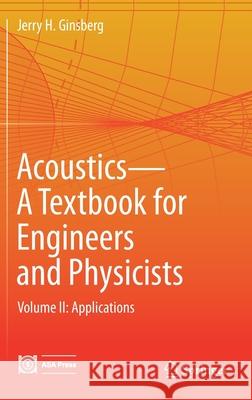
Jerry H. Ginsberg
Acoustics-A Textbook for Engineers and Physicists: Volume II: Applications Ginsberg, Jerry H. 9783319568461 Springer - książkaWidoczna okładka, to zdjęcie poglądowe, a rzeczywista szata graficzna może różnić się od prezentowanej.

Acoustics-A Textbook for Engineers and Physicists: Volume II: Applications

ISBN-13: 9783319568461 / Angielski / Twarda / 2017 / 698 str.

Jerry H. Ginsberg
cena 484,18
(netto: 461,12 VAT:  5%)

Najniższa cena z 30 dni: 462,63
Termin realizacji zamówienia:
ok. 22 dni roboczych
Bez gwarancji dostawy przed świętami

Darmowa dostawa!

This textbook provides graduate and advanced undergraduate students with a comprehensive introduction to the application of basic principles and concepts for physical and engineering acoustics. Many of the chapters are independent, and all build from introductory to more sophisticated material. Written by a well-known textbook author with 39 years of experience performing research, teaching, and mentoring in the field, it is specially designed to provide maximum support for learning. Derivations are rigorous and logical, with thorough explanations of operations that are not obvious. Many of the derivations and examples have not previously appeared in print. Important concepts are discussed for their physical implications and implementation. Many of the 56 examples are mini case studies that address systems students will find to be interesting and motivating for continued study. The example solutions address both the significance of the example and the reasoning underlying the formulation. Tasks that require computational work are fully explained. This volume contains 168 homework exercises, accompanied by a detailed solutions manual for instructors. Building on the foundation provided in Volume I: Fundamentals, this text offers a knowledge base that will enable the reader to begin undertaking research and to work in the core areas of acoustics.


Kategorie:
Nauka, Fizyka
Kategorie BISAC:
Technology & Engineering > Acoustics & Sound
Science > Acoustics & Sound
Science > Earth Sciences - Oceanography
Wydawca:
Springer
Język:
Angielski
ISBN-13:
9783319568461
Rok wydania:
2017
Wydanie:
2018
Ilość stron:
698
Waga:
1.19 kg
Wymiary:
23.39 x 15.6 x 3.96
Oprawa:
Twarda
Wolumenów:
01
Dodatkowe informacje:
Wydanie ilustrowane

"Jerry H. Ginsberg offers what will surely become a quintessential 'graduate-level' acoustical text. ... There is something for everyone in Acoustics: A Textbook for Engineers and Physicists whether they are in architectural acoustics, underwater acoustics, psychological and physiological acoustics, or electroacoustics. Ginsberg has created the "ultimate" graduate-level textbook in acoustics." (Brandon Cudequest, Journal of the Audio Engineering Society, Vol. 66 (3), March, 2018)

List of Examples

Preface

7 Radiation from Vibrating Bodies
7.1 Spherical Harmonics
7.1.1 Separation of Variables
7.1.2 Description of the Pressure Field
7.1.3 Arbitrary Spatial Dependence
7.2 Radiation from a Spherical Body
7.2.1 Analysis
7.2.2 Important Limits
7.2.3 Symmetry Plane
7.2.4 Interaction with an Elastic Spherical Shell 
7.3 Radiation from an Infinite Cylinder
7.3.1 Separation of Variables
7.3.2 Transverse Dependence-Cylindrical Bessel Functions
7.3.3 Radiation due to a Helical Surface Wave
7.3.4 Axially Periodic Surface Vibration 
7.3.5 Finite Length Effects 
7.4 Kirchhoff-Helmholtz Integral Theorem
7.4.1 Derivation for an Acoustic Cavity
7.4.2 Acoustic Radiation into an Exterior Domain
7.5 Numerical Methods for Radiation from Arbitrary Objects
7.5.1 Source Superposition
7.5.2 Boundary Element Method
7.5.3 Finite Element Method
7.6 Homework Exercises

8 Radiation from a Source in a Baffle
8.1 The Rayleigh Integral
8.2 Farfield Directivity
8.2.1 Cartesian Coordinate Description
8.2.2 Farfield of a Piston Transducer
8.3 Axial Dependence for a Circular Transducer
8.4 An Overall Picture of the Pressure Field
8.5 Radiation Impedance of a Circular Piston
8.6 Time Domain Rayleigh Integral
8.7 Homework Exercises

9 Modal Analysis of Waveguides
9.1 Propagation in a Horn
9.1.1 The Webster Horn Equation
9.1.2 Exponential Horn
9.1.3 Group Velocity
9.1.4 WKB Solution for an Arbitrary Horn
9.2 Two-Dimensional Waveguides
9.2.1 General Solution
9.2.2 Rigid Walls9.2.3 Interpretation
9.2.4 Flexible Walls
9.2.5 Orthogonality and Signal Generation
9.3 Three-Dimensional Waveguides
9.3.1 General Analytical Procedure
9.3.2 Rectangular Waveguide
9.3.3 Circular Waveguide
9.4 Homework Exercises

10 Modal Analysis of Enclosures
10.1 Fundamental Issues
10.1.1 Wall-Induced Signals
10.1.2 Source Excitation
10.2 Frequency-Domain Analysis Using Forced Cavity Modes
10.2.1 Rectangular Enclosures
10.2.2 Spherical Cavities
10.2.3 Cylindrical Enclosures
10.3 Analysis Using Natural Cavity Modes
10.3.1 Equations Governing Cavity Modes
10.3.2 Orthogonality
10.3.3 Analysis of the Pressure Field
10.3.4 Rectangular Cavity
10.3.5 Cylindrical Cavity
10.3.6 Spherical Cavity
10.4 Approximate Methods
10.4.1 The Rayleigh Ratio and Its Uses
10.4.2 Dowell’s Approximation
10.5 Homework Exercises<

11 Geometrical Acoustics
11.1 Basic Considerations: Wavefronts and Rays
11.1.1 Field Equations for an Inhomogeneous Fluid
11.1.2 Reflection and Refraction of Rays
11.2 Propagation in a Vertically Stratified Medium
11.2.1 Snell’s Law for Vertical Heterogeneity
11.2.2 Intensity and Focusing Factor
11.3 Arbitrary Heterogeneous Fluids
11.3.1 Ray Tracing Equations
11.3.2 Amplitude Dependence
11.4 Fermat’s Principle
11.5 Homework Exercises

12 Scattering
12.1 Background
12.2 Scattering by Heterogeneity
12.2.1 General Equations
12.2.2 The Born Approximation
12.3 Rayleigh Scattering Limit
12.3.1 The Rayleigh Limit of the Born Approximation
12.3.2 Mismatched Heterogeneous Region
12.3.3 Scattering from a Rigid Body
12.4 Measurements and Metrics
12.5 High Frequency Approximation
12.6 Scattering from Spheres
12.6.1 Stationary Spherical Scatterer
12.6.2 Scattering by an Elastic Spherical Shell
12.7 Homework Exercises

13 Nonlinear Acoustic Waves
13.1 Riemann’s Solution for Plane Waves
13.1.1 Analysis
13.1.2 Interpretation
13.1.3 Boundary and Initial Conditions
13.1.4 Equations of State
13.1.5 Quantitative Evaluations
13.2 Effects of Nonlinearity
13.2.1 Harmonic Generation
13.2.2 Shock Formation
13.2.3 Propagation of Weak Shocks
13.3 General Analytical Techniques
13.3.1 A Nonlinear Wave Equation
13.3.2 Frequency Domain Formulation
13.3.3 Regular Perturbation Series Expansion
13.3.4 Method of Strained Coordinates
13.4 Multidimensional Systems
13.4.1 Finite Amplitude Spherical Wave
13.4.2 Waves in Cartesian Coordinates
13.5 Further Studies
13.6 Homework Exercises

Appendix A: Curvilinear Coordinates
A.1 Spherical Coordinates
A.1.1 Gradient
A.1.2 Laplacian
A.1.3 Velocity and Acceleration
A.2 Cylindrical Coordinates
A.2.1 Transformations
A.2.2 Gradient
A.2.3 Laplacian
A.2.4 Velocity and Acceleration

Index

Jerry H. Ginsberg’s technical education began at the Bronx High School of Science, from which he graduated in 1961. This was followed by a B.S.C.E. degree in 1965 from the Cooper Union, and an E.Sc.D. degree in engineering mechanics from Columbia University in 1970, where he held Guggenheim and NASA Fellowships. From 1969 to 1973 he was an Assistant Professor in the School of Aeronautics, Astronautics, and Engineering Science at Purdue University. He then transferred to Purdue's School of Mechanical Engineering, where he was promoted to Associate Professor in 1974. In the 1975-1976 academic year, he was a Fulbright-Hayes Advanced Research Fellow at the École Nationale Supérieure d'Électricité et de Mécanique in Nancy, France. He came to Georgia Tech in 1980 as a Professor in the School of Mechanical Engineering, which awarded him the George W. Woodruff Chair in 1989. He retired in June 2008. His prior publications include five textbooks in statics, dynamics, and vibrations, most in several editions, as well as more than one hundred twenty refereed papers covering these subjects. Dr. Ginsberg became a Fellow of the Acoustical Society of America in 1987, and a Fellow of the American Society of Mechanical Engineers in 1989. The awards and recognitions he has received include Georgia Tech Professor of the Year (1994), ASEE Archie Higdon Distinguished Educator in Mechanics (1998), ASA Trent-Crede Medal (2005), ASME Per Bruel Gold Medal in Noise Control and Acoustics (2007), and the ASA Rossing Prize in Acoustics Education (2010). In addition to his technical activities, he is an exceptional photographer.

This textbook provides graduate and advanced undergraduate students with a comprehensive introduction to the application of basic principles and concepts for physical and engineering acoustics. Many of the chapters are independent, and all build from introductory to more sophisticated material. Written by a well-known textbook author with 39 years of experience performing research, teaching, and mentoring in the field, it is specially designed to provide maximum support for learning.  Derivations are rigorous and logical, with thorough explanations of operations that are not obvious. Many of the derivations and examples have not previously appeared in print. Important concepts are discussed for their physical implications and implementation. Many of the 56 examples are mini case studies that address systems students will find to be interesting and motivating for continued study. The example solutions address both the significance of the example and the reasoning underlying the formulation. Tasks that require computational work are fully explained. This volume contains 168 homework exercises, accompanied by a detailed solutions manual for instructors. Building on the foundation provided in Volume I: Fundamentals, this text offers a knowledge base that will enable the reader to begin undertaking research and to work in the core areas of acoustics.

  • Provides broad and comprehensive treatment of the application of basic principles and techniques encountered in physical and engineering acoustics
  • Contains 56 innovative examples, many of which are based on real-world research, highlighting the connection between physical phenomena and derived principles
  • Features logical and rigorous presentation of derivations and examples, without sacrificing lucidity and explanation of operations that might be unfamiliar to the student
  • Embeds coverage of numerical methods into the examples, including discussion of algorithms and associated macrocode, with Matlab code available online


Udostępnij

Facebook - konto krainaksiazek.pl


Opinie o Krainaksiazek.pl na Opineo.pl

Partner Mybenefit

Krainaksiazek.pl w programie rzetelna firma Krainaksiaze.pl - płatności przez paypal

Czytaj nas na:

Facebook - krainaksiazek.pl
  • książki na zamówienie
  • granty
  • książka na prezent
  • kontakt
  • pomoc
  • opinie
  • regulamin
  • polityka prywatności

Zobacz:

  • Księgarnia czeska

  • Wydawnictwo Książkowe Klimaty

1997-2025 DolnySlask.com Agencja Internetowa

© 1997-2022 krainaksiazek.pl
     
KONTAKT | REGULAMIN | POLITYKA PRYWATNOŚCI | USTAWIENIA PRYWATNOŚCI
Zobacz: Księgarnia Czeska | Wydawnictwo Książkowe Klimaty | Mapa strony | Lista autorów
KrainaKsiazek.PL - Księgarnia Internetowa

Polityka prywatnosci - link
Krainaksiazek.pl - płatnośc Przelewy24
Przechowalnia Przechowalnia




