• Wyszukiwanie zaawansowane
  • Kategorie
  • Kategorie BISAC
  • Książki na zamówienie
  • Promocje
  • Granty
  • Książka na prezent
  • Opinie
  • Pomoc
  • Załóż konto
  • Zaloguj się

Achieving Zero Hunger in India » książka


zaloguj się | załóż konto
Logo Krainaksiazek.pl

koszyk

konto

szukaj
topmenu
Księgarnia internetowa
Szukaj
Książki na zamówienie
Promocje
Granty
Książka na prezent
Moje konto
Pomoc
 
 
Wyszukiwanie zaawansowane
Pusty koszyk
Bezpłatna dostawa dla zamówień powyżej 20 złBezpłatna dostawa dla zamówień powyżej 20 zł

Kategorie główne

• Nauka
 [2946600]
• Literatura piękna
 [1856966]

  więcej...
• Turystyka
 [72221]
• Informatyka
 [151456]
• Komiksy
 [35826]
• Encyklopedie
 [23190]
• Dziecięca
 [619653]
• Hobby
 [140543]
• AudioBooki
 [1577]
• Literatura faktu
 [228355]
• Muzyka CD
 [410]
• Słowniki
 [2874]
• Inne
 [445822]
• Kalendarze
 [1744]
• Podręczniki
 [167141]
• Poradniki
 [482898]
• Religia
 [510455]
• Czasopisma
 [526]
• Sport
 [61590]
• Sztuka
 [243598]
• CD, DVD, Video
 [3423]
• Technologie
 [219201]
• Zdrowie
 [101638]
• Książkowe Klimaty
 [124]
• Zabawki
 [2473]
• Puzzle, gry
 [3898]
• Literatura w języku ukraińskim
 [254]
• Art. papiernicze i szkolne
 [8170]
Kategorie szczegółowe BISAC

Achieving Zero Hunger in India

ISBN-13: 9789819944156 / Angielski / Miękka / 2023
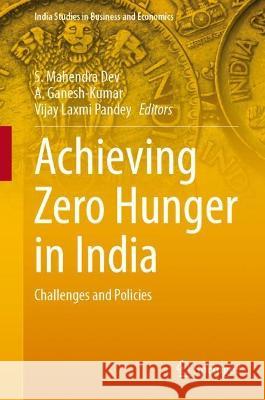
Achieving Zero Hunger in India  9789819944156 Springer Nature Singapore - książkaWidoczna okładka, to zdjęcie poglądowe, a rzeczywista szata graficzna może różnić się od prezentowanej.

Achieving Zero Hunger in India

ISBN-13: 9789819944156 / Angielski / Miękka / 2023

cena 161,36 zł
(netto: 153,68 VAT:  5%)

Najniższa cena z 30 dni: 154,18 zł
Termin realizacji zamówienia:
ok. 22 dni roboczych
Bez gwarancji dostawy przed świętami

Darmowa dostawa!
inne wydania

This open access volume discloses rich set of findings and policy recommendations for India towards achieving the SDG 2.1 target of zero hunger by 2030. Through its fourteen chapters, it takes an integrated approach by examining diverse aspects of food and nutrition security through multidisciplinary lens of Agricultural Economics, Nutrition, Crop Sciences, Anthropology and Law, while being rooted in economics. The chapters reflect this diversity in disciplines in terms of the questions posed, the data sets used, and the methodologies followed. Starting from the evolution of policy response for hunger and nutrition security, the book covers aspects such gender budgeting, dietary diversity, women’s empowerment, calorie intake norms, socio-legal aspects of right to health, subjective wellbeing, bio-fortification, crop insurance and food security linkages, interdependence of public distribution system (for food security) and employment guarantee schemes especially during COVID-19 pandemic, effects of dairy dietary supplements, and so on.  With its rich discussions, the book is compelling for students, researchers, policy makers, development professionals and practitioners working in areas of food and nutrition security, SDGs, in particular SDG1, SDG2 and SDG5, and sustainable food systems. 

Kategorie:
Nauka, Geografia
Kategorie BISAC:
Business & Economics > Industries - Agribusiness
Social Science > Socjologia
Technology & Engineering > Food Science - Food Safety & Security
Wydawca:
Springer Nature Singapore
Seria wydawnicza:
India Studies in Business and Economics
Język:
Angielski
ISBN-13:
9789819944156
Rok wydania:
2023
Waga:
0.55 kg
Wymiary:
23.5 x 15.5
Oprawa:
Miękka
Dodatkowe informacje:
Wydanie ilustrowane

1.       Introduction and Synthesis of the Book. S. Mahendra Dev, A. Ganesh-Kumar and Vijay Laxmi Pandey

2.       Evolution of India’s Policy Response to Hunger. Nutrition and Food Security Since Independence, Manoj Panda

3.       Are Gender Budgets Necessary for Reducing Inequalities in Health Outcomes? An Exploratory Analysis. Indrani Gupta, Avantika Ranjan and Kanksha Barman

4.       Food Security in Rural Bihar: Findings from a Longitudinal Survey. Swati Dutta, Sunil Mishra and Alakh N. Sharma

5.       Food Security Atlas of Rural Jharkhand. Alakh N. Sharma, Ramesh Sharan, Sunil Kumar Mishra, Tanushree Kundu, Prashant Kumar Arya, Swati Datta

6.       Milk Consumption Pattern of Young children: A Relook at the Indian Evidence. Brinda Viswanathan and Divya Purohit

7.       Revisiting Women’s Empowerment as an Agriculture-Nutrition Pathway Using the Framework of Intersectionality. Simantini Mukhopadhyay

8.       A Search for Appropriate Calorie Intake Norm for Indian States. Md Zakaria Siddiqui and Tauhidur Rahman

9.       Socio-Legal Analysis of the Impact of Food Insecurity and Hunger on Right to Health of Urban Poor Living in the State of Gujarat. S. Shanthakumar and S. Dhanya

10.   Subjective Wellbeing of Women in The Marine Fisherfolk of Kerala: Anthropological Insights on Life Experience, Attitude and Life Satisfaction. B. Bindu Ramachandran

11.   Exploring The Prevalence of Undernutrition and Consumers’ Knowledge, Preferences and Willingness to Pay for Bio-Fortified Food. Alka Singh, Venkatesh Palanisamy, Renjini Valiyaveettil Raman, Praveen Koovalamkadu Velayudhan, and Ashok Kumar Singh

12.   Does Crop Insurance Promote Nutrition and Good Health among Women and Children in the Agrarian Households of India? Reshmi Sengupta and Debasis Rooj

13.   Dietary diversity and anaemia among women: A study of four Indian states. Sunny Jose and Rabiul Ansary

14.   Gendering Tribal Food Security in Uttar Pradesh. Swati Jain

Professor S. Mahendra Dev is Distinguished Professor at ICFAI Faculty of Social Sciences, Hyderabad, Telangana, India. He was Director and Vice Chancellor, Indira Gandhi Institute of Development Research (IGIDR),  Mumbai, India from 2010  to 2022. Prior to this position, he was Chairman of the Commission for Agricultural Costs and Prices, Ministry of Agriculture from 2008 to 2010.He was Vice Chairman of the Board of Trustees of International Food Policy Research Institute (IFPRI), Washington, D.C. His main areas of interest are agriculture, rural economy, rural non-farm sector, economic growth, global economy, macro policies, employment and unemployment, social protection, development economics and social sector. He published around 150 articles in national and international articles. He has written or edited 20 books.

 Dr. A. Ganesh-Kumar is Professor at the Indira Gandhi Institute of Development Research (IGIDR), Mumbai. He is a Ph.D. from the Indian Statistical Institute, Kolkata. He specializes in computable general equilibrium (CGE) modelling with a focus on food security and grain management policies; issues in agricultural trade; pricing policies; spatial dimensions of Indian economy; and policies for sustainable human development and economic growth.

Dr. Vijay Laxmi Pandey is Professor at Indira Gandhi Institute of Development Research, Mumbai, India. She is an agricultural economist by training and has over 25 years of experience working in the field of agriculture and its relations with environment, nutrition, and rural economy. She has vast experience of conducting household level surveys. She has successfully completed many national and international research and consultancy projects and has a large number of research publications, which include research papers in peer reviewed journals, book chapters, a book and policy reports.

This open access volume discloses rich set of findings and policy recommendations for India towards achieving the SDG 2.1 target of zero hunger by 2030. Through its fourteen chapters, it takes an integrated approach by examining diverse aspects of food and nutrition security through multidisciplinary lens of Agricultural Economics, Nutrition, Crop Sciences, Anthropology and Law, while being rooted in economics. The chapters reflect this diversity in disciplines in terms of the questions posed, the data sets used, and the methodologies followed. Starting from the evolution of policy response for hunger and nutrition security, the book covers aspects such gender budgeting, dietary diversity, women’s empowerment, calorie intake norms, socio-legal aspects of right to health, subjective wellbeing, bio-fortification, crop insurance and food security linkages, interdependence of public distribution system (for food security) and employment guarantee schemes especially during COVID-19 pandemic, effects of dairy dietary supplements, and so on.  With its rich discussions, the book is compelling for students, researchers, policy makers, development professionals and practitioners working in areas of food and nutrition security, SDGs, in particular SDG1, SDG2 and SDG5, and sustainable food systems. 



Udostępnij

Facebook - konto krainaksiazek.pl


Opinie o Krainaksiazek.pl na Opineo.pl

Partner Mybenefit

Krainaksiazek.pl w programie rzetelna firma Krainaksiaze.pl - płatności przez paypal

Czytaj nas na:

Facebook - krainaksiazek.pl
  • książki na zamówienie
  • granty
  • książka na prezent
  • kontakt
  • pomoc
  • opinie
  • regulamin
  • polityka prywatności

Zobacz:

  • Księgarnia czeska

  • Wydawnictwo Książkowe Klimaty

1997-2025 DolnySlask.com Agencja Internetowa

© 1997-2022 krainaksiazek.pl
     
KONTAKT | REGULAMIN | POLITYKA PRYWATNOŚCI | USTAWIENIA PRYWATNOŚCI
Zobacz: Księgarnia Czeska | Wydawnictwo Książkowe Klimaty | Mapa strony | Lista autorów
KrainaKsiazek.PL - Księgarnia Internetowa

Polityka prywatnosci - link
Krainaksiazek.pl - płatnośc Przelewy24
Przechowalnia Przechowalnia






