• Wyszukiwanie zaawansowane
  • Kategorie
  • Kategorie BISAC
  • Książki na zamówienie
  • Promocje
  • Granty
  • Książka na prezent
  • Opinie
  • Pomoc
  • Załóż konto
  • Zaloguj się

Abstract State Machines: A Method for High-Level System Design and Analysis » książka


zaloguj się | załóż konto
Logo Krainaksiazek.pl

koszyk

konto

szukaj
topmenu
Księgarnia internetowa
Szukaj
Książki na zamówienie
Promocje
Granty
Książka na prezent
Moje konto
Pomoc
 
 
Wyszukiwanie zaawansowane
Pusty koszyk
Bezpłatna dostawa dla zamówień powyżej 20 złBezpłatna dostawa dla zamówień powyżej 20 zł

Kategorie główne

• Nauka
 [2946600]
• Literatura piękna
 [1856966]

  więcej...
• Turystyka
 [72221]
• Informatyka
 [151456]
• Komiksy
 [35826]
• Encyklopedie
 [23190]
• Dziecięca
 [619653]
• Hobby
 [140543]
• AudioBooki
 [1577]
• Literatura faktu
 [228355]
• Muzyka CD
 [410]
• Słowniki
 [2874]
• Inne
 [445822]
• Kalendarze
 [1744]
• Podręczniki
 [167141]
• Poradniki
 [482898]
• Religia
 [510455]
• Czasopisma
 [526]
• Sport
 [61590]
• Sztuka
 [243598]
• CD, DVD, Video
 [3423]
• Technologie
 [219201]
• Zdrowie
 [101638]
• Książkowe Klimaty
 [124]
• Zabawki
 [2473]
• Puzzle, gry
 [3898]
• Literatura w języku ukraińskim
 [254]
• Art. papiernicze i szkolne
 [8170]
Kategorie szczegółowe BISAC

Abstract State Machines: A Method for High-Level System Design and Analysis

ISBN-13: 9783540007029 / Angielski / Twarda / 2003 / 438 str.
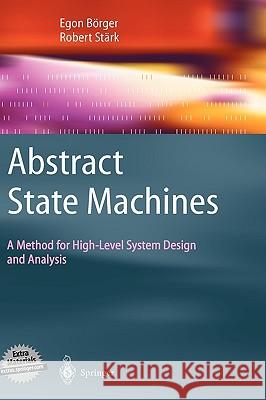
E. Borger;Boerger; Egon Bvrger
Abstract State Machines: A Method for High-Level System Design and Analysis Börger, Egon 9783540007029 Springer - książkaWidoczna okładka, to zdjęcie poglądowe, a rzeczywista szata graficzna może różnić się od prezentowanej.

Abstract State Machines: A Method for High-Level System Design and Analysis

ISBN-13: 9783540007029 / Angielski / Twarda / 2003 / 438 str.

E. Borger;Boerger; Egon Bvrger
cena 201,72 zł
(netto: 192,11 VAT:  5%)

Najniższa cena z 30 dni: 192,74 zł
Termin realizacji zamówienia:
ok. 22 dni roboczych
Bez gwarancji dostawy przed świętami

Darmowa dostawa!

Quelli che s'innamoran di pratica senza scienzia sono come 'l nocchieri ch'entra in navilio sanza timone o bussola, 1 che mai ha certezza dove si vada. - Leonardo da Vinci Ich habe oft bemerkt, dass wir uns durch allzuvieles Symbolisieren 2 die Sprache fu ]r die Wirklichkeit untu ]chtig machen. - Christian Morgenstern This is the place to express our thanks. First of all we thank all those who over the years have actively contributed to shaping the novel software design and analysis method explained in this book. They are too numerous to be mentioned here. They all appear in some way or the other on the following pages, in particular in the bibliographical and historical Chap. 9 which can be read independently of the book. We then thank those who have helped with detailed critical comments on the draft chapters to shape the way our arguments are presented in this book: M. B] orger (Diron Mu ]nster), I. Craggs (IBMHursley), G. DelCastillo(SiemensMunc ] hen), U. Gl] asser(SimonFraser University, Vancouver, Canada), J. Huggins(Kettering University, Michigan, USA), B. Koblinger (IBM Heidelberg), P. Pa ]ppinghaus (Siemens Munc ] hen), A. Preller (Universit e de Montpellier, France), M. -L. Potet (INP de Gre- ble, France), W. Reisig (Humboldt-Universit] at zu Berlin, Germany), H. Rust (Universit] at Cottbus, Germany), G. Schellhorn (Universit] at Augsburg, G- many), B. Thalheim (Universit] at Cottbus, Germany) and a dozen student generationsat Universita di Pisa. We thankM. Barmet(ETH Zur ] ich)for her solutions of the exercises in Chap. 8. We also thank L.


Kategorie:
Informatyka, Bazy danych
Kategorie BISAC:
Computers > Information Theory
Computers > Computer Science
Computers > Software Development & Engineering - General
Wydawca:
Springer
Język:
Angielski
ISBN-13:
9783540007029
Rok wydania:
2003
Wydanie:
2003
Ilość stron:
438
Waga:
0.79 kg
Wymiary:
24.49 x 15.6 x 2.97
Oprawa:
Twarda
Wolumenów:
01
Dodatkowe informacje:
Wydanie ilustrowane

From the reviews:

"The Turing Test gives a comprehensive, in-depth and contemporary assessment of this classic topic in artificial intelligence. This book elaborates in detail the numerous conflicting points of view on many aspects of this multifaceted, controversial subject. ... This volume is a valuable reading for research on the Turing test and for teaching undergraduate and graduate students in philosophy, computer science, and cognitive science." (Jörg Desel, Zentralblatt MATH, Vol. 1040 (9), 2004)

"Borger and Stark do an admirable job of documention and extending a method for bridging the considerable gap between theoretical system models, which often only allow for toy systems to be modeled and require proofs to be done only by hand, and real-life systems and practices." (Shrisha, Rao, Ceda Rapids, IA, Computing Reviews, February, 2004)

1 Introduction.- 1.1 Goals of the Book and Contours of its Method.- 1.1.1 Stepwise Refinable Abstract Operational Modeling.- 1.1.2 Abstract Virtual Machine Notation.- 1.1.3 Practical Benefits.- 1.1.4 Harness Pseudo-Code by Abstraction and Refinement.- 1.1.5 Adding Abstraction and Rigor to UML Models.- 1.2 Synopsis of the Book.- 2 ASM Design and Analysis Method.- 2.1 Principles of Hierarchical System Design.- 2.1.1 Ground Model Construction (Requirements Capture).- 2.1.2 Stepwise Refinement (Incremental Design).- 2.1.3 Integration into Software Practice.- 2.2 Working Definition.- 2.2.1 Basic ASMs.- 2.2.2 Definition.- 2.2.3 Classification of Locations and Updates.- 2.2.4 ASM Modules.- 2.2.5 Illustration by Small Examples.- 2.2.6 Control State ASMs.- 2.2.7 Exercises.- 2.3 Explanation by Example: Correct Lift Control.- 2.3.1 Exercises.- 2.4 Detailed Definition (Math. Foundation).- 2.4.1 Abstract States and Update Sets.- 2.4.2 Mathematical Logic.- 2.4.3 Transition Rules and Runs of ASMs.- 2.4.4 The Reserve of ASMs.- 2.4.5 Exercises.- 2.5 Notational Conventions.- 3 Basic ASMs.- 3.1 Requirements Capture by Ground Models.- 3.1.1 Fundamental Questions to be Asked.- 3.1.2 Illustration by Small Use Case Models.- 3.1.3 Exercises.- 3.2 Incremental Design by Refinements.- 3.2.1 Refinement Scheme and its Specializations.- 3.2.2 Two Refinement Verification Case Studies.- 3.2.3 Decomposing Refinement Verifications.- 3.2.4 Exercises.- 3.3 Microprocessor Design Case Study.- 3.3.1 Ground Model DLXseq.- 3.3.2 Parallel Model DLXpar Resolving Structural Hazards.- 3.3.3 Verifying Resolution of Structural Hazards (DLXpar).- 3.3.4 Resolving Data Hazards (Refinement DLXdata).- 3.3.5 Exercises.- 4 Structured ASMs (Composition Techniques).- 4.1 Turbo ASMs (seq, iterate, submachines, recursion).- 4.1.1 Seq and Iterate (Structured Programming).- 4.1.2 Submachines and Recursion (Encapsulation and Hiding).- 4.1.3 Analysis of Turbo ASM Steps.- 4.1.4 Exercises.- 4.2 Abstract State Processes (Interleaving).- 5 Synchronous Multi-Agent ASMs.- 5.1 Robot Controller Case Study.- 5.1.1 Production Cell Ground Model.- 5.1.2 Refinement of the Production Cell Component ASMs.- 5.1.3 Exercises.- 5.2 Real-Time Controller (Railroad Crossing Case Study).- 5.2.1 Real-TimeProcess Control Systems.- 5.2.2 Railroad Crossing Case Study.- 5.2.3 Exercises.- 6 Asynchronous Multi-Agent ASMs.- 6.1 Async ASMs: Definition and Network Examples.- 6.1.1 Mutual Exclusion.- 6.1.2 Master-Slave Agreement.- 6.1.3 Network Consensus.- 6.1.4 Load Balance.- 6.1.5 Leader Election and Shortest Path.- 6.1.6 Broadcast Acknowledgment (Echo).- 6.1.7 Phase Synchronization.- 6.1.8 Routing Layer Protocol for Mobile Ad Hoc Networks.- 6.1.9 Exercises.- 6.2 Embedded System Case Study.- 6.2.1 Light Control Ground Model.- 6.2.2 Signature (Agents and Their State).- 6.2.3 User Interaction (Manual Control).- 6.2.4 Automatic Control.- 6.2.5 Failure and Service.- 6.2.6 Component Structure.- 6.2.7 Exercises.- 6.3 Time-Constrained Async ASMs.- 6.3.1 Kermit Case Study (Alternating Bit/Sliding Window).- 6.3.2 Processor-Group-Membership Protocol Case Study.- 6.3.3 Exercises.- 6.4 Async ASMs with Durative Actions.- 6.4.1 Protocol Verification using Atomic Actions.- 6.4.2 Refining Atomic to Durative Actions.- 6.4.3 Exercises.- 6.5 Event-Driven ASMs.- 6.5.1 UML Diagrams for Dynamics.- 6.5.2 Exercises.- 7 Universal Design and Computation Model.- 7.1 Integrating Computation and Specification Models.- 7.1.1 Classical Computation Models.- 7.1.2 System Design Models.- 7.1.3 Exercises.- 7.2 Sequential ASM Thesis (A Proof from Postulates).- 7.2.1 Gurevich’s Postulates for Sequential Algorithms.- 7.2.2 Bounded-Choice Non-Determinism.- 7.2.3 Critical Terms for ASMs.- 7.2.4 Exercises.- 8 Tool Support for ASMs.- 8.1 Verification of ASMs.- 8.1.1 Logic for ASMs.- 8.1.2 Formalizing the Consistency of ASMs.- 8.1.3 Basic Axioms and Proof Rules of the Logic.- 8.1.4 Why Deterministic Transition Rules?.- 8.1.5 Completeness for Hierarchical ASMs.- 8.1.6 The Henkin Model Construction.- 8.1.7 An Extension with Explicit Step Information.- 8.1.8 Exercises.- 8.2 Model Checking of ASMs.- 8.3 Execution of ASMs.- 9 History and Survey of ASM Research.- 9.1 The Idea of Sharpening Turing’s Thesis.- 9.2 Recognizing the Practical Relevance of ASMs.- 9.3 Testing the Practicability of ASMs.- 9.3.1 Architecture Design and Virtual Machines.- 9.3.2 Protocols.- 9.3.3 Why use ASMs for Hw/Sw Engineering?.- 9.4 Making ASMs Fit for their Industrial Deployment.- 9.4.1 Practical Case Studies.- 9.4.2 Industrial Pilot Projects and Further Applications.- 9.4.3 Tool Integration.- 9.5 Conclusion and Outlook.- References.- List of Problems.- List of Figures.- List of Tables.


The systems engineering method proposed in this book, which is based on Abstract State Machines (ASMs), guides the development of software and embedded hardware-software systems seamlessly from requirements capture to actual implementation and documentation. The method bridges the gap between the human understanding and formulation of real-world problems and the deployment of their algorithmic solutions by code-executing machines. Within a single conceptual framework it covers design, verification by reasoning techniques, and validation by simulation and testing. ASMs improve current industrial practice by using accurate high-level modeling and by linking the descriptions at the successive stages of system development in an organic and efficiently maintainable chain of rigorous and coherent system models at stepwise-refined abstraction levels. In several industrial projects the ASM method has proven its superiority compared to the popular UML methodology when designing complex parallel or dynamic systems.
This book combines the features of a textbook and a handbook: the reader will find detailed explanations, proofs, and exercises as well as numerous examples and real-world case studies. Researchers will find here the most comprehensive description of ASMs available today and professionals will use it as a "modeling handbook for the working software engineer." As a textbook it supports self-study or it can form the basis of a lecture course. Even more information can be found on the related website maintained by the authors: http://www.di.unipi.it/AsmBook/


Udostępnij

Facebook - konto krainaksiazek.pl


Opinie o Krainaksiazek.pl na Opineo.pl

Partner Mybenefit

Krainaksiazek.pl w programie rzetelna firma Krainaksiaze.pl - płatności przez paypal

Czytaj nas na:

Facebook - krainaksiazek.pl
  • książki na zamówienie
  • granty
  • książka na prezent
  • kontakt
  • pomoc
  • opinie
  • regulamin
  • polityka prywatności

Zobacz:

  • Księgarnia czeska

  • Wydawnictwo Książkowe Klimaty

1997-2025 DolnySlask.com Agencja Internetowa

© 1997-2022 krainaksiazek.pl
     
KONTAKT | REGULAMIN | POLITYKA PRYWATNOŚCI | USTAWIENIA PRYWATNOŚCI
Zobacz: Księgarnia Czeska | Wydawnictwo Książkowe Klimaty | Mapa strony | Lista autorów
KrainaKsiazek.PL - Księgarnia Internetowa

Polityka prywatnosci - link
Krainaksiazek.pl - płatnośc Przelewy24
Przechowalnia Przechowalnia





