• Wyszukiwanie zaawansowane
  • Kategorie
  • Kategorie BISAC
  • Książki na zamówienie
  • Promocje
  • Granty
  • Książka na prezent
  • Opinie
  • Pomoc
  • Załóż konto
  • Zaloguj się

AI Ethics in Higher Education: Insights from Africa and Beyond » książka


zaloguj się | załóż konto
Logo Krainaksiazek.pl

koszyk

konto

szukaj
topmenu
Księgarnia internetowa
Szukaj
Książki na zamówienie
Promocje
Granty
Książka na prezent
Moje konto
Pomoc
 
 
Wyszukiwanie zaawansowane
Pusty koszyk
Bezpłatna dostawa dla zamówień powyżej 20 złBezpłatna dostawa dla zamówień powyżej 20 zł

Kategorie główne

• Nauka
 [2949524]
• Literatura piękna
 [1817948]

  więcej...
• Turystyka
 [70715]
• Informatyka
 [151291]
• Komiksy
 [35671]
• Encyklopedie
 [23176]
• Dziecięca
 [612440]
• Hobby
 [136066]
• AudioBooki
 [1740]
• Literatura faktu
 [226030]
• Muzyka CD
 [378]
• Słowniki
 [2918]
• Inne
 [445441]
• Kalendarze
 [1181]
• Podręczniki
 [166545]
• Poradniki
 [469898]
• Religia
 [508035]
• Czasopisma
 [502]
• Sport
 [61392]
• Sztuka
 [242759]
• CD, DVD, Video
 [3348]
• Technologie
 [219537]
• Zdrowie
 [98738]
• Książkowe Klimaty
 [124]
• Zabawki
 [2382]
• Puzzle, gry
 [3543]
• Literatura w języku ukraińskim
 [259]
• Art. papiernicze i szkolne
 [7107]
Kategorie szczegółowe BISAC

AI Ethics in Higher Education: Insights from Africa and Beyond

ISBN-13: 9783031230349 / Angielski / Miękka / 2023 / 103 str.
Simon Atuah Asakipaam; Caitlin C. Corrigan; Jerry John Kponyo
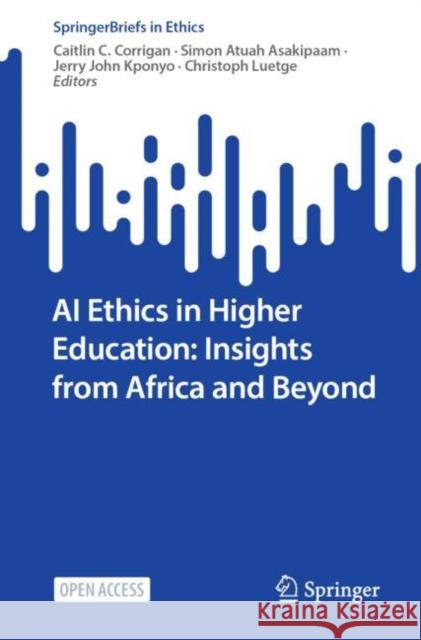
AI Ethics in Higher Education: Insights from Africa and Beyond Simon Atuah Asakipaam Caitlin C. Corrigan Jerry John Kponyo 9783031230349 Springer - książkaWidoczna okładka, to zdjęcie poglądowe, a rzeczywista szata graficzna może różnić się od prezentowanej.

AI Ethics in Higher Education: Insights from Africa and Beyond

ISBN-13: 9783031230349 / Angielski / Miękka / 2023 / 103 str.

Simon Atuah Asakipaam; Caitlin C. Corrigan; Jerry John Kponyo
cena 120,73
(netto: 114,98 VAT:  5%)

Najniższa cena z 30 dni: 115,63
Termin realizacji zamówienia:
ok. 16-18 dni roboczych.

Darmowa dostawa!

This open access book tackles the pressing problem of integrating concerns related to Artificial Intelligence (AI) ethics into higher education curriculums aimed at future AI developers in Africa and beyond. For doing so, it analyzes the present and future states of AI ethics education in local computer science and engineering programs. The authors share relevant best practices and use cases for teaching, develop answers to ongoing organizational challenges, and reflect on the practical implications of different theoretical approaches to AI ethics. The book is of great interest to faculty members, researchers, and students in the fields of artificial intelligence, computer science, mathematics, computer engineering, and related areas, as well as higher education administration.


This open access book tackles the pressing problem of integrating concerns related to Artificial Intelligence (AI) ethics into higher education curriculums aimed at future AI developers in Africa and beyond. For doing so, it analyzes the present and future states of AI ethics education in local computer science and engineering programs. The authors share relevant best practices and use cases for teaching, develop answers to ongoing organizational challenges, and reflect on the practical implications of different theoretical approaches to AI ethics. The book is of great interest to faculty members, researchers, and students in the fields of artificial intelligence, computer science, mathematics, computer engineering, and related areas, as well as higher education administration.

Kategorie:
Nauka, Filozofia
Kategorie BISAC:
Philosophy > Ethics & Moral Philosophy
Computers > Computer Science
Wydawca:
Springer
Seria wydawnicza:
Springerbriefs in Ethics
Język:
Angielski
ISBN-13:
9783031230349
Rok wydania:
2023
Dostępne języki:
Numer serii:
000440812
Ilość stron:
103
Oprawa:
Miękka
Dodatkowe informacje:
Wydanie ilustrowane

Caitlin Corrigan: As Executive Director for the IEAI, Dr. Corrigan is responsible for the development and coordination of all IEAI research and administrative activities. Additionally, she works closely with the IEAI Director to craft the IEAI’s agenda, develop strategic partnerships for the institute, and to enhance our academic network. She holds a Ph.D. in Public and International Affairs from the University of Pittsburgh. Her research interests include good governance, sustainable development, and corporate social responsibility, particularly in developing country settings. She has over ten years of experience in designing and implementing research and data collection, developing and managing research projects, and coordinating funding proposals. She has also conducted field-based research in Southern Africa with a focus on CSR, natural resource management, and community development. She has published several articles in academic journals and has worked as a consultant for local and international NGOs though the Research Group for Sustainable Impacts (RG-SI), producing data collection and evaluation systems for organizations, conducting statistical data analysis, and generating policy relevant research and reports.


Jerry John Kponyo: Prof. Jerry John Kponyo is Dean of the Quality Assurance and Planning Office of the Kwame Nkrumah University of Science and Technology (KNUST) under Vice-Chancellor’s Office. He is Former Dean of the Faculty of Electrical and Computer Engineering, KNUST. Prior to becoming Dean of the Faculty of Electrical and Computer Engineering, he was Head of Electrical Engineering Department. He is currently Principal Investigator and Scientific Director of the Responsible AI Lab, a 1 Million Canadian Dollars project sponsored by IDRC and GIZ. He is also Deputy Project Lead of the KNUST Engineering Education Project (KEEP), a 5.5 Million Dollar Africa Center of Excellence (ACE) Impact project sponsored by the World Bank with a focus on Digital Development and Energy. He is Co-Founder of the Responsible AI Network (RAIN) Africa, which is a collaborative effort between KNUST and TUM Germany. Between 2016 and 2019, he was Visiting Professor at ESIGELEC, France, on a staff mobility program where he taught postgraduate courses in Business Intelligence and conducted research with staff of ESIGELEC. He has done extensive research in IoT, intelligent systems, and AI and currently leads the Emerging Networks and Technologies Research Laboratory at the Faculty of Electrical and Computer Engineering, KNUST, which focuses on digital development technologies research. His Ph.D. research focused on applying AI to solving a traffic problem in Vehicular Ad Hoc Networks (VANETs). He has published over 50 articles in refereed journals and conference proceedings. He is Member of the Ghana Institution of Engineers. He is currently Coordinator of the West Africa Sustainable Engineering Network for Development (WASEND).


Christoph Lütge: Prof. Lütge (b. 1969) conducts research in the field of business and corporate ethics. He explores regulatory ethics—ethical behavior in the socio-economic framework of the globalized world. The role of competition and the incentives created by frameworks are also examined, as is the adequacy of ethical categories. After studying business informatics and philosophy (doctorate 1999), he became Research Associate at Chair of Philosophy and Economics at Munich’s Ludwig Maximilian University. He also completed his lecturer qualification (2005) at the same institution. He has worked as a researcher in Pittsburgh, San Diego, and Venice. From 2007 to 2010, he served as Acting Professor at the Universities of Witten/Herdecke and Braunschweig. Since 2010, he has held the position of Peter Löscher Professor of Business Ethics at TUM.

This open access book tackles the pressing problem of integrating concerns related to Artificial Intelligence (AI) ethics into higher education curriculums aimed at future AI developers in Africa and beyond. For doing so, it analyzes the present and future states of AI ethics education in local computer science and engineering programs. The authors share relevant best practices and use cases for teaching, develop answers to ongoing organizational challenges, and reflect on the practical implications of different theoretical approaches to AI ethics. The book is of great interest to faculty members, researchers, and students in the fields of artificial intelligence, computer science, mathematics, computer engineering, and related areas, as well as higher education administration.




Udostępnij

Facebook - konto krainaksiazek.pl


Opinie o Krainaksiazek.pl na Opineo.pl

Partner Mybenefit

Krainaksiazek.pl w programie rzetelna firma Krainaksiaze.pl - płatności przez paypal

Czytaj nas na:

Facebook - krainaksiazek.pl
  • książki na zamówienie
  • granty
  • książka na prezent
  • kontakt
  • pomoc
  • opinie
  • regulamin
  • polityka prywatności

Zobacz:

  • Księgarnia czeska

  • Wydawnictwo Książkowe Klimaty

1997-2026 DolnySlask.com Agencja Internetowa

© 1997-2022 krainaksiazek.pl
     
KONTAKT | REGULAMIN | POLITYKA PRYWATNOŚCI | USTAWIENIA PRYWATNOŚCI
Zobacz: Księgarnia Czeska | Wydawnictwo Książkowe Klimaty | Mapa strony | Lista autorów
KrainaKsiazek.PL - Księgarnia Internetowa

Polityka prywatnosci - link
Krainaksiazek.pl - płatnośc Przelewy24
Przechowalnia Przechowalnia




