• Wyszukiwanie zaawansowane
  • Kategorie
  • Kategorie BISAC
  • Książki na zamówienie
  • Promocje
  • Granty
  • Książka na prezent
  • Opinie
  • Pomoc
  • Załóż konto
  • Zaloguj się

A Taste of Jordan Algebras » książka


zaloguj się | załóż konto
Logo Krainaksiazek.pl

koszyk

konto

szukaj
topmenu
Księgarnia internetowa
Szukaj
Książki na zamówienie
Promocje
Granty
Książka na prezent
Moje konto
Pomoc
 
 
Wyszukiwanie zaawansowane
Pusty koszyk
Bezpłatna dostawa dla zamówień powyżej 20 złBezpłatna dostawa dla zamówień powyżej 20 zł

Kategorie główne

• Nauka
 [2952079]
• Literatura piękna
 [1850969]

  więcej...
• Turystyka
 [71058]
• Informatyka
 [151066]
• Komiksy
 [35579]
• Encyklopedie
 [23181]
• Dziecięca
 [620496]
• Hobby
 [139036]
• AudioBooki
 [1646]
• Literatura faktu
 [228729]
• Muzyka CD
 [379]
• Słowniki
 [2932]
• Inne
 [445708]
• Kalendarze
 [1409]
• Podręczniki
 [164793]
• Poradniki
 [480107]
• Religia
 [510956]
• Czasopisma
 [511]
• Sport
 [61267]
• Sztuka
 [243299]
• CD, DVD, Video
 [3411]
• Technologie
 [219640]
• Zdrowie
 [100984]
• Książkowe Klimaty
 [124]
• Zabawki
 [2281]
• Puzzle, gry
 [3363]
• Literatura w języku ukraińskim
 [258]
• Art. papiernicze i szkolne
 [8020]
Kategorie szczegółowe BISAC

A Taste of Jordan Algebras

ISBN-13: 9780387954479 / Angielski / Twarda / 2003 / 563 str.
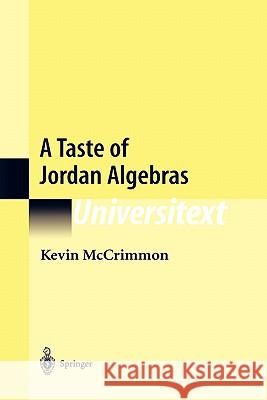
Kevin McCrimmon
A Taste of Jordan Algebras Kevin McCrimmon 9780387954479 Springer - książkaWidoczna okładka, to zdjęcie poglądowe, a rzeczywista szata graficzna może różnić się od prezentowanej.

A Taste of Jordan Algebras

ISBN-13: 9780387954479 / Angielski / Twarda / 2003 / 563 str.

Kevin McCrimmon
cena 201,72
(netto: 192,11 VAT:  5%)

Najniższa cena z 30 dni: 192,74
Termin realizacji zamówienia:
ok. 22 dni roboczych
Dostawa w 2026 r.

Darmowa dostawa!

On several occasions I and colleagues have found ourselves teaching a o- semester course for students at the second year of graduate study in ma- ematics who want to gain a general perspective on Jordan algebras, their structure, and their role in mathematics, or want to gain direct experience with nonassociative algebra. These students typically have a solid grounding in ?rst-year graduate algebra and the Artin-Wedderburn theory of assoc- tive algebras, and a few have been introduced to Lie algebras (perhaps even Cayley algebras, in an o?hand way), but otherwise they have not seen any nonassociative algebras. Most of them will not go on to do research in non- sociative algebra, so the course is not primarily meant to be a training or breeding ground for research, though the instructor often hopes that one or two will be motivated to pursue the subject further. This text is meant to serve as an accompaniment to such a course. It is designed ?rst and foremost to be read by students on their own without assistance by a teacher. It is a direct mathematical conversation between the author and a reader whose mind (as far as nonassociative algebra goes) is a tabula rasa. In keeping with the tone of a private conversation, I give more heuristicandexplanatorycommentthanisusualingraduatetextsatthislevel (pep talks, philosophical pronouncements on the proper way to think about certain concepts, historical anecdotes, mention of some mathematicians who have contributed to our understanding of Jordan algebras, etc.


Kategorie:
Nauka, Matematyka
Kategorie BISAC:
Mathematics > Algebra - General
Wydawca:
Springer
Język:
Angielski
ISBN-13:
9780387954479
Rok wydania:
2003
Wydanie:
2004
Numer serii:
000024642
Ilość stron:
563
Waga:
0.94 kg
Wymiary:
23.5 x 15.5
Oprawa:
Twarda
Wolumenów:
01
Dodatkowe informacje:
Bibliografia

From the reviews:

"This is an excellent book, masterly written and very well organized, a real compendium of Jordan algebras offering all the relevant notions and results of the theory - and not only a 'taste'. ... is written as a direct mathematical conversation between the author and a reader, who has no knowledge of Jordan algebras. Thus more heuristic and explanatory comment is provided than is usual in graduate texts. ... An exceptional book!" (H. Mitsch, Monatshefte für Mathematik, Vol. 144 (3), 2005)

"As mentioned in the preface, 'this book tells the story of one aspect of Jordan structure theory ... . The author proceeds to tell this fascinating story with a lovely and lively style ... . concentrates explicitly on the structure theory of linear Jordan algebra ... . It can be used in many different ways to teach graduate courses and also for self-study ... . graduate students will have at their disposal a very well organized, motivating and engaging textbook." (Alberto Elduque, Zentralblatt MATH, Vol. 1044 (19), 2004)

"The book ... is intended, according to the author, to serve as an accompaniment to a graduate course in Jordan algebras. In fact the exposition goes far beyond this goal, resulting in a book much richer than the typical textbook. ... The book is well written, and I enjoyed reading it. ... The style is lively ... . In my opinion this book will be indispensable for all mathematicians ... . a great book and I believe it will serve the mathematical community well." (Plamen Koshlukov, Mathematical Reviews, 2004i)

"Read 'A Taste of Jordan Algebras' by K. McCrimmon, where, for the first time, a full account of both the mathematical development of Jordan algebra theory and its historical aspects is given. ... Thanks to the very clever organization of the book ... it is suited both to the very beginner and to the specialist ... . Unlike all other monographs on Jordan algebras ... McCrimmon's book will be the fundamental textbook in this domain for many years to come." (Wolfgang Bertram, SIAM Reviews, Vol. 47 (1), 2005)

"McCrimmon is a pioneer in the subject of Jordan algebras ... . 'The reader should see isomorphisms as cloning maps, isotopes as subtle rearrangements of an algebra's DNA ... . The book is written in this marvellous style ... very thorough, and very strong on (the right kind of) pedagogy. The reader will learn a lot of wonderful algebra well, if he takes care to follow McCrimmon's plan: read carefully, do the problems, meditate on what's going on, follow and absorb the analogies ... ." (Michael Berg, MAA online, November, 2004)

0 A Colloquial Survey of Jordan Theory 0.1 Origin of the Species 0.2 The Jordan River 0.3 Links with Lie Algebras and Groups 0.4 Links with Differential Geometry 0.5 Links with the Real World 0.6 Links with the Complex World 0.7 Links with the Infinitely Complex World 0.8 Links with Projective Geometry I A Historical Survey of Jordan Structure Theory 1 Jordan Algebras in Physical Antiquity 1.1 The Matrix Interpretation of Quantum Mechanics 1.2 The Jordan Program 1.3 The Jordan Operations 1.4 Digression on Linearization 1.5 Back to the Bullet 1.6 The Jordan Axioms 1.7 The First Example: Full Algebras 1.8 The Second Example: Hermitian Algebras 1.9 The Third Example: Spin Factors 1.1 Special and Exceptional 1.11 Classification 2 Jordan Algebras in the Algebraic Renaissance 2.1 Linear Algebras over General Scalars 2.2 Categorical Nonsense 2.3 Commutators and Associators 2.4 Lie and Jordan Algebras 2.5 The 3 Basic Examples Revisited 2.6 Jordan Matrix Algebras with Associative Coordinates 2.7 Jordan Matrix Algebras with Alternative Coordinates 2.8 The $n$-Squares Problem 2.9 Forms Permitting Composition 2.1 Composition Algebras 2.11 The Cayley--Dickson Construction and Process 2.12 Split Composition Algebras 2.13 Classification 3 Jordan Algebras in the Enlightenment 3.1 Forms of Algebras 3.2 Inverses and Isotopes 3.3 Nuclear Isotopes 3.4 Twisted involutions 3.5 Twisted Hermitian Matrices 3.6 Spin Factors 3.7 Quadratic factors 3.8 Cubic Factors 3.9 Reduced Cubic Factors 3.1 Classification 4 The Classical Theory 4.1 $U$-Operators 4.2 The Quadratic Program 4.3 The Quadratic Axioms 4.4 Justification 4.5 Inverses 4.6 Isotopes 4.7 Inner Ideals 4.8 Nondegeneracy 4.9 Radical remarks 4.1 i-Special and i-Exceptional 4.11 Artin--Wedderburn--Jacobson Structure Theorem 5 The Final Classical Formulation 5.1 Capacity 5.2 Classification 6 The Classical Methods 6.1 Peirce Decompositions 6.2 Coordinatization 6.3 The Coordinates 6.4 Minimum Inner Ideals 6.5 Capacity 6.6 Capacity Classification 7 The Russian Revolution: 1977--1983 7.1 The Lull Before the Storm 7.2 The First Tremors 7.3 The Main Quake 7.4 Aftershocks 8 Zel'manov's Exceptional Methods 8.1 I-Finiteness 8.2 Absorbers 8.3 Modular Inner Ideals 8.4 Primitivity 8.5 The Heart 8.6 Spectra 8.7 Comparing Spectra 8.8 Big Resolvents 8.9 Semiprimitive Imbedding 8.1 Ultraproducts 8.11 Prime Dichotomy II The Classical Theory 1 The Category of Jordan Algebras 1.1 Categories 1.2 The Category of Linear Algebras 1.3 The Category of Unital Algebras 1.4 Unitalization 1.5 The Category of Algebras with Involution 1.6 Nucleus, Center, and Centroid 1.7 Strict Simplicity 1.8 The Category of Jordan Algebras 1.9 Problems for Chapter 1 2 The Category of Alternative Algebras 2.1 The Category of Alternative Algebras 2.2 Nuclear Involutions 2.3 Composition Algebras 2.4 Split Composition Algebras 2.5 The Cayley--Dickson Construction 2.6 The Hurwitz Theorem 2.7 Problems for Chapter 2 3 Three Special Examples 3.1 Full Type 3.2 Hermitian Type 3.3 Quadratic Form Type 3.4 Reduced Spin Factors 3.5 Problems for Chapter 3 4 Jordan Algebras of Cubic Forms 4.1 Cubic Maps 4.2 The General Construction 4.3 The Jordan Cubic Construction 4.4 The Freudenthal Construction 4.5 The Tits Constructions 4.6 Problems for Chapter 4 5 Two Basic Principles 5.1 The Macdonald and Shirshov--Cohn Principles 5.2 Funda

 Kevin McCrimmon introduced the concept of a quadratic Jordan algebra and developed a structure theory of Jordan algebras over an arbitrary ring of scalars. He is a Professor of Mathematics at the University of Virginia and the author of more than 100 research papers.

 In this book, Kevin McCrimmon describes the history of Jordan Algebras and he describes in full mathematical detail the recent structure theory for Jordan algebras of arbitrary dimension due to Efim Zel'manov. To keep the exposition elementary, the structure theory is developed for linear Jordan algebras, though the modern quadratic methods are used throughout. Both the quadratic methods and the Zelmanov results go beyond the previous textbooks on Jordan theory, written in the 1960's and 1980's before the theory reached its final form.

This book is intended for graduate students and for individuals wishing to learn more about Jordan algebras. No previous knowledge is required beyond the standard first-year graduate algebra course. General students of algebra can profit from exposure to nonassociative algebras, and students or professional mathematicians working in areas such as Lie algebras, differential geometry, functional analysis, or exceptional groups and geometry can also profit from acquaintance with the material. Jordan algebras crop up in many surprising settings and can be applied to a variety of mathematical areas.

Kevin McCrimmon introduced the concept of a quadratic Jordan algebra and developed a structure theory of Jordan algebras over an arbitrary ring of scalars. He is a Professor of Mathematics at the University of Virginia and the author of more than 100 research papers.

McCrimmon, Kevin Kevin McCrimmon introduced the concept of a quadra... więcej >


Udostępnij

Facebook - konto krainaksiazek.pl


Opinie o Krainaksiazek.pl na Opineo.pl

Partner Mybenefit

Krainaksiazek.pl w programie rzetelna firma Krainaksiaze.pl - płatności przez paypal

Czytaj nas na:

Facebook - krainaksiazek.pl
  • książki na zamówienie
  • granty
  • książka na prezent
  • kontakt
  • pomoc
  • opinie
  • regulamin
  • polityka prywatności

Zobacz:

  • Księgarnia czeska

  • Wydawnictwo Książkowe Klimaty

1997-2025 DolnySlask.com Agencja Internetowa

© 1997-2022 krainaksiazek.pl
     
KONTAKT | REGULAMIN | POLITYKA PRYWATNOŚCI | USTAWIENIA PRYWATNOŚCI
Zobacz: Księgarnia Czeska | Wydawnictwo Książkowe Klimaty | Mapa strony | Lista autorów
KrainaKsiazek.PL - Księgarnia Internetowa

Polityka prywatnosci - link
Krainaksiazek.pl - płatnośc Przelewy24
Przechowalnia Przechowalnia





