• Wyszukiwanie zaawansowane
  • Kategorie
  • Kategorie BISAC
  • Książki na zamówienie
  • Promocje
  • Granty
  • Książka na prezent
  • Opinie
  • Pomoc
  • Załóż konto
  • Zaloguj się

A Systolic Array Optimizing Compiler » książka


zaloguj się | załóż konto
Logo Krainaksiazek.pl

koszyk

konto

szukaj
topmenu
Księgarnia internetowa
Szukaj
Książki na zamówienie
Promocje
Granty
Książka na prezent
Moje konto
Pomoc
 
 
Wyszukiwanie zaawansowane
Pusty koszyk
Bezpłatna dostawa dla zamówień powyżej 20 złBezpłatna dostawa dla zamówień powyżej 20 zł

Kategorie główne

• Nauka
 [2946600]
• Literatura piękna
 [1856966]

  więcej...
• Turystyka
 [72221]
• Informatyka
 [151456]
• Komiksy
 [35826]
• Encyklopedie
 [23190]
• Dziecięca
 [619653]
• Hobby
 [140543]
• AudioBooki
 [1577]
• Literatura faktu
 [228355]
• Muzyka CD
 [410]
• Słowniki
 [2874]
• Inne
 [445822]
• Kalendarze
 [1744]
• Podręczniki
 [167141]
• Poradniki
 [482898]
• Religia
 [510455]
• Czasopisma
 [526]
• Sport
 [61590]
• Sztuka
 [243598]
• CD, DVD, Video
 [3423]
• Technologie
 [219201]
• Zdrowie
 [101638]
• Książkowe Klimaty
 [124]
• Zabawki
 [2473]
• Puzzle, gry
 [3898]
• Literatura w języku ukraińskim
 [254]
• Art. papiernicze i szkolne
 [8170]
Kategorie szczegółowe BISAC

A Systolic Array Optimizing Compiler

ISBN-13: 9780898383003 / Angielski / Twarda / 1989 / 202 str.
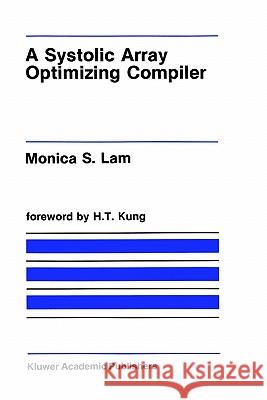
Monica S. Lam; Monica Lam
A Systolic Array Optimizing Compiler Monica S. Lam Monica Lam 9780898383003 Springer - książkaWidoczna okładka, to zdjęcie poglądowe, a rzeczywista szata graficzna może różnić się od prezentowanej.

A Systolic Array Optimizing Compiler

ISBN-13: 9780898383003 / Angielski / Twarda / 1989 / 202 str.

Monica S. Lam; Monica Lam
cena 403,47 zł
(netto: 384,26 VAT:  5%)

Najniższa cena z 30 dni: 385,52 zł
Termin realizacji zamówienia:
ok. 22 dni roboczych
Bez gwarancji dostawy przed świętami

Darmowa dostawa!
inne wydania

This book is a revision of my Ph. D. thesis dissertation submitted to Carnegie Mellon University in 1987. It documents the research and results of the compiler technology developed for the Warp machine. Warp is a systolic array built out of custom, high-performance processors, each of which can execute up to 10 million floating-point operations per second (10 MFLOPS). Under the direction of H. T. Kung, the Warp machine matured from an academic, experimental prototype to a commercial product of General Electric. The Warp machine demonstrated that the scalable architecture of high-peiformance, programmable systolic arrays represents a practical, cost-effective solu tion to the present and future computation-intensive applications. The success of Warp led to the follow-on iWarp project, a joint project with Intel, to develop a single-chip 20 MFLOPS processor. The availability of the highly integrated iWarp processor will have a significant impact on parallel computing. One of the major challenges in the development of Warp was to build an optimizing compiler for the machine. First, the processors in the xx A Systolic Array Optimizing Compiler array cooperate at a fine granularity of parallelism, interaction between processors must be considered in the generation of code for individual processors. Second, the individual processors themselves derive their performance from a VLIW (Very Long Instruction Word) instruction set and a high degree of internal pipelining and parallelism. The compiler contains optimizations pertaining to the array level of parallelism, as well as optimizations for the individual VLIW processors."


Kategorie:
Technologie
Kategorie BISAC:
Computers > Programming - Compilers
Technology & Engineering > Electrical
Computers > Computer Architecture
Wydawca:
Springer
Seria wydawnicza:
VLSI, Computer Architecture, and Digital Signal Processing
Język:
Angielski
ISBN-13:
9780898383003
Rok wydania:
1989
Wydanie:
1989
Numer serii:
000051479
Ilość stron:
202
Waga:
0.48 kg
Wymiary:
23.9 x 16.2 x 1.7
Oprawa:
Twarda
Wolumenów:
01

1. Introduction.- 1.1. Research approach.- 1.2. Overview of results.- 1.2.1. A machine abstraction for systolic arrays.- 1.2.2. Cell level optimizations.- 1.3. This presentation.- 2. Architecture of Warp.- 2.1. The architecture.- 2.1.1. Warp cell.- 2.1.2. Interface unit.- 2.1.3. The host system.- 2.2. Application domain of Warp.- 2.3. Programming complexity.- 3. A Machine Abstraction.- 3.1. Previous systolic array synthesis techniques.- 3.2. Comparisons of machine abstractions.- 3.2.1. Programmability.- 3.2.1.1. Partitioning methods.- 3.2.1.2. Programmability of synchronous models.- 3.2.2. Efficiency.- 3.3. Proposed abstraction: asynchronous communication.- 3.3.1. Effect of parallelism in cells.- 3.3.2. Scheduling constraints between receives and sends.- 3.3.2.1. The problem.- 3.3.2.2. The analysis.- 3.3.2.3. Implications.- 3.3.3. Discussion on the asynchronous communication model.- 3.4. Hardware and software support.- 3.4.1. Minimum hardware support: queues.- 3.4.2. Compile-time flow control.- 3.4.2.1. The skewed computation model.- 3.4.2.2. Algorithm to find the minimum skew.- 3.4.2.3. Hardware design.- 3.5. Chapter summary.- 4. The W2 Language and Compiler.- 4.1. The W2 language.- 4.2. Compiler overview.- 4.3. Scheduling a basic block.- 4.3.1. Problem definition.- 4.3.2. List scheduling.- 4.3.3. Ordering and priority function.- 5. Software Pipelining.- 5.1. Introduction to software pipelining.- 5.2. The scheduling problem.- 5.2.1. Scheduling constraints.- 5.2.2. Definition and complexity of problem.- 5.3. Scheduling algorithm.- 5.3.1. Bounds on the initiation interval.- 5.3.2. Scheduling an acyclic graph.- 5.3.3. Scheduling a cyclic graph.- 5.3.3.1. Combining strongly connected components.- 5.3.3.2. Scheduling a strongly connected component.- 5.3.3.3. Complete algorithm.- 5.4. Modulo variable expansion.- 5.5. Code size requirement.- 5.6. Comparison with previous work.- 5.6.1. The FPS compiler.- 5.6.2. The polycyclic machine.- 5.7. Chapter summary.- 6. Hierarchical Reduction.- 6.1. The iterative construct.- 6.2. The conditional construct.- 6.2.1. Branches taking different amounts of time.- 6.2.2. Code size.- 6.3. Global code motions.- 6.4. Comparison with previous work.- 6.4.1. Trace scheduling.- 6.4.1.1. Loop branches.- 6.4.1.2. Conditionals.- 6.4.2. Comparison with vector instructions.- 7. Evaluation.- 7.1. The experiment.- 7.1.1. Status of compiler.- 7.1.2. The programs.- 7.2. Performance analysis of global scheduling techniques.- 7.2.1. Speed up of global scheduling techniques.- 7.2.2. Efficiency of scheduler.- 7.2.2.1. Exclusive I/O time.- 7.2.2.2. Global resource use count.- 7.2.2.3. Data dependency.- 7.2.2.4. Other factors.- 7.2.3. Discussion on effectiveness of the Warp architecture.- 7.3. Performance of software pipelining.- 7.3.1. Characteristics of the loops.- 7.3.2. Effectiveness of software pipelining.- 7.3.3. Feasibility of software pipelining.- 7.4. Livermore Loops.- 7.5. Summary and discussion.- 8. Conclusions.- 8.1. Machine abstraction for systolic arrays.- 8.2. Code scheduling techniques.- References.


Udostępnij

Facebook - konto krainaksiazek.pl


Opinie o Krainaksiazek.pl na Opineo.pl

Partner Mybenefit

Krainaksiazek.pl w programie rzetelna firma Krainaksiaze.pl - płatności przez paypal

Czytaj nas na:

Facebook - krainaksiazek.pl
  • książki na zamówienie
  • granty
  • książka na prezent
  • kontakt
  • pomoc
  • opinie
  • regulamin
  • polityka prywatności

Zobacz:

  • Księgarnia czeska

  • Wydawnictwo Książkowe Klimaty

1997-2025 DolnySlask.com Agencja Internetowa

© 1997-2022 krainaksiazek.pl
     
KONTAKT | REGULAMIN | POLITYKA PRYWATNOŚCI | USTAWIENIA PRYWATNOŚCI
Zobacz: Księgarnia Czeska | Wydawnictwo Książkowe Klimaty | Mapa strony | Lista autorów
KrainaKsiazek.PL - Księgarnia Internetowa

Polityka prywatnosci - link
Krainaksiazek.pl - płatnośc Przelewy24
Przechowalnia Przechowalnia





