• Wyszukiwanie zaawansowane
  • Kategorie
  • Kategorie BISAC
  • Książki na zamówienie
  • Promocje
  • Granty
  • Książka na prezent
  • Opinie
  • Pomoc
  • Załóż konto
  • Zaloguj się

A Survey of Models for Tumor-Immune System Dynamics » książka


zaloguj się | załóż konto
Logo Krainaksiazek.pl

koszyk

konto

szukaj
topmenu
Księgarnia internetowa
Szukaj
Książki na zamówienie
Promocje
Granty
Książka na prezent
Moje konto
Pomoc
 
 
Wyszukiwanie zaawansowane
Pusty koszyk
Bezpłatna dostawa dla zamówień powyżej 20 złBezpłatna dostawa dla zamówień powyżej 20 zł

Kategorie główne

• Nauka
 [2946600]
• Literatura piękna
 [1856966]

  więcej...
• Turystyka
 [72221]
• Informatyka
 [151456]
• Komiksy
 [35826]
• Encyklopedie
 [23190]
• Dziecięca
 [619653]
• Hobby
 [140543]
• AudioBooki
 [1577]
• Literatura faktu
 [228355]
• Muzyka CD
 [410]
• Słowniki
 [2874]
• Inne
 [445822]
• Kalendarze
 [1744]
• Podręczniki
 [167141]
• Poradniki
 [482898]
• Religia
 [510455]
• Czasopisma
 [526]
• Sport
 [61590]
• Sztuka
 [243598]
• CD, DVD, Video
 [3423]
• Technologie
 [219201]
• Zdrowie
 [101638]
• Książkowe Klimaty
 [124]
• Zabawki
 [2473]
• Puzzle, gry
 [3898]
• Literatura w języku ukraińskim
 [254]
• Art. papiernicze i szkolne
 [8170]
Kategorie szczegółowe BISAC

A Survey of Models for Tumor-Immune System Dynamics

ISBN-13: 9780817639013 / Angielski / Twarda / 1996 / 344 str.
John A. Adam;Nicola Bellomo
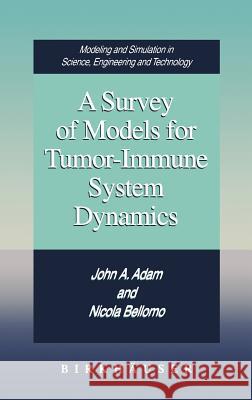
A Survey of Models for Tumor-Immune System Dynamics John A. Adam, Nicola Bellomo 9780817639013 Birkhauser Boston Inc - książkaWidoczna okładka, to zdjęcie poglądowe, a rzeczywista szata graficzna może różnić się od prezentowanej.

A Survey of Models for Tumor-Immune System Dynamics

ISBN-13: 9780817639013 / Angielski / Twarda / 1996 / 344 str.

John A. Adam;Nicola Bellomo
cena 605,23 zł
(netto: 576,41 VAT:  5%)

Najniższa cena z 30 dni: 578,30 zł
Termin realizacji zamówienia:
ok. 22 dni roboczych
Bez gwarancji dostawy przed świętami

Darmowa dostawa!
inne wydania

Mathematical Modeling and Immunology An enormous amount of human effort and economic resources has been directed in this century to the fight against cancer. The purpose, of course, has been to find strategies to overcome this hard, challenging and seemingly endless struggle. We can readily imagine that even greater efforts will be required in the next century. The hope is that ultimately humanity will be successful; success will have been achieved when it is possible to activate and control the immune system in its competition against neoplastic cells. Dealing with the above-mentioned problem requires the fullest pos sible cooperation among scientists working in different fields: biology, im munology, medicine, physics and, we believe, mathematics. Certainly, bi ologists and immunologists will make the greatest contribution to the re search. However, it is now increasingly recognized that mathematics and computer science may well able to make major contributions to such prob lems. We cannot expect mathematicians alone to solve fundamental prob lems in immunology and (in particular) cancer research, but valuable sup port, however modest, can be provided by mathematicians to the research aspirations of biologists and immunologists working in this field."


Kategorie:
Nauka, Matematyka
Kategorie BISAC:
Mathematics > Matematyka
Wydawca:
Birkhauser Boston Inc
Seria wydawnicza:
Modeling and Simulation in Science, Engineering and Technolo
Język:
Angielski
ISBN-13:
9780817639013
Rok wydania:
1996
Dostępne języki:
Angielski
Wydanie:
1997
Numer serii:
000131435
Ilość stron:
344
Waga:
1.51 kg
Wymiary:
23.523.5 x 15.5
Oprawa:
Twarda
Wolumenów:
01
Dodatkowe informacje:
Glosariusz/słownik
Wydanie ilustrowane

"This book is [a] very helpful tool for mathematicians constructing models in biology and hopefully it can also help biologists to understand some philosophy of mathematical descriptions of biological phenomena with all its pluses and minuses."

-Mathematica Bohemica

1. A Brief History of Immunologic Thinking: Is it Time for Yin and Yang?.- 1.1 Koch’s Postulates.- 1.2 Aristotle’s Laws of Logical Argument.- 1.3 Antigens and T-Cell Responses.- 1.4 Thinking About the Immune System.- 1.5 Fuzzy T-Cell Model.- 1.6 Acknowledgment.- 2. General Aspects of Modeling Tumor Growth and Immune Response.- 2.1 Introduction.- 2.2 What is a Mathematical Model?.- 2.2.1 Why are mathematical models useful?.- 2.2.2 Limitations of mathematical models.- 2.2.3 Other considerations.- 2.3 Introduction to Deterministic Tumor (or Spheroid) Growth Models.- 2.3.1 Basic models: Description.- 2.3.2 Basic diffusion models: Mathematical aspects.- 2.3.3 Diffusion of growth inhibitor.- 2.3.4 Time-evolutionary diffusion models.- 2.4 A Predator-Prey Approach.- 2.5 A Model of Tumor Cell/Immune System Interaction.- 2.6 Models, Metaphors and Similes: Some Alternative Paradigms.- 2.6.1 The tunneling phenomenon.- 2.6.2 Some speculation.- 2.7 References.- 2.8 Appendices.- 2.8.1 Appendix I - Comments on catastrophe theory.- 2.8.2 Appendix II - Solution existence, uniqueness, stability and bifurcation and the inverse problem.- 3. Mathematical Modeling of Tumor Growth Kinetics.- 3.1 Introduction.- 3.2 Tumor Growth as a Dynamical System.- 3.2.1 Construction of growth rate functions.- 3.3 The Gompertz Model.- 3.3.1 Gompertz model as a simple dynamical system.- 3.3.2 Gompertz model as an S-system.- 3.3.3 Gompertz model and quiescence.- 3.3.4 Gompertz model and cell kinetics.- 3.3.5 Gompertz model and entropy.- 3.3.6 Gompertz model and tumor heterogeneity.- 3.3.7 Other explanations and analyses of Gompertz model.- 3.4 The Logistic Model.- 3.5 Models of von Bertalanffy.- 3.6 Tumor Growth Modeled by Specific Mechanisms.- 3.6.1 Competition among cell populations.- 3.6.2 Cell cycle kinetics and regulation by growth factors.- 3.6.3 Positive feedback mechanisms in tumors.- 3.7 Mathematical Models and Measured Growth Curves.- 3.7.1 Growth data and Gompertz model.- 3.7.2 Comparative studies of deterministic tumor growth models.- 3.8 Concluding Outlooks.- 3.9 Acknowledgment.- 3.10 References.- 4. Tumor Immune System Interactions: The Kinetic Cellular Theory.- 4.1 Introduction.- 4.2 A Concise Guide to the Literature.- 4.3 Guidelines: From Observation to Simulation.- 4.4 Cell Population and Activity.- 4.5 Modeling Cell Interactions.- 4.6 Evolution Kinetic Equations.- 4.7 Experimental Activity.- 4.7.1 Transition to neoplastic behavior and tumor proliferation.- 4.7.2 Preimmunization and recognition of antigens.- 4.7.3 Cytokine genes.- 4.8 Simulation and Validation Problems.- 4.8.1 Simulation methods.- 4.8.2 Some identification and validation problems.- 4.8.3 Discrete models.- 4.9 Remarks Addressed to Applied Mathematicians.- 4.10 Perspectives.- 4.11 References.- 5. From Mutation to Metastasis: The Mathematical Modelling of the Stages of Tumour Development.- 5.1 Introduction.- 5.2 Avascular Tumour Growth: The Multicell Spheroid Model.- 5.2.1 Results.- 5.3 Thmour Angiogenesis. Capillary Sprout Formation and Growth.- 5.3.1 Model improvements and extension.- 5.3.2 Numerical simulations.- 5.4 Vascular Tumour Growth.- 5.4.1 Results.- 5.5 Discussion and Conclusions.- 5.6 References.- 6. Basic Models of Tumor-Immune System Interactions Identification, Analysis and Predictions.- 6.1 Introduction.- 6.2 Kinetics Models of Cellular Cytotoxic Reactions at the Effector Stage of Immune Response.- 6.2.1 Solutions of the model at quasi-stationary approximation.- 6.2.2 Comparison of the minimal model with experimental data.- 6.3 Regulatory Cells at the Effector Stage of the Cellular Immune Response.- 6.4 Modeling of the Recognition Mechanisms of Thmor Cells by NK-like Cells.- 6.5 Switch of Cytolytic Mechanisms: Effector Cells, Target Cells and Bispecific Regulating Molecules.- 6.5.1 Kinetics of the multiple cytotoxic reactions.- 6.5.2 General model.- 6.5.3 Kinetics of ADCC/LDCC reactions.- 6.5.4 One effector cell and two molecular mechanisms recognition.- 6.5.5 Conclusion.- 6.6 Propagation and Interaction of Tumor Specific Macromolecules in Multicellular Tumors.- 6.7 Conclusion.- 6.8 Acknowledgment.- 6.9 References.- 7. Tumor Heterogeneity and Growth Control.- 7.1 Introduction.- 7.2 The Goal.- 7.3 The Plan.- 7.4 The Foundation and Tools.- 7.4.1 Distributional heterogeneity and models of the cell cycle.- 7.4.2 Epigenetic heterogeneity and environmental factors in the development of a heterogeneous milieu.- 7.4.3 Intrinsic heterogeneity and subpopulation emergence.- 7.4.4 Intrinsic heterogeneity and interacting populations.- 7.4.5 Our models of tumor growth.- 7.5 The Structure.- 7.5.1 Paradigm #1: Tumor dormancy.- 7.5.2 Paradigm #2: Interlocking growth control.- 7.5.3 Paradigm #3: Concomitant resistance.- 7.6 Conclusions.- 7.7 References.- 8. Biological Glossary.


Udostępnij

Facebook - konto krainaksiazek.pl


Opinie o Krainaksiazek.pl na Opineo.pl

Partner Mybenefit

Krainaksiazek.pl w programie rzetelna firma Krainaksiaze.pl - płatności przez paypal

Czytaj nas na:

Facebook - krainaksiazek.pl
  • książki na zamówienie
  • granty
  • książka na prezent
  • kontakt
  • pomoc
  • opinie
  • regulamin
  • polityka prywatności

Zobacz:

  • Księgarnia czeska

  • Wydawnictwo Książkowe Klimaty

1997-2025 DolnySlask.com Agencja Internetowa

© 1997-2022 krainaksiazek.pl
     
KONTAKT | REGULAMIN | POLITYKA PRYWATNOŚCI | USTAWIENIA PRYWATNOŚCI
Zobacz: Księgarnia Czeska | Wydawnictwo Książkowe Klimaty | Mapa strony | Lista autorów
KrainaKsiazek.PL - Księgarnia Internetowa

Polityka prywatnosci - link
Krainaksiazek.pl - płatnośc Przelewy24
Przechowalnia Przechowalnia





