• Wyszukiwanie zaawansowane
  • Kategorie
  • Kategorie BISAC
  • Książki na zamówienie
  • Promocje
  • Granty
  • Książka na prezent
  • Opinie
  • Pomoc
  • Załóż konto
  • Zaloguj się

A Structured Programming Approach to Data » książka


zaloguj się | załóż konto
Logo Krainaksiazek.pl

koszyk

konto

szukaj
topmenu
Księgarnia internetowa
Szukaj
Książki na zamówienie
Promocje
Granty
Książka na prezent
Moje konto
Pomoc
 
 
Wyszukiwanie zaawansowane
Pusty koszyk
Bezpłatna dostawa dla zamówień powyżej 40 złBezpłatna dostawa dla zamówień powyżej 40 zł

Kategorie główne

• Nauka
 [2953408]
• Literatura piękna
 [1818674]

  więcej...
• Turystyka
 [70115]
• Informatyka
 [151610]
• Komiksy
 [36466]
• Encyklopedie
 [23169]
• Dziecięca
 [612210]
• Hobby
 [135681]
• AudioBooki
 [1806]
• Literatura faktu
 [226254]
• Muzyka CD
 [391]
• Słowniki
 [2978]
• Inne
 [449189]
• Kalendarze
 [1375]
• Podręczniki
 [166538]
• Poradniki
 [469635]
• Religia
 [508779]
• Czasopisma
 [523]
• Sport
 [61275]
• Sztuka
 [243340]
• CD, DVD, Video
 [3479]
• Technologie
 [219064]
• Zdrowie
 [98975]
• Książkowe Klimaty
 [124]
• Zabawki
 [2531]
• Puzzle, gry
 [3670]
• Literatura w języku ukraińskim
 [261]
• Art. papiernicze i szkolne
 [8134]
Kategorie szczegółowe BISAC

A Structured Programming Approach to Data

ISBN-13: 9781468479874 / Angielski / Miękka / 2012 / 222 str.
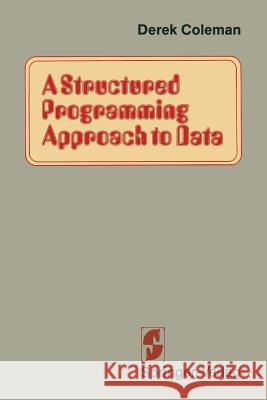
A Structured Programming Approach to Data  9781468479874 Springer - książkaWidoczna okładka, to zdjęcie poglądowe, a rzeczywista szata graficzna może różnić się od prezentowanej.

A Structured Programming Approach to Data

ISBN-13: 9781468479874 / Angielski / Miękka / 2012 / 222 str.

cena 202,19
(netto: 192,56 VAT:  5%)

Najniższa cena z 30 dni: 192,74
Termin realizacji zamówienia:
ok. 16-18 dni roboczych.

Darmowa dostawa!

Much of current programming practice is basically empirical and ad hoc in approach. Each problem is tackled without relation to those that have gone before; experiences are made and stored as a series of fragments. Now, under the pressure of events, this unsatisfactory state of affairs is coming to an end. Programming is becoming a technology, a theory known as structured programming is developing. The purpose of a theory is to categorise and explain existing practice, thus enabling it to be improved through the development of new and sharper techniques. The resulting experiences have then to be fed back into the theory so that the process of enrichment may continue. This dialectical relationship between theory and practice is essential to a healthy programming technology. The lack of such a relationship in the 1950s and 60s and the accompanying software crisis certainly confirm the converse of this proposition. My aim in writing this book has been to explain the current state of the theory of structured programming, so that it may be used to improve the reader's practice. The book deals with two facets of programming - how to design a program in terms of abstract data structures and how to represent the data structures on real and bounded computers. The separation between program design and data structure representation leads to more reliable and flexible programs.


Kategorie:
Informatyka
Kategorie BISAC:
Computers > Computer Science
Computers > Software Development & Engineering - General
Computers > Programming - General
Wydawca:
Springer
Język:
Angielski
ISBN-13:
9781468479874
Rok wydania:
2012
Wydanie:
1979
Ilość stron:
222
Waga:
0.33 kg
Wymiary:
23.39 x 15.6 x 1.27
Oprawa:
Miękka
Wolumenów:
01
Dodatkowe informacje:
Wydanie ilustrowane

1. An Overview of Program Design.- 1.1 Introduction — The Software Crisis.- 1.2 Objectives of Program Design.- 1.3 The Heart of the Problem.- 1.4 Stepwise Refinement.- 1.5 What Do We Mean When We Say a Program ‘Works’?.- 1.6 Summary.- 1.7 Bibliographical Notes.- 2. Program Design Notation.- 2.1 An Abstract Programming Language.- 2.2 Structuring Control.- 2.3 Structuring Data.- 2.4 What is a Data Structure?.- 2.5 Unstructured Data Types.- 2.6 Implementation of Unstructured Types.- 2.7 Summary.- 2.8 Bibliographical Notes.- 3. Arrays.- 3.1 Array Structures.- 3.2 Arrays and Functions.- 3.3 Implementation of Arrays.- 3.4 Summary.- 3.5 Bibliographical Notes.- 4. Simple Data Structuring.- 4.1 Record Types.- 4.2 Implementation of Record Types.- 4.3 Use of Structured Types.- 4.4 Variant Types.- 4.5 Implementation of Variant Types.- 4.6 Summary.- 4.7 Bibliographical Notes.- 5. On Program Design.- 5.1 Stepwise Refinement of Programs.- 5.2 Two Examples.- 5.3 Summary.- 5.4 Bibliographical Notes.- Exercises 1.- 6. Set Structures.- 6.1 Introduction.- 6.2 Set Operations.- 6.3 Use of Set Structures.- 6.4 Implementation of Set Structures.- 6.5 Summary.- 6.6 Bibliographical Notes.- 7. The Class Construct.- 7.1 Using and Implementing Data Structures.- 7.2 Classes.- 7.3 Implementation of Classes.- 7.4 Summary.- 7.5 Bibliographical Notes.- 8. Dynamic Data Structures.- 8.1 Introduction.- 8.2 Basic Implementation Techniques for Dynamic Data Structures.- 8.3 Linear Linked Lists.- 8.4 Storage Management for Dynamic Data Structures.- 8.5 Linear Linked List Implementation of Integersets.- 8.6 Summary.- 8.7 Bibliographical Notes.- 9. Sequences.- 9.1 Introduction.- 9.2 Operations on Sequences.- 9.3 Storage Structures for Sequences.- 9.4 Queues.- 9.5 Summary.- 9.6 Bibliographical Notes.- Exercises 2.- 10. Simple Searching Techniques.- 10.1 Sparse Mappings.- 10.2 Sparsity and Searching.- 10.3 Linear Search.- 10.4 Merge Search.- 10.5 Binary Search.- 10.6 Properties of Binary Searching.- 10.7 Summary.- 10.8 Bibliographical Notes.- 11. Hashing Techniques.- 11.1 Introduction.- 11.2 Choice of a Hashing Function.- 11.3 Collision Handling by Open Addressing.- 11.4 Ordered Hashing.- 11.5 Chained Hashing.- 11.6 Efficiency of Hashing Methods.- 11.7 Summary.- 11.8 Bibliographical Notes.- 12. Recursion and Recursive Algorithms.- 12.1 Recursion.- 12.2 Mechanics of Recursion.- 12.3 Removal of Recursion.- 12.4 Recursion in the Design of Algorithms.- 12.5 Conclusion.- 12.6 Summary.- 12.7 Bibliographical Notes.- 13. Binary Search Trees.- 13.1 Introduction.- 13.2 Operations on Binary Trees.- 13.3 Binary Search Trees.- 13.4 The Shape of Binary Search Trees.- 13.5 Implementation of Binary Trees.- 13.6 Conclusion.- 13.7 Summary.- 13.8 Bibliographical Notes.- Exercises 3.- 14. Designing Programs From Data Structures.- 14.1 Introduction.- 14.2 Traversing Binary Trees.- 14.3 Input of Advanced Data Structures.- 14.4 Program Construction Rules.- 14.5 Systematic Design of File Processing Programs.- 14.6 Conclusion.- 14.7 Summary.- 14.8 Bibliographical Notes.- Exercises 4.- References.


Udostępnij

Facebook - konto krainaksiazek.pl


Opinie o Krainaksiazek.pl na Opineo.pl

Partner Mybenefit

Krainaksiazek.pl w programie rzetelna firma Krainaksiaze.pl - płatności przez paypal

Czytaj nas na:

Facebook - krainaksiazek.pl
  • książki na zamówienie
  • granty
  • książka na prezent
  • kontakt
  • pomoc
  • opinie
  • regulamin
  • polityka prywatności

Zobacz:

  • Księgarnia czeska

  • Wydawnictwo Książkowe Klimaty

1997-2026 DolnySlask.com Agencja Internetowa

© 1997-2022 krainaksiazek.pl
     
KONTAKT | REGULAMIN | POLITYKA PRYWATNOŚCI | USTAWIENIA PRYWATNOŚCI
Zobacz: Księgarnia Czeska | Wydawnictwo Książkowe Klimaty | Mapa strony | Lista autorów
KrainaKsiazek.PL - Księgarnia Internetowa

Polityka prywatnosci - link
Krainaksiazek.pl - płatnośc Przelewy24
Przechowalnia Przechowalnia





