• Wyszukiwanie zaawansowane
  • Kategorie
  • Kategorie BISAC
  • Książki na zamówienie
  • Promocje
  • Granty
  • Książka na prezent
  • Opinie
  • Pomoc
  • Załóż konto
  • Zaloguj się

A Projection Transformation Method for Nearly Singular Surface Boundary Element Integrals » książka


zaloguj się | załóż konto
Logo Krainaksiazek.pl

koszyk

konto

szukaj
topmenu
Księgarnia internetowa
Szukaj
Książki na zamówienie
Promocje
Granty
Książka na prezent
Moje konto
Pomoc
 
 
Wyszukiwanie zaawansowane
Pusty koszyk
Bezpłatna dostawa dla zamówień powyżej 20 złBezpłatna dostawa dla zamówień powyżej 20 zł

Kategorie główne

• Nauka
 [2949965]
• Literatura piękna
 [1857847]

  więcej...
• Turystyka
 [70818]
• Informatyka
 [151303]
• Komiksy
 [35733]
• Encyklopedie
 [23180]
• Dziecięca
 [617748]
• Hobby
 [139972]
• AudioBooki
 [1650]
• Literatura faktu
 [228361]
• Muzyka CD
 [398]
• Słowniki
 [2862]
• Inne
 [444732]
• Kalendarze
 [1620]
• Podręczniki
 [167233]
• Poradniki
 [482388]
• Religia
 [509867]
• Czasopisma
 [533]
• Sport
 [61361]
• Sztuka
 [243125]
• CD, DVD, Video
 [3451]
• Technologie
 [219309]
• Zdrowie
 [101347]
• Książkowe Klimaty
 [123]
• Zabawki
 [2362]
• Puzzle, gry
 [3791]
• Literatura w języku ukraińskim
 [253]
• Art. papiernicze i szkolne
 [7933]
Kategorie szczegółowe BISAC

A Projection Transformation Method for Nearly Singular Surface Boundary Element Integrals

ISBN-13: 9783540550006 / Angielski / Miękka / 1992 / 456 str.
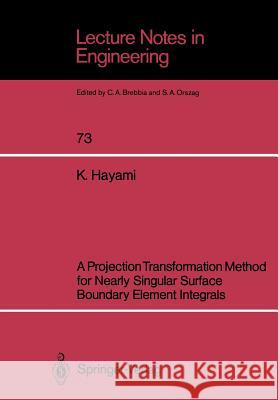
K. Hayami; Ken Hayami
A Projection Transformation Method for Nearly Singular Surface Boundary Element Integrals K. Hayami Ken Hayami 9783540550006 Springer - książkaWidoczna okładka, to zdjęcie poglądowe, a rzeczywista szata graficzna może różnić się od prezentowanej.

A Projection Transformation Method for Nearly Singular Surface Boundary Element Integrals

ISBN-13: 9783540550006 / Angielski / Miękka / 1992 / 456 str.

K. Hayami; Ken Hayami
cena 403,47 zł
(netto: 384,26 VAT:  5%)

Najniższa cena z 30 dni: 385,52 zł
Termin realizacji zamówienia:
ok. 22 dni roboczych
Bez gwarancji dostawy przed świętami

Darmowa dostawa!

In three dimensional boundary element analysis, computation of integrals is an important aspect since it governs the accuracy of the analysis and also because it usually takes the major part of the CPU time. The integrals which determine the influence matrices, the internal field and its gradients contain (nearly) singular kernels of order lIr a (0: = 1,2,3,4, ...) where r is the distance between the source point and the integration point on the boundary element. For planar elements, analytical integration may be possible 1,2,6. However, it is becoming increasingly important in practical boundary element codes to use curved elements, such as the isoparametric elements, to model general curved surfaces. Since analytical integration is not possible for general isoparametric curved elements, one has to rely on numerical integration. When the distance d between the source point and the element over which the integration is performed is sufficiently large compared to the element size (d> 1), the standard Gauss-Legendre quadrature formula 1,3 works efficiently. However, when the source is actually on the element (d=O), the kernel 1I becomes singular and the straight forward application of the Gauss-Legendre quadrature formula breaks down. These integrals will be called singular integrals. Singular integrals occur when calculating the diagonals of the influence matrices."


Kategorie:
Nauka, Matematyka
Kategorie BISAC:
Technology & Engineering > Engineering (General)
Mathematics > Matematyka stosowana
Science > Mechanika klasyczna płynów
Wydawca:
Springer
Seria wydawnicza:
Springer Proceedings in Physics (Hardcover)
Język:
Angielski
ISBN-13:
9783540550006
Rok wydania:
1992
Wydanie:
Softcover Repri
Numer serii:
000034819
Ilość stron:
456
Waga:
0.79 kg
Wymiary:
24.2 x 17.0
Oprawa:
Miękka
Wolumenów:
01

I Theory and Algorithms.- 1 Introduction.- 2 Boundary Element Formulation of 3-d Potential Problems.- 2.1 Boundary Integral Equation.- 2.2 Treatment of the Exterior Problem.- 2.3 Discretization into Boundary Elements.- 2.4 Row Sum Elimination Method.- 3 Nature of Integrals in 3-d Potential Problems.- 3.1 Weakly Singular Integrals.- 3.2 Hyper Singular Integrals.- 3.3 Nearly Singular Integrals.- 4 Survey of Quadrature Methods for 3-d Boundary Element Method.- 4.1 Closed Form Integrals.- 4.2 Gaussian Quadrature Formula.- 4.3 Quadrature Methods for Singular Integrals.- (1) The weighted Gauss method.- (2) Singularity subtraction and Taylor expansion method.- (3) Variable transformation methods.- (4) Coordinate transformation methods.- 4.4 Quadrature Methods for Nearly Singular Integrals.- (1) Element subdivision.- (2) Variable transformation methods.- (3) Polar coordinates.- 5 The Projection and Angular & Radial Transformation (Part) Method.- 5.1 Introduction.- 5.2 Source Projection.- 5.3 Approximate Projection of the Curved Element.- 5.4 Polar Coordinates in the Projected Element.- 5.5 Radial Variable Transformation.- (i) Weakly Singular Integrals.- (ii) Nearly Singular Integrals.- (1) Singularity cancelling radial variable transformation.- (2) Consideration of exact inverse projection and curvature of the element in the transformation.- (3) Adaptive logarithmic transformation (log-L2).- (4) Adaptive logarithmic transformation (log-L1).- (5) Single and double exponential transformations.- 5.6 Angular Variable Transformation.- (1) Adaptive logarithmic angular variable transformation.- (2) Single and double exponential transformations.- 5.7 Implementation of the PART method.- (1) The use of Gauss-Legendre formula.- (2) The use of truncated trapezium rule.- 5.8 Variable Transformation in the Parametric Space.- 6 Elementary Error Analysis.- 6.1 The Use of Error Estimate for Gauss-Legendre Quadrature Formula.- 6.2 Case ß = 2 (Adaptive Logarithmic Transformation: log-L2).- 6.3 Case ß = l Transformation.- 6.4 Case ß = 3 Transformation.- 6.5 Case ß = 4 Transformation.- 6.6 Case ß = 5 Transformation.- 6.7 Summary of Error Estimates for ß=1~5.- 6.8 Error Analysis for Flux Calculations.- 7 Error Analysis using Complex Function Theory.- 7.1 Basic Theorem.- 7.2 Asymptotic Expression for the Error Characteristic Function ?n(z).- 7.3 Use of the Elliptic Contour as the Integral Path.- 7.4 The Saddle Point Method.- 7.5 Integration in the Transformed Radial Variable: R.- 7.6 Error Analysis for the Identity Transformation: R(?) = ?.- (1) Estimation of the size ? of the ellipse ??.- (2) Estimation of max | f(z) | z???.- (3) Error estimate En(f).- 7.7 Error Analysis for the log-L2 Transformation.- (1) Case: ? = odd.- (2) Case: ? = even.- (i) Contribution from the branch line l+, l-.- (ii) Contribution from the ellipse ??.- (iii) Contribution from the small circle C?.- (iv) Summary.- 7.8 Error Analysis for the log-L1 Transformation.- (1) Error analysis using the saddle point method.- (2) Error analysis using the elliptic contour: ??.- (i) Estimation of max | f(z) | z???.- (ii) Estimation of ?.- (iii) Error estimate En(f).- 7.9 Summary of Theoretical Error Estimates.- II Applications and Numerical Results.- 8 Numerical Experiment Procedures and Element Types.- 8.1 Notes on Procedures for Numerical Experiments.- 8.2 Geometry of Boundary Elements used for Numerical Experiments.- (1) Planar rectangle (PLR).- (2) ‘Spherical’ quadrilateral (SPQ).- (3) Hyperbolic quadrilateral (HYQ).- 9 Applications to Weakly Singular Integrals.- 9.1 Check with Analytial Integration Formula for Constant Planar Elements.- 9.2 Planar Rectangular Element with Interpolation Function ?ij.- 9.3 ‘Spherical’ Quadrilateral Element with Interpolation Function ?ij.- (1) Results for ?S?iju* dS.- (2) Results for ?S?ijq* dS.- 9.4 Hyperbolic Quadrilateral Element with Interpolation Function ?ij.- (1) Results for ?s?iju* dS.- (2) Results for ?s?ijq*dS.- 9.5 Summary of Numerical Results for Weakly Singular Integrals.- 10 Applications to Nearly Singular Integrals.- 10.1 Analytical Integration Formula for Constant Planar Elements.- 10.2 Singularity Cancelling Radial Variable Transformation for Constant Planar Elements.- 10.3 Application of the Singularity Cancelling Transformation to Elements with Curvature and Interpolation Functions.- (1) Application to curved elements.- (2) Application to integrals including interpolation functions.- 10.4 The Derivation of the log-L2 Radial Variable Transformation.- (1) Application of radial variable transformations ?d? = r’?dR (ß? ?) to integrals ?s 1/r?dS over curved elements.- (2) Difficulty with flux calculation.- 10.5 The log-L1 Radial Variable Transformation.- 10.6 Comparison of Radial Variable transformations for the Model Radial Integral I?,?.- (1) Transformation based on the Gauss-Legendre rule.- (i) Identity transformation.- (ii) log-L2 transformation.- (iii) log-L1 transformation.- (2) Transformation based on the truncated trapezium rule.- (i) Single Exponential (SE) transformation.- (ii) Double Exponential (DE) transformation.- (3) Summary.- 10.7 Comparison of Different Numerical Integration methods on the ‘spherical’ Element.- (1) Effect of the source distance d.- (2) Effect of the position of the source projection xs.- 10.8 Summary of Numerical Results for Nearly Singular Integrals.- 11 Applications to Hypersingular Integrals.- 12 Conclusions.- References.


Udostępnij

Facebook - konto krainaksiazek.pl


Opinie o Krainaksiazek.pl na Opineo.pl

Partner Mybenefit

Krainaksiazek.pl w programie rzetelna firma Krainaksiaze.pl - płatności przez paypal

Czytaj nas na:

Facebook - krainaksiazek.pl
  • książki na zamówienie
  • granty
  • książka na prezent
  • kontakt
  • pomoc
  • opinie
  • regulamin
  • polityka prywatności

Zobacz:

  • Księgarnia czeska

  • Wydawnictwo Książkowe Klimaty

1997-2025 DolnySlask.com Agencja Internetowa

© 1997-2022 krainaksiazek.pl
     
KONTAKT | REGULAMIN | POLITYKA PRYWATNOŚCI | USTAWIENIA PRYWATNOŚCI
Zobacz: Księgarnia Czeska | Wydawnictwo Książkowe Klimaty | Mapa strony | Lista autorów
KrainaKsiazek.PL - Księgarnia Internetowa

Polityka prywatnosci - link
Krainaksiazek.pl - płatnośc Przelewy24
Przechowalnia Przechowalnia





