• Wyszukiwanie zaawansowane
  • Kategorie
  • Kategorie BISAC
  • Książki na zamówienie
  • Promocje
  • Granty
  • Książka na prezent
  • Opinie
  • Pomoc
  • Załóż konto
  • Zaloguj się

A Probability Metrics Approach to Financial Risk Measures » książka


zaloguj się | załóż konto
Logo Krainaksiazek.pl

koszyk

konto

szukaj
topmenu
Księgarnia internetowa
Szukaj
Książki na zamówienie
Promocje
Granty
Książka na prezent
Moje konto
Pomoc
 
 
Wyszukiwanie zaawansowane
Pusty koszyk
Bezpłatna dostawa dla zamówień powyżej 20 złBezpłatna dostawa dla zamówień powyżej 20 zł

Kategorie główne

• Nauka
 [2946912]
• Literatura piękna
 [1852311]

  więcej...
• Turystyka
 [71421]
• Informatyka
 [150889]
• Komiksy
 [35717]
• Encyklopedie
 [23177]
• Dziecięca
 [617324]
• Hobby
 [138808]
• AudioBooki
 [1671]
• Literatura faktu
 [228371]
• Muzyka CD
 [400]
• Słowniki
 [2841]
• Inne
 [445428]
• Kalendarze
 [1545]
• Podręczniki
 [166819]
• Poradniki
 [480180]
• Religia
 [510412]
• Czasopisma
 [525]
• Sport
 [61271]
• Sztuka
 [242929]
• CD, DVD, Video
 [3371]
• Technologie
 [219258]
• Zdrowie
 [100961]
• Książkowe Klimaty
 [124]
• Zabawki
 [2341]
• Puzzle, gry
 [3766]
• Literatura w języku ukraińskim
 [255]
• Art. papiernicze i szkolne
 [7810]
Kategorie szczegółowe BISAC

A Probability Metrics Approach to Financial Risk Measures

ISBN-13: 9781405183697 / Angielski / Twarda / 2011 / 392 str.
Svetlozar T. Rachev;Stoyan V. Stoyanov;Frank J. Fabozzi CFA
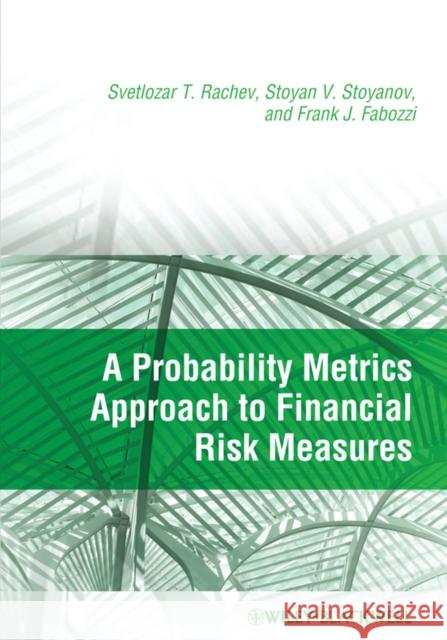
A Probability Metrics Approach to Financial Risk Measures Svetlozar T. Rachev Stoyan V. Stoyanov Frank J. Fabozzi CFA 9781405183697  - książkaWidoczna okładka, to zdjęcie poglądowe, a rzeczywista szata graficzna może różnić się od prezentowanej.

A Probability Metrics Approach to Financial Risk Measures

ISBN-13: 9781405183697 / Angielski / Twarda / 2011 / 392 str.

Svetlozar T. Rachev;Stoyan V. Stoyanov;Frank J. Fabozzi CFA
cena 816,23
(netto: 777,36 VAT:  5%)

Najniższa cena z 30 dni: 812,87
Termin realizacji zamówienia:
ok. 30 dni roboczych
Bez gwarancji dostawy przed świętami

Darmowa dostawa!

A Probability Metrics Approach to Financial Risk Measures relates the field of probability metrics and risk measures to one another and applies them to finance for the first time.

  • Helps to answer the question: which risk measure is best for a given problem?
  • Finds new relations between existing classes of risk measures
  • Describes applications in finance and extends them where possible
  • Presents the theory of probability metrics in a more accessible form which would be appropriate for non-specialists in the field
  • Applications include optimal portfolio choice, risk theory, and numerical methods in finance
  • Topics requiring more mathematical rigor and detail are included in technical appendices to chapters

Is the behavior of the stocks in our portfolio close to their behavior during the most recent crisis? How close is the strategy of hedge fund A to the strategy of hedge fund B? In which proportions do we invest in a given universe of stocks so that the resulting portfolio matches as much as possible the strategy of fund C?All of these questions are essential to finance and they have one feature in common: measuring distances between random quantities. Problems of this kind have been explored for many years in areas other than finance. In A Probability Metrics Approach to Financial Risk Measures, the field of probability metrics and risk measures are related to one another and applied to finance for the first time, revealing groundbreaking new classes of risk measures, finding new relations between existing classes of risk measures, and providing answers to the question of which risk measure is best for a given problem. Applications include optimal portfolio choice, risk theory, and numerical methods in finance.


Kategorie:
Nauka, Ekonomia i biznes
Kategorie BISAC:
Mathematics > Prawdopodobieństwo i statystyka
Business & Economics > Insurance - Risk Assessment & Management
Business & Economics > Finance - General
Język:
Angielski
ISBN-13:
9781405183697
Rok wydania:
2011
Ilość stron:
392
Waga:
0.69 kg
Wymiary:
23.11 x 15.75 x 2.54
Oprawa:
Twarda
Wolumenów:
01


Preface xiii

About the Authors xv

1 Introduction 1

1.1 Probability Metrics 1

1.2 Applications in Finance 2

2 Probability Distances and Metrics 7

2.1 Introduction 9

2.2 Some Examples of Probability Metrics 9

2.2.1 Engineer s metric 10

2.2.2 Uniform (or Kolmogorov) metric 10

2.2.3 Lévy metric 11

2.2.4 Kantorovich metric 14

2.2.5 Lp–metrics between distribution functions 15

2.2.6 Ky Fan metrics 16

2.2.7 Lp–metric 17

2.3 Distance and Semidistance Spaces 19

2.4 Definitions of Probability Distances and Metrics 24

2.5 Summary 28

2.6 Technical Appendix 28

2.6.1 Universally measurable separable metric spaces 29

2.6.2 The equivalence of the notions of p. (semi–)distance on P2 and on X 35

3 Choice under Uncertainty 40

3.1 Introduction 41

3.2 Expected Utility Theory 44

3.2.1 St Petersburg Paradox 44

3.2.2 The von Neumann Morgenstern expected utility theory 46

3.2.3 Types of utility functions 48

3.3 Stochastic Dominance 51

3.3.1 First–order stochastic dominance 52

3.3.2 Second–order stochastic dominance 53

3.3.3 Rothschild Stiglitz stochastic dominance 55

3.3.4 Third–order stochastic dominance 56

3.3.5 Efficient sets and the portfolio choice problem 58

3.3.6 Return versus payoff 59

3.4 Probability Metrics and Stochastic Dominance 63

3.5 Cumulative Prospect Theory 66

3.6 Summary 70

3.7 Technical Appendix 70

3.7.1 The axioms of choice 71

3.7.2 Stochastic dominance relations of order n 72

3.7.3 Return versus payoff and stochastic dominance 74

3.7.4 Other stochastic dominance relations 76

4 A Classification of Probability Distances 83

4.1 Introduction 86

4.2 Primary Distances and Primary Metrics 86

4.3 Simple Distances and Metrics 90

4.4 Compound Distances and Moment Functions 99

4.5 Ideal Probability Metrics 105

4.5.1 Interpretation and examples of ideal probability metrics 107

4.5.2 Conditions for boundedness of ideal probability metrics 112

4.6 Summary 114

4.7 Technical Appendix 114

4.7.1 Examples of primary distances 114

4.7.2 Examples of simple distances 118

4.7.3 Examples of compound distances 131

4.7.4 Examples of moment functions 135

5 Risk and Uncertainty 146

5.1 Introduction 147

5.2 Measures of Dispersion 150

5.2.1 Standard deviation 151

5.2.2 Mean absolute deviation 153

5.2.3 Semi–standard deviation 154

5.2.4 Axiomatic description 155

5.2.5 Deviation measures 156

5.3 Probability Metrics and Dispersion Measures 158

5.4 Measures of Risk 159

5.4.1 Value–at–risk 160

5.4.2 Computing portfolio VaR in practice 165

5.4.3 Back–testing of VaR 172

5.4.4 Coherent risk measures 175

5.5 Risk Measures and Dispersion Measures 179

5.6 Risk Measures and Stochastic Orders 181

5.7 Summary 182

5.8 Technical Appendix 183

5.8.1 Convex risk measures 183

5.8.2 Probability metrics and deviation measures 184

5.8.3 Deviation measures and probability quasi–metrics 187

6 Average Value–at–Risk 191

6.1 Introduction 192

6.2 Average Value–at–Risk 193

6.2.1 AVaR for stable distributions 200

6.3 AVaR Estimation from a Sample 204

6.4 Computing Portfolio AVaR in Practice 207

6.4.1 The multivariate normal assumption 207

6.4.2 The historical method 208

6.4.3 The hybrid method 208

6.4.4 The Monte Carlo method 209

6.4.5 Kernel methods 211

6.5 Back–testing of AVaR 218

6.6 Spectral Risk Measures 220

6.7 Risk Measures and Probability Metrics 223

6.8 Risk Measures Based on Distortion Functionals 226

6.9 Summary 227

6.10 Technical Appendix 228

6.10.1 Characteristics of conditional loss distributions 228

6.10.2 Higher–order AVaR 232

6.10.3 The minimization formula for AVaR 234

6.10.4 ETL vs AVaR 237

6.10.5 Kernel–based estimation of AVaR 242

6.10.6 Remarks on spectral risk measures 245

7 Computing AVaR through Monte Carlo 252

7.1 Introduction 253

7.2 An Illustration of Monte Carlo Variability 256

7.3 Asymptotic Distribution, Classical Conditions 259

7.4 Rate of Convergence to the Normal Distribution 262

7.4.1 The effect of tail thickness 263

7.4.2 The effect of tail truncation 268

7.4.3 Infinite variance distributions 271

7.5 Asymptotic Distribution, Heavy–tailed Returns 277

7.6 Rate of Convergence, Heavy–tailed Returns 283

7.6.1 Stable Paretian distributions 283

7.6.2 Student s t distribution 286

7.7 On the Choice of a Distributional Model 290

7.7.1 Tail behavior and return frequency 290

7.7.2 Practical implications 295

7.8 Summary 297

7.9 Technical Appendix 298

7.9.1 Proof of the stable limit result 298

8 Stochastic Dominance Revisited 304

8.1 Introduction 306

8.2 Metrization of Preference Relations 308

8.3 The Hausdorff Metric Structure 310

8.4 Examples 314

8.4.1 The L´evy quasi–semidistance and first–order stochastic dominance 315

8.4.2 Higher–order stochastic dominance 317

8.4.3 The H–quasi–semidistance 320

8.4.4 AVaR generated stochastic orders 322

8.4.5 Compound quasi–semidistances 324

8.5 Utility–type Representations 325

8.6 Almost Stochastic Orders and Degree of Violation 328

8.7 Summary 330

8.8 Technical Appendix 332

8.8.1 Preference relations and topology 332

8.8.2 Quasi–semidistances and preference relations 334

8.8.3 Construction of quasi–semidistances on classes of investors 335

8.8.4 Investors with balanced views 338

8.8.5 Structural classification of probability distances 339

Index 357

Svetlozar (Zari) T. Rachev is Chair–Professor in Statistics, Econometrics and Mathematical Finance at the University of Karlsruhe in the School of Economics and Business Engineering. He is also Professor Emeritus at the University of California, Santa Barbara in the Department of Statistics and Applied Probability. He has published seven monographs, eight handbooks and special–edited volumes, and over 300 research articles. His recently coauthored books published by Wiley in mathematical finance and financial econometrics include Fat–Tailed and Skewed Asset Return Distributions: Implications for Risk Management, Portfolio selection, and Option Pricing (2005), Operational Risk: A Guide to Basel II Capital Requirements, Models, and Analysis (2007), Financial Econometrics: From Basics to Advanced Modeling Techniques (2007), and Bayesian Methods in Finance (2008).  He is cofounder of Bravo Group, now FinAnalytica, specializing in  financial risk–management software, for which he serves as Chief Scientist.

Stoyan V. Stoyanov, Ph.D. is the Head of Quantitative Research at FinAnalytica specializing in financial risk management software. He is author and co–author of numerous papers some of which have recently appeared in Economics Letters, Journal of Banking and Finance, Applied Mathematical Finance, Applied Financial Economics, and International Journal of Theoretical and Applied Finance. He is a coauthor of the mathematical finance book Advanced Stochastic Models, Risk Assessment and Portfolio Optimization: the Ideal Risk, Uncertainty and Performance Measures (2008) published by Wiley. Dr. Stoyanov has years of experience in applying optimal portfolio theory and market risk estimation methods when solving practical problems of clients of FinAnalytica.

Frank J. Fabozzi is Professor in the Practice of Finance in the School of Management at Yale University. Prior to joining the Yale faculty, he was a Visiting Professor of Finance in the Sloan School at MIT. Professor Fabozzi is a Fellow of the International Center for Finance at Yale University and on the Advisory Council for the Department of Operations Research and Financial Engineering at Princeton University. He is the editor of the Journal of Portfolio Management. His recently coauthored books published by Wiley in mathematical finance and financial econometrics include The Mathematics of Financial Modeling and Investment  Management (2004), Financial Modeling of the Equity Market: From CAPM to Cointegration (2006), Robust Portfolio Optimization and Management (2007), Financial Econometrics: From Basics to Advanced Modeling Techniques (2007), and Bayesian Methods in Finance (2008).

Is the behavior of the stocks in our portfolio close to their behavior during the most recent crisis? How close is the strategy of hedge fund A to the strategy of hedge fund B? In which proportions do we invest in a given universe of stocks so that the resulting portfolio matches as much as possible the strategy of fund C?

All of these questions are essential to finance and they have one feature in common: measuring distances between random quantities. Problems of this kind have been explored for many years in areas other than finance. In A Probability Metrics Approach to Financial Risk Measures, the field of probability metrics and risk measures are related to one another and applied to finance for the first time, revealing groundbreaking new classes of risk measures, finding new relations between existing classes of risk measures, and providing answers to the question of which risk measure is best for a given problem. Applications include optimal portfolio choice, risk theory, and numerical methods in finance.




Udostępnij

Facebook - konto krainaksiazek.pl


Opinie o Krainaksiazek.pl na Opineo.pl

Partner Mybenefit

Krainaksiazek.pl w programie rzetelna firma Krainaksiaze.pl - płatności przez paypal

Czytaj nas na:

Facebook - krainaksiazek.pl
  • książki na zamówienie
  • granty
  • książka na prezent
  • kontakt
  • pomoc
  • opinie
  • regulamin
  • polityka prywatności

Zobacz:

  • Księgarnia czeska

  • Wydawnictwo Książkowe Klimaty

1997-2025 DolnySlask.com Agencja Internetowa

© 1997-2022 krainaksiazek.pl
     
KONTAKT | REGULAMIN | POLITYKA PRYWATNOŚCI | USTAWIENIA PRYWATNOŚCI
Zobacz: Księgarnia Czeska | Wydawnictwo Książkowe Klimaty | Mapa strony | Lista autorów
KrainaKsiazek.PL - Księgarnia Internetowa

Polityka prywatnosci - link
Krainaksiazek.pl - płatnośc Przelewy24
Przechowalnia Przechowalnia



