• Wyszukiwanie zaawansowane
  • Kategorie
  • Kategorie BISAC
  • Książki na zamówienie
  • Promocje
  • Granty
  • Książka na prezent
  • Opinie
  • Pomoc
  • Załóż konto
  • Zaloguj się

A Philosophy of Person and Identity: Where was I when I wasn't there? » książka

zaloguj się | załóż konto
Logo Krainaksiazek.pl

koszyk

konto

szukaj
topmenu
Księgarnia internetowa
Szukaj
Książki na zamówienie
Promocje
Granty
Książka na prezent
Moje konto
Pomoc
 
 
Wyszukiwanie zaawansowane
Pusty koszyk
Bezpłatna dostawa dla zamówień powyżej 20 złBezpłatna dostawa dla zamówień powyżej 20 zł

Kategorie główne

• Nauka
 [2949965]
• Literatura piękna
 [1857847]

  więcej...
• Turystyka
 [70818]
• Informatyka
 [151303]
• Komiksy
 [35733]
• Encyklopedie
 [23180]
• Dziecięca
 [617748]
• Hobby
 [139972]
• AudioBooki
 [1650]
• Literatura faktu
 [228361]
• Muzyka CD
 [398]
• Słowniki
 [2862]
• Inne
 [444732]
• Kalendarze
 [1620]
• Podręczniki
 [167233]
• Poradniki
 [482388]
• Religia
 [509867]
• Czasopisma
 [533]
• Sport
 [61361]
• Sztuka
 [243125]
• CD, DVD, Video
 [3451]
• Technologie
 [219309]
• Zdrowie
 [101347]
• Książkowe Klimaty
 [123]
• Zabawki
 [2362]
• Puzzle, gry
 [3791]
• Literatura w języku ukraińskim
 [253]
• Art. papiernicze i szkolne
 [7933]
Kategorie szczegółowe BISAC

A Philosophy of Person and Identity: Where was I when I wasn't there?

ISBN-13: 9783031095238 / Angielski / Twarda / 2022
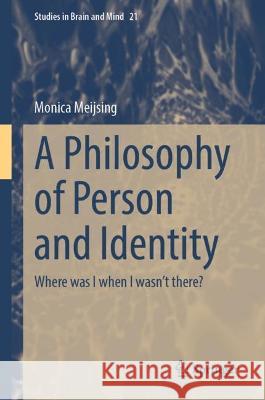
Monica Meijsing
A Philosophy of Person and Identity: Where was I when I wasn't there? Meijsing, Monica 9783031095238 Springer International Publishing - książkaWidoczna okładka, to zdjęcie poglądowe, a rzeczywista szata graficzna może różnić się od prezentowanej.

A Philosophy of Person and Identity: Where was I when I wasn't there?

ISBN-13: 9783031095238 / Angielski / Twarda / 2022

Monica Meijsing
cena 443,82
(netto: 422,69 VAT:  5%)

Najniższa cena z 30 dni: 424,07
Termin realizacji zamówienia:
ok. 22 dni roboczych
Bez gwarancji dostawy przed świętami

Darmowa dostawa!
inne wydania

This book discusses the themes of personhood and personal identity. It argues that while there is a metaphysical answer to the question of personal identity, there is no metaphysical answer to the question of what constitutes a person. The author argues against both body-mind dualism and physicalism and also against the idea that there is some metaphysically real category of persons distinct from the category of human beings or human organisms. Instead, the author presents neutral-monist, autopoietic-enactivist kind of metaphysics of the human being, and a relational, and completely human-dependent notion of a person. 


The tools used in these arguments include conceptual argumentation and empirical case studies. Using both personal experiences and studies of cultures all over the world, the author examines dualism between mind and body. The author discusses real people who seem to live a Cartesian life, as somehow disembodied minds as well as the concept of the person. The author uses the concluding chapters to present their own views arguing that questions about our identity should be separated from questions of our personhood as well as the concept of personhood. This volume is of interest to scholars of philosophy of mind.


Kategorie:
Nauka, Filozofia
Kategorie BISAC:
Philosophy > Mind & Body
Wydawca:
Springer International Publishing
Seria wydawnicza:
Studies in Brain and Mind
Język:
Angielski
ISBN-13:
9783031095238
Rok wydania:
2022
Waga:
0.47 kg
Wymiary:
23.5 x 15.5
Oprawa:
Twarda
Dodatkowe informacje:
Wydanie ilustrowane

1.     1. WHERE WAS I? WHAT AM I?


2.      2. LIFE AND DEATH, SOUL AND BODY

2.1   Is there life after death?

2.2   Out-of-body experiences and the weight of the soul

2.3   Dualism in Antiquity

2.4 Descartes: from soul to mind and from living body to lifeless mechanism 


3.     3. CONSCIOUSNESS, PERSON AND SELF

3.1   New concepts in Descartes

3.2   Locke on human being and person

3.3   Contemporary meanings of consciousness

3.4   New meanings of the self

3.5   Damasio: several forms of consciousness and several selves


4.      CARTESIAN PEOPLE 1: THE BODY A MACHINE

4.1 The helm and the pineal gland

4.2 The mind, self-consciousness and certainty

4.3 Really existing cartesian people? The case of Ian Waterman

4.4 What is Ian Waterman missing? Proprioception

4.5 Proprioception as an argument against Descartes

4.6 Has Ian Waterman lost his body? Bodylessness

4.7 Visual perception, movement and the body

4.8 Conclusion: not just bodiless thinkers, nor just passive feelers, but active embodied creatures


5.      5. CARTESIAN PEOPLE 2: THE BODY AN ILLUSION

5.1   Cartesian mind and material brain

5.2   Brains without bodies: the brain in a vat

5.3   Evil demons and evil scientists: the role of thought experiments and of empirical data

5.4   Empirical data about brains without bodies: Descartes and phantoms

5.5   Phantom phenomena as argument for the possibility of a brain in a vat

5.6   Kinds of phantom phenomena

5.7   Moving a phantom

5.8   Acquired and congenital phantoms

5.9   Moving really existing limbs: forward models in the brain

5.10          Moving really existing limbs: ownership and agency

5.11          Moving really existing limbs: intentions to move

5.12          Possible explanations for phantom movements 1: the bell cord

5.13          Possible explanations for phantom movements 2: innate motor schemas

5.14          Ian Waterman’s innate motor schemas

5.15          Possible explanations of phantom movements 3: mirror neurons

5.16          Moving limbs and brains in a vat

5.17          Conclusion: is the body an illusion?

6.      LOCKEAN PERSONS 1. LIVING WITHOUT MEMORY

6.1   Locke’s criterion for personal identity

6.2   The memory criterion as constitutive for personal identity

6.3   The memory criterion as subjective

6.4   The memory criterion for personal identity and the autobiographical self

6.5   Life without autobiographical memory, the case of Clive Wearing 

7.     7. LOCKEAN PERSONS 2. PERSONS AND ORGANISMS.

7.1   Persons and living organisms

7.2   Persons constituted by organisms: Lynne Baker

7.3   The anti-constitution argument

7.4   The self-reference argument

7.5   The development argument

7.6   Conclusion: persons cannot be non-identical with organisms 

8.     8.  THE GRADUAL ORIGIN OF SELF-CONSCIOUSNESS

8.1   The paradox of self-consciousness

8.2   Consciousness and self-consciousness in animals

8.3   The gradualist account: perception, movement and self-consciousness.

8.4   Forms of self-consciousness

9.      “HERE I AM”

9.1   Self-consciousness and the first-person pronoun

9.2   The first-person perspective as criterion of identity

9.3   Psychological identity criterion or body criterion?

9.4   What we are

9.5   Human organisms and others

9.6   How we become persons

9.7   The importance of being a person


Monica Meijsing (1954) studied psychology and philosophy. She obtained her Ph.D. in philosophy in 1986 on the mind-body problem in relation with cognitive psychology.  She has held positions in the departments of philosophy and of cognitive science at the Universities of Amsterdam, Nijmegen and Tilburg. Her research focusses on (self)consciousness and the body, personal identity and perception.

This book discusses the themes of personhood and personal identity. It argues that while there is a metaphysical answer to the question of personal identity, there is no metaphysical answer to the question of what constitutes a person. The author argues against both body-mind dualism and physicalism and also against the idea that there is some metaphysically real category of persons distinct from the category of human beings or human organisms. Instead, the author presents neutral-monist, autopoietic-enactivist kind of metaphysics of the human being, and a relational, and completely human-dependent notion of a person. 


The tools used in these arguments include conceptual argumentation and empirical case studies. Using both personal experiences and studies of cultures all over the world, the author examines dualism between mind and body. The author discusses real people who seem to live a Cartesian life, as somehow disembodied minds as well as the concept of the person. The author uses the concluding chapters to present their own views arguing that questions about our identity should be separated from questions of our personhood as well as the concept of personhood. This volume is of interest to scholars of philosophy of mind.




Udostępnij

Facebook - konto krainaksiazek.pl


Opinie o Krainaksiazek.pl na Opineo.pl

Partner Mybenefit

Krainaksiazek.pl w programie rzetelna firma Krainaksiaze.pl - płatności przez paypal

Czytaj nas na:

Facebook - krainaksiazek.pl
  • książki na zamówienie
  • granty
  • książka na prezent
  • kontakt
  • pomoc
  • opinie
  • regulamin
  • polityka prywatności

Zobacz:

  • Księgarnia czeska

  • Wydawnictwo Książkowe Klimaty

1997-2025 DolnySlask.com Agencja Internetowa

© 1997-2022 krainaksiazek.pl
     
KONTAKT | REGULAMIN | POLITYKA PRYWATNOŚCI | USTAWIENIA PRYWATNOŚCI
Zobacz: Księgarnia Czeska | Wydawnictwo Książkowe Klimaty | Mapa strony | Lista autorów
KrainaKsiazek.PL - Księgarnia Internetowa

Polityka prywatnosci - link
Krainaksiazek.pl - płatnośc Przelewy24
Przechowalnia Przechowalnia





