• Wyszukiwanie zaawansowane
  • Kategorie
  • Kategorie BISAC
  • Książki na zamówienie
  • Promocje
  • Granty
  • Książka na prezent
  • Opinie
  • Pomoc
  • Załóż konto
  • Zaloguj się

A Historical Syntax of English » książka

zaloguj się | załóż konto
Logo Krainaksiazek.pl

koszyk

konto

szukaj
topmenu
Księgarnia internetowa
Szukaj
Książki na zamówienie
Promocje
Granty
Książka na prezent
Moje konto
Pomoc
 
 
Wyszukiwanie zaawansowane
Pusty koszyk
Bezpłatna dostawa dla zamówień powyżej 20 złBezpłatna dostawa dla zamówień powyżej 20 zł

Kategorie główne

• Nauka
 [2949965]
• Literatura piękna
 [1857847]

  więcej...
• Turystyka
 [70818]
• Informatyka
 [151303]
• Komiksy
 [35733]
• Encyklopedie
 [23180]
• Dziecięca
 [617748]
• Hobby
 [139972]
• AudioBooki
 [1650]
• Literatura faktu
 [228361]
• Muzyka CD
 [398]
• Słowniki
 [2862]
• Inne
 [444732]
• Kalendarze
 [1620]
• Podręczniki
 [167233]
• Poradniki
 [482388]
• Religia
 [509867]
• Czasopisma
 [533]
• Sport
 [61361]
• Sztuka
 [243125]
• CD, DVD, Video
 [3451]
• Technologie
 [219309]
• Zdrowie
 [101347]
• Książkowe Klimaty
 [123]
• Zabawki
 [2362]
• Puzzle, gry
 [3791]
• Literatura w języku ukraińskim
 [253]
• Art. papiernicze i szkolne
 [7933]
Kategorie szczegółowe BISAC

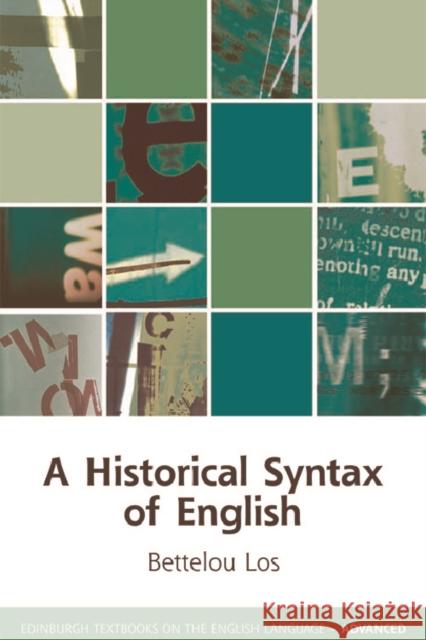
A Historical Syntax of English

ISBN-13: 9780748641437 / Angielski / Miękka / 2015 / 304 str.
Bettelou Los
A Historical Syntax of English Bettelou Los 9780748641437 Edinburgh University Press - książkaWidoczna okładka, to zdjęcie poglądowe, a rzeczywista szata graficzna może różnić się od prezentowanej.

A Historical Syntax of English

ISBN-13: 9780748641437 / Angielski / Miękka / 2015 / 304 str.

Bettelou Los
cena 128,05
(netto: 121,95 VAT:  5%)

Najniższa cena z 30 dni: 123,89
Termin realizacji zamówienia:
ok. 30 dni roboczych
Bez gwarancji dostawy przed świętami

Darmowa dostawa!
inne wydania

Aimed at advanced students, this book discusses a number of approaches to charting the major developments in the syntax of English. It does not assume any knowledge of Old or Middle English or of formal syntax, although students should be familiar with traditional syntactic concepts such as verbs and nouns, subjects and objects, and linguistic concepts such as morphology and case. Bettelou Los draws on explanations from both formal and functional approaches to explore how syntactic changes are the product of the interaction of many internal and external factors.


Kategorie:
Inne
Kategorie BISAC:
Language Arts & Disciplines > Grammar & Punctuation
Language Arts & Disciplines > Linguistics - Etymology
Wydawca:
Edinburgh University Press
Język:
Angielski
ISBN-13:
9780748641437
Rok wydania:
2015
Ilość stron:
304
Waga:
0.35 kg
Wymiary:
21.59 x 13.97 x 1.63
Oprawa:
Miękka
Wolumenów:
01
Dodatkowe informacje:
Bibliografia

List of figures and tables; List of abbreviations; Note on data references; Preface; 1: Introduction; 1.1: What is syntax?; 1.2: What is syntax for?; 1.3: Three dimensions of syntax; 1.3.1: Introduction; 1.3.2: Morphology or syntax?; 1.3.3: The expression of the semantic roles; 1.3.4: Word order variation; 1.4: Word order and meaning; 1.4.1: Introduction; 1.4.2: Pragmatics and information structure; 1.4.3: Discourse markers; 1.4.4: Discourse routines become syntax; 1.5: Interpreting historical data; 1.5.1: Introduction; 1.5.2: Sufficient data; 1.5.3: Genre and register; 1.5.4: Spoken versus written texts; 1.5.5: Dating texts; 1.5.6: The problem of negative evidence; 1.6: Summary of points; Exercises; Further reading; 2: Nominal categories: The loss of nominal morphology; 2.1: Introduction; 2.2: Derivation and inflection; 2.3: Inherent versus contextual inflection; 2.4: Number; 2.5: Gender; 2.6: Case; 2.7: The grammaticalisation of prepositions; 2.7.1: To; 2.7.2: Of; 2.8: The expression of definiteness; 2.9: Loss of morphology and word order change; 2.10: Modelling morpho-syntactic variation of case and prepositions; 2.11: Why is morphology lost?; 2.12: Which morphology is lost?; 2.13: Summary of points; Exercises; Further reading; 3: Verbal categories: The rise of the auxiliaries have and be; 3.1: Introduction; 3.2: Modality, tense, and aspect (TMA); 3.3: Lexical and grammatical aspect; 3.4: Alternative expressions for aspect; 3.4.1: Lexical items; 3.4.2: Prefixes and particles; 3.4.3: Positional verbs; 3.4.4: In or on; 3.4.5: Aspectualisers; 3.5: The perfect; 3.5.1: The development of the have+past participle perfect; 3.5.2: The development of the be+past participle perfect; 3.5.3: Competition between have- and be-perfects; 3.6: The development of the be+present participle progressives; 3.7: The passive; 3.8: Summary of points; Exercises; Further reading ; 4: Verbal categories: The rise of the modal auxiliaries; 4.1: Introduction ; 4.2: The NICE-properties in PDE; 4.2.1: Introduction; 4.2.2: Negation; 4.2.3: Inversion; 4.2.4: Code (or ellipsis); 4.2.5: Emphasis; 4.3: Modelling the NICE properties; 4.3.1: Introducing the IP; 4.3.2: Negation; 4.3.3: Negative contraction; 4.3.4: Inversion; 4.3.5: Code (or ellipsis); 4.3.6: Adverb placement; 4.4: NICE-properties in historical perspective; 4.4.1: Inversion: From V-to-I-to-C movement to I-to-C movement; 4.4.2: Negation; 4.4.3: Code (or ellipsis); 4.4.4: Emphasis; 4.4.5: Adverb placement; 4.4.6: Conclusions; 4.5: The verbal characteristics of auxiliaries ; 4.5.1: Introduction; 4.5.2: Agreement and tense; 4.5.3: Argument structure; 4.5.4: Concluding remarks; 4.6: The rise of do-support; 4.7: Ragged edges: be, do, have, dare, need and ought to; 4.8: Modelling the grammaticalisation of the modals; 4.9: Summary of points; Exercises; Further reading; 5: Complementation ; 5.1: Introduction; 5.2: Ragged edges: Usage and productivity; 5.2.1: Introduction; 5.2.2: Set; 5.2.3: Make; 5.2.4 Cause; 5.2.5: Conclusions; 5.3: The rise of the ing-form; 5.3.1: Introduction; 5.3.2: Origin of gerunds; 5.3.3: From nominalisations to gerunds; 5.3.4: The rise and spread of the gerund as verb complement; 5.3.5: The present participle/gerund nexus; 5.4:The rise of the to-infinitive; 5.4.1: Introduction; 5.4.2: Origin of to-infinitives; 5.4.3: Diagnostic tests for clausal status; 5.4.4: From adjunct to verb complement; 5.4.5: Stage I: Verbs of spatial manipulation; 5.4.6 Stage II: Verbs of firing up; 5.4.7: Stage III: Verbs of commanding and permitting; 5.4.8: Stage IV: Expressing ‘dependent desires’; 5.4.9: Stage V: Verbs of thinking and declaring; 5.5: Summary of points; Exercises; Further reading; 6: The structure of the clause; 6.1: Introduction; 6.2: The text; 6.3: The word order of the subclause ; 6.3.1: Introduction; 6.3.2: Identifying subclauses ; 6.3.3: Special positions for old information; 6.3.4: Extraposition; 6.3.5: And-clauses; 6.4: Modelling S-(A)-O-V; 6.4.1: Right-headed VP and IP; 6.4.2: Verb raising; 6.5: The change from OV to VO; 6.5.1: Postverbal objects; 6.5.2: Postverbal pronouns and particles; 6.5.3: Postverbal stranded prepositions; 6.5.4: Information structure as a diagnostic for change; 6.6: Summary of points; Exercises; Further reading; 7: Verb-Second; 7.1: Introduction; 7.2: Verb-movement to the second position; 7.3:Modelling movement to the second position; 7.4: Verb-movement to the third position; 7.5: The adverbs þa, þonne, þær and nu; 7.6: Modelling movement to the third position; 7.7: Early verbs in subclauses; 7.7.1: Introduction; 7.7.2: Main-clause-like subclauses; 7.7.3: Extraposition; 7.7.4: Verb projection raising; 7.7.5: Left-headed IP; 7.7.6: Conclusion; 7.8: Charting the decline of Verb-Second; 7.8.1: Introduction; 7.8.2: Interrogative and negative clauses; 7.8.3: Then, there, thus, so; 7.8.4: Stance adverbs; 7.8.5: Verbs of saying; 7.8.6: Nominal and pronominal subjects; 7.8.7: Discourse functions; 7.8.8: The elevated style; 7.8.9: The ‘late subject’ construction; 7.9: Causes of the decline; 7.9.1: Language-internal causes; 7.9.2: Language-external causes; 7.10: Summary of points; Exercises; Further reading; 8: Syntax and discourse; 8.1: Introduction; 8.2:Grounding, assertion and subordination ; 8.3: Foregrounding and peak marking; 8.4: Creating suspense; 8.4.1:The durative main clause+ oþ-clause pair; 8.4.2: Durative motion verbs, AcIs and Verb-First in Beowulf; 8.4.3: Durative onginnan/beginnan ‘begin’ and Verb-First in Ælfric; 8.5: Correlative linking; 8.5.1: Introduction; 8.5.2: Complement clauses; 8.5.3: Adverbial clauses; 8.5.4: Relative clauses; 8.6: From parataxis to hypotaxis; 8.7: V-to-C in þa-correlatives; 8.8: Summary of points; Exercises; Further reading

Los, Bettelou Bettelou Los is a senior lecturer in English lingu... więcej >


Udostępnij

Facebook - konto krainaksiazek.pl


Opinie o Krainaksiazek.pl na Opineo.pl

Partner Mybenefit

Krainaksiazek.pl w programie rzetelna firma Krainaksiaze.pl - płatności przez paypal

Czytaj nas na:

Facebook - krainaksiazek.pl
  • książki na zamówienie
  • granty
  • książka na prezent
  • kontakt
  • pomoc
  • opinie
  • regulamin
  • polityka prywatności

Zobacz:

  • Księgarnia czeska

  • Wydawnictwo Książkowe Klimaty

1997-2025 DolnySlask.com Agencja Internetowa

© 1997-2022 krainaksiazek.pl
     
KONTAKT | REGULAMIN | POLITYKA PRYWATNOŚCI | USTAWIENIA PRYWATNOŚCI
Zobacz: Księgarnia Czeska | Wydawnictwo Książkowe Klimaty | Mapa strony | Lista autorów
KrainaKsiazek.PL - Księgarnia Internetowa

Polityka prywatnosci - link
Krainaksiazek.pl - płatnośc Przelewy24
Przechowalnia Przechowalnia






