A Formal Background to Mathematics 2a: A Critical Approach to Elementary Analysis » książka





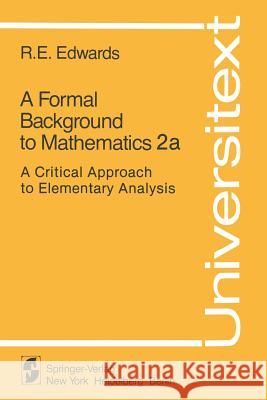
A Formal Background to Mathematics 2a: A Critical Approach to Elementary Analysis
ISBN-13: 9780387905136 / Angielski / Twarda / 1980 / 606 str.
A Formal Background to Mathematics 2a: A Critical Approach to Elementary Analysis
ISBN-13: 9780387905136 / Angielski / Twarda / 1980 / 606 str.
(netto: 270,86 VAT: 5%)
Najniższa cena z 30 dni: 269,85
ok. 16-18 dni roboczych.
Darmowa dostawa!
VII: Convergence of Sequences.- Hidden hypotheses.- VII.1 Sequences convergent inR.- VII.1.1 Definition of convergence to zero.- VII.1.2 Remarks.- VII.1.3 Definition of convergence in R.- VII.1.4 Remarks.- VII.1.5 Lemma.- VII.1.6 Theorem.- VII.1.7 Theorem.- VII.1.8 Theorem.- VII.1.9 Problems.- VII.1.10 Theorem.- VII.1.11 Theorem.- VII.1.12 Examples.- VII.1.13 More about converses.- VII.2 Infinite limits.- VII.2.1 The symbols -?, -?; the extended real line.- VII.2.2 Definition of convergence to ? or to -?.- VII.2.3 Theorem.- VII.2.4 Remarks.- VII.2.5 Example.- VII.2.6 Problems.- VII.3 Subsequences.- VII.3.1 Definition of subsequences.- VII.3.2 Theorem.- VII.3.3 Theorem.- VII.3.4 Examples.- VII.3.5 Lemma.- VII.3.6 Remark.- VII.4 The Monotone Convergence Principle again.- VII.4.1 The MCP.- VII.4.2 Example: the compound interest sequence.- VII.4.3 Preliminaries concering the number e.- VII.4.4 Problems.- VII.4.5 Theorem (Weierstrass-Bolzano).- VII.4.6 Kronecker’s Theorem.- VII.5 Suprema and infima of sets of real numbers.- VII.5.1 Suprema.- VII.5.2 Infima.- VII.5.3 Example.- VII.5.4 Problems.- VII.5.5 Concerning formalities.- VII.5.6 Concerning notation and terminology.- VII.6 Exponential and logarithmic functions.- VII.6.1 Definition of exp.- VII.6.2 Theorem.- VII.6.3 Theorem.- VII.6.4 Remarks.- VII.6.5 Theorem.- VII.6.6 Theorem.- VII.6.7 An alternative approach.- VII.6.8 Concerning formalities.- VII.7 The General Principle of Convergence.- VII.7.1 Definition.- VII.7.2 The GCP.- VII.7.3 Discussion of convergence principles.- VII.7.4 Remarks concerning Cantor’s construction of R.- VII.7.5 Concerning existential proofs.- VIII: Continuity and Limits of Functions.- and hidden hypotheses.- VIII.1 Continuous functions.- VIII.1.1 Definition of continuous functions.- VIII.1.2 Examples.- VIII.1.3 Theorem.- VIII.1.4 Problems.- VIII.2 Properties of continuous functions.- VIII.2.1 Theorem (Intermediate Value Theorem).- VIII.2.2 Comments on the preceding proof.- VIII.2.3 Corollary.- VIII.2.4 A geometrical illustration.- VIII.2.5 Theorem.- VIII.2.6 Problems.- VIII.2.7 Theorem.- VIII.2.8 Corollary.- VIII.2.9 Remark.- VIII.2.10 Problem.- VIII.2.11 Remark.- VIII.2.12 Problems.- VIII.3 General exponential, logarithmic and power functions.- VIII.3.1 Real powers of positive numbers.- VIII.3.2 The exponential and logarithmic functions with base a.- VIII.3.3 Power functions.- VIII.3.4 Problems.- VIII.4 Limit of a function at a point.- VIII.4.1 Preliminary definitions.- VIII.4.2 The full and punctured limits of a function at a point.- VIII.4.3 Theorem.- VIII.4.4 Some formalities and further discussion.- VIII.4.5 Theorem.- VIII.4.6 Limits of composite functions.- VIII.4.7 Other species of limits; one sided limits.- VIII.4.8 Problems.- VIII.5 Uniform continuity.- VIII.5.1 Preliminary discussion.- VIII.5.2 Definition.- VIII.5.3 Theorem.- VIII.5.4 Problems.- VIII.5.5 Remarks.- VIII.6 Convergence of sequences of functions.- VIII.6.1 Definition of pointwise convergence.- VIII.6.2 Examples.- VIII.6.3 Further discussion.- VIII.6.4 Definition of uniform convergence.- VIII.6.5 Theorem.- VIII.6.6 Examples.- VIII.6.7 Theorem.- VIII.6.8 Theorem.- VIII.6.9 Discussion of some formalities.- VIII.7 Polynomial approximation.- VIII.7.1 Preliminaries.- VIII.7.2 Theorem (Weierstrass).- VIII.7.3 Theorem (Bernstein).- VIII.7.4 Remarks.- VIII.8 Another approach to expa.- Preliminaries.- VIII.8.1 Existence of a solution.- VIII.8.2 Uniqueness of the solution.- VIII.8.3 Summary.- IX: Convergence of Series.- and hidden hypotheses.- IX.1 Series and their convergence.- IX.1.1 Definitions.- IX.1.2 Example.- IX.1.3 Theorem.- IX.1.4 Theorem.- IX.1.5 Theorem.- IX.1.6 Theorem.- IX.1.7 Examples.- IX.2 Absolute and conditional convergence.- IX.2.1 Definition of absolute and conditional convergence.- IX.2.2 Theorem.- IX.2.3 Theorem (General Comparison Test).- IX.2.4 Problems.- IX.2.5 Theorem (d’Alembert’s Ratio Test).- IX.2.6 Theorem (Cauchy n-th Root Test).- IX.2.7 Theorem (Leibnitz’ Test).- IX.2.8 Problem.- IX.2.9 Theorem.- IX.2.10 Problems.- IX.2.11 General remarks.- IX.3 Decimal expansions.- IX.3.1 Lemma.- IX.3.2 Lemma.- IX.3.3 Corollary.- IX.3.4 Example.- IX.3.5 Liouville numbers.- IX.4 Convergence of series of functions.- IX.4.1 Theorem.- IX.4.2 Problems.- IX.4.3 Theorem.- IX.4.4 Remark.- IX.4.5 Concluding remarks.- X: Differentiation.- and hidden hypotheses.- X.1 Derivatives.- X.1.1 Definition of derivative.- X.1.2 The derivative function.- X.1.3 Comments on the definition of derivative.- X.1.4 Equivalent formulations of X.1.1.- X.1.5 Differentiability and continuity.- X.1.6 Local nature of differentiability.- X.1.7 Derivative of jn when $$n \in \dot Nx$$.- X.1.8 Derivative of a constant function.- X.2 Rules for differentiation.- X.2.1 Theorem.- X.2.2 Theorem (The chain rule).- X.2.3 Theorem.- X.2.4 Derivative of jr when r is rational.- X.2.5 Derivatives of exponential, logarithmic and general power functions.- X.2.6 Implicit algebraic functions.- X.2.7 Cauchy’s “singular function”.- X.2.8 Continuous nowhere differentiable functions.- X.2.9 Concerning routine exercises.- X.3 The mean value theorem and its corollaries.- X.3.1 Mean value theorem.- X.3.2 Remarks.- X.3.3 Corollary.- X.3.4 Remarks.- X.3.5 Relations with monotonicity.- X.4 Primitives.- X.4.1 Difference of two primitives.- X.4.2 The existence problem for primitives.- X.4.3 Functions with no primitive.- X.4.4 Darboux continuity.- X.5 Higher order derivatives.- X.6 Extrema and derivatives.- X.6.1 Extremum points.- X.6.2 Local extrema.- X.6.3 Theorem.- X.6.4 Theorem.- X.6.5 Theorem.- X.6.6 Remarks.- X.6.7 Global extrema.- X.6.8 Global Extrema (continued).- X.6.9 The case of rational functions.- X.6.10 Some examples.- X.7 A differential equation and the exponential function again.- X.7.1 A conventional approach.- X.7.2 Remarks.- X.7.3 Preferred approach.- X.7.4 The exponential function refounded.- X.7.5 Proof of (10) in X.7.4.- X.7.6 General remarks concerning differential equations.- X.8 Calculus in several variables.- XI: Integration.- XI.1 Integration and area.- XI.1.1 Concept of area.- XI.1.2 Middle-of-the-road treatment.- XI.1.3 Area as basic concept.- XI.1.4 Purely analytic approach.- XI.1.5 Teaching background.- XI.1.6 Concerning terminology; hidden hypotheses.- XI.2 Analytic definition and study of integration.- XI.2.1 Partitions.- XI.2.2 Approximative sums.- XI.2.3 Definition of integrable functions; first consequences.- XI.2.4 Criterion of integrability; further remarks.- XI.2.5 Linearity of the integral.- XI.2.6 Integrability of continuous functions.- XI.2.7 Integrability of monotone functions.- XI.2.8 Integrability over subintervals.- XI.2.9 Additivity of the integral.- XI.2.10 Simplest cases of “change of variable”.- XI.2.11 A worked problem.- XI.2.12 Concerning the concept of integral.- XI.3 Integrals and primitives.- Preliminaries.- XI.3.1 Derivative of an integral; existence of a primitive.- XI.3.2 Remarks.- XI.3.3 Integral of a derivative.- XI.3.4 Tables of integrals.- XI.3.5 General comments.- XI.4 Integration by parts.- XI.4.1 Theorem.- XI.4.2 Remarks.- XI.5 Integration by change of variable (or by substitution).- XI.5.1 Theorem.- XI.5.2 Remarks.- XI.5.3 Use of XI.5.1.- XI.6 Termwise integration of sequences of functions.- Preliminaries.- XI.6.1 Convergence theorem for integrals.- XI.6.2 Comments on XI.6.1.- XI.6.3 Corollaries of XI.6.1.- XI.6.4 Ad hoc treatments.- XI.6.5 Problem.- XI.7 Improper integrals.- Preliminaries.- XI.7.1 Two problems discussed.- XI.7.2 Basic definitions and properties of certain improper integrals.- XI.7.3 More about conditionally convergent improper integrals.- XI.7.4 Generalised concept of limit.- XI.7.5 Concerning formalities.- XI.8 First order linear differential equations.- XI.8.1 The solutions of (1).- XI.8.2 Behaviour of solutions near the origin.- XI.8.3 Concerning formalities.- XI.9 Integrals in several variables.- XII: Complex Numbers: Complex Exponential and Trigonometric Functions.- XII.1 Definition of complex numbers.- XII.1.1 Basic definitions and theorems.- XII.1.2 Real and imaginary parts, absolute values and complex conjugates; rectangles, discs and circles.- XII.1.3 Generalisations of earlier theorems.- XII.1.4 Problems.- XII.2 Groups, subgroups and homomorphisms.- Preliminaries.- XII.2.1 Definition of groups.- XII.2.2 Subgroups.- XII.2.3 Homomorphisms and isomorphisms.- XII.2.4 Problems.- XII.3 Homomorphisms ofRinto ?; complex exponentials.- XII.3.1 Theorem.- XII.3.2 Theorem.- XII.3.3 Lemma.- XII.3.4 The functions e?.- XII.3.5 Remark.- XII.3.6 Homomorphisms of R into ?.- XII.3.7 Problems.- XII.3.8 Coupled differential equations for cos and sin.- XII.4 The exponential function with domainC.- XII.4.1 Definition.- XII.4.2 Properties of exp.- XII.4.3 Problems.- XII.4.4 Remarks.- XII.5 The trigonometric functions cosine and sine.- Preliminaries.- XII.5.1 Definition and first properties of cos and sin.- XII.5.2 Periodicity of cos and sin: the number ?.- XII.5.3 The ranges of sin, cos and ei.- XII.5.4 Polar representation, arguments, logarithms and powers.- XII.5.5 Problems.- XII.5.6 The function tan and a partial inverse.- XII.5.7 The irrationality of ?.- XII.5.8 Problems.- XII.5.9 The length of ?.- XII.5.10 The fundamental theorem of algebra.- XII.5.11 Remarks.- XII.6 Further inverse trigonometric functions.- XII.6.1 A partial inverse of sin.- XII.6.2 Discussion of a problem.- XII.6.3 Remarks.- XII.7 The simple harmonic equation.- XII.8 Another differential equation.- XII.9 Matrices and complex numbers.- XII.9.1 Definition of 2 × 2 real matrices.- XI.9.2 Complex numbers and 2 × 2 real matrices.- XII.9.3 Properties of M2(R).- XII.10 A glance at Fourier series.- XII.10.1 Fourier representation of functions.- XII.10.2 Approximation by trigonometric polynomials.- XII.10.3 Orhtonormality relations.- XII.10.4 Fourier series; the Dirichlet kernel.- XII.10.5 Theorem.- XII.10.6 The Fejér kernel.- XII.10.7 Fejér’s theorem.- XII.10.8 Parseval’s formula.- XII.10.9 Uniqueness theorem.- XII.10.10 Concluding remarks.- XII.11 Linear differential equations with constant coefficients.- XII.11.1 Concerning polynomials over C.- XII.11.2 Linear spaces and linear operators.- XII.11.3 Differential operators P(D).- XII.11.4 The structure of ker P(D).- XII.11.5 Description of K?,m.- XII.11.6 Complete solution of the homogeneous equation.- XII.11.7 The non-homogeneous equation.- XII.11.8 The spaces V, D+; convolutions over R.- XII.11.9 Green’s kernels.- XII.11.10 Solution of the non-homogeneous equation.- XII.11.11 Extensions.- XII.11.12 Systems of first order linear differential equations.- XII.11.13 Equations throughout intervals.- XII.11.14 Summary of procedure.- XI.11.15 Concerning formalities.- XIII: Concerning Approximate Integration.- XIII.1 Quotes from syllabus notes.- XIII.1.1 Error of the mid-ordinate rule.- XIII.1.2 Simpson’s rule versus the mid-ordinate rule.- XIII.1.3 Error a decreasing function of the number of strips.- XIII.2 Notation and preliminaries.- XIII.2.1 Mid-ordinate and Simpson’s Rules.- XIII.2.2 The sets C(r).- XIII.2.3 Approximation for continuous functions.- XIII.3 Precise formulation of statements XIII.1.1 – XIII.1.3.- XIII.3.1 Modification of XIII.1.1.- XIII.3.2 Modification of XIII.1.2.- XIII.3.3 Modification of XIII.1.3.- XIII.3.4 Discussion.- XIII.4 Some corrected versions.- XIII.4.1 Theorem.- XIII.4.2 Theorem.- XIII.4.3 Theorem.- XIII.4.4 Discussion.- XIII.4.5 Exceptional sets.- XIII.4.6 Total accuracy.- XIII.5 Falsity of statements XIII.3.1 – XIII.3.3.- Preliminaries.- XIII.5.1 Falsity of XIII.3.1.- XIII.5.2 Falsity of XIII.3.2.- XIII.5.3 Falsity of XIII.3.3.- XIII.5.4 The crucial point in XIII.5.2.- XIII.5.5 Concerning the proofs in XIII.5.1 – XIII.5.3.- XIII.5.6 Alternative refutations.- XIII.6 The formulas applied to tabulated data.- XIV: Differential Coefficients.- XIV.1 The d-notation and differential coefficients.- Preliminaries.- XIV.1.1 Differentials.- XIV.1.2 Differential coefficients.- XIV.1.3 Coordinate functions.- XIV.1.4 A more general approach to differential coefficients.- XIV.1.5 New definition of differential coefficients.- XIV.1.6 Basic properties of differential coefficients.- XIV.1.7 Differentiability and existence of the differential coefficient.- XIV.1.8 The chain rule again.- XIV.1.9 Fucntions with constant differential coefficients.- XIV.1.10 Summary.- XIV.1.11 Concerning extensions.- XIV.2 The simple harmonic equation.- XIV.2.1 Formulation of the problem.- XIV.2.2 The text book solution.- XIV.2.3 Criticism of the text book solution.- XIV.2.4 Alternative solutions.- XIV.2.5 Remark.- XV: Lengths of Curves.- XV.1 Quotes and criticisms.- XV.2 Paths.- XV.2.1 Definition of paths.- XV.2.2 Comments on the definition.- XV.2.3 Discussion: meagre sets.- XV.3 Lengths of paths.- XV.3.1 Definition of length.- XV.3.2 Monotonicity of L(?, p).- XV.3.3 Proof of (1) in XV.2.2.- XV.3.4 Length as a limit.- XV.4 Path length as an integral.- XV.4.1 Basic integral formula.- XV.4.2 A generalisation of XV.4.1.- XV.4.3 Further extensions.- XV.5 Ratio of arc length to chord length.- XV.5.1 Arcs.- XV.5.2 Ration of arc length to chord length.- XV.5.3 Cases in which XV.5.2(1) is true.- XV.5.4 Examples for which XV.5.2(1) is false.- XV.6 Additivity of arc length.- XV.7 Equivalent paths; simple paths.- XV.7.1 Equivalent paths.- XV.7.2 Simple paths.- XV.7.3 Theorem.- XV.7.4 Lemma.- XV.7.5 Reformulation of XV.7.4.- XV.7.6 Remarks.- XV.7.7 Lengths of simple paths and distance preserving maps.- XV.7.8 The shortest distance between two points.- XV.7.9 Minimising property of simple paths.- XV.7.10 Remarks on the preceding proof.- XV.8 Circular arcs; application to complex exponential and trigonometric functions.- XV.8.1 ? as a simple closed path.- XV.8.2 The arc length function and its inverse E.- XV.8.3 Further properties of E.- XV.8.4 E is a homomorphism.- XV.8.5 E is differentiable.- XV.8.6 The functions cos and sin.- XV.8.7 The truth of XV.5.2(1) for circular arcs.- XV.9 Angles and arguments.- XV.9.1 Arguments of complex numbers.- XV.9.2 Angles and their measurement.- XV.10 General remarks about curves.- XV.10.1 Characterisation of tracks of paths.- XV.10.2 The concept of curve.




Czytaj nas na:
1997-2026 DolnySlask.com Agencja Internetowa
KrainaKsiazek.PL - Księgarnia Internetowa


