• Wyszukiwanie zaawansowane
  • Kategorie
  • Kategorie BISAC
  • Książki na zamówienie
  • Promocje
  • Granty
  • Książka na prezent
  • Opinie
  • Pomoc
  • Załóż konto
  • Zaloguj się

A First Course in Stochastic Models » książka

zaloguj się | załóż konto
Logo Krainaksiazek.pl

koszyk

konto

szukaj
topmenu
Księgarnia internetowa
Szukaj
Książki na zamówienie
Promocje
Granty
Książka na prezent
Moje konto
Pomoc
 
 
Wyszukiwanie zaawansowane
Pusty koszyk
Bezpłatna dostawa dla zamówień powyżej 20 złBezpłatna dostawa dla zamówień powyżej 20 zł

Kategorie główne

• Nauka
 [2952079]
• Literatura piękna
 [1850969]

  więcej...
• Turystyka
 [71058]
• Informatyka
 [151066]
• Komiksy
 [35579]
• Encyklopedie
 [23181]
• Dziecięca
 [620496]
• Hobby
 [139036]
• AudioBooki
 [1646]
• Literatura faktu
 [228729]
• Muzyka CD
 [379]
• Słowniki
 [2932]
• Inne
 [445708]
• Kalendarze
 [1409]
• Podręczniki
 [164793]
• Poradniki
 [480107]
• Religia
 [510956]
• Czasopisma
 [511]
• Sport
 [61267]
• Sztuka
 [243299]
• CD, DVD, Video
 [3411]
• Technologie
 [219640]
• Zdrowie
 [100984]
• Książkowe Klimaty
 [124]
• Zabawki
 [2281]
• Puzzle, gry
 [3363]
• Literatura w języku ukraińskim
 [258]
• Art. papiernicze i szkolne
 [8020]
Kategorie szczegółowe BISAC

A First Course in Stochastic Models

ISBN-13: 9780471498803 / Angielski / Twarda / 2003 / 496 str.
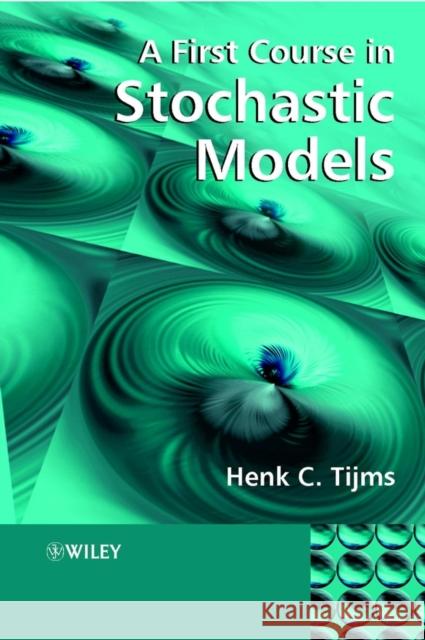
The Netherlands) Tijms Henk C. (Vrije University
A First Course in Stochastic Models Henk C. (Vrije University, The Netherlands) Tijms 9780471498803 John Wiley & Sons - książkaWidoczna okładka, to zdjęcie poglądowe, a rzeczywista szata graficzna może różnić się od prezentowanej.

A First Course in Stochastic Models

ISBN-13: 9780471498803 / Angielski / Twarda / 2003 / 496 str.

The Netherlands) Tijms Henk C. (Vrije University
cena 281,57
(netto: 268,16 VAT:  5%)

Najniższa cena z 30 dni: 279,26
Termin realizacji zamówienia:
ok. 30 dni roboczych.

Darmowa dostawa!

The field of applied probability has changed profoundly in the past twenty years. The development of computational methods has greatly contributed to a better understanding of the theory. A First Course in Stochastic Models provides a self-contained introduction to the theory and applications of stochastic models. Emphasis is placed on establishing the theoretical foundations of the subject, thereby providing a framework in which the applications can be understood. Without this solid basis in theory no applications can be solved.

  • Provides an introduction to the use of stochastic models through an integrated presentation of theory, algorithms and applications.
  • Incorporates recent developments in computational probability.
  • Includes a wide range of examples that illustrate the models and make the methods of solution clear.
  • Features an abundance of motivating exercises that help the student learn how to apply the theory.
  • Accessible to anyone with a basic knowledge of probability.
A First Course in Stochastic Models is suitable for senior undergraduate and graduate students from computer science, engineering, statistics, operations resear ch, and any other discipline where stochastic modelling takes place. It stands out amongst other textbooks on the subject because of its integrated presentation of theory, algorithms and applications.

Kategorie:
Nauka, Matematyka
Kategorie BISAC:
Mathematics > Prawdopodobieństwo i statystyka
Wydawca:
John Wiley & Sons
Język:
Angielski
ISBN-13:
9780471498803
Rok wydania:
2003
Ilość stron:
496
Waga:
0.80 kg
Wymiary:
23.57 x 15.65 x 3.1
Oprawa:
Twarda
Wolumenów:
01
Dodatkowe informacje:
Bibliografia
Wydanie ilustrowane

" successfully combined theory and real world examples into a systematic introduction...an excellent reference for the applied statistician who deals in various queuing models." ( Technometrics, August 2005)

clear and straightforward plenty of worked (or orientated) examples as well as a substantial set of exercises (Short Book Reviews, August 2004)

Preface ix

1 The Poisson Process and Related Processes 1

1.0 Introduction 1

1.1 The Poisson Process 1

1.1.1 The Memoryless Property 2

1.1.2 Merging and Splitting of Poisson Processes 6

1.1.3 The M/G/ Queue 9

1.1.4 The Poisson Process and the Uniform Distribution 15

1.2 Compound Poisson Processes 18

1.3 Non–Stationary Poisson Processes 22

1.4 Markov Modulated Batch Poisson Processes 24

Exercises 28

Bibliographic Notes 32

References 32

2 Renewal–Reward Processes 33

2.0 Introduction 33

2.1 Renewal Theory 34

2.1.1 The Renewal Function 35

2.1.2 The Excess Variable 37

2.2 Renewal–Reward Processes 39

2.3 The Formula of Little 50

2.4 Poisson Arrivals See Time Averages 53

2.5 The Pollaczek Khintchine Formula 58

2.6 A Controlled Queue with Removable Server 66

2.7 An Up– And Downcrossing Technique 69

Exercises 71

Bibliographic Notes 78

References 78

3 Discrete–Time Markov Chains 81

3.0 Introduction 81

3.1 The Model 82

3.2 Transient Analysis 87

3.2.1 Absorbing States 89

3.2.2 Mean First–Passage Times 92

3.2.3 Transient and Recurrent States 93

3.3 The Equilibrium Probabilities 96

3.3.1 Preliminaries 96

3.3.2 The Equilibrium Equations 98

3.3.3 The Long–run Average Reward per Time Unit 103

3.4 Computation of the Equilibrium Probabilities 106

3.4.1 Methods for a Finite–State Markov Chain 107

3.4.2 Geometric Tail Approach for an Infinite State Space 111

3.4.3 Metropolis Hastings Algorithm 116

3.5 Theoretical Considerations 119

3.5.1 State Classification 119

3.5.2 Ergodic Theorems 126

Exercises 134

Bibliographic Notes 139

References 139

4 Continuous–Time Markov Chains 141

4.0 Introduction 141

4.1 The Model 142

4.2 The Flow Rate Equation Method 147

4.3 Ergodic Theorems 154

4.4 Markov Processes on a Semi–Infinite Strip 157

4.5 Transient State Probabilities 162

4.5.1 The Method of Linear Differential Equations 163

4.5.2 The Uniformization Method 166

4.5.3 First Passage Time Probabilities 170

4.6 Transient Distribution of Cumulative Rewards 172

4.6.1 Transient Distribution of Cumulative Sojourn Times 173

4.6.2 Transient Reward Distribution for the General Case 176

Exercises 179

Bibliographic Notes 185

References 185

5 Markov Chains and Queues 187

5.0 Introduction 187

5.1 The Erlang Delay Model 187

5.1.1 The M/M/1 Queue 188

5.1.2 The M/M/c Queue 190

5.1.3 The Output Process and Time Reversibility 192

5.2 Loss Models 194

5.2.1 The Erlang Loss Model 194

5.2.2 The Engset Model 196

5.3 Service–System Design 198

5.4 Insensitivity 202

5.4.1 A Closed Two–node Network with Blocking 203

5.4.2 The M/G/1 Queue with Processor Sharing 208

5.5 A Phase Method 209

5.6 Queueing Networks 214

5.6.1 Open Network Model 215

5.6.2 Closed Network Model 219

Exercises 224

Bibliographic Notes 230

References 231

6 Discrete–Time Markov Decision Processes 233

6.0 Introduction 233

6.1 The Model 234

6.2 The Policy–Improvement Idea 237

6.3 The Relative Value Function 243

6.4 Policy–Iteration Algorithm 247

6.5 Linear Programming Approach 252

6.6 Value–Iteration Algorithm 259

6.7 Convergence Proofs 267

Exercises 272

Bibliographic Notes 275

References 276

7 Semi–Markov Decision Processes 279

7.0 Introduction 279

7.1 The Semi–Markov Decision Model 280

7.2 Algorithms for an Optimal Policy 284

7.3 Value Iteration and Fictitious Decisions 287

7.4 Optimization of Queues 290

7.5 One–Step Policy Improvement 295

Exercises 300

Bibliographic Notes 304

References 305

8 Advanced Renewal Theory 307

8.0 Introduction 307

8.1 The Renewal Function 307

8.1.1 The Renewal Equation 308

8.1.2 Computation of the Renewal Function 310

8.2 Asymptotic Expansions 313

8.3 Alternating Renewal Processes 321

8.4 Ruin Probabilities 326

Exercises 334

Bibliographic Notes 337

References 338

9 Algorithmic Analysis of Queueing Models 339

9.0 Introduction 339

9.1 Basic Concepts 341

9.2 The M/G/1 Queue 345

9.2.1 The State Probabilities 346

9.2.2 The Waiting–Time Probabilities 349

9.2.3 Busy Period Analysis 353

9.2.4 Work in System 358

9.3 The MX/G/1 Queue 360

9.3.1 The State Probabilities 361

9.3.2 The Waiting–Time Probabilities 363

9.4 M/G/1 Queues with Bounded Waiting Times 366

9.4.1 The Finite–Buffer M/G/1 Queue 366

9.4.2 An M/G/1 Queue with Impatient Customers 369

9.5 The GI/G/1 Queue 371

9.5.1 Generalized Erlangian Services 371

9.5.2 Coxian–2 Services 372

9.5.3 The GI /P h/1 Queue 373

9.5.4 The Ph/G/1 Queue 374

9.5.5 Two–moment Approximations 375

9.6 Multi–Server Queues with Poisson Input 377

9.6.1 The M/D/c Queue 378

9.6.2 The M/G/c Queue 384

9.6.3 The MX/G/c Queue 392

9.7 The GI/G/c Queue 398

9.7.1 The GI/M/c Queue 400

9.7.2 The GI/D/c Queue 406

9.8 Finite–Capacity Queues 408

9.8.1 The M/G/c/c + N Queue 408

9.8.2 A Basic Relation for the Rejection Probability 410

9.8.3 The MX/G/c/c + N Queue with Batch Arrivals 413

9.8.4 Discrete–Time Queueing Systems 417

Exercises 420

Bibliographic Notes 428

References 428

Appendices 431

Appendix A. Useful Tools in Applied Probability 431

Appendix B. Useful Probability Distributions 440

Appendix C. Generating Functions 449

Appendix D. The Discrete Fast Fourier Transform 455

Appendix E. Laplace Transform Theory 458

Appendix F. Numerical Laplace Inversion 462

Appendix G. The Root–Finding Problem 470

References 474

Index 475

The field of applied probability has changed profoundly in the past twenty years. The development of computational methods has greatly contributed to a better understanding of the theory. A First Course in Stochastic Models provides a self–contained introduction to the theory and applications of stochastic models. Emphasis is placed on establishing the theoretical foundations of the subject, thereby providing a framework in which the applications can be understood. Without this solid basis in theory no applications can be solved.

  • Provides an introduction to the use of stochastic models through an integrated presentation of theory, algorithms and applications.
  • Incorporates recent developments in computational probability.
  • Includes a wide range of examples that illustrate the models and make the methods of solution clear.
  • Features an abundance of motivating exercises that help the student learn how to apply the theory.
  • Accessible to anyone with a basic knowledge of probability.

A First Course in Stochastic Models is suitable for senior undergraduate and graduate students from computer science, engineering, statistics, operations research, and any other discipline where stochastic modelling takes place. It stands out amongst other textbooks on the subject because of its integrated presentation of theory, algorithms and applications.


Udostępnij

Facebook - konto krainaksiazek.pl


Opinie o Krainaksiazek.pl na Opineo.pl

Partner Mybenefit

Krainaksiazek.pl w programie rzetelna firma Krainaksiaze.pl - płatności przez paypal

Czytaj nas na:

Facebook - krainaksiazek.pl
  • książki na zamówienie
  • granty
  • książka na prezent
  • kontakt
  • pomoc
  • opinie
  • regulamin
  • polityka prywatności

Zobacz:

  • Księgarnia czeska

  • Wydawnictwo Książkowe Klimaty

1997-2026 DolnySlask.com Agencja Internetowa

© 1997-2022 krainaksiazek.pl
     
KONTAKT | REGULAMIN | POLITYKA PRYWATNOŚCI | USTAWIENIA PRYWATNOŚCI
Zobacz: Księgarnia Czeska | Wydawnictwo Książkowe Klimaty | Mapa strony | Lista autorów
KrainaKsiazek.PL - Księgarnia Internetowa

Polityka prywatnosci - link
Krainaksiazek.pl - płatnośc Przelewy24
Przechowalnia Przechowalnia






