• Wyszukiwanie zaawansowane
  • Kategorie
  • Kategorie BISAC
  • Książki na zamówienie
  • Promocje
  • Granty
  • Książka na prezent
  • Opinie
  • Pomoc
  • Załóż konto
  • Zaloguj się

A First Course in Probability Models and Statistical Inference » książka


zaloguj się | załóż konto
Logo Krainaksiazek.pl

koszyk

konto

szukaj
topmenu
Księgarnia internetowa
Szukaj
Książki na zamówienie
Promocje
Granty
Książka na prezent
Moje konto
Pomoc
 
 
Wyszukiwanie zaawansowane
Pusty koszyk
Bezpłatna dostawa dla zamówień powyżej 20 złBezpłatna dostawa dla zamówień powyżej 20 zł

Kategorie główne

• Nauka
 [2950560]
• Literatura piękna
 [1849509]

  więcej...
• Turystyka
 [71097]
• Informatyka
 [151150]
• Komiksy
 [35848]
• Encyklopedie
 [23178]
• Dziecięca
 [617388]
• Hobby
 [139064]
• AudioBooki
 [1657]
• Literatura faktu
 [228597]
• Muzyka CD
 [383]
• Słowniki
 [2855]
• Inne
 [445295]
• Kalendarze
 [1464]
• Podręczniki
 [167547]
• Poradniki
 [480102]
• Religia
 [510749]
• Czasopisma
 [516]
• Sport
 [61293]
• Sztuka
 [243352]
• CD, DVD, Video
 [3414]
• Technologie
 [219456]
• Zdrowie
 [101002]
• Książkowe Klimaty
 [124]
• Zabawki
 [2311]
• Puzzle, gry
 [3459]
• Literatura w języku ukraińskim
 [254]
• Art. papiernicze i szkolne
 [8079]
Kategorie szczegółowe BISAC

A First Course in Probability Models and Statistical Inference

ISBN-13: 9781461264316 / Angielski / Miękka / 2012 / 719 str.
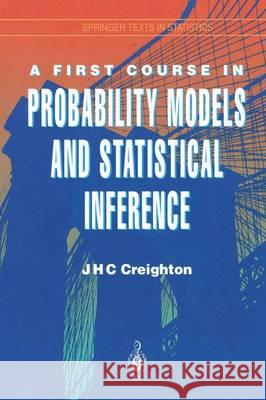
James H. C. Creighton
A First Course in Probability Models and Statistical Inference James H. C. Creighton 9781461264316 Springer - książkaWidoczna okładka, to zdjęcie poglądowe, a rzeczywista szata graficzna może różnić się od prezentowanej.

A First Course in Probability Models and Statistical Inference

ISBN-13: 9781461264316 / Angielski / Miękka / 2012 / 719 str.

James H. C. Creighton
cena 201,24
(netto: 191,66 VAT:  5%)

Najniższa cena z 30 dni: 192,74
Termin realizacji zamówienia:
ok. 22 dni roboczych
Dostawa w 2026 r.

Darmowa dostawa!

Welcome to new territory: A course in probability models and statistical inference. The concept of probability is not new to you of course. You've encountered it since childhood in games of chance-card games, for example, or games with dice or coins. And you know about the "90% chance of rain" from weather reports. But once you get beyond simple expressions of probability into more subtle analysis, it's new territory. And very foreign territory it is. You must have encountered reports of statistical results in voter sur veys, opinion polls, and other such studies, but how are conclusions from those studies obtained? How can you interview just a few voters the day before an election and still determine fairly closely how HUN DREDS of THOUSANDS of voters will vote? That's statistics. You'll find it very interesting during this first course to see how a properly designed statistical study can achieve so much knowledge from such drastically incomplete information. It really is possible-statistics works But HOW does it work? By the end of this course you'll have understood that and much more. Welcome to the enchanted forest."


Kategorie:
Nauka, Matematyka
Kategorie BISAC:
Mathematics > Prawdopodobieństwo i statystyka
Mathematics > Matematyka stosowana
Wydawca:
Springer
Seria wydawnicza:
Springer Texts in Statistics
Język:
Angielski
ISBN-13:
9781461264316
Rok wydania:
2012
Wydanie:
Softcover Repri
Numer serii:
000022139
Ilość stron:
719
Oprawa:
Miękka
Wolumenów:
01

1 — Introduction to Probability Models of the Real World.- 1.1 Probability Distributions of Random Variables.- Probability Models.- Random Variables and Their Random Experiments.- 1.2 Parameters to Characterize a Probability Distribution.- The Expected Value or Mean of a Random Variable.- The Variance, Measuring the Accuracy of the Mean.- 1.3 Linear Functions of a Random Variable.- 1.4 The Fundamentals of Probability Theory.- Three Basic Rules of Probability.- Bayes’ Theorem.- Random Experiments with Equally Likely Outcomes.- Chebyshev’s Theorem.- 1.5 Some Review Exercises.- 2 —Understanding Observed Data.- 2.1 Observed Data from the Real World.- Presenting Data Graphically.- Collecting Data.- Simple Random Samples Drawn from a Probability Distribution.- Populations.- Statistical Questions.- Simple Random Samples Drawn from a Population.- 2.2 Presenting and Summarizing Observed Numeric Data.- Measures of Centrality for Observed Numeric Data.- Measures of Spread for Observed Numeric Data.- 2.3 Grouped Data: Suppressing Irrelevant Detail.- Grouped Distributions of Observed Real World Data.- Histograms: Graphical Display of Grouped Relative Frequency Distributions.- 2.4 Using the Computer.- Describing, Picturing, and Comparing Population and Sample Data.- 3 — Discrete Probability Models.- 3.1 Introduction.- 3.2 The Discrete Uniform Distribution.- 3.3 The Hypergeometric Distribution.- Counting Rules.- What Is the Hypergeometric Model.- Calculating the Probabilities.- The Formulas.- 3.4 Sampling with Replacement from a Dichotomous Population.- What Is the Model?.- The Formulas.- 3.5 The Bernoulli Trial.- 3.6 The Geometric Distribution.- What Is the Model?.- The Formulas.- 3.7 The Binomial Distribution.- The Binomial Experiment.- The Binomial Random Variable Itself.- 3.8 The Poisson Distribution.- 3.9 The Negative Binomial Distribution.- 3.10 Some Review Problems.- 4 — Continuous Probability Models.- 4.1 Continuous Distributions and the Continuous Uniform Distribution.- Continuous Distributions.- The Probability Density function.- The Continuous Uniform Distribution.- 4.2 The Exponential Distribution.- Modeling the Reliability of a System.- The Exponential Distribution.- 4.3 The Normal Distribution.- The Normal Distribution as a Model for Measurement Error.- The Normal Distribution as an Abstract Model.- The Standardizing Transformation.- The Normal Probability Plot.- Continuous Approximations to Integer-Valued Random Variables.- The Normal Approximation to the Binomial.- 4.4 The Chi-Squared Distribution.- 4.5 A Few Review Problems.- 5 — Estimation of Parameters.- 5.1 Parameters and Their Estimators.- Estimators—the Entire Context.- 5.2 Estimating an Unknown Proportion.- The Sampling Distribution for % MathType!MTEF!2!1!+- % feaagaart1ev2aaatCvAUfKttLearuqr1ngBPrgarmWu51MyVXguY9 % gCGievaerbd9wDYLwzYbWexLMBbXgBcf2CPn2qVrwzqf2zLnharyav % P1wzZbItLDhis9wBH5garqqtubsr4rNCHbGeaGqiVu0Je9sqqrpepC % 0xbbL8F4rqqrFfpeea0xe9Lq-Jc9vqaqpepm0xbba9pwe9Q8fs0-yq % aqpepae9pg0FirpepeKkFr0xfr-xfr-xb9adbaqaaeGaciGaaiaabe % qaamaaeaqbaaGcbaGafmiCaaNbaKaaaaa!3D50! $$ \hat p $$.- Estimating the Value of an Unknown p.- Constructing the Confidence Interval for p.- The Exact (Almost) Endpoints of a Confidence Interval for p.- A Less Conservative Approach to the Standard Error for % MathType!MTEF!2!1!+- % feaagaart1ev2aaatCvAUfKttLearuqr1ngBPrgarmWu51MyVXguY9 % gCGievaerbd9wDYLwzYbWexLMBbXgBcf2CPn2qVrwzqf2zLnharyav % P1wzZbItLDhis9wBH5garqqtubsr4rNCHbGeaGqiVu0Je9sqqrpepC % 0xbbL8F4rqqrFfpeea0xe9Lq-Jc9vqaqpepm0xbba9pwe9Q8fs0-yq % aqpepae9pg0FirpepeKkFr0xfr-xfr-xb9adbaqaaeGaciGaaiaabe % qaamaaeaqbaaGcbaGafmiCaaNbaKaaaaa!3D50! $$ \hat p $$.- Too Many Approximations: Are They Valid?.- The Appropriate Sample Size for a Given Error Tolerance.- 5.3 Estimating an Unknown Mean.- The Estimator % MathType!MTEF!2!1!+- % feaagaart1ev2aaatCvAUfKttLearuqr1ngBPrgarmWu51MyVXguY9 % gCGievaerbd9wDYLwzYbWexLMBbXgBcf2CPn2qVrwzqf2zLnharyav % P1wzZbItLDhis9wBH5garqqtubsr4rNCHbGeaGqiVu0Je9sqqrpepC % 0xbbL8F4rqqrFfpeea0xe9Lq-Jc9vqaqpepm0xbba9pwe9Q8fs0-yq % aqpepae9pg0FirpepeKkFr0xfr-xfr-xb9adbaqaaeGaciGaaiaabe % qaamaaeaqbaaGcbaGafmiwaGLbaebaaaa!3D28! $$ \bar X $$.- The Central Limit Theorem.- The Sampling Distribution for % MathType!MTEF!2!1!+- % feaagaart1ev2aaatCvAUfKttLearuqr1ngBPrgarmWu51MyVXguY9 % gCGievaerbd9wDYLwzYbWexLMBbXgBcf2CPn2qVrwzqf2zLnharyav % P1wzZbItLDhis9wBH5garqqtubsr4rNCHbGeaGqiVu0Je9sqqrpepC % 0xbbL8F4rqqrFfpeea0xe9Lq-Jc9vqaqpepm0xbba9pwe9Q8fs0-yq % aqpepae9pg0FirpepeKkFr0xfr-xfr-xb9adbaqaaeGaciGaaiaabe % qaamaaeaqbaaGcbaGafmiwaGLbaebaaaa!3D28! $$ \bar X $$.- Constructing a Confidence Interval for u.- Estimating the Standard Error % MathType!MTEF!2!1!+- % feaagaart1ev2aaatCvAUfKttLearuqr1ngBPrgarmWu51MyVXguY9 % gCGievaerbd9wDYLwzYbWexLMBbXgBcf2CPn2qVrwzqf2zLnharyav % P1wzZbItLDhis9wBH5garqqtubsr4rNCHbGeaGqiVu0Je9sqqrpepC % 0xbbL8F4rqqrFfpeea0xe9Lq-Jc9vqaqpepm0xbba9pwe9Q8fs0-yq % aqpepae9pg0FirpepeKkFr0xfr-xfr-xb9adbaqaaeGaciGaaiaabe % qaamaaeaqbaaGcbaGaeiikaGIaeq4WdmNaei4la8YaaOaaaeaacqWG % UbGBaSqabaGccqGHijYUcqWGZbWCcqGGVaWldaGcaaqaaiabd6gaUb % WcbeaakiabcMcaPaaa!474C! $$ (\sigma /\sqrt n \approx s/\sqrt n ) $$, Using s Instead of ? Takes Us to Student’s t-Distribution When the Distribution You’re Sampling from Is Normal.- 5.4 A Confidence Interval Estimate for an Unknown ?.- 5.5 One-Sided Intervals, Prediction Intervals, Tolerance Intervals.- One-Sided Confidence Intervals.- Prediction Intervals for Observations from a Normal Distribution.- Tolerance Intervals.- 6 — Introduction to Tests of Statistical Hypotheses.- 6.1 Introduction.- Statistical Hypotheses.- What Are These Two Testing Procedures?.- Contrasting the Two Testing Procedures.- 6.2 Tests of Significance.- A Dialogue.- The p-Value.- Comparing Means and Comparing Proportions (Large Samples): Two New Parameters and Their Estimators.- Practical Versus Statistical Significance.- The Test of Significance as an Argument by Contradiction.- What If the p-Value is Not Small?.- A Case Where “Not Small p-Value” Is Conclusive and “Small” Not.- Chi-Squared Tests for Goodness of Fit, Homogeneity, and Independence.- 6.3 Hypothesis Tests.- Setting Up the Hypothesis Test.- The Possible Errors.- Real-World Interpretation of the Conclusions and Errors.- Moving in the Direction of Common Practice.- The Rejection Region.- The Decision Rule and Test Statistic p-Values for Hypothesis Tests 273.- Controlling Power and Type II Error.- 6.4 A Somewhat Comprehensive Review.- 7 — Introduction to Simple Linear Regression.- 7.1 The Simple Linear Regression Model.- 7.2 The Least Squares Estimates for ? and ?.- The Principle of Least Squares.- Calculating the Least Squares Estimate of ? and ?.- 7.3 Using the Simple Linear Regression Model.- Testing Hypotheses Concerning ?.- The Coefficient of Determination.- Confidence Intervals to Predict ?Y|X or the Average of a Few Y’s for Xp, a Particular Value of X.- 7.4 Some Review Problems.- The Data.- Answers to Try Your Hand—Level 1.- Answers to Try Your Hand—Level II.- Tables.- The Standard Normal Distribution.- The Chi-Squared Distribution.- Index of Notation.- Author Index.


Udostępnij

Facebook - konto krainaksiazek.pl


Opinie o Krainaksiazek.pl na Opineo.pl

Partner Mybenefit

Krainaksiazek.pl w programie rzetelna firma Krainaksiaze.pl - płatności przez paypal

Czytaj nas na:

Facebook - krainaksiazek.pl
  • książki na zamówienie
  • granty
  • książka na prezent
  • kontakt
  • pomoc
  • opinie
  • regulamin
  • polityka prywatności

Zobacz:

  • Księgarnia czeska

  • Wydawnictwo Książkowe Klimaty

1997-2025 DolnySlask.com Agencja Internetowa

© 1997-2022 krainaksiazek.pl
     
KONTAKT | REGULAMIN | POLITYKA PRYWATNOŚCI | USTAWIENIA PRYWATNOŚCI
Zobacz: Księgarnia Czeska | Wydawnictwo Książkowe Klimaty | Mapa strony | Lista autorów
KrainaKsiazek.PL - Księgarnia Internetowa

Polityka prywatnosci - link
Krainaksiazek.pl - płatnośc Przelewy24
Przechowalnia Przechowalnia





