• Wyszukiwanie zaawansowane
  • Kategorie
  • Kategorie BISAC
  • Książki na zamówienie
  • Promocje
  • Granty
  • Książka na prezent
  • Opinie
  • Pomoc
  • Załóż konto
  • Zaloguj się

A Dynamic Theory of the Firm: Production, Finance and Investment » książka


zaloguj się | załóż konto
Logo Krainaksiazek.pl

koszyk

konto

szukaj
topmenu
Księgarnia internetowa
Szukaj
Książki na zamówienie
Promocje
Granty
Książka na prezent
Moje konto
Pomoc
 
 
Wyszukiwanie zaawansowane
Pusty koszyk
Bezpłatna dostawa dla zamówień powyżej 20 złBezpłatna dostawa dla zamówień powyżej 20 zł

Kategorie główne

• Nauka
 [2952079]
• Literatura piękna
 [1850969]

  więcej...
• Turystyka
 [71058]
• Informatyka
 [151066]
• Komiksy
 [35579]
• Encyklopedie
 [23181]
• Dziecięca
 [620496]
• Hobby
 [139036]
• AudioBooki
 [1646]
• Literatura faktu
 [228729]
• Muzyka CD
 [379]
• Słowniki
 [2932]
• Inne
 [445708]
• Kalendarze
 [1409]
• Podręczniki
 [164793]
• Poradniki
 [480107]
• Religia
 [510956]
• Czasopisma
 [511]
• Sport
 [61267]
• Sztuka
 [243299]
• CD, DVD, Video
 [3411]
• Technologie
 [219640]
• Zdrowie
 [100984]
• Książkowe Klimaty
 [124]
• Zabawki
 [2281]
• Puzzle, gry
 [3363]
• Literatura w języku ukraińskim
 [258]
• Art. papiernicze i szkolne
 [8020]
Kategorie szczegółowe BISAC

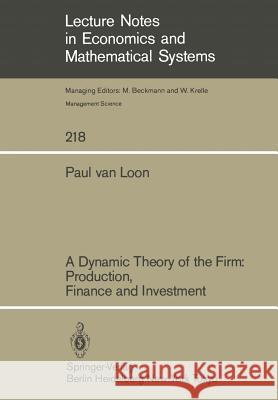
A Dynamic Theory of the Firm: Production, Finance and Investment

ISBN-13: 9783540126782 / Angielski / Miękka / 1983 / 194 str.
Paul van Loon
A Dynamic Theory of the Firm: Production, Finance and Investment Paul van Loon 9783540126782 Springer-Verlag Berlin and Heidelberg GmbH &  - książkaWidoczna okładka, to zdjęcie poglądowe, a rzeczywista szata graficzna może różnić się od prezentowanej.

A Dynamic Theory of the Firm: Production, Finance and Investment

ISBN-13: 9783540126782 / Angielski / Miękka / 1983 / 194 str.

Paul van Loon
cena 201,24
(netto: 191,66 VAT:  5%)

Najniższa cena z 30 dni: 192,74
Termin realizacji zamówienia:
ok. 22 dni roboczych.

Darmowa dostawa!

This volume is the final result of the research project ''Micro growth model," that was sponsored by the Central Research Pool of Tilburg University, the Netherlands. Apart from the University Council for this important financial support, I owe Prof. Dr. Fiet Verheyen very much for the way in which he introduced me into scientific circles and for the way in which he supervised and stimulated my work. Dr. Jan de Jong and Peter Janssen C. E., Technical University of Eindhoven, piloted me safely through the mathe matics of optimal control theory and removed some technical barriers. Their help was indispensable for the success of this project. I would also like to mention the kind support of Prof. Dr. Jack Kleijnen, who gave me many valuable hints on how to present the results of this project. In this way I was able to contact with several resear chers inside and outside the Netherlands. Most grateful I am to Prof. Dr. Charles Tapiero, Jerusalem University, who commented on important parts of this book in a constructive way and who suggested many subjects for further research. Also Mr. Geert Jan vsn Schijndel, Tilburg University, should be mentioned here, because he closely read the work and I appreciated his remarks and corrections very much. Many collea gues have contributed to the results of this research project in a direct or indirect way. Especially I should like to mention my contacts with Prof. Dr."


Kategorie:
Nauka, Ekonomia i biznes
Kategorie BISAC:
Business & Economics > Production & Operations Management
Business & Economics > Finance - General
Business & Economics > Economics - Theory
Wydawca:
Springer-Verlag Berlin and Heidelberg GmbH &
Seria wydawnicza:
Lecture Notes in Economics and Mathematical Systems
Język:
Angielski
ISBN-13:
9783540126782
Rok wydania:
1983
Dostępne języki:
Angielski
Wydanie:
Softcover Repri
Numer serii:
000221492
Ilość stron:
194
Waga:
0.36 kg
Wymiary:
24.424.4 x 17.0
Oprawa:
Miękka
Wolumenów:
01

1. Introduction.- 1. Scope of the book.- 2. Outline of the book.- 3. Relevance of dynamic theories of the firm.- 4. Origins of dynamic theories of the firm.- 5. Nature of the theory of the firm and of this book.- 6. Summary.- 2. A Survey of Dynamic Theories of the Firm.- 1. Introduction.- 2. Shareholders.- 3. Management.- 4. Employees.- 5. Labour Market.- 6. Output Market.- 7. Competitors.- 8. Lenders of debt money.- 9. Suppliers of assets.- 10. Government.- 11. Macro economic data.- 12. Summary.- 3. Some Predecessors.- 1. Introduction.- 2. Investments and depreciation (Jorgenson).- 3. Production and finance I (Leland).- 4. Finance and the value of the firm (Ludwig).- 5. Production and finance II (Lesourne & Leban).- 6. Summary.- 4. A Dynamic Model of the Firm.- 1. Introduction.- 2. Production.- 3. Sales and operating income.- 4. Financing and government.- 5. Policy of the firm.- 6. The model.- 7. Further assumptions.- 8. Optimal solution.- 9. Summary.- 5. Optimal Trajectories of the Firm.- 1. Introduction.- 2. Basic trajectory.- 3. Depth investments.- 4. Consolidation.- 5. Depth investments and consolidation.- 6. Summary.- 6. A Further Analysis.- 1. Introduction.- 2. Optimal decision rules.- 2.1 Production.- 2.2 Financial structure.- 2.3 Investment and dividend.- 3. Environmental influence on the trajectory of the firm.- 3.1 Reallocation.- 3.2 Final output.- 3.3 Consolidation.- 3.4 Expansion.- 3.5 Substitution.- 3.6 Financial substitution.- 4. Influence of (sets of) environmental parameters.- 4.1 Corporation profit tax rate.- 4.2 Investment grant rate.- 4.3 Abolishing investment grants.- 4.4 Financial parameters.- 4.5 Wage rate.- 5. Summary.- 7. Conclusions.- Appendix 1. An Interpretation of the Maximum Principle.- 1. Introduction.- 2. Technical terms.- 3. The Maximum Principle of Pontryagin.- 4. Mixed control constraints.- 5. State constraints.- 6. Summary.- Appendix 2. Solutions of the Models of Chapter 3.- 1. Introduction.- 2. A general solution procedure.- 3. The model of Jorgenson.- 4. The model of Ludwig.- 5. The model of Lesourne & Leban.- 6. Summary.- Appendix 3. Solution of the Model of Chapter 4.- 1. A reduced form of the model.- 2. Optimality conditions.- 3. A reduced form of the optimality conditions.- 4. Infeasible paths.- 5. Feasible paths.- 6. Final paths.- 7. Coupling conditions.- 8. Coupling procedure.- 9. Summary.- List of Symbols.- References.- Author Index.

Paul van Loon, einer der populärsten Kinderbuchautoren in den Niederlanden, ist ein Meister der phantastischen Erzählungen, Grusel- und Gespenstergeschichten. Oft haben seine Bücher auch etwas humorvolles, "Grumor" nennt er das dann selbst.


Udostępnij

Facebook - konto krainaksiazek.pl


Opinie o Krainaksiazek.pl na Opineo.pl

Partner Mybenefit

Krainaksiazek.pl w programie rzetelna firma Krainaksiaze.pl - płatności przez paypal

Czytaj nas na:

Facebook - krainaksiazek.pl
  • książki na zamówienie
  • granty
  • książka na prezent
  • kontakt
  • pomoc
  • opinie
  • regulamin
  • polityka prywatności

Zobacz:

  • Księgarnia czeska

  • Wydawnictwo Książkowe Klimaty

1997-2026 DolnySlask.com Agencja Internetowa

© 1997-2022 krainaksiazek.pl
     
KONTAKT | REGULAMIN | POLITYKA PRYWATNOŚCI | USTAWIENIA PRYWATNOŚCI
Zobacz: Księgarnia Czeska | Wydawnictwo Książkowe Klimaty | Mapa strony | Lista autorów
KrainaKsiazek.PL - Księgarnia Internetowa

Polityka prywatnosci - link
Krainaksiazek.pl - płatnośc Przelewy24
Przechowalnia Przechowalnia






