• Wyszukiwanie zaawansowane
  • Kategorie
  • Kategorie BISAC
  • Książki na zamówienie
  • Promocje
  • Granty
  • Książka na prezent
  • Opinie
  • Pomoc
  • Załóż konto
  • Zaloguj się

A Course on Damage Mechanics » książka


zaloguj się | załóż konto
Logo Krainaksiazek.pl

koszyk

konto

szukaj
topmenu
Księgarnia internetowa
Szukaj
Książki na zamówienie
Promocje
Granty
Książka na prezent
Moje konto
Pomoc
 
 
Wyszukiwanie zaawansowane
Pusty koszyk
Bezpłatna dostawa dla zamówień powyżej 20 złBezpłatna dostawa dla zamówień powyżej 20 zł

Kategorie główne

• Nauka
 [2939893]
• Literatura piękna
 [1808953]

  więcej...
• Turystyka
 [70366]
• Informatyka
 [150555]
• Komiksy
 [35137]
• Encyklopedie
 [23160]
• Dziecięca
 [608786]
• Hobby
 [136447]
• AudioBooki
 [1631]
• Literatura faktu
 [225099]
• Muzyka CD
 [360]
• Słowniki
 [2914]
• Inne
 [442115]
• Kalendarze
 [1068]
• Podręczniki
 [166599]
• Poradniki
 [468390]
• Religia
 [506548]
• Czasopisma
 [506]
• Sport
 [61109]
• Sztuka
 [241608]
• CD, DVD, Video
 [3308]
• Technologie
 [218981]
• Zdrowie
 [98614]
• Książkowe Klimaty
 [124]
• Zabawki
 [2174]
• Puzzle, gry
 [3275]
• Literatura w języku ukraińskim
 [260]
• Art. papiernicze i szkolne
 [7376]
Kategorie szczegółowe BISAC

A Course on Damage Mechanics

ISBN-13: 9783540609803 / Angielski / Miękka / 1996 / 228 str.
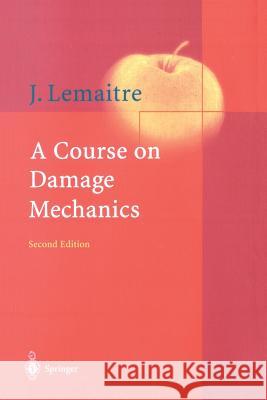
J. Lemaitre; Jean Lemaitre; H. Lippmann
A Course on Damage Mechanics Lippmann, H. 9783540609803 Springer - książkaWidoczna okładka, to zdjęcie poglądowe, a rzeczywista szata graficzna może różnić się od prezentowanej.

A Course on Damage Mechanics

ISBN-13: 9783540609803 / Angielski / Miękka / 1996 / 228 str.

J. Lemaitre; Jean Lemaitre; H. Lippmann
cena 342,14
(netto: 325,85 VAT:  5%)

Najniższa cena z 30 dni: 327,68
Termin realizacji zamówienia:
ok. 22 dni roboczych.

Darmowa dostawa!

A new branch of science usually develops thus. Somebody publishes the basic ideas. Hesitatingly at first, then little by little, other original contributions appear, until a certain threshold is reached. Then, overview articles are printed, conferences are held, and a first mention is made in textbooks, until specialized monographs are written. Continuum damage mechanics has reached that status now. To analyze or, if possible, to predict the failure of machine parts or other structures is one of the main goals of engineering science. Consequently fracture mechanics became one of its leading branches. It was based on the analysis of existing cracks. However, especially under conditions of cyclic loading, this might be too late to prevent a disaster. Therefore, the question regarding the precursory state, that is, the evolution of internal damage before macrocracks become visible, was then posed. One of the successful approaches to the problem was Weibull's theory which examined, in a statistical manner, the " weakest link" in the material volume under consideration. Unfortunately it proved too difficult mathematically to be applied to complicated parts or structures. Therefore it was highly appreciated by the scientific community when L. M. Kachanov published in 1958 a simple model of material damage which subsequently could be extended to brittle elastic, plastic or viscous materials under all conditions of uniaxial or multiaxial, simple or cyclic loadings, so that it may be considered nearly universal.


Kategorie:
Technologie
Kategorie BISAC:
Technology & Engineering > Fracture Mechanics
Technology & Engineering > Mechanical
Science > Physics - Condensed Matter
Wydawca:
Springer
Język:
Angielski
ISBN-13:
9783540609803
Rok wydania:
1996
Wydanie:
Rev and Enl
Ilość stron:
228
Waga:
0.36 kg
Wymiary:
23.39 x 15.6 x 1.35
Oprawa:
Miękka
Wolumenów:
01
Dodatkowe informacje:
Wydanie ilustrowane

1 Phenomenological Aspects of Damage.- 1.1 Physical Nature of the Solid State and Damage.- 1.1.1 Atoms, Elasticity and Damage.- 1.1.2 Slips, Plasticity and Irreversible Strains.- 1.1.3 Scale of the Phenomena of Strain and Damage.- 1.1.4 Different Manifestations of Damage.- 1.1.5 Exercise on Micrographic Observations.- 1.2 Mechanical Representation of Damage.- 1.2.1 One-Dimensional Surface Damage Variable.- 1.2.2 Effective Stress Concept.- 1.2.3 Strain Equivalence Principle.- 1.2.4 Coupling Between Strains and Damage; Rupture Criterion; Damage Threshold.- 1.2.5 Exercise on the Micromechanics of the Effective Damage Area.- 1.3 Measurement of Damage.- 1.3.1 Direct Measurements.- 1.3.2 Variation of the Elasticity Modulus.- 1.3.3 Variation of the Microhardness.- 1.3.4 Other Methods.- 1.3.5 Exercise on Measurement of Damage by the Stress Amplitude Drop.- 2 Thermodynamics and Micromechanics of Damage.- 2.1 Three-Dimensional Analysis of Isotropic Damage.- 2.1.1 Thermodynamical Variables, State Potential.- 2.1.2 Damage Equivalent Stress Criterion.- 2.1.3 Potential of Dissipation.- 2.1.4 Strain-Damage Coupled Constitutive Equations.- 2.1.5 Exercise on the Identification of Material Parameters.- 2.2 Analysis of Anisotropic Damage.- 2.2.1 Geometrical Definition of a Second-Order Damage Tensor.- 2.2.2 Thermodynamical Definition of a Fourth-Order Damage Tensor.- 2.2.3 Energetic Definition of a Double Scalar Variable.- 2.2.4 Exercise on Anisotropic Damage in Proportional Loading.- 2.3 Micromechanics of Damage.- 2.3.1 Brittle Isotropie Damage.- 2.3.2 Ductile Isotropie Damage.- 2.3.3 Anisotropie Damage.- 2.3.4 Microcrack Closure Effect, Unilateral Conditions.- 2.3.5 Damage Localization and Instability.- 2.3.6 Exercise on the Fiber Bundle System.- 3 Kinetic Laws of Damage Evolution.- 3.1 Unified Formulation of Damage Laws.- 3.1.1 General Properties and Formulation.- 3.1.2 Stored Energy Damage Threshold.- 3.1.3 Three-Dimensional Rupture Criterion.- 3.1.4 Case of Elastic-Perfectly Plastic and Damageable Materials.- 3.1.5 Identification of the Material Parameters.- 3.1.6 Exercise on Identification by a Low Cycle Test.- 3.2 Brittle Damage of Metals, Ceramics, Composites and Concrete.- 3.2.1 Pure Brittle Damage.- 3.2.2 Quasi-brittle Damage.- 3.2.3 Exercise on the Influence of the Triaxiality on Rupture.- 3.3 Ductile and Creep Damage of Metals and Polymers.- 3.3.1 Ductile Damage.- 3.3.2 Exercises on the Fracture Limits in Metal Forming.- 3.3.3 Creep Damage.- 3.3.4 Exercise on Isochronous Creep Damage Curves.- 3.4 Fatigue Damage.- 3.4.1 Low Cycle Fatigue.- 3.4.2 Exercise on Creep Fatigue Interaction.- 3.4.3 High Cycle Fatigue.- 3.4.4 Exercise on Damage Accumulation.- 3.5 Damage of Interfaces.- 3.5.1 Continuity of the Stress and Strain Vectors.- 3.5.2 Strain Surface Energy Release Rate.- 3.5.3 Kinetic Law of Debonding Damage Evolution.- 3.5.4 Simplified Model.- 3.5.5 Exercise on a Debonding Criterion for Interfaces.- 3.6 Table of Material Parameters.- 4 Analysis of Crack Initiation in Structures.- 4.1 Stress-Strain Analysis.- 4.1.1 Stress Concentrations.- 4.1.2 Neuter’s Method.- 4.1.3 Finite Element Method.- 4.1.4 Exercise on the Stress Concentration Near a Hole.- 4.2 Uncoupled Analysis of Crack Initiation.- 4.2.1 Determination of the Critical Point(s).- 4.2.2 Integration of the Kinetic Damage Law.- 4.2.3 Exercise on Fatigue Crack Initiation Near a Hole.- 4.3 Locally Coupled Analysis.- 4.3.1 Localization of Damage.- 4.3.2 Postprocessing of Damage Growth.- 4.3.3 Description and Listing of the Postprocessor DAMAGE 90.- 4.3.4 Exercises Using the DAMAGE 90 Postprocessor.- 4.4 Fully Coupled Analysis.- 4.4.1 Initial Strain Hardening and Damage.- 4.4.2 Example of a Calculation Using the Finite Element Method.- 4.4.3 Growth of Damaged Zones and Macrocracks.- 4.4.4 Exercise on Damage Zone at a Crack Tip.- 4.5 Statistical Analysis with Microdefects.- 4.5.1 Initial Defects.- 4.5.2 Case of Brittle Materials.- 4.5.3 Case of Quasi Brittle Materials.- 4.5.4 Case of Ductile Materials.- 4.5.5 Volume Effect.- 4.5.6 Effect of Stress Heterogeneity.- 4.5.7 Exercise on Bending Fatigue of a Beam.- History of International Damage Mechanics Conferences.- Authors and Subject Index.

This well-established textbook teaches macroscopic modeling for design, processing, testing, and control of mechanical components in engineering. The first chapter deals with the phenomenology of damage; the second couples damage to strains and covers the three-dimensional situation; the third is devoted to kinetic laws of damage evolution used by the author to unify many models; the fourth gives several methods for predicting crack initiation. Detailed calculations and many exercises help students to apply the powerful techniques to practical problems in engineering.
This second, corrected and enlarged edition also includes the damage of interfaces and statistical damage analysis with microdefects.


Udostępnij

Facebook - konto krainaksiazek.pl


Opinie o Krainaksiazek.pl na Opineo.pl

Partner Mybenefit

Krainaksiazek.pl w programie rzetelna firma Krainaksiaze.pl - płatności przez paypal

Czytaj nas na:

Facebook - krainaksiazek.pl
  • książki na zamówienie
  • granty
  • książka na prezent
  • kontakt
  • pomoc
  • opinie
  • regulamin
  • polityka prywatności

Zobacz:

  • Księgarnia czeska

  • Wydawnictwo Książkowe Klimaty

1997-2026 DolnySlask.com Agencja Internetowa

© 1997-2022 krainaksiazek.pl
     
KONTAKT | REGULAMIN | POLITYKA PRYWATNOŚCI | USTAWIENIA PRYWATNOŚCI
Zobacz: Księgarnia Czeska | Wydawnictwo Książkowe Klimaty | Mapa strony | Lista autorów
KrainaKsiazek.PL - Księgarnia Internetowa

Polityka prywatnosci - link
Krainaksiazek.pl - płatnośc Przelewy24
Przechowalnia Przechowalnia





