• Wyszukiwanie zaawansowane
  • Kategorie
  • Kategorie BISAC
  • Książki na zamówienie
  • Promocje
  • Granty
  • Książka na prezent
  • Opinie
  • Pomoc
  • Załóż konto
  • Zaloguj się

The Theory of Turbulence: Subrahmanyan Chandrasekhar's 1954 Lectures » książka


zaloguj się | załóż konto
Logo Krainaksiazek.pl

koszyk

konto

szukaj
topmenu
Księgarnia internetowa
Szukaj
Książki na zamówienie
Promocje
Granty
Książka na prezent
Moje konto
Pomoc
 
 
Wyszukiwanie zaawansowane
Pusty koszyk
Bezpłatna dostawa dla zamówień powyżej 20 złBezpłatna dostawa dla zamówień powyżej 20 zł

Kategorie główne

• Nauka
 [2950560]
• Literatura piękna
 [1849509]

  więcej...
• Turystyka
 [71097]
• Informatyka
 [151150]
• Komiksy
 [35848]
• Encyklopedie
 [23178]
• Dziecięca
 [617388]
• Hobby
 [139064]
• AudioBooki
 [1657]
• Literatura faktu
 [228597]
• Muzyka CD
 [383]
• Słowniki
 [2855]
• Inne
 [445295]
• Kalendarze
 [1464]
• Podręczniki
 [167547]
• Poradniki
 [480102]
• Religia
 [510749]
• Czasopisma
 [516]
• Sport
 [61293]
• Sztuka
 [243352]
• CD, DVD, Video
 [3414]
• Technologie
 [219456]
• Zdrowie
 [101002]
• Książkowe Klimaty
 [124]
• Zabawki
 [2311]
• Puzzle, gry
 [3459]
• Literatura w języku ukraińskim
 [254]
• Art. papiernicze i szkolne
 [8079]
Kategorie szczegółowe BISAC

The Theory of Turbulence: Subrahmanyan Chandrasekhar's 1954 Lectures

ISBN-13: 9789400701168 / Angielski / Miękka / 2010 / 117 str.
Edward A. Spiegel
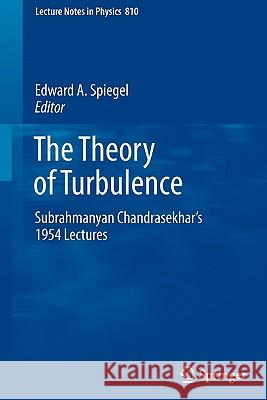
The Theory of Turbulence: Subrahmanyan Chandrasekhar's 1954 Lectures Edward A. Spiegel 9789400701168 Springer - książkaWidoczna okładka, to zdjęcie poglądowe, a rzeczywista szata graficzna może różnić się od prezentowanej.

The Theory of Turbulence: Subrahmanyan Chandrasekhar's 1954 Lectures

ISBN-13: 9789400701168 / Angielski / Miękka / 2010 / 117 str.

Edward A. Spiegel
cena 181,11
(netto: 172,49 VAT:  5%)

Najniższa cena z 30 dni: 173,46
Termin realizacji zamówienia:
ok. 22 dni roboczych
Dostawa w 2026 r.

Darmowa dostawa!

In January 1937, Nobellaureate in PhysicsSubrahmanyan Chandrasekhar was recruited to the University of Chicago. He was to remain there for his entire career, becoming Morton D. Hull Distinguished Service Professor of Theoretical Astrophysics in 1952 and attaining emeritus status in 1985. This is where his then student Ed Spiegel met him during the summer of 1954, attended his lectures on turbulence and jotted down the notes in hand. His lectures had a twofold purpose: they not only provided a very elementary introduction to some aspects of the subject for novices, they also allowed Chandra to organize his thoughts in preparation to formulating his attack on the statistical problem of homogeneous turbulence. After each lecture Ed Spiegel transcribed the notes and filled in the details of the derivations that Chandrasekhar had not included, trying to preserve the spirit of his presentation and even adding some of his side remarks. The lectures were rather impromptu and the notes as presented here are as they were set down originally in 1954. Now they are being made generally available for Chandrasekhar s centennial."


Kategorie:
Nauka, Fizyka
Kategorie BISAC:
Science > Mechanics - General
Science > Mechanika klasyczna płynów
Science > Fizyka
Wydawca:
Springer
Seria wydawnicza:
Lecture Notes in Physics
Język:
Angielski
ISBN-13:
9789400701168
Rok wydania:
2010
Dostępne języki:
Angielski
Numer serii:
000050590
Ilość stron:
117
Waga:
0.45 kg
Wymiary:
23.523.5 x 15.5
Oprawa:
Miękka
Wolumenów:
01
Dodatkowe informacje:
Wydanie ilustrowane

From the book reviews:

"The book under review is part of the Lecture Notes in Physics series, and aims to 'quickly and informally' communicate knowledge in the subject. The book is structured in 25 chapters plus a prologue and epilogue. ... The book is addressed to both the novice and advanced reader, as it provides basic and advanced proofs, as well as different approaches and derivation of classical results." (Iuliana Stanculescu, Mathematical Reviews, May, 2014)

"The lecture notes on Turbulence by S. Chandrasekhar are transcribed and filled in with details by Edward Spiegel in the year 1954. ... it is interesting to have a book on these lecture notes for three reasons: 1. The scientific historian will enjoy this compilation. 2. The didactically interested lecturer can learn much about presentations in theoretical physics. 3. Students will find many explicitly calculated details in the presentation of the mathematical formalism." (Johannes Viktor Feitzinger, Zentralblatt MATH, Vol. 1207, 2011)

1: The Turbulence Problem. 1.1 The Meaning of ‘Turbulence’ 1.2 Two Fundamental Aspects of Turbulence 2: The Net Energy Balance. 3: The Interchange of Energy Between States of Motion. 4. Some Remarks. 4.1. On the Harmonic Analysis. 4.2. On the Concept of Isotropy. 4.3. On the Possibility of a Universal Theory. 5: The Spectrum of Turbulent Energy. 5.1 The Spectrum 5.2. An Equation for the Spectrum 6: Some Preliminaries to the Development of a Theory of Turbulence. 7: Heisenberg's Theory of Turbulence. 7.1 The Fundamental Equation of the Theory 7.2 Chandrasekhar’s Solution of (7.17) for the Case of Stationary Turbulence 8: Other Derivatives of K-2/3 Law. 8.1 Fermi’s Approach 8.2 Kolmogoroff’s Theory 8.3 The Method of von Neumann 8.4 Conclusion 9: An Alternate Approach – Correlations. 10: The Equations of Isotropic Turbulence. 10.1 The Concept of Isotropy 10.2 Qij as an Isotropic Tensor 10.3 Solenoidal Isotropic Tensors 11: The Karman-Howarth Equations. 12: The Meanings of the Defining Scalars. 13: Some Results from the Karman-Howarth Equation. 13.1 The Taylor Microscale 13.2 The Study of the Decay of Turbulence 13.3 The Connection between the Karman-Howarth Equation and the Kolmogoroff Theory 14: The Relation Between Fourth Order and Second Order Correlations when the Velocity Follows a Gaussian Distribution. 14.1 Some Properties of the Gaussian Distribution 14.2 Addition Theorem for Gaussian Distributions 14.3 Proof of Equation (14.2) 15: Chandrasekhar's Theory of Turbulence. 16: A More Subjective Approach to the Derivation of Chandrasekhar's Equation. 17: The Dimensionless Form of Chandrasekhar's Equation. 18: Some Aspects and Advantages of the New Theory. 18.1 A Mathematical Justification of the Assumptions of the Heisenberg Theory 18.2 Compatibility with the Kolmogoroff Theory 19: The Problem of Introducing the Boundary Conditions. 20: Discussion of the Case of Negligible Inertial Term. 21: The Case in which Viscosity is Neglected. 22: Solution of the Non-Viscous Case near r = 0. 23: Solution of the Heat Equation. 24: Solution of the Quasi-Wave Equation. 25. The Introduction of Boundary Conditions. 26. Epilogue.

Nobel Laureate Chandrasekhar derived a novel theory of Turbulence in the 1950's. These notes give a first hand account from Chandrasekhar of the development of this theory. Transcribed by his then student Ed Spiegel, these notes provide a unique insight into the development of this theory. Ed Spiegel is a renowned and highly respected expert in the field of astrophysics, and astrophysical fluid dynamics (he coined the term Blazar), and he provides a wonderful introduction describing the course given by Chandrasekhar with some interesting anecdotes from the lectures as well as a short account of how the theory has evolved since Chandrasekhar's unique contributions over half a century ago.

In January 1937, Nobel laureate in Physics Subrahmanyan Chandrasekhar was recruited to the University of Chicago. He was to remain there for his entire career, becoming Morton D. Hull Distinguished Service Professor of Theoretical Astrophysics in 1952 and attaining emeritus status in 1985. This is where his then student Ed Spiegel met him during the summer of 1954, attended his lectures on turbulence and jotted down the notes in hand. His lectures had a twofold purpose: they not only provided a very elementary introduction to some aspects of the subject for novices, they also allowed Chandra to organize his thoughts in preparation to formulating his attack on the statistical problem of homogeneous turbulence. After each lecture Ed Spiegel transcribed the notes and filled in the details of the derivations that Chandrasekhar had not included, trying to preserve the spirit of his presentation and even adding some of his side remarks. The lectures were rather impromptu and the notes as presented here are as they were set down originally in 1954. Now they are being made generally available for Chandrasekhar’s centennial.


Udostępnij

Facebook - konto krainaksiazek.pl


Opinie o Krainaksiazek.pl na Opineo.pl

Partner Mybenefit

Krainaksiazek.pl w programie rzetelna firma Krainaksiaze.pl - płatności przez paypal

Czytaj nas na:

Facebook - krainaksiazek.pl
  • książki na zamówienie
  • granty
  • książka na prezent
  • kontakt
  • pomoc
  • opinie
  • regulamin
  • polityka prywatności

Zobacz:

  • Księgarnia czeska

  • Wydawnictwo Książkowe Klimaty

1997-2025 DolnySlask.com Agencja Internetowa

© 1997-2022 krainaksiazek.pl
     
KONTAKT | REGULAMIN | POLITYKA PRYWATNOŚCI | USTAWIENIA PRYWATNOŚCI
Zobacz: Księgarnia Czeska | Wydawnictwo Książkowe Klimaty | Mapa strony | Lista autorów
KrainaKsiazek.PL - Księgarnia Internetowa

Polityka prywatnosci - link
Krainaksiazek.pl - płatnośc Przelewy24
Przechowalnia Przechowalnia






