• Wyszukiwanie zaawansowane
  • Kategorie
  • Kategorie BISAC
  • Książki na zamówienie
  • Promocje
  • Granty
  • Książka na prezent
  • Opinie
  • Pomoc
  • Załóż konto
  • Zaloguj się

Non-Bayesian Decision Theory: Beliefs and Desires as Reasons for Action » książka


zaloguj się | załóż konto
Logo Krainaksiazek.pl

koszyk

konto

szukaj
topmenu
Księgarnia internetowa
Szukaj
Książki na zamówienie
Promocje
Granty
Książka na prezent
Moje konto
Pomoc
 
 
Wyszukiwanie zaawansowane
Pusty koszyk
Bezpłatna dostawa dla zamówień powyżej 20 złBezpłatna dostawa dla zamówień powyżej 20 zł

Kategorie główne

• Nauka
 [2950560]
• Literatura piękna
 [1849509]

  więcej...
• Turystyka
 [71097]
• Informatyka
 [151150]
• Komiksy
 [35848]
• Encyklopedie
 [23178]
• Dziecięca
 [617388]
• Hobby
 [139064]
• AudioBooki
 [1657]
• Literatura faktu
 [228597]
• Muzyka CD
 [383]
• Słowniki
 [2855]
• Inne
 [445295]
• Kalendarze
 [1464]
• Podręczniki
 [167547]
• Poradniki
 [480102]
• Religia
 [510749]
• Czasopisma
 [516]
• Sport
 [61293]
• Sztuka
 [243352]
• CD, DVD, Video
 [3414]
• Technologie
 [219456]
• Zdrowie
 [101002]
• Książkowe Klimaty
 [124]
• Zabawki
 [2311]
• Puzzle, gry
 [3459]
• Literatura w języku ukraińskim
 [254]
• Art. papiernicze i szkolne
 [8079]
Kategorie szczegółowe BISAC

Non-Bayesian Decision Theory: Beliefs and Desires as Reasons for Action

ISBN-13: 9789048179572 / Angielski / Miękka / 2010 / 170 str.
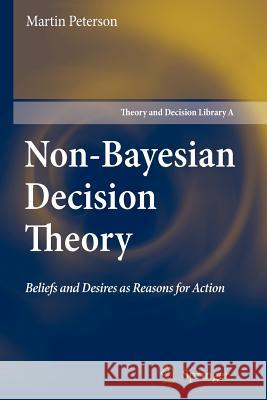
Martin Peterson
Non-Bayesian Decision Theory: Beliefs and Desires as Reasons for Action Peterson, Martin 9789048179572 Springer - książkaWidoczna okładka, to zdjęcie poglądowe, a rzeczywista szata graficzna może różnić się od prezentowanej.

Non-Bayesian Decision Theory: Beliefs and Desires as Reasons for Action

ISBN-13: 9789048179572 / Angielski / Miękka / 2010 / 170 str.

Martin Peterson
cena 402,53
(netto: 383,36 VAT:  5%)

Najniższa cena z 30 dni: 385,52
Termin realizacji zamówienia:
ok. 22 dni roboczych
Dostawa w 2026 r.

Darmowa dostawa!

For quite some time, philosophers, economists, and statisticians have endorsed a view on rational choice known as Bayesianism. The work on this book has grown out of a feeling that the Bayesian view has come to dominate the academic com- nitytosuchanextentthatalternative, non-Bayesianpositionsareseldomextensively researched. Needless to say, I think this is a pity. Non-Bayesian positions deserve to be examined with much greater care, and the present work is an attempt to defend what I believe to be a coherent and reasonably detailed non-Bayesian account of decision theory. The main thesis I defend can be summarised as follows. Rational agents m- imise subjective expected utility, but contrary to what is claimed by Bayesians, ut- ity and subjective probability should not be de?ned in terms of preferences over uncertain prospects. On the contrary, rational decision makers need only consider preferences over certain outcomes. It will be shown that utility and probability fu- tions derived in a non-Bayesian manner can be used for generating preferences over uncertain prospects, that support the principle of maximising subjective expected utility. To some extent, this non-Bayesian view gives an account of what modern - cision theory could have been like, had decision theorists not entered the Bayesian path discovered by Ramsey, de Finetti, Savage, and others. I will not discuss all previous non-Bayesian positions presented in the literature


Kategorie:
Nauka, Filozofia
Kategorie BISAC:
Science > Philosophy & Social Aspects
Computers > Computer Science
Mathematics > Teoria gier
Wydawca:
Springer
Seria wydawnicza:
Theory and Decision Library A:
Język:
Angielski
ISBN-13:
9789048179572
Rok wydania:
2010
Numer serii:
000296969
Ilość stron:
170
Waga:
0.28 kg
Wymiary:
23.5 x 15.5
Oprawa:
Miękka
Wolumenów:
01

From the reviews:

"This book presents an account of rational choice from a non-Bayesian point of view. ... this book argues that the non-Bayesian approach offers more action guidance to the decision maker. ... the book is well addressed to all researchers in the field of decision theory, and especially those with philosophical concerns." (Vangelis Grigoroudis, Zentralblatt MATH, Vol. 1151, 2009)

"Anyone concerned in the foundations of normative decision theory and who feels puzzled by the way this theory typically proceeds will doubtless welcome Martin Peterson's Non-Bayesian Decision Theory. ... Perterson's book is written in a clear and pleasant style, is well organized and shows an impressive mastery of both formal models and conceptual issues pertaining to contemporary decision theory. ... Its reading will be valuable to every scholar - philosopher or economist - interested by decision theory." (Mikaël Cozic, Economics and Philosophy, Vol. 27, 2011)

1. Introduction, 2.Bayesian decision theory, 3. Choosing what to decide, 4. Indeterminate preference, 5. Utility, 6. Probability, 7. Expected utility, 8. Risk aversion, 9. Appendix: Proofs

Martin Peterson received his PhD in philosophy in 2003 from the Royal Institute of Technology, Stockholm. He is currently an associate professor of philosophy at Eindhoven University of Technology. Between 2005 and 2008 he worked for three years at the University of Cambridge, where he was a Research Fellow in the Department of History and Philosophy of Science and Director of Studies in Philosophy at St Edmund's College. He has also held teaching and research positions at the Royal Institute of Technology and at Lulea University of Technology.

This book aims to present an account of rational choice from a non-Bayesian point of view. Rational agents maximize subjective expected utility, but contrary to what is claimed by Bayesians, the author argues that utility and subjective probability should not be defined in terms of preferences over uncertain prospects. To some extent, the author’s non-Bayesian view gives a modern account of what decision theory could have been like, had decision theorists not entered the Bayesian path discovered by Ramsey, Savage, and Jeffrey. The author argues that traditional Bayesian decision theory is unavailing from an action-guiding perspective. For the deliberating Bayesian agent, the output of decision theory is not a set of preferences over alternative acts - these preferences are on the contrary used as input to the theory. Instead, the output is a (set of) utility function(s) that can be used for describing the agent as an expected utility maximizer, which are of limited normative relevance.On the non-Bayesian view articulated by the author, utility and probability are defined in terms of preferences over certain outcomes. These utility and probability functions are then used for generating preferences over uncertain prospects, which conform to the principle of maximizing expected utility. It is argued that this approach offers more action guidance.

Peterson, Martin Martin Peterson is Sue and Harry E. Bovay Professo... więcej >


Udostępnij

Facebook - konto krainaksiazek.pl


Opinie o Krainaksiazek.pl na Opineo.pl

Partner Mybenefit

Krainaksiazek.pl w programie rzetelna firma Krainaksiaze.pl - płatności przez paypal

Czytaj nas na:

Facebook - krainaksiazek.pl
  • książki na zamówienie
  • granty
  • książka na prezent
  • kontakt
  • pomoc
  • opinie
  • regulamin
  • polityka prywatności

Zobacz:

  • Księgarnia czeska

  • Wydawnictwo Książkowe Klimaty

1997-2025 DolnySlask.com Agencja Internetowa

© 1997-2022 krainaksiazek.pl
     
KONTAKT | REGULAMIN | POLITYKA PRYWATNOŚCI | USTAWIENIA PRYWATNOŚCI
Zobacz: Księgarnia Czeska | Wydawnictwo Książkowe Klimaty | Mapa strony | Lista autorów
KrainaKsiazek.PL - Księgarnia Internetowa

Polityka prywatnosci - link
Krainaksiazek.pl - płatnośc Przelewy24
Przechowalnia Przechowalnia





