• Wyszukiwanie zaawansowane
  • Kategorie
  • Kategorie BISAC
  • Książki na zamówienie
  • Promocje
  • Granty
  • Książka na prezent
  • Opinie
  • Pomoc
  • Załóż konto
  • Zaloguj się

Logic Programming and Databases » książka


zaloguj się | załóż konto
Logo Krainaksiazek.pl

koszyk

konto

szukaj
topmenu
Księgarnia internetowa
Szukaj
Książki na zamówienie
Promocje
Granty
Książka na prezent
Moje konto
Pomoc
 
 
Wyszukiwanie zaawansowane
Pusty koszyk
Bezpłatna dostawa dla zamówień powyżej 20 złBezpłatna dostawa dla zamówień powyżej 20 zł

Kategorie główne

• Nauka
 [2946912]
• Literatura piękna
 [1852311]

  więcej...
• Turystyka
 [71421]
• Informatyka
 [150889]
• Komiksy
 [35717]
• Encyklopedie
 [23177]
• Dziecięca
 [617324]
• Hobby
 [138808]
• AudioBooki
 [1671]
• Literatura faktu
 [228371]
• Muzyka CD
 [400]
• Słowniki
 [2841]
• Inne
 [445428]
• Kalendarze
 [1545]
• Podręczniki
 [166819]
• Poradniki
 [480180]
• Religia
 [510412]
• Czasopisma
 [525]
• Sport
 [61271]
• Sztuka
 [242929]
• CD, DVD, Video
 [3371]
• Technologie
 [219258]
• Zdrowie
 [100961]
• Książkowe Klimaty
 [124]
• Zabawki
 [2341]
• Puzzle, gry
 [3766]
• Literatura w języku ukraińskim
 [255]
• Art. papiernicze i szkolne
 [7810]
Kategorie szczegółowe BISAC

Logic Programming and Databases

ISBN-13: 9783642839542 / Angielski / Miękka / 2011 / 284 str.
Stefano Ceri; Georg Gottlob; Letizia Tanca
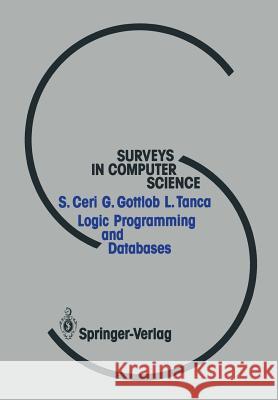
Logic Programming and Databases Stefano Ceri Georg Gottlob Letizia Tanca 9783642839542 Springer - książkaWidoczna okładka, to zdjęcie poglądowe, a rzeczywista szata graficzna może różnić się od prezentowanej.

Logic Programming and Databases

ISBN-13: 9783642839542 / Angielski / Miękka / 2011 / 284 str.

Stefano Ceri; Georg Gottlob; Letizia Tanca
cena 302,60
(netto: 288,19 VAT:  5%)

Najniższa cena z 30 dni: 289,13
Termin realizacji zamówienia:
ok. 22 dni roboczych
Bez gwarancji dostawy przed świętami

Darmowa dostawa!

The topic of logic programming and databases. has gained in creasing interest in recent years. Several events have marked the rapid evolution of this field: the selection, by the Japanese Fifth Generation Project, of Prolog and of the relational data model as the basis for the development of new machine archi tectures; the focusing of research in database theory on logic queries and on recursive query processing; and the pragmatic, application-oriented development of expert database systems and of knowledge-base systems. As a result, an enormous amount of work has been produced in the recent literature, coupled with the spontaneous growth of several advanced projects in this area. The goal of this book is to present a systematic overview of a rapidly evolving discipline, which is presently not described with the same approach in other books. We intend to introduce stu dents and researchers to this new discipline; thus we use a plain, tutorial style, and complement the description of algorithms with examples and exercises. We attempt to achieve a balance be tween theoretical foundations and technological issues; thus we present a careful introduction to the new language Datalog, but we also focus on the efficient interfacing of logic programming formalisms (such as Prolog and Datalog) with large databases."


Kategorie:
Informatyka, Bazy danych
Kategorie BISAC:
Computers > System Administration - Storage & Retrieval
Computers > Database Administration & Management
Computers > Artificial Intelligence - General
Wydawca:
Springer
Seria wydawnicza:
Surveys in Computer Science
Język:
Angielski
ISBN-13:
9783642839542
Rok wydania:
2011
Wydanie:
Softcover Repri
Numer serii:
000403683
Ilość stron:
284
Waga:
0.52 kg
Wymiary:
24.2 x 17.0
Oprawa:
Miękka
Wolumenów:
01

1 Logic Programming and Databases: An Overview.- 1.1 Logic Programming as Query Language.- 1.2 Prolog and Datalog.- 1.3 Alternative Architectures.- 1.4 Applications.- 1.5 Bibliographic Notes.- 2 A Review of Relational Databases and Prolog.- 2.1 Overview of Relational Databases.- 2.1.1 The Relational Model.- 2.1.2 Relational Languages.- 2.2 Prolog: A Language for Programming in Logic.- 2.3 Bibliographic Notes.- I Coupling Prolog to Relational Databases.- 3 Prolog as a Query Language.- 3.1 The Anti-Trust Control Problem.- 3.2 The Bill of Materials Problem.- 3.3 Conclusions.- 3.4 Bibliographic Notes.- 3.5 Exercises.- 4 Coupling Prolog Systems to Relational Databases.- 4.1 Architectures for Coupling Prolog and Relational Systems.- 4.1.1 Assumptions and Terminology.- 4.1.2 Components of a CPR System.- 4.1.3 Architecture of CPR Systems.- 4.2 Base Conjunctions.- 4.2.1 Determining Base Conjunctions in LCPR Systems.- 4.2.2 Improving Base Conjunctions in TCPR Systems.- 4.3 Optimization of the Prolog/Database Interface.- 4.3.1 Caching of Data.- 4.3.2 Caching of Data and Queries.- 4.3.3 Use of Subsumption.- 4.3.4 Caching Queries.- 4.3.5 Parallelism and Pre-fetching in Database Interfaces.- 4.4 Conclusions.- 4.5 Bibliographic Notes.- 4.6 Exercises.- 5 Overview of Systems for Coupling Prolog to Relational Databases.- 5.1 PRO-SQL.- 5.2 EDUCE.- 5.3 ESTEAM.- 5.4 BERMUDA.- 5.5 CGW and PRIMO.- 5.6 QUINTUS-PROLOG.- 5.7 Bibliographic Notes.- II Foundations of Datalog.- 6 Syntax and Semantics of Datalog.- 6.1 Basic Definitions and Assumptions.- 6.1.1 Alphabets, Terms, and Clauses.- 6.1.2 Extensional Databases and Datalog Programs.- 6.1.3 Substitutions, Subsumption, and Unification.- 6.2 The Model Theory of Datalog.- 6.2.1 Possible Worlds, Truth, and Herbrand Interpretations.- 6.2.2 The Least Herbrand Model.- 6.3 Conclusions.- 6.4 Bibliographic Notes.- 6.5 Exercises.- 7 Proof Theory and Evaluation Paradigms of Datalog.- 7.1 The Proof Theory of Datalog.- 7.1.1 Fact Inference.- 7.1.2 Soundness and Completeness of the Inference Rule EP.- 7.2 Least Fixpoint Iteration.- 7.2.1 Basic Results of Fixpoint Theory.- 7.2.2 Least Fixpoints and Datalog Programs.- 7.3 Backward Chaining and Resolution.- 7.3.1 The Principle of Backward Chaining.- 7.3.2 Resolution.- 7.4 Conclusions.- 7.5 Bibliographic Notes.- 7.6 Exercises.- III Optimization Methods for Datalog.- 8 Classification of Optimization Methods for Datalog.- 8.1 Criteria for the Classification of Optimization Methods.- 8.1.1 Formalism.- 8.1.2 Search Strategy.- 8.1.3 Objectives of Optimization Methods.- 8.1.4 Type of Information Considered.- 8.2 Classification of Optimization Methods.- 8.3 Translation of Datalog into Relational Algebra.- 8.4 Classification of Datalog Rules.- 8.5 The Expressive Power of Datalog.- 8.6 Bibliographic Notes.- 8.7 Exercises.- 9 Evaluation Methods.- 9.1 Bottom-up Evaluation.- 9.1.1 Algebraic Naive Evaluation.- 9.1.2 Semi-naive Evaluation.- 9.1.3 The Method of Henschen and Naqvi.- 9.2 Top-down Evaluation.- 9.2.1 Query-Subquery.- 9.2.2 The RQA/FQI Method.- 9.3 Bibliographic Notes.- 9.4 Exercises.- 10 Rewriting Methods.- 10.1 Logical Rewriting Methods.- 10.1.1 Magic Sets.- 10.1.2 The Counting Method.- 10.1.3 The Static Filtering Method.- 10.1.4 Semi-naive Evaluation by Rewriting.- 10.2 Rewriting of Algebraic Systems.- 10.2.1 Reduction to Union-Join Normal Form.- 10.2.2 Determination of Common Subexpressions.- 10.2.3 Query Subsetting and Strong Components.- 10.2.4 Marking of Variables.- 10.2.5 Reduction of Variables.- 10.2.6 Reduction of Constants.- 10.2.7 Summary of the Algebraic Approach.- 10.3 A General View of Optimization.- 10.4 Bibliographic Notes.- 10.5 Exercises.- 11 Extensions of Pure Datalog.- 11.1 Using Built-in Predicates in Datalog.- 11.2 Incorporating Negation into Datalog.- 11.2.1 Negation and the Closed World Assumption.- 11.2.2 Stratified Datalog.- 11.2.3 Perfect Models and Local Stratification.- 11.2.4 Inflationary Semantics and Expressive Power.- 11.3 Representation and Manipulation of Complex Objects.- 11.3.1 Basic Features of LDL.- 11.3.2 Semantics of Admissible LDL Programs.- 11.3.3 Data Models for Complex Objects.- 11.4 Conclusions.- 11.5 Bibliographic Notes.- 11.6 Exercises.- 12 Overview of Research Prototypes for Integrating Relational Databases and Logic Programming.- 12.1 The LDL Project.- 12.2 The NAIL! Project.- 12.3 The POSTGRES Project.- 12.4 The FIFTH GENERATION Project.- 12.5 The KIWI Project.- 12.6 The ALGRES Project.- 12.7 The PRISMA Project.- 12.8 Bibliographic Notes.

Ceri, Stefano Stefano Ceri is a Professor of Database Systems an... więcej >


Udostępnij

Facebook - konto krainaksiazek.pl


Opinie o Krainaksiazek.pl na Opineo.pl

Partner Mybenefit

Krainaksiazek.pl w programie rzetelna firma Krainaksiaze.pl - płatności przez paypal

Czytaj nas na:

Facebook - krainaksiazek.pl
  • książki na zamówienie
  • granty
  • książka na prezent
  • kontakt
  • pomoc
  • opinie
  • regulamin
  • polityka prywatności

Zobacz:

  • Księgarnia czeska

  • Wydawnictwo Książkowe Klimaty

1997-2025 DolnySlask.com Agencja Internetowa

© 1997-2022 krainaksiazek.pl
     
KONTAKT | REGULAMIN | POLITYKA PRYWATNOŚCI | USTAWIENIA PRYWATNOŚCI
Zobacz: Księgarnia Czeska | Wydawnictwo Książkowe Klimaty | Mapa strony | Lista autorów
KrainaKsiazek.PL - Księgarnia Internetowa

Polityka prywatnosci - link
Krainaksiazek.pl - płatnośc Przelewy24
Przechowalnia Przechowalnia





