• Wyszukiwanie zaawansowane
  • Kategorie
  • Kategorie BISAC
  • Książki na zamówienie
  • Promocje
  • Granty
  • Książka na prezent
  • Opinie
  • Pomoc
  • Załóż konto
  • Zaloguj się

Epistemic Foundations of Fuzziness: Unified Theories on Decision-Choice Processes » książka

zaloguj się | załóż konto
Logo Krainaksiazek.pl

koszyk

konto

szukaj
topmenu
Księgarnia internetowa
Szukaj
Książki na zamówienie
Promocje
Granty
Książka na prezent
Moje konto
Pomoc
 
 
Wyszukiwanie zaawansowane
Pusty koszyk
Bezpłatna dostawa dla zamówień powyżej 20 złBezpłatna dostawa dla zamówień powyżej 20 zł

Kategorie główne

• Nauka
 [2946912]
• Literatura piękna
 [1852311]

  więcej...
• Turystyka
 [71421]
• Informatyka
 [150889]
• Komiksy
 [35717]
• Encyklopedie
 [23177]
• Dziecięca
 [617324]
• Hobby
 [138808]
• AudioBooki
 [1671]
• Literatura faktu
 [228371]
• Muzyka CD
 [400]
• Słowniki
 [2841]
• Inne
 [445428]
• Kalendarze
 [1545]
• Podręczniki
 [166819]
• Poradniki
 [480180]
• Religia
 [510412]
• Czasopisma
 [525]
• Sport
 [61271]
• Sztuka
 [242929]
• CD, DVD, Video
 [3371]
• Technologie
 [219258]
• Zdrowie
 [100961]
• Książkowe Klimaty
 [124]
• Zabawki
 [2341]
• Puzzle, gry
 [3766]
• Literatura w języku ukraińskim
 [255]
• Art. papiernicze i szkolne
 [7810]
Kategorie szczegółowe BISAC

Epistemic Foundations of Fuzziness: Unified Theories on Decision-Choice Processes

ISBN-13: 9783642099885 / Angielski / Miękka / 2010 / 264 str.
Springer
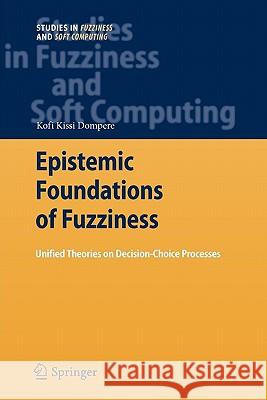
Epistemic Foundations of Fuzziness: Unified Theories on Decision-Choice Processes Dompere, Kofi Kissi 9783642099885 Springer - książkaWidoczna okładka, to zdjęcie poglądowe, a rzeczywista szata graficzna może różnić się od prezentowanej.

Epistemic Foundations of Fuzziness: Unified Theories on Decision-Choice Processes

ISBN-13: 9783642099885 / Angielski / Miękka / 2010 / 264 str.

Springer
cena 605,23
(netto: 576,41 VAT:  5%)

Najniższa cena z 30 dni: 578,30
Termin realizacji zamówienia:
ok. 22 dni roboczych
Bez gwarancji dostawy przed świętami

Darmowa dostawa!

This monograph is a second in the series of treatment on fuzzy rationality as an enveloping of decision-choice rationalities where limited information, vagueness, ambiguities and inexactnes are essential characteristics of our knowledge structure and reasoning process. The volume is devoted to a unified epistemic models and theories of decision-choice under total uncertainties.


Kategorie:
Technologie
Kategorie BISAC:
Mathematics > Matematyka stosowana
Philosophy > Logic
Computers > Artificial Intelligence - General
Wydawca:
Springer
Język:
Angielski
ISBN-13:
9783642099885
Rok wydania:
2010
Numer serii:
000044347
Ilość stron:
264
Waga:
0.44 kg
Wymiary:
23.5 x 15.5
Oprawa:
Miękka
Wolumenów:
01

General Epistemics on Science and Rationality.- Information and Knowledge in Decision-Choice Rationality.- Decision, Choice and Rationality.- Ideology and Decision-Choice Rationalities.- Ideology and Decision-Choice Rationalities.- Decision, Choice and Rationality.

This monograph is a treatment on optimal fuzzy rationality as an enveloping of decision-choice rationalities where limited information, vagueness, ambiguities and inexactness are essential characteristics of our knowledge structure and reasoning processes. The volume is devoted to a unified system of epistemic models and theories of decision-choice behavior under total uncertainties composed of fuzzy and stochastic types. The unified epistemic analysis of decision-choice models and theories begins with the question of how best to integrate vagueness, ambiguities, limited information, subjectivity and approximation into the decision-choice process. The answer to the question leads to the shifting of the classical paradigm of reasoning to fuzzy paradigm. This is followed by discussions and establishment of the epistemic foundations of fuzzy mathematics where the nature and role of information and knowledge are explicated and represented.

The epistemic foundation allows total uncertainties that constrain decision-choice activities, knowledge enterprise, logic and mathematical structures as our cognitive instruments to be discussed in reference to the phenomena of fuzzification, defuzzification and fuzzy logic. The discussions on these phenomena lead us to analyze and present models and theories on decision-choice rationality and the needed mathematics for problem formulation, reasoning and computations. The epistemic structures of two number systems made up of classical numbers and fuzzy numbers are discussed in relation to their differences, similarities and relative relevance to decision-choice rationality. The properties of the two number systems lead to the epistemic analysis of two mathematical systems that allow the partition of the mathematical space in support of decision-choice space of knowledge and non-knowledge production into four cognitively separate but interdependent cohorts whose properties are analyzed by the methods and techniques of category theory. The four cohorts are identified as non-fuzzy and non-stochastic, non-fuzzy and stochastic both of which belong to the classical paradigm and classical mathematical space; and fuzzy and non-stochastic, and fuzzy and stochastic cohorts both of which belong to the fuzzy paradigm and fuzzy mathematical space. The differences in the epistemic foundations of the two mathematical systems are discussed. The discussion leads to the establishment of the need for fuzzy mathematics and computing as a new system of reasoning in both exact and inexact sciences.

The mathematical structures of the cohorts are imposed on the decision-choice process to allow a grouping of decision-choice models and theories. The corresponding classes of decision-choice theories have the same characteristics as the logico-mathematical cohorts relative to the assumed information-knowledge structures. The four groupings of models and theories on decision-choice activities are then classified as: 1) non-fuzzy and non-stochastic class with exact and full information-knowledge structure (no uncertainty), 2) non-fuzzy and stochastic class with exact and limited information-knowledge structure (stochastic uncertainty), 3) fuzzy and non-stochastic class with full and fuzzy information-knowledge structure (fuzzy uncertainty) and 4) Fuzzy and stochastic class with fuzzy and limited information-knowledge structure (fuzzy and stochastic uncertainties). All these different classes of decision choice problems have their corresponding rationalities which are fully discussed to present a unified logical system of theories on decision-choice process.

The volume is concluded with epistemic discussions on the nature of contradictions and paradoxes viewed as logical decision-choice problems in the classical paradigm, and how these contradictions and paradoxes may be resolved through fuzzy paradigm and the methods and techniques of optimal fuzzy decision-choice rationality. The logical problem of sorites paradox with its resolution is given as an example. Interested audience includes those working in the areas of economies, decision-choice theories, philosophy of sciences, epistemology, mathematics, computer science, engineering, cognitive psychology, fuzzy mathematics and mathematics of fuzzy-stochastic processes.


Udostępnij

Facebook - konto krainaksiazek.pl


Opinie o Krainaksiazek.pl na Opineo.pl

Partner Mybenefit

Krainaksiazek.pl w programie rzetelna firma Krainaksiaze.pl - płatności przez paypal

Czytaj nas na:

Facebook - krainaksiazek.pl
  • książki na zamówienie
  • granty
  • książka na prezent
  • kontakt
  • pomoc
  • opinie
  • regulamin
  • polityka prywatności

Zobacz:

  • Księgarnia czeska

  • Wydawnictwo Książkowe Klimaty

1997-2025 DolnySlask.com Agencja Internetowa

© 1997-2022 krainaksiazek.pl
     
KONTAKT | REGULAMIN | POLITYKA PRYWATNOŚCI | USTAWIENIA PRYWATNOŚCI
Zobacz: Księgarnia Czeska | Wydawnictwo Książkowe Klimaty | Mapa strony | Lista autorów
KrainaKsiazek.PL - Księgarnia Internetowa

Polityka prywatnosci - link
Krainaksiazek.pl - płatnośc Przelewy24
Przechowalnia Przechowalnia







