• Wyszukiwanie zaawansowane
  • Kategorie
  • Kategorie BISAC
  • Książki na zamówienie
  • Promocje
  • Granty
  • Książka na prezent
  • Opinie
  • Pomoc
  • Załóż konto
  • Zaloguj się

Xplore -- Learning Guide: Learning Guide » książka


zaloguj się | załóż konto
Logo Krainaksiazek.pl

koszyk

konto

szukaj
topmenu
Księgarnia internetowa
Szukaj
Książki na zamówienie
Promocje
Granty
Książka na prezent
Moje konto
Pomoc
 
 
Wyszukiwanie zaawansowane
Pusty koszyk
Bezpłatna dostawa dla zamówień powyżej 20 złBezpłatna dostawa dla zamówień powyżej 20 zł

Kategorie główne

• Nauka
 [2950560]
• Literatura piękna
 [1849509]

  więcej...
• Turystyka
 [71097]
• Informatyka
 [151150]
• Komiksy
 [35848]
• Encyklopedie
 [23178]
• Dziecięca
 [617388]
• Hobby
 [139064]
• AudioBooki
 [1657]
• Literatura faktu
 [228597]
• Muzyka CD
 [383]
• Słowniki
 [2855]
• Inne
 [445295]
• Kalendarze
 [1464]
• Podręczniki
 [167547]
• Poradniki
 [480102]
• Religia
 [510749]
• Czasopisma
 [516]
• Sport
 [61293]
• Sztuka
 [243352]
• CD, DVD, Video
 [3414]
• Technologie
 [219456]
• Zdrowie
 [101002]
• Książkowe Klimaty
 [124]
• Zabawki
 [2311]
• Puzzle, gry
 [3459]
• Literatura w języku ukraińskim
 [254]
• Art. papiernicze i szkolne
 [8079]
Kategorie szczegółowe BISAC

Xplore -- Learning Guide: Learning Guide

ISBN-13: 9783540662075 / Angielski / Miękka / 1999 / 526 str.
Wolfgang Hardle; W. Hardlw; S. Klinke
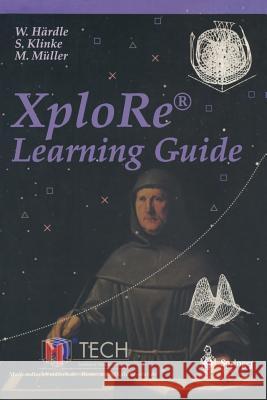
Xplore -- Learning Guide: Learning Guide Härdle, W. 9783540662075 Springer - książkaWidoczna okładka, to zdjęcie poglądowe, a rzeczywista szata graficzna może różnić się od prezentowanej.

Xplore -- Learning Guide: Learning Guide

ISBN-13: 9783540662075 / Angielski / Miękka / 1999 / 526 str.

Wolfgang Hardle; W. Hardlw; S. Klinke
cena 201,24
(netto: 191,66 VAT:  5%)

Najniższa cena z 30 dni: 192,74
Termin realizacji zamówienia:
ok. 22 dni roboczych
Dostawa w 2026 r.

Darmowa dostawa!

It is generally accepted that training in statistics must include some exposure to the mechanics of computational statistics. This learning guide is intended for beginners in computer-aided statistical data analysis. The prerequisites for XploRe - the statistical computing environment - are an introductory course in statistics or mathematics. The reader of this book should be familiar with basic elements of matrix algebra and the use of HTML browsers. This guide is designed to help students to XploRe their data, to learn (via data interaction) about statistical methods and to disseminate their findings via the HTML outlet. The XploRe APSS (Auto Pilot Support System) is a powerful tool for finding the appropriate statistical technique (quantlet) for the data under analysis. Homogeneous quantlets are combined in XploRe into quantlibs. The XploRe language is intuitive and users with prior experience of other sta tistical programs will find it easy to reproduce the examples explained in this guide. The quantlets in this guide are available on the CD-ROM as well as on the Internet. The statistical operations that the student is guided into range from basic one-dimensional data analysis to more complicated tasks such as time series analysis, multivariate graphics construction, microeconometrics, panel data analysis, etc. The guide starts with a simple data analysis of pullover sales data, then in troduces graphics. The graphics are interactive and cover a wide range of dis plays of statistical data."


Kategorie:
Nauka, Matematyka
Kategorie BISAC:
Gardening > General
Mathematics > Prawdopodobieństwo i statystyka
Computers > Mathematical & Statistical Software
Wydawca:
Springer
Język:
Angielski
ISBN-13:
9783540662075
Rok wydania:
1999
Wydanie:
2000
Ilość stron:
526
Waga:
0.73 kg
Wymiary:
23.39 x 15.6 x 2.72
Oprawa:
Miękka
Wolumenów:
01

From the reviews:

"XploRe is a statistical package with an econometric focus. ... XploRe is an excellent tool for those who wish to engage in some fairly sophisticated econometric analysis. It is also an excellent environment to teach budding statisticians. ... I also believe that serious researchers in the area will find the professional package to be a very useful analytic tool." (Joseph Hilbe, The American Statistician, Vol. 55 (2), May 2001)

"XploRe Learning Guide and the accompanying CD are intended for beginners in computer-aided statistical data analysis. The guide contains 17 Chapters and an Appendix." (Shibdas Bandyopadhyay, Sankhya, Vol. 64 B, Part 3, 2002)

I: First Steps.- 1 Getting Started.- 1.1 Using XploRe.- 1.1.1 Input and Output Windows.- 1.1.2 Simple Computations.- 1.1.3 First Data Analysis.- 1.1.4 Exploring Data.- 1.1.5 Printing Graphics.- 1.2 Quantlet Examples.- 12.1 Summary Statistics.- 1.2.2 Histograms.- 1.2.3 2D Density Estimation.- 1.2.4 Interactive Kernel Regression.- 1.3 Getting Help.- 1.4 Basic XploRe Syntax.- 1.4.1 Operators.- 1.4.2 Variables.- 1.4.3 Variable Names.- 1.4.4 Functions.- 1.4.5 Quantlet files.- 2. Descriptive Statistics.- 2.1 Data Matrices.- 2.1.1 Creating Data Matrices.- 2.1.2 Loading Data Files.- 2.1.3 Matrix Operations.- 2.2 Computing Statistical Characteristics.- 2.1.1 Minimum and Maximum.- 2.2.2 Mean, Variance and Other Moments.- 2.2.3 Median and Quantiles.- 2.2.4 Covariance and Correlation.- 2.2.5 Categorical Data.- 2.2.6 Missing Values and Infinite Values.- 2.3 Summarizing Statistical Information.- 2.3.1 Summarizing Metric Data.- 2.3.2 Summarizing Categorical Data.- 3 Graphics.- 3.1 Basic Plotting.- 3.1.1 Plotting a Data Set.- 3.1.2 Plotting a Function.- 3.1.3 Plotting Several Functions.- 3.1.4 Coloring Data Sets.- 3.1.5 Plotting Lines from Data Sets.- 3.1.6 Several Plots.- 3.2 Univariate Graphics.- 3.2.1 Boxplots.- 3.2.2 Dotplots.- 3.2.3 Bar Charts.- 3.2.4 Quantile-Quantile Plots.- 3.2.5 Histograms.- 3.3 Multivariate Graphics.- 3.3.1 Three-Dimensional Plots.- 3.3.2 Surface Plots.- 3.3.3 Contour Plots.- 3.3.4 Sunflower Plots.- 3.3.5 Linear Regression.- 3.3.6 Bivariate Plots.- 3.3.7 Star Diagrams.- 3.3.8 Scatter-Plot Matrices.- 3.3.9 Andrews Curves.- 3.3.10 Parallel Coordinate Plots.- 3.4 Advanced Graphics.- 3.4.1 Moving and Rotating.- 3.4.2 Simple Predefined Graphic Primitives.- 3.4.3 Color Models.- 3.5 Graphic Commands.- 3.5.1 Controlling Data Points.- 3.5.2 Color of Data Points.- 3.5.3 Symbol of Data Points.- 3.5.4 Size of Data Points.- 3.5.5 Connection of Data Points.- 3.5.6 Label of Data Points.- 3.5.7 Title and Axes Labels.- 3.5.8 Axes Layout.- 4 Regression Methods.- 4.1 Simple Linear Regression.- 4.2 Multiple Linear Regression.- 4.3 Nonlinear Regression.- 5 Teachware Quantlets.- 5.1 Visualizing Data.- 5.2 Random Sampling.- 5.3 The p-Value in Hypothesis Testing.- 5.4 Approximating the Binomial by the Normal Distribution.- 5.5 The Central Limit Theorem.- 5.6 The Pearson Correlation Coefficient.- 5.7 Linear Regression.- II: Statistical Libraries.- 6 Smoothing Methods.- 6.1 Kernel Density Estimation.- 6.1.1 Computational Aspects.- 6.1.2 Computing Kernel Density Estimates.- 6.1.3 Kernel Choice.- 6.1.4 Bandwidth Selection.- 6.1.5 Confidence Intervals and Bands.- 6.2 Kernel Regression.- 6.2.1 Computational Aspects.- 6.2.2 Computing Kernel Regression Estimates.- 6.2.3 Bandwidth Selection.- 6.2.4 Confidence Intervals and Bands.- 6.2.5 Local Polynomial Regression and Derivative Estimation.- 6.3 Multivariate Density and Regression Functions.- 6.3.1 Computational Aspects.- 6.3.2 Multivariate Density Estimation.- 6.3.3 Multivariate Regression.- 7 Generalized Linear Models.- 7.1 Estimating GLMs.- 7.1.1 Models.- 7.1.2 Maximum-Likelihood Estimation.- 7.2 Computing GLM Estimates.- 7.2.1 Data Preparation.- 7.2.2 Interactive Estimation.- 7.2.2 Noninteractive Estimation.- 7.3 Weights & Constraints.- 7.3.1 Prior Weights.- 7.3.2 Replications in Data.- 7.3.3 Constrained Estimation.- 7.4 Options.- 7.4.1 Setting Options.- 7.4.2 Weights and Offsets.- 7.4.3 Control Parameters.- 7.4.4 Output Modification.- 7.5 Statistical Evaluation and Presentation.- 7.5.1 Statistical Characteristics.- 7.5.2 Output Display.- 7.5.3 Significance of Parameters.- 7.5.4 Likelihood Ratio Tests for Comparing Nested Models.- 7.5.5 Subset Selection.- 8 Neural Networks.- 8.1 Feed-Forward Networks.- 8.2 Computing a Neural Network.- 8.2.1 Controlling the Parameters of the Neural Network.- 8.2.2 The Resulting Neural Network.- 8.3 Running a Neural Network.- 8.3.1 Implementing a Simple Discriminant Analysis.- 8.3.2 Implementing a More Complex Discriminant Analysis.- 9 Time Series.- 9.1 Time Domain and Frequency Domain Analysis.- 9.1.1 Autocovariance and Autocorrelation Function.- 9.1.2 The Periodogram and the Spectrum of a Series.- 9.2 Linear Models.- 9.2.1 Autoregressive Models.- 9.2.2 Autoregressive Moving Average Models.- 9.2.3 Estimating ARMA Processes.- 9.3 Nonlinear Models.- 9.3.1 Several Examples of Nonlinear Models.- 9.3.2 Nonlinearity in the Conditional Second Moments.- 9.3.3 Estimating ARCH Models.- 9.3.4 Testing for ARCH.- 10 Kalman Filtering.- 10.1 State-Space Models.- 10.1.1 Examples of State-Space Models.- 10.1.2 Modeling State-Space Models in XploRe.- 10.2 Kalman Filtering and Smoothing.- 10.3 Parameter Estimation in State-Space Models.- 11 Finance.- 11.1 Outline of the Theory.- 11.1.1 Some History.- 11.1.2 The Black-Scholes Formula.- 11.2 Assets.- 11.2.1 Stock Simulation.- 11.2.2 Stock Estimation.- 11.2.3 Stock Estimation and Simulation.- 11.3 Options.- 11.3.1 Calculation of Option Prices and Implied Volatilities.- 11.3.2 Option Price Determining Factors.- 11.3.3 Greeks.- 11.4 Portfolios and Hedging.- 11.4.1 Calculation of Arbitrage.- 11.4.2 Bull-Call Spreads.- 12 Microeconometrics and Panel Data.- 12.1 Limited-Dependent and Qualitative Dependent Variables.- 12.1.1 Probit, Logit and Tobit.- 12.1.2 Single Index Models.- 12.1.3 Average Derivatives.- 12.1.4 Average Derivative Estimation.- 12.1.5 Weighted Average Derivative Estimation.- 12.1.6 Average Derivatives and Discrete Variables.- 12.1.7 Parametric versus Semiparametric Single Index Models.- 12.2 Multiple Index Models.- 12.2.1 Sliced Inverse Regression.- 12.2.2 Testing Parametric Multiple Index Models.- 12.3 Self-Selection Models.- 12.3.1 Parametric Model.- 12.3.2 Semiparametric Model.- 12.4 Panel Data Analysis.- 12.4.1 The Data Set.- 12.4.2 Time Effects.- 12.4.3 Model Specification.- 12.4.4 Estimation.- 12.4.5 An Example.- 12.5 Dynamic Panel Data Models.- 12.6 Unit Root Tests for Panel Data.- 13 Extreme Value Analysis.- 13.1 Extreme Value Models.- 13.2 Generalized Pareto Distributions.- 13.3 Assessing the Adequacy: Mean Excess Functions.- 13.4 Estimation in EV Models.- 13.4.1 Linear Combination of Ratios of Spacings (LRS).- 13.4.2 ML Estimator in the EV Model.- 13.4.3 ML Estimator in the Gumbel Model.- 13.5 Fitting GP Distributions to the Upper Tail.- 13.6 Parametric Estimators for GP Models.- 13.6.1 Moment Estimator.- 13.6.2 ML Estimator in the GP Model.- 13.6.3 Pickands Estimator.- 13.6.4 Drees-Pickands Estimator.- 13.6.5 Hill Estimator.- 13.6.6 ML Estimator for Exponential Distributions.- 13.6.7 Selecting a Threshold by Means of a Diagram.- 13.7 Graphical User Interface.- 13.8 Example.- 14 Wavelets.- 14.1 Quantlib twave.- 14.1.1 Change Basis.- 14.1.2 Change Function.- 14.1.3 Change View.- 14.2 Discrete Wavelet Transform.- 14.3 Function Approximation.- 14.4 Data Compression.- 14.5 Two Sines.- 14.6 Frequency Shift.- 14.7 Thresholding.- 14.7.1 Hard Thresholding.- 14.7.2 Soft Thresholding.- 14.7.3 Adaptive Thresholding.- 14.8 Translation Invariance.- 14.9 Image Denoising.- III: Programming.- 15 Reading and Writing Data.- 15.1 Reading and Writing Data Files.- 15.2 Input Format Strings.- 15.3 Output Format Strings.- 15.4 Customizing the Output Window.- 15.4.1 Headline Style.- 15.4.2 Layer Style.- 15.4.3 Line Number Style.- 15.4.4 Value Formats and Lengths.- 15.4.5 Saving Output to a File.- 16 Matrix Handling.- 16.1 Basic Operations.- 16.1.1 Creating Matrices and Arrays.- 16.1.2 Operators for Numeric Matrices.- 16.2 Comparison Operators.- 16.3 Matrix Manipulation.- 16.3.1 Extraction of Elements.- 16.3.2 Matrix Transformation.- 16.4 Sums and Products.- 16.5 Distance Function.- 16.6 Decompositions.- 16.6.1 Spectral Decomposition.- 16.6.2 Singular Value Decomposition.- 16.6.3 LU Decomposition.- 16.6.4 Cholesky Decomposition.- 16.7 Lists.- 16.7.1 Creating Lists.- 16.7.2 Handling Lists.- 16.7.3 Getting Information on Lists.- 17 Quantlets and Quantlibs.- 17.1 Quantlets.- 17.2 Flow Control.- 17.2.1 Local and Global Variables.- 17.2.2 Conditioning.- 17.2.3 Branching.- 17.2.4 While-Loop.- 17.2.5 Do-Loop.- 17.2.6 Optional Input and Output in Procedures.- 17.2.7 Errors and Warnings.- 17.3 User Interaction.- 17.4 APSS.- 17.5 Quantlibs.

Wolfgang Härdle is a professor of statistics at the Humboldt-Universität zu Berlin and director of C.A.S.E. the Centre for Applied Statistics and Economics. He teaches quantitative finance and semiparametric statistical methods. His research focuses on dynamic factor models, multivariate statistics in finance and computational statistics. He is an elected ISI member and advisor to the Guanghua School of Management, Peking University and to National Central University, Taiwan.


Udostępnij

Facebook - konto krainaksiazek.pl


Opinie o Krainaksiazek.pl na Opineo.pl

Partner Mybenefit

Krainaksiazek.pl w programie rzetelna firma Krainaksiaze.pl - płatności przez paypal

Czytaj nas na:

Facebook - krainaksiazek.pl
  • książki na zamówienie
  • granty
  • książka na prezent
  • kontakt
  • pomoc
  • opinie
  • regulamin
  • polityka prywatności

Zobacz:

  • Księgarnia czeska

  • Wydawnictwo Książkowe Klimaty

1997-2025 DolnySlask.com Agencja Internetowa

© 1997-2022 krainaksiazek.pl
     
KONTAKT | REGULAMIN | POLITYKA PRYWATNOŚCI | USTAWIENIA PRYWATNOŚCI
Zobacz: Księgarnia Czeska | Wydawnictwo Książkowe Klimaty | Mapa strony | Lista autorów
KrainaKsiazek.PL - Księgarnia Internetowa

Polityka prywatnosci - link
Krainaksiazek.pl - płatnośc Przelewy24
Przechowalnia Przechowalnia





