• Wyszukiwanie zaawansowane
  • Kategorie
  • Kategorie BISAC
  • Książki na zamówienie
  • Promocje
  • Granty
  • Książka na prezent
  • Opinie
  • Pomoc
  • Załóż konto
  • Zaloguj się

Mathematical Modelling Programs in Latin America: A Collaborative Context for Social Construction of Knowledge for Educational Change » książka


zaloguj się | załóż konto
Logo Krainaksiazek.pl

koszyk

konto

szukaj
topmenu
Księgarnia internetowa
Szukaj
Książki na zamówienie
Promocje
Granty
Książka na prezent
Moje konto
Pomoc
 
 
Wyszukiwanie zaawansowane
Pusty koszyk
Bezpłatna dostawa dla zamówień powyżej 20 złBezpłatna dostawa dla zamówień powyżej 20 zł

Kategorie główne

• Nauka
 [2950560]
• Literatura piękna
 [1849509]

  więcej...
• Turystyka
 [71097]
• Informatyka
 [151150]
• Komiksy
 [35848]
• Encyklopedie
 [23178]
• Dziecięca
 [617388]
• Hobby
 [139064]
• AudioBooki
 [1657]
• Literatura faktu
 [228597]
• Muzyka CD
 [383]
• Słowniki
 [2855]
• Inne
 [445295]
• Kalendarze
 [1464]
• Podręczniki
 [167547]
• Poradniki
 [480102]
• Religia
 [510749]
• Czasopisma
 [516]
• Sport
 [61293]
• Sztuka
 [243352]
• CD, DVD, Video
 [3414]
• Technologie
 [219456]
• Zdrowie
 [101002]
• Książkowe Klimaty
 [124]
• Zabawki
 [2311]
• Puzzle, gry
 [3459]
• Literatura w języku ukraińskim
 [254]
• Art. papiernicze i szkolne
 [8079]
Kategorie szczegółowe BISAC

Mathematical Modelling Programs in Latin America: A Collaborative Context for Social Construction of Knowledge for Educational Change

ISBN-13: 9783031042706 / Angielski / Twarda / 2022 / 486 str.
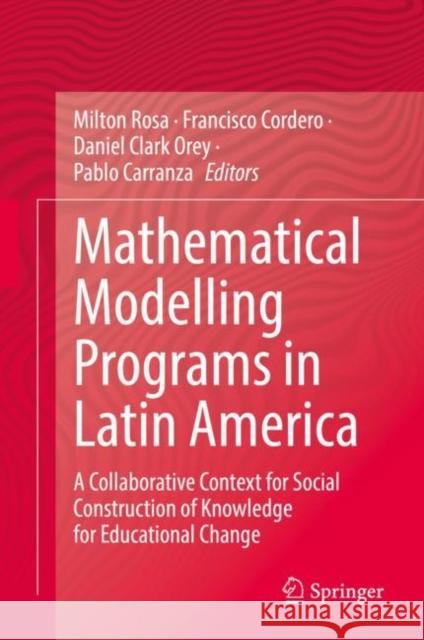
Milton Rosa;Francisco Cordero;Daniel Clark Orey
Mathematical Modelling Programs in Latin America: A Collaborative Context for Social Construction of Knowledge for Educational Change Milton Rosa Francisco Cordero Daniel Clark Orey 9783031042706 Springer International Publishing AG - książkaWidoczna okładka, to zdjęcie poglądowe, a rzeczywista szata graficzna może różnić się od prezentowanej.

Mathematical Modelling Programs in Latin America: A Collaborative Context for Social Construction of Knowledge for Educational Change

ISBN-13: 9783031042706 / Angielski / Twarda / 2022 / 486 str.

Milton Rosa;Francisco Cordero;Daniel Clark Orey
cena 602,40
(netto: 573,71 VAT:  5%)

Najniższa cena z 30 dni: 578,30
Termin realizacji zamówienia:
ok. 22 dni roboczych
Dostawa w 2026 r.

Darmowa dostawa!
inne wydania

This book is about the unique, sophisticated, and rigorous study of mathematics in Latin America developed over centuries of cultural exchange between Europe, North, and South America. More specifically, the book explores the tradition of mathematical modelling, introduced a century ago. This modelling was adapted to assist members of distinct communities to draw information about their own realities through the elaboration of representations, which generate mathematical knowledge that deals with creativity and invention. The book provides empirical evidence that a category of mathematical modelling developed in Latin America assesses the horizontal and reciprocal relations between mathematics (school/non-school contexts) and the real world. These relations provide an epistemological and ontological change, where mathematical knowledge of the others is recognized on a horizontal plane. Further, they oblige mathematics teachers and students to understand as a community of knowledge that builds their own mathematical categories of their environment governed by the reciprocal relationships between academic knowledge and functional knowledge. The dimensions of the relationships make up a frame of reference that guides educational change in mathematics. The book presents an inquiry-based approach of three Latin American modelling programs: ethnomodelling, transversality of knowledge, and reasoned decision-making. Each one, with its respective theoretical and methodological foundations related to ethnomathematics and mathematical modelling, socioepistemology, and the attribution of meaning to learning. Undoubtedly, the three mathematical modelling programs, independently, provide educational gains, each with its levels of specificity and loyal to its philosophical, theoretical, and methodological principles. However, the book places them together, organized by axes, to define a corpus of mathematical knowledge that envisions profound educational change through the development of different approaches of mathematical modelling. The authors of the 18 chapters in this book, who represent the diversity of Latin America, are from eight countries: Argentina, Brazil, Chile, Colombia, Costa Rica, Cuba, Ecuador, Honduras, and Mexico. They were invited to share their ideas, perspectives, and discuss investigations that represent a rich sample of three Latin American perspectives on mathematical modelling.


Kategorie:
Podręczniki
Kategorie BISAC:
Education > Teaching - Subjects - Mathematics
Political Science > Public Policy - Social Policy
Education > Philosophy, Theory & Social Aspects
Wydawca:
Springer International Publishing AG
Język:
Angielski
ISBN-13:
9783031042706
Rok wydania:
2022
Dostępne języki:
Ilość stron:
486
Waga:
0.77 kg
Wymiary:
23.39 x 15.6 x 2.39
Oprawa:
Twarda
Dodatkowe informacje:
Wydanie ilustrowane

Foreword

PART I

Introduction

Chapter 1 Modelling in the life of people: an alternative program for teaching and learning of mathematics

PART II Ethnomathematics and Ethnomodelling: Empirical Work, TheoreticalMethodological Approaches, and Research Questions

 Chapter 2 Conceptualizing positive deviance in ethnomodelling research: creatively insubordinating and responsably subverting mathematics education

 Chapter 3 Ethnomodelling as an alternative to Basic Education: perceptions of members of a research project

Chapter 4 Ethnomodelling aspects of positionality between local and global knowledge through glocalization: a case of a farmer vendor

Chapter 5 Ethnomodeling as a pedagogical action in diverse contexts by using dialogical knowledge

Chapter 6 Ethnomodelling: weaving networks between academic mathematical knowledge and cultural knowledge in the southeastern region of Tocantins

Chapter 7 Mathematical Analysis of the Ceramic Designs of the Pre-Columbian Cultures of Ecuador through Ethnomodelling with a Sociocultural Approach


PART III Interdisciplinary Ecosystems: Empirical Work, Theoretical-Methodological Approaches, and Research Questions

Chapter 8 Analyzing the availability of renewable energy resources in a project in real context: a framework for making sense of learning

Chapter 9 Descriptive and prescriptive modeling in a math class project: disciplinary concepts participating in the construction of arguments for decision-making

Chapter 10 Designing and building a mobile support for solar panels: a project for 12-year-old students that required mathematical modelling and more

Chapter 11 From an epistemological approach to an epistemic one: reference change in the looks of math teachers in real context projects


PART IV Mathematics and People: Empirical Work, Theoretical-Methodological Approaches, and Research Questions

Chapter 12 A category of modelling: the uses and learning of mathematical knowledge in different scenarios

Chapter 13 Modelling and anticipation of graphical behaviors in Industrial Chemical Engineering: the role of transversality of knowledge in learning mathematics

Chapter 14 Category of modelling and reproduction of behaviours in other disciplines: the teaching of mathematics and engineering

Chapter 15 The disciplinary identity in initial mathematics teacher training and people´s category of modelling: a valorization of the knowledge of the learner

Chapter 16 Contemporary learning in the interaction of the human with data, via technology-mediated graphics: the discourse-representation dialogue in mathematics

Capítulo 17 Modelling of natural phenomena as a source to re-signify mathematical knowledge: some examples

Part V

Conclusion The Mathematical Teaching and Learning Process through Mathematical Modelling: Educational Change in Latin America

Dr. Milton Rosa earned a Masters’ degree in 2001 and a Doctorate degree in 2010 both in Education from California State University in Sacramento. He also earned a post-doctorate degree in Education from Universidade de São Paulo and his studies focuses on ethnomodelling research, which is the connection between ethnomathematics and mathematical modelling. He has published papers and articles in national and international journals, chapter books, and books in Portuguese, Spanish, and English. He joined conferences and symposia in international and national levels with contributions of plenaries, round tables, communications, and posters. He also has supervised numerous master theses in the area of Mathematics Education. In 2010, Dr. Rosa was awarded the Dr. Carlos J. Vallejo Memorial Award, in the area of Multicultural and Multiethnic Education (MME), in the Special Interest Group (SIG) in the American Education Research Association (AERA) for his contributions in the area of cultural diversity in Mathematics Education.

Dr. Francisco Cordero, PhD, is a Senior Researcher in the Department of Educational Mathematics of the Center for Research and Advanced Studies (CINVESTAV) and Coordinator of the Higher Education Area. He earned his PhD in Mathematics Education at CINVESTAV and postdoc at Purdue University, Indiana, United States. Dr Cordero's research topics are the socio-epistemology theory of educational mathematics, categories of the use of mathematical knowledge of people, mathematical modelling and transversality of knowledge, training and professionalization of the teacher in mathematics and the socialization of the science. He is a member of the National System of Researchers (SNI), the Mexican Academy of Sciences (AMC) and the Latin American Committee for Educational Mathematics (Clame). He has trained researchers for several generations: he has supervised a little more than 62 master's theses and 22 doctoral theses. He has published a hundred articles in prestigious magazines, as well as twenty books and chapters in prestigious publishing houses. Due to his academic leadership, he has given a hundred conferences at universities in different countries: Argentina, Brazil, Colombia, Chile, Cuba, Guatemala, Honduras, Mexico, Panama, Dominican Republic, Uruguay, United States, Spain, France, and Turkey.

Dr. Daniel Clark Orey, Ph.D. is Professor Emeritus of Mathematics and Multicultural Education at California State University, Sacramento where he served from 1987 to January 2011. Dr. Orey graduated from Oregon State University in 1978 and taught in Oregon and in Guatemala. He earned his Ph.D. in Curriculum and Instruction in Multicultural Education at the University of New Mexico in 1988. His masters work took him to Patzun, Chimaltenango in Guatemala where he did field research with Logo, computers and Mayan children. In 1998, at the invitation of Professor Ubiratan D'Ambrosio, Dr. Orey served as a Fulbright Scholar at the Pontifícia Universidade Católica de Campinas in Brasil, which he conducted research in classrooms and taught courses in ethnomathematics and mathematical modeling. In 2007, Dr. Orey served as Senior Fulbright Specialist in Kathmandu University, Nepal, giving lectures on topics related to mathematics education and teaching on Ethnomathematics and Modelling. He is currently professor of mathematics education in the Departamento de Educação Matemática and in the Master’ Degree Program in Mathematics Education at the Universidade Federal de Ouro Preto, Brasil.

Pablo Carranza carried out master's and doctorate studies in Mathematics Didactics at Denis Diderot University in France. He has worked as a mathematics teacher in rural, urban, public and private schools. He is currently a research professor at the National University of Rio Negro. There he conducts research on projects in real context as a framework for learning disciplinary concepts. In this context, he directs both research and extension projects aimed at real problems in the community.

This book is about the unique, sophisticated, and rigorous study of mathematics in Latin America developed over centuries of cultural exchange between Europe, North, and South America. More specifically, the book explores the tradition of mathematical modelling, introduced a century ago. This modelling was adapted to assist members of distinct communities to draw information about their own realities through the elaboration of representations, which generate mathematical knowledge that deals with creativity and invention. The book provides empirical evidence that a category of mathematical modelling developed in Latin America assesses the horizontal and reciprocal relations between mathematics (school/non-school contexts) and the real world. These relations provide an epistemological and ontological change, where mathematical knowledge of the others is recognized on a horizontal plane. Further, they oblige mathematics teachers and students to understand as a community of knowledge that builds their own mathematical categories of their environment governed by the reciprocal relationships between academic knowledge and functional knowledge. The dimensions of the relationships make up a frame of reference that guides educational change in mathematics. The book presents an inquiry-based approach of three Latin American modelling programs: ethnomodelling, transversality of knowledge, and reasoned decision-making. Each one, with its respective theoretical and methodological foundations related to ethnomathematics and mathematical modelling, socioepistemology, and the attribution of meaning to learning. Undoubtedly, the three mathematical modelling programs, independently, provide educational gains, each with its levels of specificity and loyal to its philosophical, theoretical, and methodological principles. However, the book places them together, organized by axes, to define a corpus of mathematical knowledge that envisions profound educational change through the development of different approaches of mathematical modelling. The authors of the 18 chapters in this book, who represent the diversity of Latin America, are from eight countries: Argentina, Brazil, Chile, Colombia, Costa Rica, Cuba, Ecuador, Honduras, and Mexico. They were invited to share their ideas, perspectives, and discuss investigations that represent a rich sample of three Latin American perspectives on mathematical modelling.




Udostępnij

Facebook - konto krainaksiazek.pl


Opinie o Krainaksiazek.pl na Opineo.pl

Partner Mybenefit

Krainaksiazek.pl w programie rzetelna firma Krainaksiaze.pl - płatności przez paypal

Czytaj nas na:

Facebook - krainaksiazek.pl
  • książki na zamówienie
  • granty
  • książka na prezent
  • kontakt
  • pomoc
  • opinie
  • regulamin
  • polityka prywatności

Zobacz:

  • Księgarnia czeska

  • Wydawnictwo Książkowe Klimaty

1997-2025 DolnySlask.com Agencja Internetowa

© 1997-2022 krainaksiazek.pl
     
KONTAKT | REGULAMIN | POLITYKA PRYWATNOŚCI | USTAWIENIA PRYWATNOŚCI
Zobacz: Księgarnia Czeska | Wydawnictwo Książkowe Klimaty | Mapa strony | Lista autorów
KrainaKsiazek.PL - Księgarnia Internetowa

Polityka prywatnosci - link
Krainaksiazek.pl - płatnośc Przelewy24
Przechowalnia Przechowalnia



