• Wyszukiwanie zaawansowane
  • Kategorie
  • Kategorie BISAC
  • Książki na zamówienie
  • Promocje
  • Granty
  • Książka na prezent
  • Opinie
  • Pomoc
  • Załóż konto
  • Zaloguj się

Sustaining Moore's Law: Uncertainty Leading to a Certainty of IoT Revolution » książka


zaloguj się | załóż konto
Logo Krainaksiazek.pl

koszyk

konto

szukaj
topmenu
Księgarnia internetowa
Szukaj
Książki na zamówienie
Promocje
Granty
Książka na prezent
Moje konto
Pomoc
 
 
Wyszukiwanie zaawansowane
Pusty koszyk
Bezpłatna dostawa dla zamówień powyżej 20 złBezpłatna dostawa dla zamówień powyżej 20 zł

Kategorie główne

• Nauka
 [2946912]
• Literatura piękna
 [1852311]

  więcej...
• Turystyka
 [71421]
• Informatyka
 [150889]
• Komiksy
 [35717]
• Encyklopedie
 [23177]
• Dziecięca
 [617324]
• Hobby
 [138808]
• AudioBooki
 [1671]
• Literatura faktu
 [228371]
• Muzyka CD
 [400]
• Słowniki
 [2841]
• Inne
 [445428]
• Kalendarze
 [1545]
• Podręczniki
 [166819]
• Poradniki
 [480180]
• Religia
 [510412]
• Czasopisma
 [525]
• Sport
 [61271]
• Sztuka
 [242929]
• CD, DVD, Video
 [3371]
• Technologie
 [219258]
• Zdrowie
 [100961]
• Książkowe Klimaty
 [124]
• Zabawki
 [2341]
• Puzzle, gry
 [3766]
• Literatura w języku ukraińskim
 [255]
• Art. papiernicze i szkolne
 [7810]
Kategorie szczegółowe BISAC

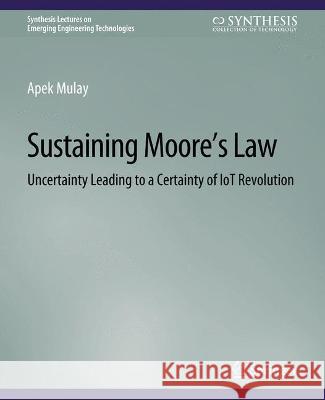
Sustaining Moore's Law: Uncertainty Leading to a Certainty of IoT Revolution

ISBN-13: 9783031008979 / Angielski / Miękka / 2015 / 112 str.
Apek Mulay
Sustaining Moore's Law: Uncertainty Leading to a Certainty of IoT Revolution Apek Mulay   9783031008979 Springer International Publishing AG - książkaWidoczna okładka, to zdjęcie poglądowe, a rzeczywista szata graficzna może różnić się od prezentowanej.

Sustaining Moore's Law: Uncertainty Leading to a Certainty of IoT Revolution

ISBN-13: 9783031008979 / Angielski / Miękka / 2015 / 112 str.

Apek Mulay
cena 132,80
(netto: 126,48 VAT:  5%)

Najniższa cena z 30 dni: 127,20
Termin realizacji zamówienia:
ok. 22 dni roboczych
Bez gwarancji dostawy przed świętami

Darmowa dostawa!

In 1965, Intel co-founder Gordon Moore, in ""Cramming more components onto Integrated Circuits"" in Electronics Magazine (April 19, 1965), made the observation that, in the history of computing hardware, the number of transistors on integrated circuits doubles approximately every two years. Since its inception in 1965 until recent times, this law has been used in the semiconductor industry to guide investments for long-term planning as well as to set targets for research and development. These investments have helped in a productive utilization of wealth, which created more employment opportunities for semiconductor industry professionals. In this way, the development of Moore's Law has helped sustain the progress of today's knowledge-based economy. While Moore's Law has, on one hand, helped drive investments toward technological and economic growth, thereby benefiting the consumers with more powerful electronic gadgets, Moore's Law has indirectly also helped to fuel other innovations in the global economy. However, the Law of diminishing returns is now questioning the sustainability of further evolution of Moore's Law and its ability to sustain the progress of today's knowledge based economy. The lack of liquidity in the global economy is truly bringing the entire industry to a standstill and the dark clouds of an economic depression are hovering over the global economy. What factors have been ignored by the global semiconductor industry leading to a demise of Moore's Law? Do the existing business models prevalent in the semiconductor industry pose any problems? Have supply chains made that progress unsustainable? In today's globalized world, have businesses been able to sustain national interests while driving the progress of Moore's Law? Could the semiconductor industry help the entire global economy move toward a radiance of the new crimson dawn, beyond the veil of the darkest night by sustaining the progress of Moore's Law? The entire semiconductor industry is now clamoring for a fresh approach to overcome existing barriers to the progress of Moore's Law, and this book delivers just that. Moore's Law can easily continue for the foreseeable future if the chip manufacturing industry becomes sustainable by having a balanced economy. The sustainable progress of Moore's Law advocates the ""heresy"" of transforming the current economic orthodoxy of monopoly capitalism into free-market capitalism. The next big thing that everybody is looking forward to after mobile revolution is the ""Internet of Things"" (IoT) revolution. While some analysts forecast that the IoT market would achieve 5.4 billion connections worldwide by 2020, the poor consumer purchasing power in global economy makes this forecast truly questionable. Sustaining Moore's Law presents a blueprint for sustaining the progress of Moore's Law to bring about IoT Revolution in the global economy.


Kategorie:
Technologie
Kategorie BISAC:
Technology & Engineering > Electrical
Technology & Engineering > Electronics - Circuits - General
Wydawca:
Springer International Publishing AG
Język:
Angielski
ISBN-13:
9783031008979
Rok wydania:
2015
Dostępne języki:
Ilość stron:
112
Waga:
0.20 kg
Wymiary:
23.5 x 19.05 x 0.58
Oprawa:
Miękka
Dodatkowe informacje:
Wydanie ilustrowane

Foreword.- Preface.- Acknowledgments.- Impacts of Moore's Law on Human Progress.- From an Unsustainable to a Sustainable Progress of Moore's Law.- Impacts of Semiconductor Business Models on U.S. National Interests.- Impacts of Semiconductor Business Models on Sustainability.- Macroeconomic Cycles and Business Models for the Progress of Moore's Law.- Would Economics End Moore's Law?.- Design of Supply Chains for the Success of the Internet of Things (IoT).- The Macroeconomics of 450 mm Wafers.- Moore's Law Beyond 50.- Macroeconomics of Semiconductor Manufacturing for Emerging Economies.- The Internet of Things (IoT) Revolution.- An Engagement with Semiconductor Industry Thought Leaders about the Future of the Semiconductor Industry.- Author's Biography .

Apek Mulay is a business and technology consultant and author of two books, Mass Capitalism: A Blueprint for Economic Revival and Sustaining Moore's Law. He pursued undergraduate studies in electronics engineering at the University of Mumbai and completed his Master's Degree at Texas Tech University. He is sole author of a patent "Surface Imaging with Materials Identified by Colors," developed during his employment in Advanced CMOS technology at Texas Instruments, Inc. Mr. Mulay chaired technical sessions at the International Symposium for Testing and Failure Analysis (ISTFA) in 2009 and 2010. He has authored several articles showing a wide expertise in macroeconomics, geo-politics, supply chains, business models, socio-economics, and microeconomics; relating these to the capital-intensive semiconductor industry. You can read his blog at www.apekmulay.com.


Udostępnij

Facebook - konto krainaksiazek.pl


Opinie o Krainaksiazek.pl na Opineo.pl

Partner Mybenefit

Krainaksiazek.pl w programie rzetelna firma Krainaksiaze.pl - płatności przez paypal

Czytaj nas na:

Facebook - krainaksiazek.pl
  • książki na zamówienie
  • granty
  • książka na prezent
  • kontakt
  • pomoc
  • opinie
  • regulamin
  • polityka prywatności

Zobacz:

  • Księgarnia czeska

  • Wydawnictwo Książkowe Klimaty

1997-2025 DolnySlask.com Agencja Internetowa

© 1997-2022 krainaksiazek.pl
     
KONTAKT | REGULAMIN | POLITYKA PRYWATNOŚCI | USTAWIENIA PRYWATNOŚCI
Zobacz: Księgarnia Czeska | Wydawnictwo Książkowe Klimaty | Mapa strony | Lista autorów
KrainaKsiazek.PL - Księgarnia Internetowa

Polityka prywatnosci - link
Krainaksiazek.pl - płatnośc Przelewy24
Przechowalnia Przechowalnia






