• Wyszukiwanie zaawansowane
  • Kategorie
  • Kategorie BISAC
  • Książki na zamówienie
  • Promocje
  • Granty
  • Książka na prezent
  • Opinie
  • Pomoc
  • Załóż konto
  • Zaloguj się

Introduction to Deep Learning for Healthcare » książka


zaloguj się | załóż konto
Logo Krainaksiazek.pl

koszyk

konto

szukaj
topmenu
Księgarnia internetowa
Szukaj
Książki na zamówienie
Promocje
Granty
Książka na prezent
Moje konto
Pomoc
 
 
Wyszukiwanie zaawansowane
Pusty koszyk
Bezpłatna dostawa dla zamówień powyżej 20 złBezpłatna dostawa dla zamówień powyżej 20 zł

Kategorie główne

• Nauka
 [2944077]
• Literatura piękna
 [1814251]

  więcej...
• Turystyka
 [70679]
• Informatyka
 [151074]
• Komiksy
 [35590]
• Encyklopedie
 [23169]
• Dziecięca
 [611005]
• Hobby
 [136031]
• AudioBooki
 [1718]
• Literatura faktu
 [225599]
• Muzyka CD
 [379]
• Słowniki
 [2916]
• Inne
 [443741]
• Kalendarze
 [1187]
• Podręczniki
 [166463]
• Poradniki
 [469211]
• Religia
 [506887]
• Czasopisma
 [481]
• Sport
 [61343]
• Sztuka
 [242115]
• CD, DVD, Video
 [3348]
• Technologie
 [219293]
• Zdrowie
 [98602]
• Książkowe Klimaty
 [124]
• Zabawki
 [2385]
• Puzzle, gry
 [3504]
• Literatura w języku ukraińskim
 [260]
• Art. papiernicze i szkolne
 [7151]
Kategorie szczegółowe BISAC

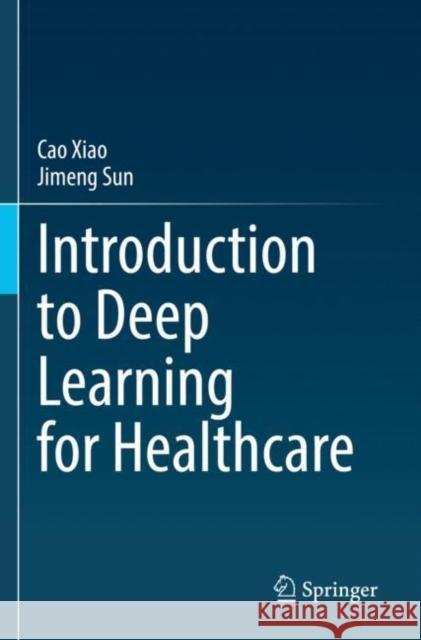
Introduction to Deep Learning for Healthcare

ISBN-13: 9783030821869 / Angielski / Miękka / 2022
Cao Xiao;Jimeng Sun
Introduction to Deep Learning for Healthcare Cao Xiao, Jimeng Sun 9783030821869 Springer International Publishing - książkaWidoczna okładka, to zdjęcie poglądowe, a rzeczywista szata graficzna może różnić się od prezentowanej.

Introduction to Deep Learning for Healthcare

ISBN-13: 9783030821869 / Angielski / Miękka / 2022

Cao Xiao;Jimeng Sun
cena 241,50
(netto: 230,00 VAT:  5%)

Najniższa cena z 30 dni: 231,29
Termin realizacji zamówienia:
ok. 22 dni roboczych.

Darmowa dostawa!
inne wydania

This textbook presents deep learning models and their healthcare applications. It focuses on rich health data and deep learning models that can effectively model health data. Healthcare data: Among all healthcare technologies, electronic health records (EHRs) had vast adoption and a significant impact on healthcare delivery in recent years. One crucial benefit of EHRs is to capture all the patient encounters with rich multi-modality data. Healthcare data include both structured and unstructured information. Structured data include various medical codes for diagnoses and procedures, lab results, and medication information. Unstructured data contain 1) clinical notes as text, 2) medical imaging data such as X-rays, echocardiogram, and magnetic resonance imaging (MRI), and 3) time-series data such as the electrocardiogram (ECG) and electroencephalogram (EEG). Beyond the data collected during clinical visits, patient self-generated/reported data start to grow thanks to wearable sensors’ increasing use.  The authors  present deep learning case studies on all data described.Deep learning models: Neural network models are a class of machine learning methods with a long history. Deep learning models are neural networks of many layers, which can extract multiple levels of features from raw data. Deep learning applied to healthcare is a natural and promising direction with many initial successes. The authors cover deep neural networks, convolutional neural networks, recurrent neural networks, embedding methods, autoencoders, attention models, graph neural networks, memory networks, and generative models. It’s presented with concrete healthcare case studies such as clinical predictive modeling, readmission prediction, phenotyping, x-ray classification, ECG diagnosis, sleep monitoring, automatic diagnosis coding from clinical notes, automatic deidentification, medication recommendation, drug discovery (drug property prediction and molecule generation), and clinical trial matching.
This textbook targets graduate-level students focused on deep learning methods and their healthcare applications. It can be used for the concepts of deep learning and its applications as well. Researchers working in this field will also find this book to be extremely useful and valuable for their research.


Kategorie:
Nauka, Medycyna
Kategorie BISAC:
Computers > Artificial Intelligence - General
Medical > Informatics
Mathematics > Prawdopodobieństwo i statystyka
Wydawca:
Springer International Publishing
Język:
Angielski
ISBN-13:
9783030821869
Rok wydania:
2022
Waga:
0.38 kg
Wymiary:
23.5 x 15.5
Oprawa:
Miękka
Dodatkowe informacje:
Wydanie ilustrowane

Contents
I Introduction
I.1 Who should read this book?
I.2 Book organization
II Health Data
II.1 The growth of EHR Adoption
II.2 Health Data
II.2.1 Life cycle of health data
II.2.2 Structured Health Data
II.2.3 Unstructured clinical notes
II.2.4 Continuous signals
II.2.5 Medical Imaging Data
II.2.6 Biomedical data for in silico drug Discovery 
II.3 Health Data Standards
III Machine Learning Basics
III.1 Supervised Learning
III.1.1 Logistic Regression
III.1.2 Softmax Regression
III.1.3 Gradient Descent
III.1.4 Stochastic and Minibatch Gradient Descent
III.2 Unsupervised Learning
III.2.1 Principal component analysis
III.2.2 t-distributed stochastic neighbor embedding (t-SNE)
III.2.3 Clustering
III.3 Assessing Model Performance
III.3.1 Evaluation Metrics for Regression Tasks
III.3.2 Evaluation Metrics for Classification Tasks
III.3.3 Evaluation Metrics for Clustering Tasks
III.3.4 Evaluation Strategy
III.4 Modeling Exercise
III.5 Hands-On Practice
3
4 CONTENTS
IVDeep Neural Networks (DNN)
IV.1 A Single neuron
IV.1.1 Activation function
IV.1.2 Loss Function
IV.1.3 Train a single neuron
IV.2 Multilayer Neural Network
IV.2.1 Network Representation
IV.2.2 Train a Multilayer Neural Network
IV.2.3 Summary of the Backpropagation Algorithm
IV.2.4 Parameters and Hyper-parameters
IV.3 Readmission Prediction from EHR Data with DNN
IV.4 DNN for Drug Property Prediction
V Embedding
V.1 Overview
V.2 Word2Vec
V.2.1 Idea and Formulation of Word2Vec
V.2.2 Healthcare application of Word2Vec
V.3 Med2Vec: two-level embedding for EHR
V.3.1 Med2Vec Method
V.4 MiME: Embed Internal Structure
V.4.1 Notations of MIME
V.4.2 Description of MIME
V.4.3 Experiment results of MIME
VI Convolutional Neural Networks (CNN)
VI.1 CNN intuition
VI.2 Architecture of CNN
VI.2.1 Convolution layer - 1D
VI.2.2 Convolution layer - 2D
VI.2.3 Pooling Layer
VI.2.4 Fully Connected Layer
VI.3 Backpropagation Algorithm in CNN*
VI.3.1 Forward and Backward Computation for 1-D Data
VI.3.2 Forward Computation and Backpropagation for 2-D Convolution
Layer . 
VI.3.3 Special CNN Architecture
VI.4 Healthcare Applications 
VI.5 Automated surveillance of cranial images for acute neurologic events
VI.6 Detection of Lymph Node Metastases from Pathology Images
VI.7 Cardiologist-level arrhythmia detection and classification in ambulatory
ECG
CONTENTS 5
VIIRecurrent Neural Networks (RNN)
VII.1Basic Concepts and Notations
VII.2Backpropagation Through Time (BPTT) algorithm
VII.2.1Forward Pass
VII.2.2 Backward Pass
VII.3RNN Variants
VII.3.1 Long Short-Term Memory (LSTM)
VII.3.2 Gated Recurrent Unit (GRU)
VII.3.3 Bidirectional RNN
VII.3.4 Encoder-Decoder Sequence-to-Sequence Models
VII.4Case Study: Early detection of heart failure
VII.5Case Study: Sequential clinical event prediction
VII.6Case Study: De-identification of Clinical Notes
VII.7Case Study: Automatic Detection of Heart Disease from electrocardiography
(ECG) Data
VIIAIutoencoders (AE)
VIII.1Overview
VIII.2Autoencoders
VIII.3Sparse Autoencoders
VIII.4Stacked Autoencoders
VIII.5Denoising Autoencoders
VIII.6Case Study: “Deep Patient” via stacked denoising autoencoders
VIII.7Case Study: Learning from Noisy, Sparse, and Irregular Clinical
data
IX Attention Models
IX.1 Overview
IX.2 Attention Mechanism
IX.2.1 Attention based on Encoder-Decoder RNN Models
IX.2.2 Case Study: Attention Model over Longitudinal EHR
IX.2.3 Case Study: Attention model over a Medical Ontology
IX.2.4 Case Study: ICD Classification from Clinical Notes
X Memory Networks
X.1 Original Memory Networks
X.2 End-to-end Memory Networks
X.3 Case Study: Medication Recommendation
X.4 EEG-RelNet: Memory Derived from Data
X.5 Incorporate Memory from Unstructured Knowledge Base
XIGraph Neural Networks
XI.1 Overview
XI.2 Graph Convolutional Networks
XI.2.1 Basic Setting of GCN
XI.2.2 Spatial Convolution on Graphs
6 CONTENTS
XI.2.3 Spectral Convolution on Graphs
XI.2.4 Approximate Graph Convolution
XI.2.5 Neighborhood Aggregation
XI.3 Neural Fingerprinting: Drug Molecule Embedding with GCN
XI.4 Decagon: Modeling Polypharmacy Side Effects with GCN
XI.5 Case Study: Multiview Drug-drug Interaction Prediction
XIIGenerative Models
XII.1Generative adversarial networks (GAN)
XII.1.1 The GAN Framework
XII.1.2 The Cost Function of Discriminator
XII.1.3 The Cost Function of Generator
XII.2Variational Autoencoders (VAE)
XII.2.1 Latent Variable Models
XII.2.2Objective Formulation
XII.2.3Objective Approximation
XII.2.4 Reparameterization Trick
XII.3Case Study: Generating Patient Records
XII.4Case Study: Small Molecule Generation for Drug Discovery
XII CIonclusion
XIII.1Model Setup
XIII.2Model Training
XIII.3Testing and Performance Evaluation
XIII.4Result Visualization
XIII.5Case Studies
XIVAppendix
XIV.1Regularization*
XIV.1.1Vanishing or Exploding Gradient Problem
XIV.1.2Dropout
XIV.1.3Batch normalization
XIV.2Stochastic Gradient Descent and Minibatch gradient descent*
XIV.3Advanced optimization*
XIV.3.1Momentum
XIV.3.2Adagrad, Adadelta, and RMSprop
XIV.3.3Adam

Dr. Cao ``Danica'' Xiao is the senior director, head of data science and machine learning at Amplitude. Before that, she was the director of machine learning in the analytics center of excellence of IQVIA. Before IQVIA, she was a research staff member in IBM Research. Her work focuses on developing machine learning and deep learning models to solve real-world healthcare challenges. She got her Ph.D. degree from University of Washington, Seattle.

Dr. Jimeng Sun is a Health Innovation Professor at the Computer Science Department and Carle's Illinois College of Medicine in the University of Illinois Urbana-Champaign. His research focuses on artificial intelligence (AI) for healthcare, including deep learning for drug discovery, clinical trial optimization, computational phenotyping, clinical predictive modeling, treatment recommendation, and health monitoring. He completed his B.S. and M.Phil. in computer science at Hong Kong University of Science and Technology and his Ph.D. in computer science at Carnegie Mellon University.

This textbook presents deep learning models and their healthcare applications. It focuses on rich health data and deep learning models that can effectively model health data. Healthcare data: Among all healthcare technologies, electronic health records (EHRs) had vast adoption and a significant impact on healthcare delivery in recent years. One crucial benefit of EHRs is to capture all the patient encounters with rich multi-modality data. Healthcare data include both structured and unstructured information. Structured data include various medical codes for diagnoses and procedures, lab results, and medication information. Unstructured data contain 1) clinical notes as text, 2) medical imaging data such as X-rays, echocardiogram, and magnetic resonance imaging (MRI), and 3) time-series data such as the electrocardiogram (ECG) and electroencephalogram (EEG). Beyond the data collected during clinical visits, patient self-generated/reported data start to grow thanks to wearable sensors’ increasing use.  The authors  present deep learning case studies on all data described.

Deep learning models: Neural network models are a class of machine learning methods with a long history. Deep learning models are neural networks of many layers, which can extract multiple levels of features from raw data. Deep learning applied to healthcare is a natural and promising direction with many initial successes. The authors cover deep neural networks, convolutional neural networks, recurrent neural networks, embedding methods, autoencoders, attention models, graph neural networks, memory networks, and generative models. It’s presented with concrete healthcare case studies such as clinical predictive modeling, readmission prediction, phenotyping, x-ray classification, ECG diagnosis, sleep monitoring, automatic diagnosis coding from clinical notes, automatic deidentification, medication recommendation, drug discovery (drug property prediction and molecule generation), and clinical trial matching.


This textbook targets graduate-level students focused on deep learning methods and their healthcare applications. It can be used for the concepts of deep learning and its applications as well. Researchers working in this field will also find this book to be extremely useful and valuable for their research.




Udostępnij

Facebook - konto krainaksiazek.pl


Opinie o Krainaksiazek.pl na Opineo.pl

Partner Mybenefit

Krainaksiazek.pl w programie rzetelna firma Krainaksiaze.pl - płatności przez paypal

Czytaj nas na:

Facebook - krainaksiazek.pl
  • książki na zamówienie
  • granty
  • książka na prezent
  • kontakt
  • pomoc
  • opinie
  • regulamin
  • polityka prywatności

Zobacz:

  • Księgarnia czeska

  • Wydawnictwo Książkowe Klimaty

1997-2026 DolnySlask.com Agencja Internetowa

© 1997-2022 krainaksiazek.pl
     
KONTAKT | REGULAMIN | POLITYKA PRYWATNOŚCI | USTAWIENIA PRYWATNOŚCI
Zobacz: Księgarnia Czeska | Wydawnictwo Książkowe Klimaty | Mapa strony | Lista autorów
KrainaKsiazek.PL - Księgarnia Internetowa

Polityka prywatnosci - link
Krainaksiazek.pl - płatnośc Przelewy24
Przechowalnia Przechowalnia




