• Wyszukiwanie zaawansowane
  • Kategorie
  • Kategorie BISAC
  • Książki na zamówienie
  • Promocje
  • Granty
  • Książka na prezent
  • Opinie
  • Pomoc
  • Załóż konto
  • Zaloguj się

Quantum Computing and Communications » książka


zaloguj się | załóż konto
Logo Krainaksiazek.pl

koszyk

konto

szukaj
topmenu
Księgarnia internetowa
Szukaj
Książki na zamówienie
Promocje
Granty
Książka na prezent
Moje konto
Pomoc
 
 
Wyszukiwanie zaawansowane
Pusty koszyk
Bezpłatna dostawa dla zamówień powyżej 20 złBezpłatna dostawa dla zamówień powyżej 20 zł

Kategorie główne

• Nauka
 [2946912]
• Literatura piękna
 [1852311]

  więcej...
• Turystyka
 [71421]
• Informatyka
 [150889]
• Komiksy
 [35717]
• Encyklopedie
 [23177]
• Dziecięca
 [617324]
• Hobby
 [138808]
• AudioBooki
 [1671]
• Literatura faktu
 [228371]
• Muzyka CD
 [400]
• Słowniki
 [2841]
• Inne
 [445428]
• Kalendarze
 [1545]
• Podręczniki
 [166819]
• Poradniki
 [480180]
• Religia
 [510412]
• Czasopisma
 [525]
• Sport
 [61271]
• Sztuka
 [242929]
• CD, DVD, Video
 [3371]
• Technologie
 [219258]
• Zdrowie
 [100961]
• Książkowe Klimaty
 [124]
• Zabawki
 [2341]
• Puzzle, gry
 [3766]
• Literatura w języku ukraińskim
 [255]
• Art. papiernicze i szkolne
 [7810]
Kategorie szczegółowe BISAC

Quantum Computing and Communications

ISBN-13: 9781852330910 / Angielski / Miękka / 1999 / 170 str.
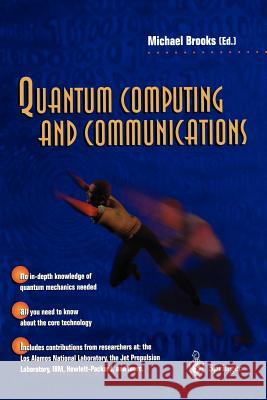
Michael Brooks; Michael Brooks; M. E. Brooks
Quantum Computing and Communications Michael Brooks Michael Brooks M. E. Brooks 9781852330910 Springer - książkaWidoczna okładka, to zdjęcie poglądowe, a rzeczywista szata graficzna może różnić się od prezentowanej.

Quantum Computing and Communications

ISBN-13: 9781852330910 / Angielski / Miękka / 1999 / 170 str.

Michael Brooks; Michael Brooks; M. E. Brooks
cena 201,72
(netto: 192,11 VAT:  5%)

Najniższa cena z 30 dni: 192,74
Termin realizacji zamówienia:
ok. 22 dni roboczych
Bez gwarancji dostawy przed świętami

Darmowa dostawa!

We have, in the last few years, radically improved our grasp of the quantum world. Not just intellectually, either: our ability to manipulate real quantum systems has grown in equal measure with our understanding of their fundamental behavior. These two shoots - the intellectual and the practical harnessing of the quantum world - have sprung up at a time when a third shoot - information processing - has also been experiencing explosive growth. These three shoots are now becoming intertwined. Twisted together, our understanding of information processing, quantum theory and practical quantum control make for a strong new growth with enormous potential. One must always be careful about using the word 'revolutionary' too readily. It is, however, difficult to find another word to describe the developments that have been taking place during the second half of the 1990s. In 1986 Richard Feynman, the visionary professor of physics, made a very interesting remark: " ... we are going to be even more ridiculous later and consider bits written on one atom instead of the present 1011 atoms. Such nonsense is very entertaining to professors like me." It is exceptionally unfortunate that Feynman did not live to see this 'nonsense' fully transformed into reality. He, more than anybody, would enjoy the fact that it is now possible to write information onto an atom, or indeed an ion or a photon.


Kategorie:
Informatyka, Bazy danych
Kategorie BISAC:
Computers > Computer Science
Computers > Networking - Hardware
Computers > Machine Theory
Wydawca:
Springer
Język:
Angielski
ISBN-13:
9781852330910
Rok wydania:
1999
Wydanie:
Softcover Repri
Ilość stron:
170
Waga:
0.26 kg
Wymiary:
23.57 x 15.65 x 1.09
Oprawa:
Miękka
Wolumenów:
01
Dodatkowe informacje:
Wydanie ilustrowane

Section I A Wide Perspective.- 1 Introduction.- 1.1 Exploiting the Quantum World.- 1.2 Historical Background.- 1.3 Worldwide Efforts in QCC.- 2 The Fundamentals of Quantum Information.- 3 Quantum Computer Science.- 3.1 Introduction.- 3.2 Algorithms and the Complexity Problem.- 3.3 The Quantum Computation Answer.- 3.4 Quantum Algorithms.- 3.5 Quantum Logic Gates and Networks.- 3.6 Obstacles.- 3.7 A Workable Solution: Quantum Error Correction.- 3.8 Conclusions.- 4 Experimental Realizations.- 4.1 Introduction.- 4.2 Trapped Ions.- 4.3 Nuclear Magnetic Resonance.- 4.4 Cavity Quantum Electrodynamics.- 4.5 Quantum Dots.- 5 Optical Technologies for Quantum Computing and Communications.- 5.1 Introduction.- 5.2 Using the Quantum Nature of Light.- 5.2.1 Potential.- 5.2.2 Problems.- 5.3 Quantum Noise in Optical Communications.- 5.4 Generic Technologies in Quantum Communications.- 5.4.1 Nonlinear Optics.- 5.4.2 Cavity Quantum Electrodynamics.- 5.5 Operations Performed on Optical Signals.- 5.5.1 Signal Generation.- 5.5.2 Detection.- 5.5.3 Attenuation.- 5.5.4 Distribution.- 5.5.5 Amplification.- 5.6 Conclusions: Towards the Second Generation.- 6 Applications.- 6.1 Introduction.- 6.2 Emerging Technologies.- 6.2.1 Quantum Cryptography.- 6.2.2 Quantum Repeaters.- 6.2.3 Quantum Simulators.- 6.2.4 Metrology and Few Photon Applications.- 6.3 Conclusions: Measuring Progress.- 7 A Note on the Question of Scaling: Decoherence and Error Correction.- Section II Personal Perspectives.- 8 Solid State Quantum Computation: Prospects, Proposals, and Prejudices.- 9 Information is Physical, But Slippery.- 10 Nanocircuitry, Defect Tolerance and Quantum Computing: Architectural and Manufacturing Considerations.- 11 Quantum Computing and NMR.- 12 Quantum Networks and Quantum Algorithms.- 13 Quantum Cryptography.- Section III A Perspective for the Future.- 14 Realizing the Potential of Quantum Information Processing.- 14.1 Prospects for Quantum Computing.- 14.2 Prospects for Special Applications.- 14.2.1 Quantum Simulation.- 14.2.2 Limited Qubit and Reduced-Noise High Precision Applications.- 14.2.3 Secure Communications.- 14.3 Meeting The Needs of the QIP Field.- 14.3.1 The Need for Academic Focus.- 14.3.2 The Need for Industrial Focus.- 14.3.3 The Need for Awareness.- 15 The Role of Europe.- 15.1 The Pioneering Stage.- 15.2 Today.- 15.2.1 Multi-Disciplinary or Trans-Disciplinary Nature of the Community.- 15.2.2 The Numbers Involved.- 15.2.3 The Geographical Spread.- 15.2.4 The Industrial Scene.- 15.2.5 Summary of the European Scene.- 16 Quantum Computing and Communications: A View from the USA.- 16.1 Introduction.- 16.2 What Works Well.- 16.3 What Does Not Work So Well.- 16.4 NASA/JPL.- 16.5 Lessons Learned from Experience with NASA.- 16.6 Opportunities for Europe.- 16.7 Commercialization.- 16.8 Recommendations.- 16.8.1 Programmatic Recommendations.- 16.8.2 Technology Solutions.- 16.8.3 Quantum Computer Science.- 16.8.4 Education and Training.- Section IV Reference materials.- 17 Quantum Information Processing: A Brief Overview of Recent Advances.- 17.1 Introduction.- 17.2 The Underlying Physical System.- 17.2.1 Quantum Bits and Quantum Superpositions.- 17.2.2 Quantum Gates.- 17.2.3 Quantum Parallelism.- 17.3 Fundamentals of Quantum Information.- 17.3.1 Entanglement.- 17.3.2 Quantum Dense Coding.- 17.3.3 Quantum Teleportation.- 17.4 Quantum Cryptography.- 17.4.1 Standard Cryptosystems.- 17.4.2 Quantum Key Distribution.- 17.5 Quantum Computing.- 17.5.1 Quantum Algorithms.- 17.5.2 Grover’s Search Algorithm.- 17.5.3 Period Finding and Shor’s Factorization Algorithm.- 17.5.4 Minimum Requirements for any Quantum System to Be a Quantum Computer.- 17.5.5 Simulation of Other Quantum Systems.- 17.6 Quantum Decoherence.- 17.6.1 What is Decoherence?.- 17.6.2 Quantum Error Correction.- 17.7 Experimental Realizations.- 17.7.1 Systems with Few Degrees of Freedom.- 17.7.2 Macroscopic Systems.- 17.8 Conclusions.- 18 Categories and Definitions.- 18.1 Definitions and Glossary of Terms.- 18.1.1 Definition of Quantum Computing and Communications.- 18.1.2 Sub-Sector Definitions.- 18.1.3 Some Relevant Terms.- 18.2 The Disciplines that Contribute to Quantum Information Processing.- Appendix A The Pathfinder Project.- A.1 Pathfmder Activities.- A.1.1 Newsletters.- A.1.2 Database of Active Individuals and Organizations.- A.1.3 Taxonomy of the Subject.- A.1.4 Helsinki Conference.- A.1.5 QIP Report.- A.2 Pathfinder Project Partners.- Appendix B A Preliminary QIP Roadmap.

Michael Brooks geboren 1970 in Manchester, hat in Quantenphysik promoviert. Er ist leitender Redakteur beim New Scientist und schreibt u.a. für den Guardian, den Independent, den Observer und worauf er besonders stolz ist den Playboy. Er lebt mit seiner Frau und seinen beiden Kindern in Südengland.

Brooks, Michael Brooks holda a doctorate in the quantum mechanical... więcej >


Udostępnij

Facebook - konto krainaksiazek.pl


Opinie o Krainaksiazek.pl na Opineo.pl

Partner Mybenefit

Krainaksiazek.pl w programie rzetelna firma Krainaksiaze.pl - płatności przez paypal

Czytaj nas na:

Facebook - krainaksiazek.pl
  • książki na zamówienie
  • granty
  • książka na prezent
  • kontakt
  • pomoc
  • opinie
  • regulamin
  • polityka prywatności

Zobacz:

  • Księgarnia czeska

  • Wydawnictwo Książkowe Klimaty

1997-2025 DolnySlask.com Agencja Internetowa

© 1997-2022 krainaksiazek.pl
     
KONTAKT | REGULAMIN | POLITYKA PRYWATNOŚCI | USTAWIENIA PRYWATNOŚCI
Zobacz: Księgarnia Czeska | Wydawnictwo Książkowe Klimaty | Mapa strony | Lista autorów
KrainaKsiazek.PL - Księgarnia Internetowa

Polityka prywatnosci - link
Krainaksiazek.pl - płatnośc Przelewy24
Przechowalnia Przechowalnia





