• Wyszukiwanie zaawansowane
  • Kategorie
  • Kategorie BISAC
  • Książki na zamówienie
  • Promocje
  • Granty
  • Książka na prezent
  • Opinie
  • Pomoc
  • Załóż konto
  • Zaloguj się

Higher Education Accreditation: How It's Changing, Why It Must » książka


zaloguj się | załóż konto
Logo Krainaksiazek.pl

koszyk

konto

szukaj
topmenu
Księgarnia internetowa
Szukaj
Książki na zamówienie
Promocje
Granty
Książka na prezent
Moje konto
Pomoc
 
 
Wyszukiwanie zaawansowane
Pusty koszyk
Bezpłatna dostawa dla zamówień powyżej 20 złBezpłatna dostawa dla zamówień powyżej 20 zł

Kategorie główne

• Nauka
 [2950560]
• Literatura piękna
 [1849509]

  więcej...
• Turystyka
 [71097]
• Informatyka
 [151150]
• Komiksy
 [35848]
• Encyklopedie
 [23178]
• Dziecięca
 [617388]
• Hobby
 [139064]
• AudioBooki
 [1657]
• Literatura faktu
 [228597]
• Muzyka CD
 [383]
• Słowniki
 [2855]
• Inne
 [445295]
• Kalendarze
 [1464]
• Podręczniki
 [167547]
• Poradniki
 [480102]
• Religia
 [510749]
• Czasopisma
 [516]
• Sport
 [61293]
• Sztuka
 [243352]
• CD, DVD, Video
 [3414]
• Technologie
 [219456]
• Zdrowie
 [101002]
• Książkowe Klimaty
 [124]
• Zabawki
 [2311]
• Puzzle, gry
 [3459]
• Literatura w języku ukraińskim
 [254]
• Art. papiernicze i szkolne
 [8079]
Kategorie szczegółowe BISAC

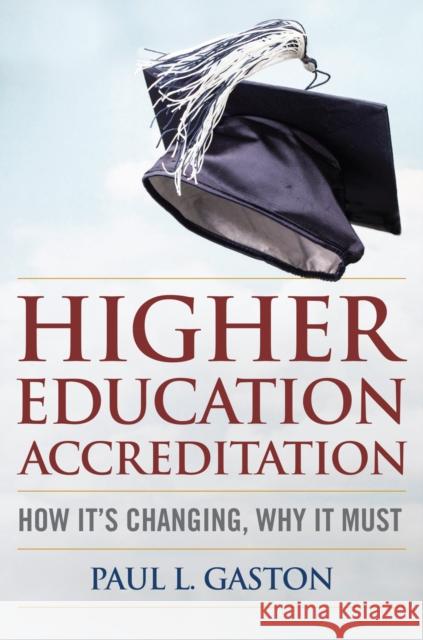
Higher Education Accreditation: How It's Changing, Why It Must

ISBN-13: 9781579227623 / Angielski / Twarda / 2013 / 240 str.
Paul L. Gaston
Higher Education Accreditation: How It's Changing, Why It Must Gaston, Paul L. 9781579227623 Stylus Publishing (VA) - książkaWidoczna okładka, to zdjęcie poglądowe, a rzeczywista szata graficzna może różnić się od prezentowanej.

Higher Education Accreditation: How It's Changing, Why It Must

ISBN-13: 9781579227623 / Angielski / Twarda / 2013 / 240 str.

Paul L. Gaston
cena 165,11
(netto: 157,25 VAT:  5%)

Najniższa cena z 30 dni: 164,10
Termin realizacji zamówienia:
ok. 22 dni roboczych
Dostawa w 2026 r.

Darmowa dostawa!

Is the accreditation system -broken- as claimed by successive Secretaries of Education and some recent reports?

This book addresses this question head-on, asking whether accreditation is indeed in need of radical reform, and whether the agencies' authority should be curtailed; or whether in fact the changes now underway - that accrediting agencies contend ensure rigorous and consistent standards and degrees that are a reliable gauge of student attainment - are moving the academy and the nation in the right direction.

In a sweeping and ambitious book, Paul Gaston deploys his knowledge and experience as a peer reviewer for three regional accrediting agencies, a former board member and chair of the Association of Specialized and Professional Accreditors, and his involvement in the early stages of the Council for Higher Education Accreditation, to go beyond the polemics to explore whether a strategy that builds on the emerging values and good practices can achieve the substantive and positive improvements the public is demanding.

As an introduction for readers new to the debate, he provides a brief overview of the development of accreditation, its terminology, and structure, describing how it currently works, and what it has achieved; and offers insight into the proliferation of the missions of accreditation - as well as the multiplicity of stakeholders with an interest in its outcomes - to question whether the mandate of accreditation should, as some contend, be expanded, or particular missions reassigned or abandoned.

This established, he undertakes a dispassionate analysis of the arguments and recommendations of critics and supporters of the current direction of accreditation to identify common ground and explore constructive ways forward, paying specific attention to current and potential reforms of the three sectors of higher education accreditation: the seven regional accrediting associations, the national accreditors, and programmatic, or -specialized- accreditation.

The book concludes by outlining a comprehensive approach to reform. His proposal would preserve practices that already work well while advancing important changes that can be incrementally implemented. The result would be a higher education accreditation structure more cost effective, more efficient, more transparent and accountable, and more responsive to institutional and public needs.


Kategorie:
Nauka, Pedagogika i oświata
Kategorie BISAC:
Education > Schools - Levels - Higher
Education > Finance
Education > Educational Policy & Reform
Wydawca:
Stylus Publishing (VA)
Język:
Angielski
ISBN-13:
9781579227623
Rok wydania:
2013
Ilość stron:
240
Waga:
0.52 kg
Wymiary:
23.11 x 15.75 x 2.54
Oprawa:
Twarda
Wolumenów:
01
Dodatkowe informacje:
Bibliografia
Obwoluta

“Paul Gaston has done a masterful job of reviewing the history and practice of accreditation in our country. Our way of doing accreditation plays a key role in the strength of American Higher Education. It is very useful to have such an excellent and nuanced review of accreditation from Paul who is so committed to helping campuses improve their work with students and who has such deep experience in the university.”

Scott E. Evenbeck, President of the New Community College at The City University of New York.

"Among all the 21st century proposals aimed at improving accreditation, Gaston has got it just right. His thoughtful, compelling, and comprehensive framework, recognizing important developments in accrediting practices to date, calls for accelerated innovations in practices, processes, standards, requirements, and priorities across regional, specialized, and national accreditors. Identifying the complex set of changing and challenging realities that higher education faces, such as new educational providers and modes of learning, an enhanced focus on evidence of student achievement, or the shifting financial sands of higher education, Gaston identifies clear parameters for necessary collaborative reform across accreditors. Let the reform begin."

Peggy Maki, Education Consultant Specializing in Assessing Student Learning

“Accreditation is the lighting rod of higher education, but few understand the nuanced complex changes in the field. Political leaders want to assure that students can transition from two- to four-year institutions without losing credits. University leaders want accreditation to cost less and be less intrusive. Students want it to make colleges more affordable.

Few authors could write a book on accreditation that diverse stakeholders would demand in their library, but Paul Gaston has crafted a balanced, thoughtful explanation of accreditation. With higher education changing faster than it has at any period in its history, Gaston’s book is a must-read to understand the sea change impacting higher education and how accreditation can impact our future."

Robert G. Frank, President, The University of New Mexico

“There is a remarkable lack of awareness of the considerable work of the past twenty-five years in assessment of learning, in shifting to student-centered pedagogies, in explicit formulation of learning outcomes, and in developing continuous improvement processes in higher education. Paul Gaston is absolutely right that higher education needs to articulate a shared vision of our work and its significance for the nation. Without such a vision, the issues will be framed by others who are less well-informed, and the policy consequences will be—and have been—unfortunate. Paul Gaston’s thoughtful book gives us a balanced assessment of American higher-education accreditation and recommends a measured set of reforms to meet the challenges of this new era.”

Eduardo M. Ochoa, President, California State University, Monterey Bay, and former U.S. Assistant Secretary for Postsecondary Education

Foreword - Eduardo M. Ochoa Preface. The State of the Union and the State of Accreditation Acknowledgments Introduction 1. QUESTIONS THAT SHOULD BE FREQUENTLY ASKED 2. MANY MISSIONS, MANY MASTERS. AN EVOLVING CHALLENGE 3. WHAT ARE THE PROBLEMS?. ISSUES CONCERNING ACCREDITATION 4. WHAT’S TO BE DONE? INDICTMENTS AND PROPOSALS 5. HOW REGIONAL ACCREDITATION IS CHANGING—AND WHY IT MUST 6. HOW NATIONAL ACCREDITATION IS CHANGING—AND WHY IT MUST 7. HOW SPECIALIZED ACCREDITATION IS CHANGING—AND WHY IT MUST 8. CONSIDERING PRIORITIES FOR CHANGE AGAIN FOR THE FIRST TIME Appendix A. An Acronymic Guide to Accreditation References Index

Paul L. Gaston, Trustees Professor Emeritus at Kent State University (Ohio), has served four universities as a faculty member, dean, and provost. Having offered 14 years of university service as a provost (Northern Kentucky and Kent State), he has focused more recently on teaching, writing, and consulting.His recent books include General Education Transformed: How We Can, Why We Must (AAC&U, 2015), Higher Education Accreditation: How It’s Changing, Why It Must (Stylus Publishing, 2014), General Education and Liberal Learning (AAC&U, 2010), The Challenge of Bologna: What U.S. Higher Education Has to Learn from Europe and Why It Matters That We Learn It (Stylus Publishing, 2010), and Revising General Education, with Jerry Gaff (AAC&U, 2009). His most recent book prior to this one, Ohio’s Craft Beers (Kent State University Press, 2017), explores alternate approaches to “higher” education.His more than 50 published articles on literature and higher education include studies of the British hymn tradition, Anthony Powell, George Herbert, the role of the provost in fund-raising, the Bologna Process, minor league baseball, accreditation reform, Il Gattopardo, interart analogies, and the cultures of futures markets. He is one of the four original authors of the influential Degree Qualifications Profile (Lumina Foundation: 2011, 2015.)He received his degrees from Southeastern Louisiana College (BA) and from the University of Virginia (MA, Ph.D.), where he was a Woodrow Wilson Fellow. He is now Distinguished Fellow at the Association of American Colleges and Universities and a consultant to Lumina Foundation. He lives in Northeast Ohio with his wife, Eileen, and two cats, Scout and Binx. For recreation, he enjoys hiking, cycling, reading, and supporting Chelsea (soccer) and the St. Louis Cardinals. His Twitter name is CardsFaninOhio.

Eduardo M. Ochoa is interim president of California State University, Monterey Bay. He served in the Obama Administration as the U.S. assistant secretary for postsecondary education—the secretary of education's chief advisor on higher education issues. Prior to that role, Ochoa served for seven years as the provost and vice president for academic affairs at Sonoma State University.

Gaston, Paul L. Paul L. Gaston serves Kent State University as its... więcej >


Udostępnij

Facebook - konto krainaksiazek.pl


Opinie o Krainaksiazek.pl na Opineo.pl

Partner Mybenefit

Krainaksiazek.pl w programie rzetelna firma Krainaksiaze.pl - płatności przez paypal

Czytaj nas na:

Facebook - krainaksiazek.pl
  • książki na zamówienie
  • granty
  • książka na prezent
  • kontakt
  • pomoc
  • opinie
  • regulamin
  • polityka prywatności

Zobacz:

  • Księgarnia czeska

  • Wydawnictwo Książkowe Klimaty

1997-2025 DolnySlask.com Agencja Internetowa

© 1997-2022 krainaksiazek.pl
     
KONTAKT | REGULAMIN | POLITYKA PRYWATNOŚCI | USTAWIENIA PRYWATNOŚCI
Zobacz: Księgarnia Czeska | Wydawnictwo Książkowe Klimaty | Mapa strony | Lista autorów
KrainaKsiazek.PL - Księgarnia Internetowa

Polityka prywatnosci - link
Krainaksiazek.pl - płatnośc Przelewy24
Przechowalnia Przechowalnia






