• Wyszukiwanie zaawansowane
  • Kategorie
  • Kategorie BISAC
  • Książki na zamówienie
  • Promocje
  • Granty
  • Książka na prezent
  • Opinie
  • Pomoc
  • Załóż konto
  • Zaloguj się

Idea-Based Learning: A Course Design Process to Promote Conceptual Understanding » książka


zaloguj się | załóż konto
Logo Krainaksiazek.pl

koszyk

konto

szukaj
topmenu
Księgarnia internetowa
Szukaj
Książki na zamówienie
Promocje
Granty
Książka na prezent
Moje konto
Pomoc
 
 
Wyszukiwanie zaawansowane
Pusty koszyk
Bezpłatna dostawa dla zamówień powyżej 20 złBezpłatna dostawa dla zamówień powyżej 20 zł

Kategorie główne

• Nauka
 [2939893]
• Literatura piękna
 [1808953]

  więcej...
• Turystyka
 [70366]
• Informatyka
 [150555]
• Komiksy
 [35137]
• Encyklopedie
 [23160]
• Dziecięca
 [608786]
• Hobby
 [136447]
• AudioBooki
 [1631]
• Literatura faktu
 [225099]
• Muzyka CD
 [360]
• Słowniki
 [2914]
• Inne
 [442115]
• Kalendarze
 [1068]
• Podręczniki
 [166599]
• Poradniki
 [468390]
• Religia
 [506548]
• Czasopisma
 [506]
• Sport
 [61109]
• Sztuka
 [241608]
• CD, DVD, Video
 [3308]
• Technologie
 [218981]
• Zdrowie
 [98614]
• Książkowe Klimaty
 [124]
• Zabawki
 [2174]
• Puzzle, gry
 [3275]
• Literatura w języku ukraińskim
 [260]
• Art. papiernicze i szkolne
 [7376]
Kategorie szczegółowe BISAC

Idea-Based Learning: A Course Design Process to Promote Conceptual Understanding

ISBN-13: 9781579226145 / Angielski / Miękka / 2011 / 226 str.
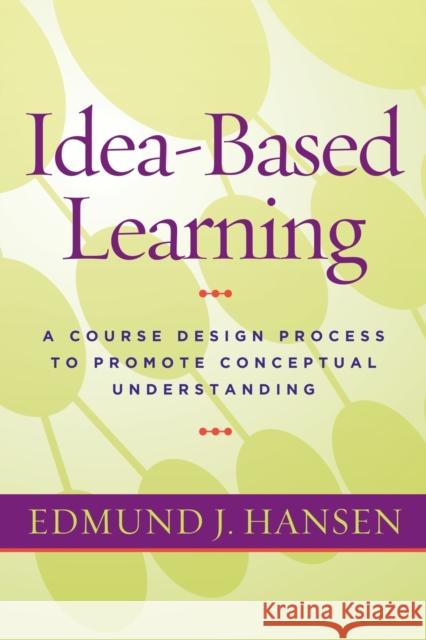
Edmund J. Hansen
Idea-Based Learning: A Course Design Process to Promote Conceptual Understanding Edmund J. Hansen 9781579226145 Stylus Publishing (VA) - książkaWidoczna okładka, to zdjęcie poglądowe, a rzeczywista szata graficzna może różnić się od prezentowanej.

Idea-Based Learning: A Course Design Process to Promote Conceptual Understanding

ISBN-13: 9781579226145 / Angielski / Miękka / 2011 / 226 str.

Edmund J. Hansen
cena 151,78
(netto: 144,55 VAT:  5%)

Najniższa cena z 30 dni: 139,97
Termin realizacji zamówienia:
ok. 22 dni roboczych.

Darmowa dostawa!
inne wydania

Synthesizing the best current thinking about learning, course design, and promoting student achievement, this is a guide to developing college instruction that has clear purpose, is well integrated into the curriculum, and improves student learning in predictable and measurable ways.

The process involves developing a transparent course blueprint, focused on a limited number of key concepts and ideas, related tasks, and corresponding performance criteria; as well as on frequent practice opportunities, and early identification of potential learning barriers.

Idea-based Learning takes as its point of departure the big conceptual ideas of a discipline that give structure and unity to a course and even to the curriculum, as opposed to a focus on content that can lead to teaching sequences of loosely-related topics; and aligns with notions of student-centered and outcomes-based learning environments.

Adopting a backwards design model, it begins with three parallel processes: first, identifying the material that is crucial for conceptual understanding; second, articulating a clear rationale for how to choose learning outcomes based on student needs and intellectual readiness; and finally, aligning the learning outcomes with the instructional requirements of the authentic performance tasks.

The resulting syllabi ensure cohesion between sections of the same course as well as between courses within a whole curriculum, assuring the progressive development of students' skills and knowledge.

Key elements of IBL include:
* Helping students see the big picture
* Building courses around one or more authentic performance tasks that illuminate the core concepts of the discipline
* Clearly identifying performance criteria for all tasks
* Incorporating practice in the competencies that are deemed important for students' success
* By placing the onus of learning on the student, liberating faculty to take on the role of learning coaches
* Designing tasks that help students unlearn simplistic ideas and replace them with improved understandings

Edmund Hansen expertly guides the reader through the steps of the process, providing examples along the way, and concluding with a sample course design document and syllabus that illustrate the principles he propounds.


Kategorie:
Nauka, Pedagogika i oświata
Kategorie BISAC:
Education > Schools - Levels - Higher
Wydawca:
Stylus Publishing (VA)
Język:
Angielski
ISBN-13:
9781579226145
Rok wydania:
2011
Ilość stron:
226
Waga:
0.56 kg
Wymiary:
22.61 x 14.99 x 2.79
Oprawa:
Miękka
Wolumenów:
01
Dodatkowe informacje:
Bibliografia

"For Scholars of religious studies and philosophy, Idea-Based Learning has much to commend it. It is not directed towards any specific discipline; instead, Hansen has included examples from across the curriculum. Hansen's book is readable and thought-provoking. It does not bog down the reader with excessive theory or debate, but rather seeks to be a concise guidebook for course design. It is an excellent starting point for new teachers, while also offering something to those more seasoned in the classroom. Finally, his work provides enough context that the reader is encouraged to move beyond this particular work in order to gain further depth into one's own reflection on teaching."

Forrest Clingerman, Ohio Northern University

Teaching Theology & Religion

"Marr and Forsyth have written a very accessible and readable volume, one that is brief and yet comprehensive enough to adequately introduce the reader to the subject. Further, the explanations of the current milieu of higher education in the U.K. as well as the role of academics within this are lucid and helpful. those who are considering entering the world of higher education in England, Scotland, Wales, or Northern Ireland will certainly find this book valuable, particularly those interested in a career in teaching. Indeed, those considering postgraduate study in the U.K. may also wish to consult this volume, as it helpfully describes the lay of the academic landscape."

Bradford A. Anderson, M

Teaching Theology & Religion

"A guide to course design that emphasizes a starting point of big conceptual ideas within a discipline."

The Chronicle of Higher Education

“Much of course design consists of stringing together related topics in a linear fashion. This excellent book shows how to identify one or two central ideas and organize the course around them, so that topic selection, teaching practices, and assessments all converge to advance attainment of those ideas, and deep learning, improved critical thinking, and other valued skills emerge naturally as outcomes. Full of examples and practical suggestions, it provides invaluable step-by-step guidance that will benefit both novice and veteran teachers.”

Mano Singham, author of God vs. Darwin: The War Between Evolution and Creationism in the Classroom and Director, University Center for Innovation in Teaching and Education

Case Western Reserve University

“In Idea-Based Learning Edmund Hansen shows faculty how college courses need to be designed! Hansen has the blueprint we all need to follow if we are to put together courses that will produce meaningful and long-lasting learning for our students."

Terry Doyle is the Chief Instructor for Faculty Development and Coordinator of the New Faculty Transition Program, Faculty Center for Teaching & Learning

Ferris State University

1. Practical Benefits of Course Design Faculty Stressors in Teaching Benefits From Idea-based Course Design 2. Backward Design Traditional Course Design Critique of the Traditional Design The Backward Design Model The Importance of Course Design 3. Learning Outcomes Problems With (Conceptualizing. Learning Outcomes Identifying Big Ideas Deriving Enduring Understandings Determining Learning Outcomes 4. Critical Thinking Significance of Critical Thinking Lay Definitions of Critical Thinking The Confusing State of the Critical Thinking Literature Need for Teaching Critical Thinking Barrier 1. Intellectual Development Barrier 2. Habits of Mind Barrier 3. Misconceptions Barrier 4. Complex Reasoning Conclusion 5. Content, Part 1. Guiding Questions and Concepts Topics Two parts of Course Content Essential Questions Guiding Concepts Course Content and Critical Thinking 6. Assessment, Part 1. Educative Assessment Assessment for Grading Assessment for Learning A Continuum of Assessments Assessment as Coaching Principles of Assessing for Understanding 7. Assessment, Part 2. Rubrics Examples of Assignments Lacking Clear Criteria The Main Parts of a Rubric Sample Rubric. Critical Thinking Common Misunderstandings About Rubrics The Triple Function of Rubrics 8. Content, Part 2. Learning Experiences Examples of Poor Assignments Authentic Performance Tasks Assignment-Centered Instruction Assignment-Related Competencies Building Block Designs Principles for Designing Effective Learning Experiences Student Involvement in the Pedagogy 9. Course Design Document Why Create Course Design Documents? Elements of the Course Design Document Sample Design Document. Psychology 624 - Theories of Motivation Summary of Course Design Features and Benefits Translating the Course Design Document Into a Syllabus 10. Implementing Course Design With Online Technology Key Characteristics of Online Teaching Course Design Elements Enhanced by Online Technology Conclusion References Appendix Syllabus for PY-624:Theories of Motivation Course

Edmund J. Hansen has been the director of the Center for Teaching and Learning at Northeastern Illinois University since its inception in 2001. Before joining NEIU, he worked in faculty development for over twelve years, half of that time at Indiana University in Bloomington, and the other half at Emporia State University in Kansas. In Emporia, he was the founding director of the Teaching Enhancement Center and also an assistant professor in the psychology department. For seven years, Edmund served as President of the Chicago Area Faculty Development Network (CAFDN), a consortium of faculty development offices at both two and four-year institutions in the region. He has published articles and book chapters related to the improvement of college teaching, including the integration of instructional technology into the classroom. He is originally from Germany, where he worked in adult education. Edmund has a PhD in Educational Psychology from Indiana University, and Masters Degrees from the University of Pennsylvania and from the University of Aachen, Germany.


Udostępnij

Facebook - konto krainaksiazek.pl


Opinie o Krainaksiazek.pl na Opineo.pl

Partner Mybenefit

Krainaksiazek.pl w programie rzetelna firma Krainaksiaze.pl - płatności przez paypal

Czytaj nas na:

Facebook - krainaksiazek.pl
  • książki na zamówienie
  • granty
  • książka na prezent
  • kontakt
  • pomoc
  • opinie
  • regulamin
  • polityka prywatności

Zobacz:

  • Księgarnia czeska

  • Wydawnictwo Książkowe Klimaty

1997-2026 DolnySlask.com Agencja Internetowa

© 1997-2022 krainaksiazek.pl
     
KONTAKT | REGULAMIN | POLITYKA PRYWATNOŚCI | USTAWIENIA PRYWATNOŚCI
Zobacz: Księgarnia Czeska | Wydawnictwo Książkowe Klimaty | Mapa strony | Lista autorów
KrainaKsiazek.PL - Księgarnia Internetowa

Polityka prywatnosci - link
Krainaksiazek.pl - płatnośc Przelewy24
Przechowalnia Przechowalnia






