• Wyszukiwanie zaawansowane
  • Kategorie
  • Kategorie BISAC
  • Książki na zamówienie
  • Promocje
  • Granty
  • Książka na prezent
  • Opinie
  • Pomoc
  • Załóż konto
  • Zaloguj się

Beginning Java Objects: From Concepts to Code » książka


zaloguj się | załóż konto
Logo Krainaksiazek.pl

koszyk

konto

szukaj
topmenu
Księgarnia internetowa
Szukaj
Książki na zamówienie
Promocje
Granty
Książka na prezent
Moje konto
Pomoc
 
 
Wyszukiwanie zaawansowane
Pusty koszyk
Bezpłatna dostawa dla zamówień powyżej 20 złBezpłatna dostawa dla zamówień powyżej 20 zł

Kategorie główne

• Nauka
 [2950560]
• Literatura piękna
 [1849509]

  więcej...
• Turystyka
 [71097]
• Informatyka
 [151150]
• Komiksy
 [35848]
• Encyklopedie
 [23178]
• Dziecięca
 [617388]
• Hobby
 [139064]
• AudioBooki
 [1657]
• Literatura faktu
 [228597]
• Muzyka CD
 [383]
• Słowniki
 [2855]
• Inne
 [445295]
• Kalendarze
 [1464]
• Podręczniki
 [167547]
• Poradniki
 [480102]
• Religia
 [510749]
• Czasopisma
 [516]
• Sport
 [61293]
• Sztuka
 [243352]
• CD, DVD, Video
 [3414]
• Technologie
 [219456]
• Zdrowie
 [101002]
• Książkowe Klimaty
 [124]
• Zabawki
 [2311]
• Puzzle, gry
 [3459]
• Literatura w języku ukraińskim
 [254]
• Art. papiernicze i szkolne
 [8079]
Kategorie szczegółowe BISAC

Beginning Java Objects: From Concepts to Code

ISBN-13: 9781484290590 / Angielski / Miękka / 2023 / 880 str.
Jacquie Barker
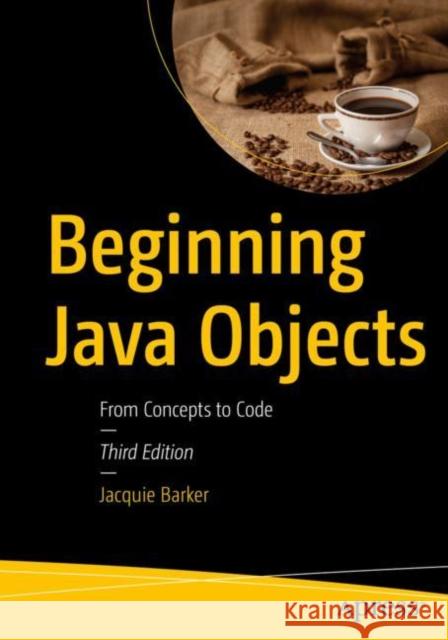
Beginning Java Objects: From Concepts to Code Jacquie Barker 9781484290590 Apress - książkaWidoczna okładka, to zdjęcie poglądowe, a rzeczywista szata graficzna może różnić się od prezentowanej.

Beginning Java Objects: From Concepts to Code

ISBN-13: 9781484290590 / Angielski / Miękka / 2023 / 880 str.

Jacquie Barker
cena 322,01
(netto: 306,68 VAT:  5%)

Najniższa cena z 30 dni: 308,41
Termin realizacji zamówienia:
ok. 22 dni roboczych
Dostawa w 2026 r.

Darmowa dostawa!

Beginning user level

Export author Barker covers information key for proficiency with an OO programming language like Java, and shows how to really create reusable code and extensible applications.

Kategorie:
Informatyka, Programowanie
Kategorie BISAC:
Computers > Languages - Java
Computers > Software Development & Engineering - General
Wydawca:
Apress
Język:
Angielski
ISBN-13:
9781484290590
Rok wydania:
2023
Dostępne języki:
Ilość stron:
880
Oprawa:
Miękka
Dodatkowe informacje:
Wydanie ilustrowane

Part I:  The ABCs of Objects
Chapter 1:  Abstraction and Modeling
Chapter Goal:  Introducing the mechanism of abstraction as a natural way for humans to interpret the world, and how this relates to object modeling in the software realm.
Subtopics:
• Simplification through abstraction
• Generalization through abstraction
• Reusing abstractions

Chapter 2:  Some Java Basics
Chapter Goal:  Provide the reader with an immediate introduction to Java language fundamentals so that object concepts can be illustrated using Java code examples as soon as we begin introducing them in chapter 3.
Subtopics:
• Strengths of the Java language
• Primitive Java types
• The anatomy of a Java program
• Mechanics of compiling and running a Java program
• Java’s block structured nature
• Elements of Java programming style

Chapter 3:  Objects and Classes
Chapter Goal:  Explain the basic building blocks of an OO application – classes as mini-abstractions aka templates for creating object instances.
Subtopics:
• Advantages of an OO approach to software development over a non-OO approach
• How classes are used to specify a type of object’s data 
• How objects are created (instantiated) at run time
• The use of reference variables to refer to objects symbolically

Chapter 4:  Object Interactions
Chapter Goal:  Explain how object behaviors are defined as methods within classes, and how objects collaborate by invoking one another’s methods to accomplish the overall mission of the system.
Subtopics:
• How methods are used to specify an object’s behaviors
• The anatomy of a Java method
• How objects send messages to one another to accomplish collaboration
• How classes use public and private visibility to publicize what services a type of object can perform while hiding both the logic for how the service is accomplished and the internal data structure needed to support the service
• The use of constructors to instantiate the state of an object when first instantiated 

Chapter 5:  Relationships Between Objects
Chapter Goal:  Explains the notion of a structural relationship between two objects, wherein the data structures of the classes to which they belong are designed to maintain lasting relationships between objects once instantiated.  The two main approaches to accomplishing this are (a) encoding associations between two classes of objects as reference variables within their data structures, (b) having one class inherit and extend the capabilities of another.
Subtopics:
• Types of structural relationships maintained by objects:  associations, aggregations, inheritance
• The inheritance mechanism, and guidelines for what we can and cannot achieve when deriving new classes via inheritance
• Revisiting constructors regarding some complexities that must be understood when inheritance is involved

Chapter 6:  Collections of Objects
Chapter Goal:  Introduce a special category of objects (classes) known as collections, to be used for efficiently managing an indefinite number of objects of the same type.
Subtopics:
• The properties of three generic collection types:  ordered lists, sets, and dictionaries
• The specifics of several different commonly-used built-in Java collection types
• The concept of Java packages as logical groupings of classes, and the use of import statements
• The power of collections in modeling very sophisticated real-world scenarios
• Design techniques for programmer-defined collection types

Chapter 7:  Some Final Object Concepts
Chapter Goal:  Covers several key but often misunderstood advanced language features that are essential to taking full advantage of Java’s object-oriented nature:  polymorphism (how a single line of code representing a method invocation can exhibit a variety of different behaviors at run time); abstract methods, classes, and interfaces; and static features (data/methods belonging to an entire class of objects versus objects individually).
Subtopics:
• The runtime mechanism of polymorphism
• Abstract classes and methods
• The incredible power of interfaces in streamlining Java code
• Static features

Part II:  Object Modeling 101
Chapter 8:  The Object Modeling Process in a Nutshell
Chapter Goal:  A high-level overview of how to approach the requirements of a system so as to structure it from the ground up to take advantage of all of the strengths of an OO language like Java.
Subtopics:
• The goals of and philosophy begin object modeling
• Flexibility in terms of selecting or devising a modeling methodology
• The pros and cons of using object modeling software tools

Chapter 9:  Formalizing Requirements Through Use Cases
Chapter Goal:  Explains the importance of developing use cases when establishing requirements for an application, to ensure that (a) all categories of intended user are identified, (b) all of the services that each user category will expect the system to provide, and (c) what their expectations are of the desired outcome for each of the service types.
Subtopics:
• Introduction to use cases
• The notion of actors 
• Involving users in defining use cases
• Approaches to documenting/diagramming use cases

Chapter 10:  Modeling the Data Aspects of the System
Chapter Goal:  Illustrate the process by which the types of classes, their respective data structures, and their interrelationships can be discovered and rendered graphically using UML notation.
Subtopics:
• Technique for identifying the appropriate classes and their respective attributes
• Technique for determining the structural relationships that exist among these classes
• How to graphically portray this information in proper UML notation

Chapter 11:  Modeling the Behavioral Aspects of the System
Chapter Goal:  Revisiting the evolving object model of chapter 10 to reflect the services/behaviors/methods required of each identified class to ensure that the overall requirements of the application will be satisfied.
Subtopics:
• How the behaviors (method execution) of an object affects its state (data)
• Developing scenarios for how use cases (defined in chapter 9) might play out
• Creating sequence diagrams based on scenarios
• Using sequence diagrams to determine methods

Chapter 12:  Wrapping Up Our Modeling Efforts
Chapter Goal:  This chapter focuses on ways to test a model before coding begins, as well as 
Subtopics:
• Testing the model
• Revisiting requirements and adapting the model as necessary
• Reusing models in the form of design patterns 

Part III:  Translating an Object Blueprint into Java Code
Chapter 13:  A Few More Key Java Details (retitled from 2nd edition)
Chapter Goal:  Covering a variety of important Java topics that were not essential to illustrating the object concepts of Part I per se, but which are nonetheless key to a rounding out a beginning level Java programmer’s facility with the language.  I plan on eliminating a few sections from this chapter if I determine that any of the topics covered are *not* essential to understanding the Student Registration System (SRS) code of chapter 14.
Subtopics:
• Java application architecture, revisited
• Nature and purpose of Java Archive (JAR) files
• Java documentation comments
• Object nature of Strings
• Java enums (enumerations)
• Object self-referencing via the “this” keyword
• The nature of run-time exceptions, how to handle them, and how to define and use custom exception types
• Important features of the built-in Object class
• Techniques for command line input
• Remove:  discussion of inner classes (no longer needed since we are eliminating the chapter on the Swing API)
• Remove:  narrative regarding Java version 5 language enhancements

Chapter 14:  Transforming Your Model into Java Code
Chapter Goal:  In this chapter, I pull together all that we’ve covered in Part I of the book to render the UML model created in Part II of the book into a complete, fully functioning model layer for the Student Registration System.  This code can be run from the command line, and will be downloadable from the Apress website.
Subtopics:  How to code …
• … associations of varying multiplicities (one-to-one, one-to-many, many-to-many)
• … inheritance relationships
• … association classes
• … reflexive associations
• … abstract classes
• … metadata
• … static attributes and methods

Chapter 15:  Three Tier Architectures:  Considerations for Adding a User Interface and Data Layer to Your Application
Chapter Goal:  Conceptually introduce the notion of model – presentation layer – data layer separation, using pseudocode examples to illustrate how these layers interact with the model layer code of chapter 14.
Subtopics:
• Overview of the power of model – presentation layer – data layer separation 
• Concept of operations for the Student Registration System user interface
• Detailed walk-through of pseudocode illustrating (a) how the data layer is used to validate and persist model layer logic, (b) how the user interface/presentation layer is used to receive data and operational requests from a user

Jacquie Barker is a professional software engineer, author, and former adjunct faculty member at both George Mason University in Fairfax, VA and The George Washington University in Washington, DC.  With over 30 years of experience as a software developer and project manager, Jacquie has spent the past 15 years focused on object technology, and is proficient as an object modeler and Sun Microsystems Certified Java programmer.  

Jacquie earned a bachelor of science degree in computer engineering with highest honors from Case Institute of Technology/Case Western Reserve University in Cleveland, Ohio, and a master of science degree in computer science, emphasizing software systems engineering, from the University of California, Los Angeles. She has subsequently pursued postgraduate studies in information technology at George Mason University in Fairfax, VA.  Jacquie’s winning formula for teaching object fundamentals continues to receive praise from readers around the world, and her Apress book Beginning Java Objects:  From Concepts to Code has been adopted by many universities as a key textbook in their core IT curricula.  

On a personal note, Jacquie’s passions include her husband Steve and their three cats Walter, Rocky, and Tanner; serving as founder and executive director of Pets Bring Joy, a 501(c)(3) non-profit animal rescue organization (pbj.org); and her recent launch of a pro bono IT consulting service for start-up non profits (probonoit.org).  

As a programming language, Java's object-oriented nature is key to creating powerful, reusable code and applications that are easy to maintain and extend. That being said, many people learn Java syntax without truly understanding its object-oriented roots, setting them up to fail to harness all of the power of Java. This book is your key to learning both!

This new third edition of Beginning Java Objects: From Concepts to Code discusses Java syntax, object principles, and how to properly structure the requirements of an application around an object architecture. It is unique in that it uses a single case study of a Student Registration System throughout the book, carrying the reader from object concepts, to object modeling, to building actual code for a full-blown application. A new chapter covers a technology-neutral discussion of the principles of building a three-tier architecture using Java, introducing the notion of model layer – presentation layer – data layer separation.

Coding examples used throughout the book are Java version-neutral. The core object-oriented principles that you will learn from this book are timeless, and are relevant to all versions of the Java language, as well as to many other object-oriented languages.  

The book can be used for individual self-study or as a university-level textbook.

What You Will Learn

  • Know basic object-oriented principles, from the simplest notion of classes and objects through the power of encapsulation, abstract classes, and polymorphism
  • Approach the requirements for an application to structure it properly around objects
  • Render the resultant object model into Java code, building a complete functioning model layer for the Student Registration System case study
  • Conceptually round out an object layer by adding presentation and data layers 


Udostępnij

Facebook - konto krainaksiazek.pl


Opinie o Krainaksiazek.pl na Opineo.pl

Partner Mybenefit

Krainaksiazek.pl w programie rzetelna firma Krainaksiaze.pl - płatności przez paypal

Czytaj nas na:

Facebook - krainaksiazek.pl
  • książki na zamówienie
  • granty
  • książka na prezent
  • kontakt
  • pomoc
  • opinie
  • regulamin
  • polityka prywatności

Zobacz:

  • Księgarnia czeska

  • Wydawnictwo Książkowe Klimaty

1997-2025 DolnySlask.com Agencja Internetowa

© 1997-2022 krainaksiazek.pl
     
KONTAKT | REGULAMIN | POLITYKA PRYWATNOŚCI | USTAWIENIA PRYWATNOŚCI
Zobacz: Księgarnia Czeska | Wydawnictwo Książkowe Klimaty | Mapa strony | Lista autorów
KrainaKsiazek.PL - Księgarnia Internetowa

Polityka prywatnosci - link
Krainaksiazek.pl - płatnośc Przelewy24
Przechowalnia Przechowalnia






