• Wyszukiwanie zaawansowane
  • Kategorie
  • Kategorie BISAC
  • Książki na zamówienie
  • Promocje
  • Granty
  • Książka na prezent
  • Opinie
  • Pomoc
  • Załóż konto
  • Zaloguj się

Recursive Block Coding for Image Data Compression » książka


zaloguj się | załóż konto
Logo Krainaksiazek.pl

koszyk

konto

szukaj
topmenu
Księgarnia internetowa
Szukaj
Książki na zamówienie
Promocje
Granty
Książka na prezent
Moje konto
Pomoc
 
 
Wyszukiwanie zaawansowane
Pusty koszyk
Bezpłatna dostawa dla zamówień powyżej 20 złBezpłatna dostawa dla zamówień powyżej 20 zł

Kategorie główne

• Nauka
 [2949965]
• Literatura piękna
 [1857847]

  więcej...
• Turystyka
 [70818]
• Informatyka
 [151303]
• Komiksy
 [35733]
• Encyklopedie
 [23180]
• Dziecięca
 [617748]
• Hobby
 [139972]
• AudioBooki
 [1650]
• Literatura faktu
 [228361]
• Muzyka CD
 [398]
• Słowniki
 [2862]
• Inne
 [444732]
• Kalendarze
 [1620]
• Podręczniki
 [167233]
• Poradniki
 [482388]
• Religia
 [509867]
• Czasopisma
 [533]
• Sport
 [61361]
• Sztuka
 [243125]
• CD, DVD, Video
 [3451]
• Technologie
 [219309]
• Zdrowie
 [101347]
• Książkowe Klimaty
 [123]
• Zabawki
 [2362]
• Puzzle, gry
 [3791]
• Literatura w języku ukraińskim
 [253]
• Art. papiernicze i szkolne
 [7933]
Kategorie szczegółowe BISAC

Recursive Block Coding for Image Data Compression

ISBN-13: 9781461396789 / Angielski / Miękka / 2011 / 297 str.
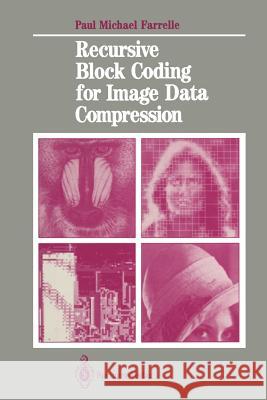
Paul M. Farrelle
Recursive Block Coding for Image Data Compression Paul M. Farrelle 9781461396789 Springer - książkaWidoczna okładka, to zdjęcie poglądowe, a rzeczywista szata graficzna może różnić się od prezentowanej.

Recursive Block Coding for Image Data Compression

ISBN-13: 9781461396789 / Angielski / Miękka / 2011 / 297 str.

Paul M. Farrelle
cena 403,47
(netto: 384,26 VAT:  5%)

Najniższa cena z 30 dni: 385,52
Termin realizacji zamówienia:
ok. 22 dni roboczych
Bez gwarancji dostawy przed świętami

Darmowa dostawa!

Recursive Block Coding, a new image data compression technique that has its roots in noncausal models for 1d and 2d signals, is the subject of this book. The underlying theory provides a multitude of compression algorithms that encompass two course coding, quad tree coding, hybrid coding and so on. Since the noncausal models provide a fundamentally different image representation, they lead to new approaches to many existing algorithms, including useful approaches for asymmetric, progressive, and adaptive coding techniques. On the theoretical front, the basic result shows that a random field (an ensemble of images) can be coded block by block such that the interblock redundancy can be completely removed while the individual blocks are transform coded. On the practical side, the artifact of tiling, a block boundary effect, present in conventional block by block transform coding techniques has been greatly suppressed. This book contains not only a theoretical discussion of the algorithms but also exhaustive simulation and suggested methodologies for ensemble design techniques. Each of the resulting algorithms has been applied to twelve images over a wide range of image data rates and the results are reported using subjective descriptions, photographs, mathematical MSE values, and h-plots, a recently proposed graphical representation showing a high level of agreement with image quality as judged subjectively.


Kategorie:
Informatyka
Kategorie BISAC:
Computers > Software Development & Engineering - Computer Graphics
Computers > Artificial Intelligence - Computer Vision & Pattern Recognition
Wydawca:
Springer
Język:
Angielski
ISBN-13:
9781461396789
Rok wydania:
2011
Wydanie:
Softcover Repri
Ilość stron:
297
Waga:
0.50 kg
Wymiary:
23.5 x 15.5
Oprawa:
Miękka
Wolumenów:
01

1 Introduction.- 1.1 The Need for Data Compression.- 1.2 Data Compression Techniques.- Predictive Coding—DPCM.- Transform Coding.- Karhunen-Lòeve Transform (KLT).- Hybrid Coding.- Vector Quantization (VQ).- 1.3 The Problem—the Tile Effect.- 1.4 Our Approach—Two Source Decomposition.- 1.5 Organization.- 2 RBC—The Theory behind the Algorithms.- 2.1 Introduction.- 2.2 Modeling.- 2.3 Autoregressive Models.- Example—1st-order AR process.- 2.4 Noncausal Models.- Example—noncausal MVR for a 1st-order AR sequence.- 2.5 Two Source Decomposition.- 2.6 The 1d RBC Algorithm.- 2.7 Boundary Response for First Order AR Models.- Transform Domain Solution.- Spatial Domain Solution.- Simple Algorithm for 1st-Order AR Models.- 2.8 2d Minimum Variance Models.- 2.9 Examples of 2d Noncausal Image Models.- The NC1 Model.- Two Source Decomposition.- 2.10 2d Boundary Response via Transform Methods.- Transform Domain Solution.- 2.11 The 2d RBC Algorithm.- 2.12 Approximate Boundary Response.- Spatial Domain Solution.- The Alternative 2d RBG Algorithm.- Bilinear Patches.- Coon’s Patches.- Bicubic Patches.- 2.13 Advantages of RBC.- Removing Interblock Redundancy.- Reducing the Tile Effect.- 3 Bit Allocation and Quantization for Transform Coding.- 3.1 Introduction.- 3.2 Choice of Transform and Quantizer.- Fidelity Criterion.- Transform Domain Distortion.- Optimal Transformation and Quantization.- Transform.- Amplitude Probability Density Function.- Coefficient Variances.- 3.3 Bit Allocation.- Rate-Distortion Functions.- Optimal Bit Allocation.- Shannon Rate Distortion Function.- Approximations.- Huang and Schultheiss.- Wintz and Kurtenbach.- Segall.- Wang and Jain.- General Approximation For Piecewise Exponentials.- The Integral Constraint.- 3.4 Integer Bit Allocation.- General Integer Bit Allocation.- Comments.- 3.5 Zero Level Quantizers.- 3.6 Choice of RD Function for Bit Allocation.- Shannon versus Lloyd-Max.- 3.7 RBC Rate Distortion Analysis.- Id RBC Rate-Distortion Analysis.- 2d RBC Rate-Distortion Analysis.- Alternative Minimization Strategy.- 3.8 Ensemble Design for DCT and RBC.- RBC Variance Reduction.- Variance Reduction With 2d RBC.- 3.9 Color Coding.- 4 Zonal Coding.- 4.1 Introduction.- 4.2 Original Images.- Color Images.- 4.3 Simulation Facilities.- 4.4 Image Quality Measures.- Hosaka Plots (h-plots).- 4.5 1d Coding Results.- 1d DCT Design.- 1d RBC Design.- Discussion of Results.- Ensemble A.- Tiffany.- Ensemble B.- 4.6 2d Coding Results.- 2d DCT Design.- 2d RBC Design.- Discussion of Results.- 4.7 Hybrid Coding.- DPCM Equations.- Bit Allocation.- Hybrid Coding Results.- Hybrid DCT Design.- Hybrid RBC Design.- Discussion of Results.- 4.8 Conclusions.- 5 Adaptive Coding Based on Activity Classes.- 5.1 Introduction.- 5.2 Adaptive DCT.- Design Methodology.- DC Quantizer.- Standard Normalized Variances.- Performance Curve.- Class Rate Allocation.- Coding Methodology.- 5.3 Adaptive RBC.- Design Methodology.- Coding Methodology.- 5.4 Coding Results.- Ensemble Design.- Individual Design.- 5.5 Conclusions.- Future Work.- 6 Adaptive Coding Based on Quad Tree Segmentation.- 6.1 Introduction.- 6.2 Adaptive Segmentation.- 6.3 The Quad Tree Approach.- Residual.- Overlapping Blocks.- Predictor.- Uniformity.- Mean Residual Energy.- Segmentation.- Choosing the Segmentation Parameters.- 6.4 Coding the Segmentation.- Generating Split and Merge Information.- Split and Merge Bits for Fig. 6.4.2.- Prediction Rate.- 6.5 Reconstruction.- Fast Linear Interpolation for N a Power of 2.- Fast Bilinear Interpolation.- Modified Interpolation.- Examples of Reconstructed Images.- 6.6 Coding the Residual.- Choice of Transform.- Choice of Threshold.- 6.7 Results.- Zero Level Quantizers.- 6.8 Conclusions.- 7 QVQ—Vector Quantization of the Quad Tree Residual.- 7.1 Introduction.- 7.2 Vector Quantization.- Advantages of VQ Over Scalar Quantization.- Vector Methods: Transform Coding and VQ.- VQ Design.- Splitting Codewords.- VQ Coding.- Performance Considerations.- 7.3 Differential and Interpolate VQ.- 7.4 VQ of the Quad Tree Residual.- Choosing the Vector Dimension.- Choosing the Training Sequence.- 7.5 Coding Results.- 7.6 Conclusions.- 8 Conclusions.- 8.1 Introduction.- 8.2 New Results.- 8.3 Coding Recommendations.- 8.4 Future Work.- Appendix A Ordinary and Partial Differential and Difference Equations.- A.1 Introduction.- A.2 Second Order Ordinary Differential Equations.- A.3 Second Order Ordinary Difference Equations.- A.4 Second Order Partial Differential Equations.- A.5 Second Order Partial Difference Equations.- Appendix B Properties of the Discrete Sine Transform.- B.1 Introduction.- Definition.- Notation.- Tridiagonal Toeplitz Matrices.- B.2 DST Evaluation Technique.- B.3 Exponential Sequences.- B.4 Constant Sequences.- B.5 Linear Sequences.- B.6 Hyperbolic Sequences.- B.7 Sinusoidal Sequences.- Appendix C Transform Domain Variance Distributions.- C.1 Introduction.- C.2 1d RBC.- Normalized Variance Distribution.- Variance Reduction Ratio.- C.3 1d DCT.- Appendix D Coding Parameters for Adaptive Coding Based on Activity Classes.- D.1 Introduction.- D.2 Adaptive DCT Coding Parameters.- D.3 Adaptive RBC Coding Parameters.- References.


Udostępnij

Facebook - konto krainaksiazek.pl


Opinie o Krainaksiazek.pl na Opineo.pl

Partner Mybenefit

Krainaksiazek.pl w programie rzetelna firma Krainaksiaze.pl - płatności przez paypal

Czytaj nas na:

Facebook - krainaksiazek.pl
  • książki na zamówienie
  • granty
  • książka na prezent
  • kontakt
  • pomoc
  • opinie
  • regulamin
  • polityka prywatności

Zobacz:

  • Księgarnia czeska

  • Wydawnictwo Książkowe Klimaty

1997-2025 DolnySlask.com Agencja Internetowa

© 1997-2022 krainaksiazek.pl
     
KONTAKT | REGULAMIN | POLITYKA PRYWATNOŚCI | USTAWIENIA PRYWATNOŚCI
Zobacz: Księgarnia Czeska | Wydawnictwo Książkowe Klimaty | Mapa strony | Lista autorów
KrainaKsiazek.PL - Księgarnia Internetowa

Polityka prywatnosci - link
Krainaksiazek.pl - płatnośc Przelewy24
Przechowalnia Przechowalnia





