• Wyszukiwanie zaawansowane
  • Kategorie
  • Kategorie BISAC
  • Książki na zamówienie
  • Promocje
  • Granty
  • Książka na prezent
  • Opinie
  • Pomoc
  • Załóż konto
  • Zaloguj się

Mathematical Ecology of Populations and Ecosystems » książka


zaloguj się | załóż konto
Logo Krainaksiazek.pl

koszyk

konto

szukaj
topmenu
Księgarnia internetowa
Szukaj
Książki na zamówienie
Promocje
Granty
Książka na prezent
Moje konto
Pomoc
 
 
Wyszukiwanie zaawansowane
Pusty koszyk
Bezpłatna dostawa dla zamówień powyżej 20 złBezpłatna dostawa dla zamówień powyżej 20 zł

Kategorie główne

• Nauka
 [2939893]
• Literatura piękna
 [1808953]

  więcej...
• Turystyka
 [70366]
• Informatyka
 [150555]
• Komiksy
 [35137]
• Encyklopedie
 [23160]
• Dziecięca
 [608786]
• Hobby
 [136447]
• AudioBooki
 [1631]
• Literatura faktu
 [225099]
• Muzyka CD
 [360]
• Słowniki
 [2914]
• Inne
 [442115]
• Kalendarze
 [1068]
• Podręczniki
 [166599]
• Poradniki
 [468390]
• Religia
 [506548]
• Czasopisma
 [506]
• Sport
 [61109]
• Sztuka
 [241608]
• CD, DVD, Video
 [3308]
• Technologie
 [218981]
• Zdrowie
 [98614]
• Książkowe Klimaty
 [124]
• Zabawki
 [2174]
• Puzzle, gry
 [3275]
• Literatura w języku ukraińskim
 [260]
• Art. papiernicze i szkolne
 [7376]
Kategorie szczegółowe BISAC

Mathematical Ecology of Populations and Ecosystems

ISBN-13: 9781405177955 / Angielski / Miękka / 2008 / 344 str.
John Pastor
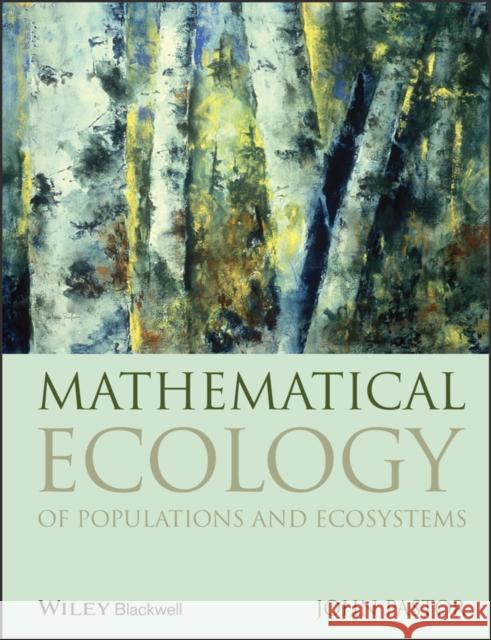
Mathematical Ecology of Populations and Ecosystems John Pastor 9781405177955 Blackwell Publishers - książkaWidoczna okładka, to zdjęcie poglądowe, a rzeczywista szata graficzna może różnić się od prezentowanej.

Mathematical Ecology of Populations and Ecosystems

ISBN-13: 9781405177955 / Angielski / Miękka / 2008 / 344 str.

John Pastor
cena 334,17
(netto: 318,26 VAT:  5%)

Najniższa cena z 30 dni: 330,08
Termin realizacji zamówienia:
ok. 30 dni roboczych.

Darmowa dostawa!

Population ecologists study how births and deaths affect the dynamics of populations and communities, while ecosystem ecologists study how species control the flux of energy and materials through food webs and ecosystems. Although all these processes occur simultaneously in nature, the mathematical frameworks bridging the two disciplines have developed independently. Consequently, this independent development of theory has impeded the cross-fertilization of population and ecosystem ecology. Using recent developments from dynamical systems theory, this advanced undergraduate/graduate level textbook shows how to bridge the two disciplines seamlessly. The book shows how bifurcations between the solutions of models can help understand regime shifts in natural populations and ecosystems once thresholds in rates of births, deaths, consumption, competition, nutrient inputs, and decay are crossed.

"Mathematical Ecology" is essential reading for students of ecology who have had a first course in calculus and linear algebra or students in mathematics wishing to learn how dynamical systems theory can be applied to ecological problems.


Kategorie:
Nauka, Biologia i przyroda
Kategorie BISAC:
Science > Life Sciences - Ecology
Mathematics > Matematyka stosowana
Science > System Theory
Wydawca:
Blackwell Publishers
Język:
Angielski
ISBN-13:
9781405177955
Rok wydania:
2008
Ilość stron:
344
Waga:
0.83 kg
Wymiary:
24.38 x 18.8 x 1.78
Oprawa:
Miękka
Wolumenów:
01
Dodatkowe informacje:
Bibliografia
Wydanie ilustrowane
Podręcznik

"Nevertheless, it is an excellent summary which will sweep away the cobwebs from the mind of someone who has learnt this stuff at some time in the past. . . It would be ideal as a text for a course taught in a mathematics department, to convince mathematics students that their skills in differential equations can be applied to ecological problems." (Austral Ecology, 2011)

"Its best feature a the scientific soundness t hat permeates the whole book, founded on a robust mathematical treatment of most of the arguments." ( Ecoscience, June 2010)"Pastor (Univ. of Minnesota, Duluth) does an admirable job of bridging the gap, providing a work that should quickly become a popular choice for upper–level undergraduate or graduate courses in both disciplines." ( CHOICE, January 2009)

Prologue.

Preface.

Acknowledgments.

Part I: Preliminaries.

1. What is Mathematical Ecology and Why Should We Do It?.

2. Mathematical Toolbox.

Part II: Populations.

3. Homogeneous Populations: Exponential and Geometric Growth and Decay.

4. Age– and Stage–structured Linear Models: Relaxing The Assumption Of Population Homogeneity.

5. Nonlinear Models of Single Populations: The Continuous Time Logistic Model.

6. Discrete Logistic Growth, Oscillations, and Chaos.

7. Harvesting and the Logistic Model.

8. Predators and their Prey.

9. Competition between Two Species, Mutualism, and Species Invasions.

10. Multispecies Community and Food Web Models.

Part III: Ecosystems.

11. Inorganic Resources, Mass Balance, Resource Uptake, and Resource Use Efficiency.

12. Litter Return, Nutrient Cycling, and Ecosystem Stability.

13. Consumer Regulation of Nutrient Cycling.

14. Stoichiometry and Linked Element Cycles.

Part IV: Populations and Ecosystems in Space and Time.

15. Transitions between Populations and States in Landscapes.

16. Diffusion, Advection, the Spread of Populations and Resources, and the Emergence of Spatial Patterns.

Appendix: MatLab Commands for Equilibrium and Stability Analysis of Multi–compartment Models by Solving the Jacobian and its Eigenvalues.

References.

Index

John Pastor is Professor of Biology, at University of Minnesota Duluth, USA

Population ecologists study how births and deaths affect the dynamics of populations and communities, while ecosystem ecologists study how species control the flux of energy and materials through food webs and ecosystems. Although all these processes occur simultaneously in nature, the mathematical frameworks bridging the two disciplines have developed independently. Consequently, this independent development of theory has impeded the cross–fertilization of population and ecosystem ecology. Using recent developments from dynamical systems theory, this advanced undergraduate/graduate level textbook shows how to bridge the two disciplines seamlessly. The book shows how bifurcations between the solutions of models can help understand regime shifts in natural populations and ecosystems once thresholds in rates of births, deaths, consumption, competition, nutrient inputs, and decay are crossed.

Mathematical Ecology is essential reading for students of ecology who have had a first course in calculus and linear algebra or students in mathematics wishing to learn how dynamical systems theory can be applied to ecological problems.

Pastor, John John Pastor is Professor and Senior Research Assoc... więcej >


Udostępnij

Facebook - konto krainaksiazek.pl


Opinie o Krainaksiazek.pl na Opineo.pl

Partner Mybenefit

Krainaksiazek.pl w programie rzetelna firma Krainaksiaze.pl - płatności przez paypal

Czytaj nas na:

Facebook - krainaksiazek.pl
  • książki na zamówienie
  • granty
  • książka na prezent
  • kontakt
  • pomoc
  • opinie
  • regulamin
  • polityka prywatności

Zobacz:

  • Księgarnia czeska

  • Wydawnictwo Książkowe Klimaty

1997-2026 DolnySlask.com Agencja Internetowa

© 1997-2022 krainaksiazek.pl
     
KONTAKT | REGULAMIN | POLITYKA PRYWATNOŚCI | USTAWIENIA PRYWATNOŚCI
Zobacz: Księgarnia Czeska | Wydawnictwo Książkowe Klimaty | Mapa strony | Lista autorów
KrainaKsiazek.PL - Księgarnia Internetowa

Polityka prywatnosci - link
Krainaksiazek.pl - płatnośc Przelewy24
Przechowalnia Przechowalnia





