• Wyszukiwanie zaawansowane
  • Kategorie
  • Kategorie BISAC
  • Książki na zamówienie
  • Promocje
  • Granty
  • Książka na prezent
  • Opinie
  • Pomoc
  • Załóż konto
  • Zaloguj się

introduction to modeling in wildlife and resource conservation » książka

zaloguj się | załóż konto
Logo Krainaksiazek.pl

koszyk

konto

szukaj
topmenu
Księgarnia internetowa
Szukaj
Książki na zamówienie
Promocje
Granty
Książka na prezent
Moje konto
Pomoc
 
 
Wyszukiwanie zaawansowane
Pusty koszyk
Bezpłatna dostawa dla zamówień powyżej 20 złBezpłatna dostawa dla zamówień powyżej 20 zł

Kategorie główne

• Nauka
 [2950560]
• Literatura piękna
 [1849509]

  więcej...
• Turystyka
 [71097]
• Informatyka
 [151150]
• Komiksy
 [35848]
• Encyklopedie
 [23178]
• Dziecięca
 [617388]
• Hobby
 [139064]
• AudioBooki
 [1657]
• Literatura faktu
 [228597]
• Muzyka CD
 [383]
• Słowniki
 [2855]
• Inne
 [445295]
• Kalendarze
 [1464]
• Podręczniki
 [167547]
• Poradniki
 [480102]
• Religia
 [510749]
• Czasopisma
 [516]
• Sport
 [61293]
• Sztuka
 [243352]
• CD, DVD, Video
 [3414]
• Technologie
 [219456]
• Zdrowie
 [101002]
• Książkowe Klimaty
 [124]
• Zabawki
 [2311]
• Puzzle, gry
 [3459]
• Literatura w języku ukraińskim
 [254]
• Art. papiernicze i szkolne
 [8079]
Kategorie szczegółowe BISAC

introduction to modeling in wildlife and resource conservation

ISBN-13: 9781405144391 / Angielski / Miękka / 2007 / 344 str.
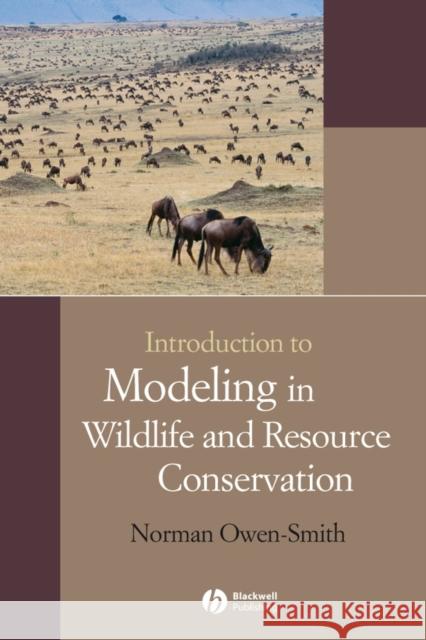
Norman Owen-Smith
introduction to modeling in wildlife and resource conservation  Owen-Smith, Norman 9781405144391 Blackwell Publishers - książkaWidoczna okładka, to zdjęcie poglądowe, a rzeczywista szata graficzna może różnić się od prezentowanej.

introduction to modeling in wildlife and resource conservation

ISBN-13: 9781405144391 / Angielski / Miękka / 2007 / 344 str.

Norman Owen-Smith
cena 264,56
(netto: 251,96 VAT:  5%)

Najniższa cena z 30 dni: 264,01
Termin realizacji zamówienia:
ok. 30 dni roboczych
Dostawa w 2026 r.

Darmowa dostawa!

This book provides students with the skills to develop their own models for application in conservation biology and wildlife management. Assuming no special mathematical expertise, the computational models used are kept simple and show how to develop models in both spreadsheet and programming language format.


  • Develops thought-provoking applications which emphasize the value of modeling as a learning tool
  • Examines basic descriptive equations, matrix representations, consumer-resources interactions, applications in simulation, scenarios, harvesting, population viability, metapopulation dynamics, disease outbreaks, vegetation stage and state dynamics, habitat suitability assessment, and model selection statistics
  • Includes a wide range of examples relating to birds, fish, plants and large African mammals

Kategorie:
Nauka, Biologia i przyroda
Kategorie BISAC:
Nature > Environmental Conservation & Protection - General
Nature > Animals - Wildlife
Science > Life Sciences - Ecology
Wydawca:
Blackwell Publishers
Język:
Angielski
ISBN-13:
9781405144391
Rok wydania:
2007
Ilość stron:
344
Waga:
0.53 kg
Wymiary:
23.24 x 15.8 x 1.96
Oprawa:
Miękka
Wolumenów:
01
Dodatkowe informacje:
Bibliografia
Wydanie ilustrowane

"This is consequently very much a hands–on work and ideal as a basic manual for a course on the topic. At the same time, it will be of value to conservationists who wish to understand the basis of some modeling approach they find in a paper directly pertinent to their particular interests." (Biodivers Conserv, 2011) An easy approach to modelling." ( Mammalia , April 2009) "This is a very interesting text. ... The focus on method and theory as well as programming means that the text encourages the reader to question even basic assumptions." ( Ecological and Environmental Education )

Preface.

1 Introduction: why learn modeling?.

1.1 Introduction.

1.2 Structure of the book.

1.3 Supporting computer software.

Recommended supporting reading.

Supporting file on the CD.

2 A starting problem: conservation of the dodo.

2.1 Introduction.

2.2 Conservation of the dodo.

3 Descriptive models: choosing an equation.

3.1 Introduction.

3.2 Dynamic equations.

3.3 Geometric and exponential growth.

3.4 Adding a population ceiling.

3.5 Basic density–dependent models.

3.6 Curvilinear density dependence.

3.7 Delayed density dependence.

3.8 Depensation or Allee effect.

3.9 Incorporating environmental variability.

3.10 Overview.

Recommended supporting reading.

Programs on the accompanying CD.

Exercises.

4 Structured population models: age, size, or stage.

4.1 Introduction.

4.2 Age–structured models.

4.3 Stage–structured models.

4.4 Projection versus prediction.

4.5 Overview.

Recommended supporting reading.

Programs on the accompanying CD.

Exercises.

5 Consumer resource models: population interactions.

5.1 Introduction.

5.2 Coupling population equations.

5.3 Simple interactive model.

5.4 Incorporating competitive interference.

5.5 Ratio–dependent intake response and time frames.

5.6 Accommodating environmental variability.

5.7 Overview.

Recommended supporting reading.

Programs on the accompanying CD.

Exercises.

6 Simulation models: assessing understanding.

6.1 Introduction.

6.2 Adding density dependence to an age–structured model.

6.3 Aspecific example: the kudu model.

6.4 Simplification for management.

6.5 Generalizing the model for other species.

6.6 Overview.

Recommended supporting reading.

Programs on the accompanying CD.

Exercises.

7 Harvesting models: adaptive management.

7.1 Introduction.

7.2 Principles of maximum sustained yield .

7.3 Surplus production model accommodating environmental variability.

7.4 Stock–recruitment model.

7.5 Policies for setting the harvest quota.

7.6 Adaptive management responses.

7.7 Stock–recruitment models for fish populations.

7.8 Overview.

Recommended supporting reading.

Programs on the accompanying CD.

Exercises.

8 Population viability models: risk analysis.

8.1 Introduction.

8.2 Demographic stochasticity.

8.3 Environmental variability and catastrophes.

8.4 Genetic stochasticity.

8.5 Population viability models.

8.6 Overview.

Recommended supporting reading.

Programs on the accompanying CD.

Exercises.

9 Metapopulation models: spreading the risk.

9.1 Introduction.

9.2 Basic patch incidence model.

9.3 Correlated migration and extinction.

9.4 Variable patch size and spacing.

9.5 Source and sink populations.

9.6 Mainland island habitats.

9.7 Examples of vertebrate metapopulations.

9.8 Overview.

Recommended supporting reading.

Exercises.

10 Modeling infectious diseases: outbreak dynamics.

10.1 Introduction.

10.2 Basic infection model.

10.3 Cyclic outbreak dynamics: measles.

10.4 Slowly spreading sexually transmitted disease: HIV AIDS.

10.5 Controlling the spread of wildlife diseases.

10.6 Overview.

Recommended supporting reading.

Exercises.

11 Scenario models: exploring options.

11.1 Introduction.

11.2 Background situation.

11.3 Theoretical concepts.

11.4 Modeling the white rhino grassland system.

11.5 Exploring management options.

11.6 Overview.

Recommended supporting reading.

Program on the accompanying CD.

Exercises.

12 Vegetation models: biomass to gap dynamics.

12.1 Introduction.

12.2 Seasonal biomass dynamics of vegetation supporting herbivores.

12.3 Size–structured dynamics of a tree population.

12.4 Gap dynamics model.

12.5 Overview.

Recommended supporting reading.

Programs on the accompanying CD.

Exercises.

13 State transition models: habitat patch dynamics.

13.1 Introduction.

13.2 Vegetation successional dynamics.

13.3 Managing savanna vegetation for livestock.

13.4 Spatially explicit grid model.

13.5 Overview.

Recommended supporting reading.

Programs on the accompanying CD.

Exercises.

14 Habitat suitability models: adaptive behavior.

14.1 Introduction.

14.2 Shifting habitat use by overwintering geese.

14.3 Habitat suitability for a browsing antelope from vegetation composition.

14.4 General principles.

14.5 Overview.

Recommended supporting reading.

Programs on the accompanying CD.

Exercises.

15 Reconciling models with data: statistical diagnosis.

15.1 Introduction.

15.2 Model selection statistics.

15.3 Diagnosing the causes of antelope population declines.

15.4 Overview.

Recommended supporting reading.

Programs on the accompanying CD.

Exercise.

Appendices.

References.

Index

Norman Owen–Smith is Research Professor in African Ecology in the School of Animal, Plant, and Environmental Sciences at the University of the Witwatersrand in South Africa. He teaches ecology at undergraduate and postgraduate levels, and is well–known internationally for his research into all aspects of wildlife ecology and bioresource conservation.

Introduction to Modeling in Wildlife and Resource Conservation provides students with the skills to develop their own models for application in conservation biology and wildlife management. Assuming no special mathematical expertise, the computational models used are kept simple and show how to develop models in both spreadsheet and programming language format.

The bookdevelops thought–provoking applications which emphasize the value of modeling as a learning tool. Beginning with basic descriptive equations, matrix representations, and consumer–resources interactions, the book proceeds to explore applications in simulation, scenarios, harvesting, population viability, metapopulation dynamics, disease outbreaks, vegetation stage and state dynamics, habitat suitability assessment, and model selection statistics. Detailed instructions are given on how to construct spreadsheet models, and programmes are written in True BASIC which forms a readily understandable foundation language. Throughout the book a wide range of examples are used relating to birds, fish, plants and large African mammals.

An accompanying CD provides models as well as a trial version of the True BASIC programming language.

This book provides an essential introduction to modeling for upper–level undergraduate and graduate students who have a completed a basic course in ecology and plan careers in wildlife conservation.

Owen-Smith, Norman Norman Owen-Smith is Research Professor in African... więcej >


Udostępnij

Facebook - konto krainaksiazek.pl


Opinie o Krainaksiazek.pl na Opineo.pl

Partner Mybenefit

Krainaksiazek.pl w programie rzetelna firma Krainaksiaze.pl - płatności przez paypal

Czytaj nas na:

Facebook - krainaksiazek.pl
  • książki na zamówienie
  • granty
  • książka na prezent
  • kontakt
  • pomoc
  • opinie
  • regulamin
  • polityka prywatności

Zobacz:

  • Księgarnia czeska

  • Wydawnictwo Książkowe Klimaty

1997-2025 DolnySlask.com Agencja Internetowa

© 1997-2022 krainaksiazek.pl
     
KONTAKT | REGULAMIN | POLITYKA PRYWATNOŚCI | USTAWIENIA PRYWATNOŚCI
Zobacz: Księgarnia Czeska | Wydawnictwo Książkowe Klimaty | Mapa strony | Lista autorów
KrainaKsiazek.PL - Księgarnia Internetowa

Polityka prywatnosci - link
Krainaksiazek.pl - płatnośc Przelewy24
Przechowalnia Przechowalnia







