• Wyszukiwanie zaawansowane
  • Kategorie
  • Kategorie BISAC
  • Książki na zamówienie
  • Promocje
  • Granty
  • Książka na prezent
  • Opinie
  • Pomoc
  • Załóż konto
  • Zaloguj się

How Do You Know?: The Epistemological Foundations of 21st Century Literacy » książka

zaloguj się | załóż konto
Logo Krainaksiazek.pl

koszyk

konto

szukaj
topmenu
Księgarnia internetowa
Szukaj
Książki na zamówienie
Promocje
Granty
Książka na prezent
Moje konto
Pomoc
 
 
Wyszukiwanie zaawansowane
Pusty koszyk
Bezpłatna dostawa dla zamówień powyżej 20 złBezpłatna dostawa dla zamówień powyżej 20 zł

Kategorie główne

• Nauka
 [2950560]
• Literatura piękna
 [1849509]

  więcej...
• Turystyka
 [71097]
• Informatyka
 [151150]
• Komiksy
 [35848]
• Encyklopedie
 [23178]
• Dziecięca
 [617388]
• Hobby
 [139064]
• AudioBooki
 [1657]
• Literatura faktu
 [228597]
• Muzyka CD
 [383]
• Słowniki
 [2855]
• Inne
 [445295]
• Kalendarze
 [1464]
• Podręczniki
 [167547]
• Poradniki
 [480102]
• Religia
 [510749]
• Czasopisma
 [516]
• Sport
 [61293]
• Sztuka
 [243352]
• CD, DVD, Video
 [3414]
• Technologie
 [219456]
• Zdrowie
 [101002]
• Książkowe Klimaty
 [124]
• Zabawki
 [2311]
• Puzzle, gry
 [3459]
• Literatura w języku ukraińskim
 [254]
• Art. papiernicze i szkolne
 [8079]
Kategorie szczegółowe BISAC

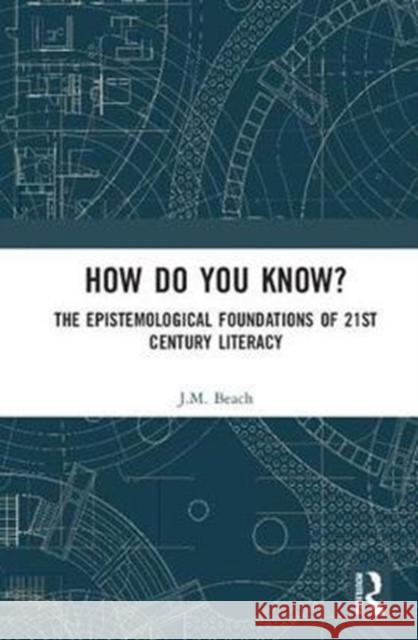
How Do You Know?: The Epistemological Foundations of 21st Century Literacy

ISBN-13: 9781138098060 / Angielski / Twarda / 2017 / 252 str.
J. M. Beach
How Do You Know?: The Epistemological Foundations of 21st Century Literacy J. M. Beach 9781138098060 Routledge - książkaWidoczna okładka, to zdjęcie poglądowe, a rzeczywista szata graficzna może różnić się od prezentowanej.

How Do You Know?: The Epistemological Foundations of 21st Century Literacy

ISBN-13: 9781138098060 / Angielski / Twarda / 2017 / 252 str.

J. M. Beach
cena 728,68
(netto: 693,98 VAT:  5%)

Najniższa cena z 30 dni: 705,23
Termin realizacji zamówienia:
ok. 22 dni roboczych
Dostawa w 2026 r.

Darmowa dostawa!
inne wydania

This book defines the concept and practices of literacy. Examining the ways in which the spread of literacy and education have caused culture wars in pluralist societies since the 16th century, the author argues that science, and more broadly evidence-based inductive arguments, offer the only reliable source information and the only peaceful solution to cultural conflict in the 21st century. With a focus on the multifaceted practice of literacy-as-communication, the book calls for a new literacy that incorporates reading and writing with advanced cognitive and epistemological skills.


Kategorie:
Nauka, Socjologia i społeczeństwo
Kategorie BISAC:
Social Science > Socjologia
Reference > Questions & Answers
Wydawca:
Routledge
Język:
Angielski
ISBN-13:
9781138098060
Rok wydania:
2017
Ilość stron:
252
Waga:
0.56 kg
Wymiary:
16.4 x 24.1 x 2.3
Oprawa:
Twarda
Wolumenów:
01
Dodatkowe informacje:
Bibliografia

"The ability to learn and reason is badly taught in our public schools, and deserves a radical upgrade. The pathway for this crucial improvement is clearly marked out in Beach’s How Do You Know?"

Edward O. Wilson, University Research Professor Emeritus, Harvard University.

"Beach outlines the kind of curriculum that has long been needed to clarify the mysteries of intellectual culture, a culture that otherwise will remain a secret society reserved for the few. It won’t help students much to learn masses of factual information unless they learn "how to use" that information, which for Beach (drawing on the important work of psychologist Deanna Kuhn) means being able to use what they know to make arguments, which includes assessing the arguments of others. This argument literacy lies at the core of Beach’s proposed critical thinking curriculum for the 21st century, and nobody I know has said all this better than has Josh Beach in this book."

Gerald Graff, Emeritus Professor of English and Education, University of Illinois at Chicago, and 2008 President, Modern Language Association of America.

"A giant step towards a comprehensive theory of literacy that would help to explain its role in the shaping of mind and society."

David R. Olson, University Professor Emeritus, Ontario Institute for Studies in Education, University of Toronto .

"Beach forges a wide and studious path across much of philosophy, science and psychology in an effort to answer the question of how we can know.  His answer -- to commit to open argument, grounded on values of truth and freedom -- doesn't resolve all concerns. But I agree that it is the best one we have, and today's world makes it more urgent than ever that we embrace it."

Deanna Kuhn, Professor of Psychology and Education, Teachers College, Columbia University.

"This is a book that calls for a wide readership – basically, anyone interested in the role of critical and rational thinking in a democratic society, the compelling need to teach individuals to make discerning evaluations of the array of information encountered, and the importance of understanding the premises of scientific theories, methods, and empirically grounded claims. Providing a sweeping (and deeply engaging) historical, philosophical, and cultural context for his argument, Beach makes it clear why an expanded definition of literacy must include a focus on how we know what we know, what psychologists call epistemic cognition. Such a definition of 21st century literacy would be an invaluable one for the muddled and complicated times in which we are living. Seldom is a book of such scope and depth so imminently readable and engaging."

Barbara Hofer, Professor of Psychology, Middlebury College.

"Beach helps us understand how in a pluralistic society we got to culture wars, alternative facts, the era of post truth, spin and fake news and how to develop an interdisciplinary approach to knowing, judging wisely and acting skillfully. He explores the relationships amongst subjectivity, biology, culture and the objective world. Since we can’t trust our subjectivity, our biological brains, cultural influences, authority, or the news, Beach asks what do we do? How do we distinguish sophistry from truth? For practical, critical thinking to succeed, it needs to incorporate the foundational elements of science: empiricism, rationality, and open debate. Beach proposes that to have respectful democratic deliberations, we need an education that helps us critically understand and evaluate our knowledge and premises about value, offering a way to knowledge and out of our divisiveness."

Robert Frank, Professor Emeritus of English and Associate Dean of the College of Liberal Arts, Oregon State University.

"This book makes a critical intervention into a very old problem: what does it mean to be an ‘educated’ person, to be a citizen in the classical sense? Working in a vein that stretches back from Richard Rorty through John Dewey to Horace Mann, Josh Beach offers pragmatic solutions to the question posed by The Uses of Literacy for 21st century Americans."

John Cline, Lecturer in Engineering Communication, Department of Mechanical Engineering, University of Texas at Austin.

Preface: 'Clarifying the Mysteries of Intellectual Culture', by Gerald Graff, Introduction: The Knowledge Gap 1. An Institutional History of Literacy Education, Part I: A History of Education, Democracy, and Culture War 2. The Authority of Tradition: Schooling, Books, and the Development of Literacy 3. Culture Wars: Literacy, Schooling, and the Development of Democracy 4. Discontent with Democracy: Culture Wars in U. S., Part II: Subjectivity, Culture, and Bounded Rationality 5. Oral Culture and the Development of Literacy 6. The Concept of Culture 7. The Subjective Truth of Fiction 8. Bounded Rationality: The Problems of Subjective Knowledge 9. Culture, Common Sense, and the News Media  10. Is This Story True? Bias in the News Media, Part III: Philosophy, Science and the Development of Objectivity 11. Philosophy and the Development of Knowledge 12. Science and the Development of Objectivity 13. Provisional Truth: The Limitations of Science 14. Practical Reasoning: Solving the Problems of Everyday Life Part IV: The Limitations of Argument: Pluralism, Values, and Contested Communication 15. Culture Is a Debate 16. Understanding Cultural Values 17. Open Arguments and the Warrant, Conclusion: The Virtues of Toleration and Democratic Deliberation, Acknowledgements, Bibliography, Index

J.M. Beach is a lecturer with the University Writing Program at the University of Texas, San Antonio, USA. He has advanced degrees in the fields of English, History, Philosophy, and Education, and has taught students in the United States, South Korea, and China. He is the Director of 21st Century Literacy; a non-profit organization focused on literacy education, and is also a poet. His research interests focus on the philosophy of knowledge, the science of culture and society, the history and philosophy of education, and literature. Some of Beach’s previous books include What Is Education? On the Social Ecology of Teaching, Learning, and Schooling (2014), Gateway to Opportunity? A History of the Community College in the United States (2011), Children Dying Inside: Education in South Korea (2011), and Studies in Poetry: The Visionary (2004). Visit the author’s website at www.jmbeach.com.

Beach, J. M. J. M. Beach has been a teacher and educational adm... więcej >


Udostępnij

Facebook - konto krainaksiazek.pl


Opinie o Krainaksiazek.pl na Opineo.pl

Partner Mybenefit

Krainaksiazek.pl w programie rzetelna firma Krainaksiaze.pl - płatności przez paypal

Czytaj nas na:

Facebook - krainaksiazek.pl
  • książki na zamówienie
  • granty
  • książka na prezent
  • kontakt
  • pomoc
  • opinie
  • regulamin
  • polityka prywatności

Zobacz:

  • Księgarnia czeska

  • Wydawnictwo Książkowe Klimaty

1997-2025 DolnySlask.com Agencja Internetowa

© 1997-2022 krainaksiazek.pl
     
KONTAKT | REGULAMIN | POLITYKA PRYWATNOŚCI | USTAWIENIA PRYWATNOŚCI
Zobacz: Księgarnia Czeska | Wydawnictwo Książkowe Klimaty | Mapa strony | Lista autorów
KrainaKsiazek.PL - Księgarnia Internetowa

Polityka prywatnosci - link
Krainaksiazek.pl - płatnośc Przelewy24
Przechowalnia Przechowalnia






