• Wyszukiwanie zaawansowane
  • Kategorie
  • Kategorie BISAC
  • Książki na zamówienie
  • Promocje
  • Granty
  • Książka na prezent
  • Opinie
  • Pomoc
  • Załóż konto
  • Zaloguj się

Geocryology: Characteristics and Use of Frozen Ground and Permafrost Landforms » książka


zaloguj się | załóż konto
Logo Krainaksiazek.pl

koszyk

konto

szukaj
topmenu
Księgarnia internetowa
Szukaj
Książki na zamówienie
Promocje
Granty
Książka na prezent
Moje konto
Pomoc
 
 
Wyszukiwanie zaawansowane
Pusty koszyk
Bezpłatna dostawa dla zamówień powyżej 20 złBezpłatna dostawa dla zamówień powyżej 20 zł

Kategorie główne

• Nauka
 [2948695]
• Literatura piękna
 [1824038]

  więcej...
• Turystyka
 [70868]
• Informatyka
 [151073]
• Komiksy
 [35227]
• Encyklopedie
 [23181]
• Dziecięca
 [621575]
• Hobby
 [138961]
• AudioBooki
 [1642]
• Literatura faktu
 [228651]
• Muzyka CD
 [371]
• Słowniki
 [2933]
• Inne
 [445341]
• Kalendarze
 [1243]
• Podręczniki
 [164416]
• Poradniki
 [479493]
• Religia
 [510449]
• Czasopisma
 [502]
• Sport
 [61384]
• Sztuka
 [243086]
• CD, DVD, Video
 [3417]
• Technologie
 [219673]
• Zdrowie
 [100865]
• Książkowe Klimaty
 [124]
• Zabawki
 [2168]
• Puzzle, gry
 [3372]
• Literatura w języku ukraińskim
 [260]
• Art. papiernicze i szkolne
 [7838]
Kategorie szczegółowe BISAC

Geocryology: Characteristics and Use of Frozen Ground and Permafrost Landforms

ISBN-13: 9781138054165 / Angielski / Twarda / 2017 / 766 str.
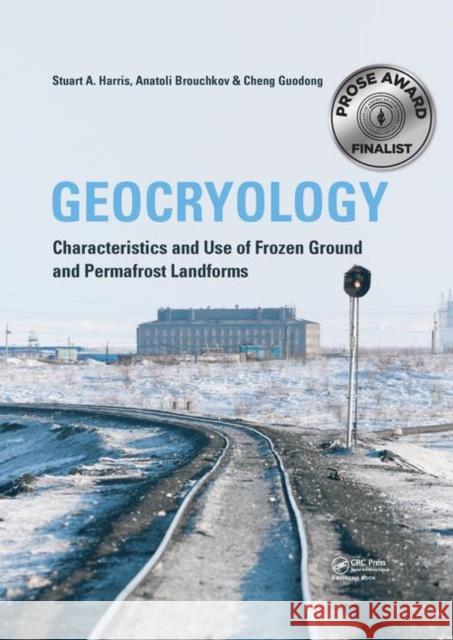
Stuart A. Harris; Anatoli Brouchkov; Cheng Guodong
Geocryology: Characteristics and Use of Frozen Ground and Permafrost Landforms Stuart A. Harris Anatoli Brouchkov Cheng Guodong 9781138054165 CRC Press - książkaWidoczna okładka, to zdjęcie poglądowe, a rzeczywista szata graficzna może różnić się od prezentowanej.

Geocryology: Characteristics and Use of Frozen Ground and Permafrost Landforms

ISBN-13: 9781138054165 / Angielski / Twarda / 2017 / 766 str.

Stuart A. Harris; Anatoli Brouchkov; Cheng Guodong
cena 1124,18
(netto: 1070,65 VAT:  5%)

Najniższa cena z 30 dni: 1057,85
Termin realizacji zamówienia:
ok. 22 dni roboczych.

Darmowa dostawa!
inne wydania

This book provides a general survey of Geocryology, which is the study of frozen ground called permafrost. Frozen ground is the product of cold climates as well as a variety of environmental factors. Its major characteristic is the accumulation of large quantities of ice which may exceed 90% by volume. Soil water changing to ice results in ground heaving, while thawing of this ice produces ground subsidence often accompanied by soil flowage. Permafrost is very susceptible to changes in weather and climate as well as to changes in the microenvironment. Cold weather produces contraction of the ground, resulting in cracking of the soil as well as breakup of concrete, rock, etc. Thus permafrost regions have unique landforms and processes not found in warmer lands. The book is divided into three parts. Part 1 provides an introduction to the characteristics of permafrost. Four chapters deal with its definition and characteristics, the unique processes operating there, the factors affecting it, and its general distribution. Part 2 consists of seven chapters describing the characteristic landforms unique to these areas and the processes involved in their formation. Part 3 discusses the special problems encountered by engineers in construction projects including settlements, roads and railways, the oil and gas industry, mining, and the agricultural and forest industries. The three authors represent three countries and three language groups, and together have over 120 years of experience of working in permafrost areas throughout the world. The book contains over 300 illustrations and photographs, and includes an extensive bibliography in order to introduce the interested reader to the large current literature.


Kategorie:
Nauka, Geografia
Kategorie BISAC:
Science > Earth Sciences - Geology
Technology & Engineering > Civil - General
Wydawca:
CRC Press
Język:
Angielski
ISBN-13:
9781138054165
Rok wydania:
2017
Ilość stron:
766
Waga:
1.75 kg
Wymiary:
24.89 x 18.03 x 4.83
Oprawa:
Twarda
Wolumenów:
01
Dodatkowe informacje:
Bibliografia
Wydanie ilustrowane

Part I Introduction and characteristics of permafrost

1 Definition and description
1.1 Introduction
1.2 Additional terms originating in Russia
1.3 History of permafrost research
1.4 Measurement of ground temperature
1.5 Conduction, convection and advection
1.6 Thermal regimes in regions based on heat conduction
1.7 Continentality index
1.8 Moisture movement in the active layer during freezing and thawing
1.9 Moisture conditions in permafrost grond
1.10 Results of freezing moisture
1.11 Strength of ice
1.12 Cryosols, gelisols, and leptosols
1.13 Fragipans
1.14 Salinity in permafrost regions
1.15 Organic matter
1.16 Micro-organisms in permafrost
1.17 Gas and gas hydrates
1.18 Thermokarst areas
1.19 Offshore permafrost

2 Cryogenic processes where temperatures dip below 0◦C
2.1 Introduction
2.2 The nature of ice and water
2.3 Effects of oil pollution on freezing
2.4 Freezing and thawing of the active layer in permafrost in equilibrium with a stable climate
2.5 Relation of clay mineralogy to the average position of the permafrost table
2.6 Ground temperature envelopes in profiles affected by changes in mean annual ground surface temperature (MASGT)
2.7 Needle ice
2.8 Frost heaving
2.9 Densification and thaw settlement
2.10 Cryostratigraphy, cryostructures, cryotextures and cryofacies
2.11 Ground cracking
2.12 Dilation cracking
2.13 Frost susceptibility
2.14 Cryoturbation, gravity processes and injection structures
2.15 Upheaving of objects
2.16 Upturning of objects
2.17 Sorting
2.18 Weathering and frost comminution
2.19 Karst in areas with permafrost
2.20 Seawater density and salinity

3 Factors affecting permafrost distribution
3.1 Introduction
3.2 Climatic factors
3.3 Terrain factors

4 Permafrost distribution
4.1 Introduction
4.2 Zonation of permafrost
4.3 Permafrost mapping
4.4 Examples of mapping units used
4.5 Modeling permafrost distribution
4.6 Advances in geophysical methods
4.7 Causes of variability reducing the reliability of small-scale maps
4.8 Maps of permafrost-related properties based on field observations
4.9 Use of remote sensing and aiborne platforms in monitoring environmental conditions and distubances
4.10 Sensitivity to climate change: Hazard zonation
4.11 Classification of permafrost stability based on mean annual ground temperature

Part II Permafrost landforms
II.1 Introduction

5 Frost cracking, ice-wedges, sand, loess and rock tessellons
5.1 Introduction
5.2 Primary and secondary wedges

6 Massive ground ice in lowlands
6.1 Introduction
6.2 Distribution of massive icy beds in surface sediments
6.3 Sources of the sediments
6.4 Deglaciation of the Laurentide ice sheet
6.5 Methods used to determine the origin of the massive icy beds
6.6 Massive icy beds interpreted as being formed by cryosuction
6.7 Massive icy beds that may represent stgnant glacial ice
6.8 Other origins of massive icy beds
6.9 Ice complexes including Yedoma deposits
6.10 Conditions for growth of thick ice-wedges
6.11 The mechanical condition of the growth of ice-wedges and its connection to the properties of the surrounding sediments
6.12 Buoyancy of ice-wedges
6.13 Summary of the ideas explaining yedoma evolution
6.14 Aufeis
6.15 Perennial ice caves
6.16 Types of ice found in perennial ice caves
6.17 Processes involved in the formation of perennial ice caves
6.18 Cycles of perennial cave evolution
6.19 Ice caves in subtropical climates
6.20 Massive blocks of ice in bedrock or soil

7 Permafrost mounds
7.1 Introduction
7.2 Mounds over 2.5m diameter
7.3 Cryogenic mounds less than 2.5m in diameter

8 Mass wasting of fine-grained materials in cold climates
8.1 Introduction
8.2 Classification of mass wasting
8.3 Slow flows
8.4 Cryogenic fast flows
8.5 Relative effect in moving debris downslope in the mountains

9 Landforms consisting of blocky materials in cold climates
9.1 Introduction
9.2 Source of the blocks
9.3 Influence of rock type
9.4 Weathering products
9.5 Biogenic weathering
9.6 Fate of the sloluble salts produced by chemical and biogenic weathering
9.7 Rate of cliff retreat
9.8 Landforms resulting from the accumulation of predominantly blocky materials in cryogenic climates
9.9 Talus containing significant amounts of finer material
9.10 Cryogenic block streams
9.11 Surface appearance of blocky landforms

10 Cryogenic patterned ground
10.1 Introduction
10.2 Forms of cryogenic patterned ground
10.3 Factors affecting the development of cryogenic patterned ground
10.4 Macroforms of cryogenic patterned ground
10.5 Cryogenic sorted patterned ground
10.6 Identification of active versus inactive forms of macro-sorted patterns
10.7 Microforms of cryogenic patterned ground

11 Thermokarst and thermal erosion
11.1 Introduction
11.2 Causes of thermokarst
11.3 Cavity development in permafrost
11.4 Effect of thermokarst on soil
11.5 Thermokarst landforms
11.6 Thermokarst and thermal erosion along river banks
11.7 Thermal erosion and thermokarst processes along sea coasts
11.8 Processes involved in the erosion of ice-rich arctic coastal sediments
11.9 Importance of coastal erosion of sediments containing permafrost

Part III Use of permafrost areas
III.1 Introduction

12 The mechanics of frozen soils
12.1 Introduction
12.2 Strains and stresses in the freezing and thawing of soils resulting in frost heaving
12.3 Rheological processes
12.4 Frost susceptibility

13 Foundations in permafrost regions: building stability
13.1 Introduction
13.2 The effect of construction on permafrost stability
13.3 Choice of method of construction
13.4 Building materials
13.5 Timing of construction
13.6 Types of foundations

14 Roads, railways and airfields
14.1 Introduction
14.2 The problems
14.3 Types of roads
14.4 Experimental embankments
14.5 Winter roads
14.6 Environmental effects of winter roads
14.7 Embankment heights
14.8 Unpaved embankments
14.9 Main problems with embankment stability
14.10 Concrete versus ballast railway tracks
14.11 Paving of road and airfield runways
14.12 Use of white paint
14.13 Bridges
14.14 Icings
14.15 Cut slopes
14.16 Airfield construction

15 Oil and gas industry
15.1 Introduction
15.2 Oil and gas exploration
15.3 Drilling rigs
15.4 Production and keeper wells
15.5 Sump problems
15.6 Pipelines
15.7 Monitoring
15.8 Compressor stations
15.9 Pipeline crossings
15.10 Effects of heat advection from producing wells
15.11 Gas hydrates in permafrost ice

16 Mining in permafrost areas
16.1 Introduction
16.2 Placer mining
16.3 Open cast/pit mining
16.4 Underground mining
16.5 Waste materials and tailings ponds
16.5.1 Toxic wastes

17 Provision of utilities
17.1 Introduction
17.2 Water supply
17.3 Waste disposal
17.4 Electric transmission lines

18 Agriculture and forestry
18.1 Introduction
18.2 Zonation of natural vegetation across Siberia
18.3 Zonation of natural vegetation in North America
18.4 Southern and Eastern Kazakhstan, Mongolia and the Qinghai-Tibet Plateau
18.5 The Eichfeld zones
18.6 Asian steppe grasslands and deserts
18.7 The development of modern agriculture in permafrost areas
18.8 Forestry
18.9 Potential effects of climate changes

Stuart Arthur Harris was born in 1931, in Cheltenham, England. He earned the degrees of B. Sc. (Honours), M.Sc. and Ph.D. in Geology and D.Sc. in Geography from Queen Mary University, University of London. During his National Service, he advised the Chief Engineers Branch, British Troops Egypt and the Arab Legion Engineers in Jordan, solving problems in geology, water supply and engineering. Subsequently, he was a soil surveyor for the consulting firm, Hunting Technical Services, before becoming Government Soil Surveyor in Guyana. He taught in the geography Departments of the University of Chicago, Wilfred Laurier University, and the University of Kansas before joining the University of Calgary in 1969. The National Research Council of Canada asked him to study the relationship of climate to permafrost in 1973, and he mapped the permafrost distribution from Northern New Mexico to Inuvik, Northwest Territories. Subsequently, he carried out detailed studies of the permafrost landforms and processes in northwest Canada, as well as on the Tibetan Plateau, China. He has carried out field work in Iceland, the Alps, Poland, Russia, China, Mongolia, New Zealand and Kazakhstan, publishing over 200 papers, books and reports. The Russian Geographical Society awarded him the Nikolai Mihailovich Prjevalsky Medal for his research on Alpine permafrost in 1996. He has also organised three International Field Trips in the Rocky Mountains for overseas scientists in connection with International meetings in Canada.

Professor Anatoli Brouchkov was born April 18, 1957 and raised in Khatanga of Arctic Siberia. He obtained his Ph.D and D.Sc degrees from the Geocryology Department of Geology Faculty of Lomonosov Moscow State University, studying under the tutelage of some of the recent famous Russian permafrost scientists such as V.A. Kudryavtsev, S.S. Vyalov, E. D. Yershov and N. N. Romanovski. Over the years, he has run a geocryological laboratory for the Russian Academy of Sciences as well as an underground permafrost laboratory in Amderma, involving research all over the Russian Arctic. He has specialized in the study of the effects of salinity on the properties of frozen ground and the effects of climate change on permafrost. He has also carried out a research on the survival of microorganisms in permafrost. In addition, he has acted as a geocryological consultant to Gazprom and other Russian and international companies, and a permafrost expert for World Meteorological Organization. He was a professor at Hokkaido University (Japan, 2001–2004) and Tyumen State University (since 2005), publishing over 150 papers and books. In 2010, he succeeded the late Edward Yershov as Professor and Head of the Geocryology Department of Moscow State University.

Academician Cheng Guodong was born in 1943 in Shanghai, China. He earned his B.Sc. at Beijing Geology College (China University of Geosciences), and carried out fundamental research in the CREEL laboratories at Hanover, New Hampshire, before returning to China. Guodong became an Academician of the Chinese Academy of Sciences in 1993. He was responsible for reorganizing the Institute of Glaciology and Geocryology of the Chinese Academy of Sciences to form the Cold and Arid Regions Environmental and Engineering Research Institute. He has led the research very successfully, thus enabling the modernization of the construction techniques in the permafrost areas of China during the last 15 years. One of his most important achievements was the development of the most effective methods of cooling the beds of linear transportation routes using blocks of rock. He has written eight books, and his name appears below the title of numerous papers dealing with the use of permafrost lands. He has received many awards in China, as well as being the recipient of one of the first three IPA Lifetime Achievement awards by the International Permafrost Association.


Udostępnij

Facebook - konto krainaksiazek.pl


Opinie o Krainaksiazek.pl na Opineo.pl

Partner Mybenefit

Krainaksiazek.pl w programie rzetelna firma Krainaksiaze.pl - płatności przez paypal

Czytaj nas na:

Facebook - krainaksiazek.pl
  • książki na zamówienie
  • granty
  • książka na prezent
  • kontakt
  • pomoc
  • opinie
  • regulamin
  • polityka prywatności

Zobacz:

  • Księgarnia czeska

  • Wydawnictwo Książkowe Klimaty

1997-2026 DolnySlask.com Agencja Internetowa

© 1997-2022 krainaksiazek.pl
     
KONTAKT | REGULAMIN | POLITYKA PRYWATNOŚCI | USTAWIENIA PRYWATNOŚCI
Zobacz: Księgarnia Czeska | Wydawnictwo Książkowe Klimaty | Mapa strony | Lista autorów
KrainaKsiazek.PL - Księgarnia Internetowa

Polityka prywatnosci - link
Krainaksiazek.pl - płatnośc Przelewy24
Przechowalnia Przechowalnia





