• Wyszukiwanie zaawansowane
  • Kategorie
  • Kategorie BISAC
  • Książki na zamówienie
  • Promocje
  • Granty
  • Książka na prezent
  • Opinie
  • Pomoc
  • Załóż konto
  • Zaloguj się

Multiscale Modelling and Optimisation of Materials and Structures » książka


zaloguj się | załóż konto
Logo Krainaksiazek.pl

koszyk

konto

szukaj
topmenu
Księgarnia internetowa
Szukaj
Książki na zamówienie
Promocje
Granty
Książka na prezent
Moje konto
Pomoc
 
 
Wyszukiwanie zaawansowane
Pusty koszyk
Bezpłatna dostawa dla zamówień powyżej 20 złBezpłatna dostawa dla zamówień powyżej 20 zł

Kategorie główne

• Nauka
 [2946912]
• Literatura piękna
 [1852311]

  więcej...
• Turystyka
 [71421]
• Informatyka
 [150889]
• Komiksy
 [35717]
• Encyklopedie
 [23177]
• Dziecięca
 [617324]
• Hobby
 [138808]
• AudioBooki
 [1671]
• Literatura faktu
 [228371]
• Muzyka CD
 [400]
• Słowniki
 [2841]
• Inne
 [445428]
• Kalendarze
 [1545]
• Podręczniki
 [166819]
• Poradniki
 [480180]
• Religia
 [510412]
• Czasopisma
 [525]
• Sport
 [61271]
• Sztuka
 [242929]
• CD, DVD, Video
 [3371]
• Technologie
 [219258]
• Zdrowie
 [100961]
• Książkowe Klimaty
 [124]
• Zabawki
 [2341]
• Puzzle, gry
 [3766]
• Literatura w języku ukraińskim
 [255]
• Art. papiernicze i szkolne
 [7810]
Kategorie szczegółowe BISAC

Multiscale Modelling and Optimisation of Materials and Structures

ISBN-13: 9781119975922 / Angielski / Twarda / 2020 / 512 str.
Tadeusz Burczynski; Maciej Pietrzyk
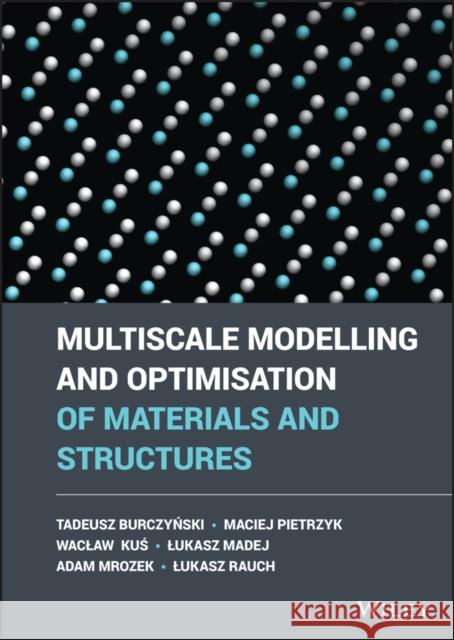
Multiscale Modelling and Optimisation of Materials and Structures Pietrzyk, Maciej 9781119975922 John Wiley & Sons - książkaWidoczna okładka, to zdjęcie poglądowe, a rzeczywista szata graficzna może różnić się od prezentowanej.

Multiscale Modelling and Optimisation of Materials and Structures

ISBN-13: 9781119975922 / Angielski / Twarda / 2020 / 512 str.

Tadeusz Burczynski; Maciej Pietrzyk
cena 575,20
(netto: 547,81 VAT:  5%)

Najniższa cena z 30 dni: 574,01
Termin realizacji zamówienia:
ok. 30 dni roboczych
Bez gwarancji dostawy przed świętami

Darmowa dostawa!

Addresses the very topical, crucial and original subject of parameter identification and optimization within multiscale modeling methods Multiscale Modelling and Optimization of Materials and Structures presents an important and challenging area of research that enables the design of new materials and structures with better quality, strength and performance parameters as well as the creation of reliable models that take into account structural, material and topological properties at different scales. The authors' approach is four-fold; 1) the basic principles of micro and nano scale modeling techniques; 2) the connection of micro and/or nano scale models with macro simulation software; 3) optimization development in the framework of multiscale engineering and the solution of identification problems; 4) the computer science techniques used in this model and advice for scientists interested in developing their own models and software for multiscale analysis and optimization. The authors present several approaches such as the bridging and homogenization methods, as well as the general formulation of complex optimization and identification problems in multiscale modelling. They apply global optimization algorithms based on robust bioinspired algorithms, proposing parallel and multi-subpopulation approaches in order to speed-up computations, and discuss several numerical examples of multiscale modeling, optimization and identification of composite and functionally graded engineering materials and bone tissues. Multiscale Modelling and Optimization of Materials and Structures is thereby a valuable source of information for young scientists and students looking to develop their own models, write their own computer programs and implement them into simulation systems.

  • Describes micro and nano scale models developed by the authors along with case studies of analysis and optimization
  • Discusses the problems of computing costs, efficiency of information transfer, effective use of the computer memory and several other aspects of development of multiscale models
  • Includes real physical, chemical and experimental studies with modern experimental techniques
  • Provides a valuable source of information for young scientists and students looking to develop their own models, write their own computer programs and implement them into simulation systems, with the available of bespoke software available on the accompanying website www.wiley.com/go/burczynski


Kategorie:
Technologie
Kategorie BISAC:
Technology & Engineering > Drafting & Mechanical Drawing
Technology & Engineering > Materials Science - General
Wydawca:
John Wiley & Sons
Język:
Angielski
ISBN-13:
9781119975922
Rok wydania:
2020
Ilość stron:
512
Oprawa:
Twarda
Wolumenów:
01
Dodatkowe informacje:
Bibliografia

Preface ixBiography xi1 Introduction to Multiscale Modelling and Optimization 11.1 Multiscale Modelling 21.1.1 Basic Information on Multiscale Modelling 21.1.2 Review of problems connected with multiscale modelling techniques 31.1.3 Prospective Applications of the Multiscale Modelling 61.2 Optimization 61.3 Contents of the Book 7References 72 Modelling of Phenomena 92.1 Physical Phenomena in Nanoscale 92.1.1 The Linkage Between Quantum and Classical Molecular Mechanics 102.1.2 Atomic Potentials 152.1.2.1 Lennard-Jones Potential 152.1.2.2 Morse Potential 162.1.2.3 Stillinger-Weber Potential 172.1.2.4 Reactive empirical bond order (REBO) potential 182.1.2.5 Reactive force fields (ReaxFF) 192.1.2.6 Murrell-Mottram Potential 202.1.2.7 Embedded Atom Method 212.2 Physical Phenomena in Microscale 222.2.1 Microstructural Aspects of Selection of a Microscale Model 222.2.1.1 Plastometric Tests 232.2.1.2 Inverse Analysis 262.2.2 Flow Stress 262.2.2.1 Procedure to Determine Flow Stress 262.2.2.2 Flow Stress Model 282.2.2.3 Identification of the Flow Stress Model 302.2.3 Recrystallization 322.2.3.1 Static Microstructural Changes 332.2.3.2 Dynamic Softening 382.2.3.3 Grain Growth 412.2.3.4 Effect of Precipitation 422.2.4 Phase Transformations 432.2.4.1 JMAK-Equation-Based Model 472.2.4.2 Differential Equation Model 492.2.4.3 Numerical Solution 502.2.4.4 Additivity Rule 502.2.4.5 Phase Transformation During Heating 512.2.4.6 Identification of the Model 522.2.4.7 Case Studies 562.2.5 Fracture 572.2.5.1 Fundamentals of Fracture Mechanics and Classical Fracture and Failure Hypotheses 582.2.5.2 Empirical Fracture Criteria 602.2.5.3 Fracture Mechanics 612.2.5.4 Continuum Damage Mechanics (CDM) 622.2.6 Creep 662.2.7 Fatigue 71References 733 Computational Methods 813.1 Computational Methods for Continuum 813.1.1 FEM and XFEM 813.1.1.1 Principles of Computational Modelling Using FEM 813.1.1.2 Principles of Computational Modelling Using FEM 833.1.1.3 Extended Finite Element Method 883.1.2 BEM and FEM/BEM Coupling 913.1.2.1 BEM 913.1.2.2 Coupling FEM and BEM 953.1.3 Computational Homogenization 963.2 Computational Methods for Nano and Micro 1013.2.1 Classical Molecular Dynamics 1013.2.1.1 Equations of Motion 1013.2.1.2 Discretization of Equations of Motion 1023.2.1.3 Temperature Controller 1053.2.1.4 Evaluation of the Time Step 1083.2.1.5 Cutoff Radius and Nearest-Neighbour Lists 1093.2.1.6 Boundary Conditions 1113.2.1.7 Size of the Atomistic Domain - Limitations of the Molecular Simulations 1123.2.2 Molecular Statics 1143.2.2.1 Equilibrium of Interatomic Forces 1143.2.2.2 Solution of the Molecular Statics Problem 1163.2.2.3 Numerical Example of the Molecular Statics 1183.2.3 Cellular Automata 1193.2.3.1 Cellular Automata Definitions 1193.2.4 Monte Carlo Methods 1253.3 Methods of Optimization 1273.3.1 Optimization Problem Formulation 1273.3.2 Methods of Conventional Optimization 1273.3.3 Methods of Nonconventional Optimization 1293.3.3.1 Evolutionary Algorithm 1293.3.3.2 Artificial Immune System 1323.3.3.3 Particle Swarm Optimization 1333.3.3.4 Hybrid Optimization Algorithms 134References 1354 Preparation of Material Representation 1434.1 Generation of Nanostructures 1434.1.1 Modelling of Polycrystals and Material Defects 1434.1.1.1 Controlled Cooling 1454.1.1.2 Adjustable Range of Atomic Interactions 1484.1.1.3 Squeezing of the Nanoparticles 1494.1.1.4 Modelling of Structures with Voids 1524.1.1.5 Material Properties of the Nanostructures 1534.1.1.6 Models and Mechanical Properties of 2D Materials with Point Defects 1564.2 Microstructure 1604.2.1 Generation of Microstructures 1604.2.1.1 Voronoi Tessellation 1614.2.1.2 Cellular Automata Grain Growth Algorithm 1614.2.1.3 Close-Packed Sphere Growth CA-Based Grain Growth Algorithm 1674.2.1.4 Monte Carlo Grain Growth Algorithm 1724.2.1.5 DigiCore Library 1754.2.1.6 Image Processing 1784.2.2 Properties of the Microstructure Features 182References 1845 Examples of Multiscale Simulations 1895.1 Classification of Multiscale Modelling Methods 1895.2 Case Studies 1965.2.1 Nano-Micro 1965.2.1.1 Multiscale Discrete-Continuum Model 1965.2.1.2 Conversion of the Nodal Forces to Tractions 2005.2.1.3 Examples of the Nanoscale-Microscale Modelling 2015.2.2 Microscale-Macroscale 2065.2.2.1 Dynamic Recrystallization 2075.2.2.2 Phase Transformation 2105.2.2.3 Microshear Bands, Shear Bands, and Strain Localization 211References 2136 Optimization and Identification in Multiscale Modelling 2196.1 Multiscale Optimization 2206.1.1 Optimization of Atomic Clusters 2206.1.1.1 Introduction to Optimization of Atomic Clusters 2206.1.1.2 Optimization of Carbon Atomic Clusters 2246.1.1.3 New Stable Carbon Networks X and Y 2306.1.2 Material, Shape, and Topology Optimization 2366.2 Identification in Multiscale Modelling 2426.2.1 Material Parameters Identification 2446.2.2 Multiscale Identification Problem in Stochastic Conditions 2456.2.3 Shape and Topology Identification 2506.2.4 Identification of Shape for Multiscale Thermomechanical Problems 251References 2557 Computer Implementation Issues 2617.1 Interactions Between the Analysis and Optimization Solutions 2617.1.1 Example of Direct Problem Solver File Access 2637.1.2 Examples of an Internal Script in Direct Problem Solver 2647.2 Visualization of Large Data Sets 2657.2.1 Implementation Aspects and Tools 2667.2.1.1 Graphical Libraries 2667.2.1.2 Software 2687.2.1.3 Frameworks 2697.2.1.4 Data Storing 2707.2.2 High Efficiency of Visualization 2717.2.2.1 Dedicated Algorithms 2727.2.2.2 Hardware Parallelism 2727.2.2.3 Quality Improvement 2737.2.2.4 Material Data for Visualization Purposes 2747.2.3 Visualization Based on Sectioning 2777.2.3.1 Algorithm Idea 2777.2.3.2 Background Buffering 2787.2.3.3 Preferred Sections 2797.2.4 Functional Assumptions 2817.2.4.1 Data Preprocessing 2817.2.4.2 Visualization 2847.2.5 Case Studies 2867.2.5.1 Digital Microstructures 2867.2.5.2 Performance Tests 287References 2918 Concluding Remarks 293Index

Pietrzyk, Maciej Professor Maciej Pietrzyk is Professor of Metallur... więcej >


Udostępnij

Facebook - konto krainaksiazek.pl


Opinie o Krainaksiazek.pl na Opineo.pl

Partner Mybenefit

Krainaksiazek.pl w programie rzetelna firma Krainaksiaze.pl - płatności przez paypal

Czytaj nas na:

Facebook - krainaksiazek.pl
  • książki na zamówienie
  • granty
  • książka na prezent
  • kontakt
  • pomoc
  • opinie
  • regulamin
  • polityka prywatności

Zobacz:

  • Księgarnia czeska

  • Wydawnictwo Książkowe Klimaty

1997-2025 DolnySlask.com Agencja Internetowa

© 1997-2022 krainaksiazek.pl
     
KONTAKT | REGULAMIN | POLITYKA PRYWATNOŚCI | USTAWIENIA PRYWATNOŚCI
Zobacz: Księgarnia Czeska | Wydawnictwo Książkowe Klimaty | Mapa strony | Lista autorów
KrainaKsiazek.PL - Księgarnia Internetowa

Polityka prywatnosci - link
Krainaksiazek.pl - płatnośc Przelewy24
Przechowalnia Przechowalnia





