• Wyszukiwanie zaawansowane
  • Kategorie
  • Kategorie BISAC
  • Książki na zamówienie
  • Promocje
  • Granty
  • Książka na prezent
  • Opinie
  • Pomoc
  • Załóż konto
  • Zaloguj się

Activity Learning: Discovering, Recognizing, and Predicting Human Behavior from Sensor Data » książka

zaloguj się | załóż konto
Logo Krainaksiazek.pl

koszyk

konto

szukaj
topmenu
Księgarnia internetowa
Szukaj
Książki na zamówienie
Promocje
Granty
Książka na prezent
Moje konto
Pomoc
 
 
Wyszukiwanie zaawansowane
Pusty koszyk
Bezpłatna dostawa dla zamówień powyżej 20 złBezpłatna dostawa dla zamówień powyżej 20 zł

Kategorie główne

• Nauka
 [2949965]
• Literatura piękna
 [1857847]

  więcej...
• Turystyka
 [70818]
• Informatyka
 [151303]
• Komiksy
 [35733]
• Encyklopedie
 [23180]
• Dziecięca
 [617748]
• Hobby
 [139972]
• AudioBooki
 [1650]
• Literatura faktu
 [228361]
• Muzyka CD
 [398]
• Słowniki
 [2862]
• Inne
 [444732]
• Kalendarze
 [1620]
• Podręczniki
 [167233]
• Poradniki
 [482388]
• Religia
 [509867]
• Czasopisma
 [533]
• Sport
 [61361]
• Sztuka
 [243125]
• CD, DVD, Video
 [3451]
• Technologie
 [219309]
• Zdrowie
 [101347]
• Książkowe Klimaty
 [123]
• Zabawki
 [2362]
• Puzzle, gry
 [3791]
• Literatura w języku ukraińskim
 [253]
• Art. papiernicze i szkolne
 [7933]
Kategorie szczegółowe BISAC

Activity Learning: Discovering, Recognizing, and Predicting Human Behavior from Sensor Data

ISBN-13: 9781118893760 / Angielski / Twarda / 2015 / 288 str.
Diane J. Cook
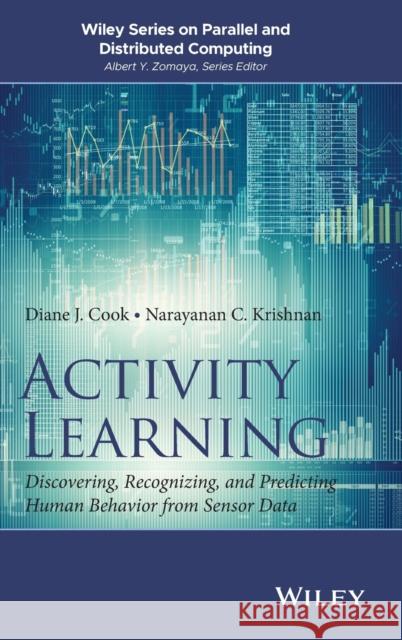
Activity Learning: Discovering, Recognizing, and Predicting Human Behavior from Sensor Data Cook, Diane J. 9781118893760 John Wiley & Sons - książkaWidoczna okładka, to zdjęcie poglądowe, a rzeczywista szata graficzna może różnić się od prezentowanej.

Activity Learning: Discovering, Recognizing, and Predicting Human Behavior from Sensor Data

ISBN-13: 9781118893760 / Angielski / Twarda / 2015 / 288 str.

Diane J. Cook
cena 547,71
(netto: 521,63 VAT:  5%)

Najniższa cena z 30 dni: 524,69
Termin realizacji zamówienia:
ok. 16-18 dni roboczych
Bez gwarancji dostawy przed świętami

Darmowa dostawa!

Defines the notion of an activity model learned from sensor data and presents key algorithms that form the core of the field Activity Learning: Discovering, Recognizing and Predicting Human Behavior from Sensor Data provides an in-depth look at computational approaches to activity learning from sensor data. Each chapter is constructed to provide practical, step-by-step information on how to analyze and process sensor data. The book discusses techniques for activity learning that include the following:

  • Discovering activity patterns that emerge from behavior-based sensor data
  • Recognizing occurrences of predefined or discovered activities in real time
  • Predicting the occurrences of activities
The techniques covered can be applied to numerous fields, including security, telecommunications, healthcare, smart grids, and home automation. An online companion site enables readers to experiment with the techniques described in the book, and to adapt or enhance the techniques for their own use.

With an emphasis on computational approaches, Activity Learning: Discovering, Recognizing, and Predicting Human Behavior from Sensor Data provides graduate students and researchers with an algorithmic perspective to activity learning.


Kategorie:
Technologie
Kategorie BISAC:
Technology & Engineering > Electronics - Digital
Technology & Engineering > Sensors
Computers > Data Science - Data Analytics
Wydawca:
John Wiley & Sons
Seria wydawnicza:
Wiley Series on Parallel and Distributed Computing
Język:
Angielski
ISBN-13:
9781118893760
Rok wydania:
2015
Ilość stron:
288
Waga:
0.59 kg
Wymiary:
23.62 x 15.75 x 2.54
Oprawa:
Twarda
Wolumenów:
01
Dodatkowe informacje:
Komentarz
Bibliografia

Preface ix

List of Figures xi

1. Introduction 1

2. Activities 5

2.1 Definitions 5

2.2 Classes of Activities 7

2.3 Additional Reading 8

3. Sensing 11

3.1 Sensors Used for Activity Learning 11

3.1.1 Sensors in the Environment 12

3.1.2 Sensors on the Body 15

3.2 Sample Sensor Datasets 17

3.3 Features 17

3.3.1 Sequence Features 21

3.3.2 Discrete Event Features 23

3.3.3 Statistical Features 25

3.3.4 Spectral Features 31

3.3.5 Activity Context Features 34

3.4 Multisensor Fusion 34

3.5 Additional Reading 38

4. Machine Learning 41

4.1 Supervised Learning Framework 41

4.2 Naïve Bayes Classifier 44

4.3 Gaussian Mixture Model 48

4.4 Hidden Markov Model 50

4.5 Decision Tree 54

4.6 Support Vector Machine 56

4.7 Conditional Random Field 62

4.8 Combining Classifier Models 63

4.8.1 Boosting 64

4.8.2 Bagging 65

4.9 Dimensionality Reduction 66

4.10 Additional Reading 72

5. Activity Recognition 75

5.1 Activity Segmentation 76

5.2 Sliding Windows 81

5.2.1 Time Based Windowing 81

5.2.2 Size Based Windowing 82

5.2.3 Weighting Events Within a Window 83

5.2.4 Dynamic Window Sizes 87

5.3 Unsupervised Segmentation 88

5.4 Measuring Performance 92

5.4.1 Classifier–Based Activity Recognition Performance Metrics 95

5.4.2 Event–Based Activity Recognition Performance Metrics 99

5.4.3 Experimental Frameworks for Evaluating Activity Recognition 102

5.5 Additional Reading 103

6. Activity Discovery 107

6.1 Zero–Shot Learning 108

6.2 Sequence Mining 110

6.2.1 Frequency–Based Sequence Mining 111

6.2.2 Compression–Based Sequence Mining 112

6.3 Clustering 117

6.4 Topic Models 119

6.5 Measuring Performance 121

6.5.1 Expert Evaluation 121

6.6 Additional Reading 124

7. Activity Prediction 127

7.1 Activity Sequence Prediction 128

7.2 Activity Forecasting 133

7.3 Probabilistic Graph–Based Activity Prediction 137

7.4 Rule–Based Activity Timing Prediction 139

7.5 Measuring Performance 142

7.6 Additional Reading 146

8. Activity Learning in the Wild 149

8.1 Collecting Annotated Sensor Data 149

8.2 Transfer Learning 158

8.2.1 Instance and Label Transfer 162

8.2.2 Feature Transfer with No Co–occurrence Data 166

8.2.3 Informed Feature Transfer with Co–occurrence Data 167

8.2.4 Uninformed Feature Transfer with Co–occurrence Data Using a Teacher Learner Model 168

8.2.5 Uninformed Feature Transfer with Co–occurrence Data Using Feature Space Alignment 170

8.3 Multi–Label Learning 170

8.3.1 Problem Transformation 173

8.3.2 Label Dependency Exploitation 174

8.3.3 Evaluating the Performance of Multi–Label Learning Algorithms 179

8.4 Activity Learning for Multiple Individuals 180

8.4.1 Learning Group Activities 180

8.4.2 Train on One/Test on Multiple 183

8.4.3 Separating Event Streams 185

8.4.4 Tracking Multiple Users 188

8.5 Additional Reading 190

9. Applications of Activity Learning 195

9.1 Health 195

9.2 Activity–Aware Services 198

9.3 Security and Emergency Management 199

9.4 Activity Reconstruction, Expression and Visualization 201

9.5 Analyzing Human Dynamics 207

9.6 Additional Reading 210

10. The Future of Activity Learning 213

Appendix: Sample Activity Data 217

Bibliography 237

Index 253

Diane Cook, PhD, is a professor in the School of Electrical Engineering and Computer Science at Washington State University. Her research relating to artificial intelligence and data mining have been supported by grants from the National Science Foundation, the National Institutes of Health, NASA, DARPA, USAF, NRL, and DHS. She is the co–author of Mining Graph Data and Smart Environments, both published by Wiley. Dr. Cook is an IEEE Fellow and a member of AAAI.

Narayanan C. Krishnan, PhD, is a faculty member of the Department of Computer Science and Engineering at the Indian Institute of Technology Ropar. His research focuses on activity recognition, pervasive computing, and applied machine learning. Dr. Krishnan received the gold medal for academic excellence in Masters of Technology in Computer Science in 2004 and was nominated for the Best PhD Thesis Award at Arizona State University in 2010.

Defines the notion of an activity model learned from sensor data and presents key algorithms that form the core of the field

Activity Learning: Discovering, Recognizing and Predicting Human Behavior from Sensor Data provides an in–depth look at computational approaches to activity learning from sensor data. Each chapter is constructed to provide practical, step–by–step information on how to analyze and process sensor data. The book discusses techniques for activity learning that include the following:

  • Discovering activity patterns that emerge from behavior–based sensor data
  • Recognizing occurrences of predefined or discovered activities in real time
  • Predicting the occurrences of activities

The techniques covered can be applied to numerous fields, including security, telecommunications, healthcare, smart grids, and home automation. An online companion site enables readers to experiment with the techniques described in the book, and to adapt or enhance the techniques for their own use.

With an emphasis on computational approaches, Activity Learning: Discovering, Recognizing, and Predicting Human Behavior from Sensor Data provides graduate students and researchers with an algorithmic perspective to activity learning.

Cook, Diane J. DIANE J. COOK, PhD, is the Huie-Rogers Chair Profe... więcej >


Udostępnij

Facebook - konto krainaksiazek.pl


Opinie o Krainaksiazek.pl na Opineo.pl

Partner Mybenefit

Krainaksiazek.pl w programie rzetelna firma Krainaksiaze.pl - płatności przez paypal

Czytaj nas na:

Facebook - krainaksiazek.pl
  • książki na zamówienie
  • granty
  • książka na prezent
  • kontakt
  • pomoc
  • opinie
  • regulamin
  • polityka prywatności

Zobacz:

  • Księgarnia czeska

  • Wydawnictwo Książkowe Klimaty

1997-2025 DolnySlask.com Agencja Internetowa

© 1997-2022 krainaksiazek.pl
     
KONTAKT | REGULAMIN | POLITYKA PRYWATNOŚCI | USTAWIENIA PRYWATNOŚCI
Zobacz: Księgarnia Czeska | Wydawnictwo Książkowe Klimaty | Mapa strony | Lista autorów
KrainaKsiazek.PL - Księgarnia Internetowa

Polityka prywatnosci - link
Krainaksiazek.pl - płatnośc Przelewy24
Przechowalnia Przechowalnia





