• Wyszukiwanie zaawansowane
  • Kategorie
  • Kategorie BISAC
  • Książki na zamówienie
  • Promocje
  • Granty
  • Książka na prezent
  • Opinie
  • Pomoc
  • Załóż konto
  • Zaloguj się

Language, Society and Identity in Early Iceland » książka

zaloguj się | załóż konto
Logo Krainaksiazek.pl

koszyk

konto

szukaj
topmenu
Księgarnia internetowa
Szukaj
Książki na zamówienie
Promocje
Granty
Książka na prezent
Moje konto
Pomoc
 
 
Wyszukiwanie zaawansowane
Pusty koszyk
Bezpłatna dostawa dla zamówień powyżej 20 złBezpłatna dostawa dla zamówień powyżej 20 zł

Kategorie główne

• Nauka
 [2952079]
• Literatura piękna
 [1850969]

  więcej...
• Turystyka
 [71058]
• Informatyka
 [151066]
• Komiksy
 [35579]
• Encyklopedie
 [23181]
• Dziecięca
 [620496]
• Hobby
 [139036]
• AudioBooki
 [1646]
• Literatura faktu
 [228729]
• Muzyka CD
 [379]
• Słowniki
 [2932]
• Inne
 [445708]
• Kalendarze
 [1409]
• Podręczniki
 [164793]
• Poradniki
 [480107]
• Religia
 [510956]
• Czasopisma
 [511]
• Sport
 [61267]
• Sztuka
 [243299]
• CD, DVD, Video
 [3411]
• Technologie
 [219640]
• Zdrowie
 [100984]
• Książkowe Klimaty
 [124]
• Zabawki
 [2281]
• Puzzle, gry
 [3363]
• Literatura w języku ukraińskim
 [258]
• Art. papiernicze i szkolne
 [8020]
Kategorie szczegółowe BISAC

Language, Society and Identity in Early Iceland

ISBN-13: 9781118294963 / Angielski / Miękka / 2012 / 198 str.
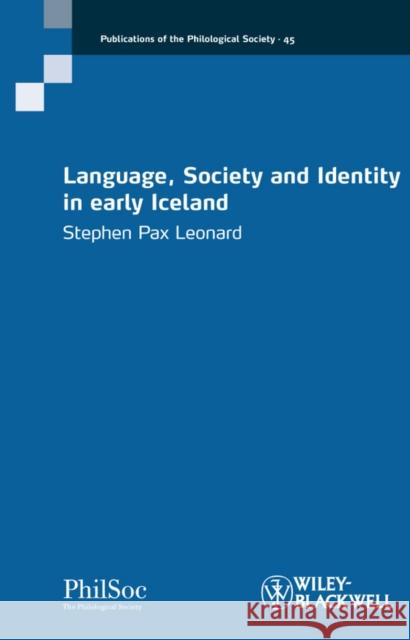
Stephen Pax Leonard
Language, Society and Identity in Early Iceland Leonard, Stephen Pax 9781118294963 Wiley-Blackwell - książkaWidoczna okładka, to zdjęcie poglądowe, a rzeczywista szata graficzna może różnić się od prezentowanej.

Language, Society and Identity in Early Iceland

ISBN-13: 9781118294963 / Angielski / Miękka / 2012 / 198 str.

Stephen Pax Leonard
cena 118,04
(netto: 112,42 VAT:  5%)

Najniższa cena z 30 dni: 116,83
Termin realizacji zamówienia:
ok. 30 dni roboczych.

Darmowa dostawa!

Language, Society and Identity in early Iceland offers a much-needed exploration into the problem of linguistic and social identity construction in early Iceland, and is a fascinating account of an under examined historical-linguistic story that will spur further research and discussion amongst researchers.

  • Engages with recent theoretical research on dialect formation and language isolation
  • Makes a significant contribution to our understanding of dialect development, putting forward a persuasive hypothesis accounting for the lack of dialect variation in Icelandic
  • Uses a unique, multi-disciplinary approach that brings together material from a wide range of fields for a comprehensive examination of the role of language in identity construction
  • Opens up opportunities for further research, especially for those concerned with language and identity in Iceland today, where there is for the first time sociolinguistic variation


Kategorie:
Nauka, Językoznawstwo
Kategorie BISAC:
Language Arts & Disciplines > Linguistics - General
Wydawca:
Wiley-Blackwell
Seria wydawnicza:
Publications of the Philological Society
Język:
Angielski
ISBN-13:
9781118294963
Rok wydania:
2012
Numer serii:
000115447
Ilość stron:
198
Waga:
0.27 kg
Wymiary:
22.61 x 14.73 x 1.02
Oprawa:
Miękka
Wolumenów:
01
Dodatkowe informacje:
Bibliografia
Wydanie ilustrowane

1 Introduction

1.1 Aims of the present study

1.2 Organisation of study

1.3 The settlement of Iceland

1.4 The establishment of social structures

1.5 The language of the Icelanders

1.6 Sources

1.6.1 Historical texts

1.6.2 Religious works

1.6.3 Law codes

1.6.4 Grammatical Treatises

1.6.5 Poetry

1.6.6 Saga material

2 Language and identity: theoretical considerations

2.1 Introduction

2.2 Socio–historical linguistics and sociolinguistic theory

2.3 Language change and norms

2.3.1 Intra–linguistic versus extra–linguistic explanations of language change

2.4 Language and dialect contact

2.4.1 Dialect levelling and koineisation

2.4.2 Markedness in tabula rasa dialect–formation

2.5 Language and dialect isolation

2.5.1 Drift

2.6 Language development in tabula rasa societies               

2.6.1 Language community types (and settlement patterns)

2.6.2 A deterministic model versus social factors

2.6.3 The Founder Principle and prestige

2.7 Identity: essentialism versus constructivism

2.7.1 Personal identity and group membership

2.7.2 Place and identity

2.8 Language and identity

2.8.1 Accommodation and networks

2.8.2 Accommodation Theory

2.8.3 Social network theory and language change

2.8.4 Deixis, pronouns and identity

2.9 Conclusion

3 Norm–establishment in Iceland

3.1 Introduction

3.2 Norse dialectal variation prior to the Settlement

3.2.1 The runic evidence

3.2.2 Runic evidence and the spoken language

3.3 The settlers: geographic origins and social mobility

3.3.1 The geographic origins of the settlers

3.3.2 Social background and mobility of the settlers

3.3.3 The status of Norse and Common Gaelic at the time of the Settlement

3.4 Dialect features in Iceland, the Faroe Islands and south–west Norway

3.5 Iceland as a new society

3.5.1 Features of new societies

3.6 Language development in early Iceland

3.6.1 The mixture theory

3.6.2 Dialect levelling in early Iceland

3.6.3 The basis for koineisation

3.7 Establishment of a linguistic norm in Iceland

3.7.1 Pre– and post–Settlement linguistic norms

3.7.2 Spoken norms and standardised written languages

3.7.3 The establishment of a norm: skaldic poetry (and the laws)

3.7.4 The establishment of a norm: the role of the sagas

3.8 The homogeneity of Icelandic

3.8.1 Background

3.8.2 Factors explaining the homogeneity of Icelandic

3.9 Conclusion

4 Social structures in the lexicon

4.1 Introduction

4.2 Social identity and Icelandic social structures

4.2.1 Emerging social structures and identities

4.2.2 Characteristics of Icelandic social structures: role of the law

4.2.3 The significance of assembly–attachment

4.3 Specific Icelandic social structures

4.3.1 hreppr ( commune )

4.3.2 bu´ar ( neighbours )

4.3.3 alþingi ( General Assembly ) and lo¨gre´tta ( Law Council )

4.3.4 goðar ( chieftains )

4.4 Individual identity and Icelandic kinship structures

4.4.1 landna´m ( Settlement ) and kinship structures

4.4.2 Kinship and land–transfer

4.4.3 Genealogies and identity

4.4.4 Icelandic kinship terminology: cousin terms

4.5 Conclusion

5 Perception and use of language as an identity marker

5.1 Introduction

5.2 Icelanders perceptions of foreign languages

5.2.1 References to a foreign language

5.2.2 References to Irish

5.3 A vernacular identity: do¨nsk tunga, norræna and its speakers

5.3.1 The do¨nsk tunga as an identity marker

5.3.2 norræna as an identity marker

5.3.3 Norse dialectical variation and Anglo–Norse intelligibility

5.4 Grammatical variables as identity markers

5.4.1 Agreeing possessive adjectives

5.4.2 Pronominal usage in the early Icelandic law codes

5.4.3 The they

5.4.4 The we

5.5 Spatial references: the issue of identity

5.5.1 Spatio–directional particles

5.5.2 Idiomatic use of spatial grammar

5.5.3 Semantics of orientation: the Norwegian system

5.5.4 Semantics of orientation: the Quarter–based system

5.6 Conclusion

6 Conclusion

References

Index 

Stephen Pax Leonard is a Fellow of Trinity Hall, Cambridge and a Research Associate at the Scott Polar Research Institute. Educated at the University of Oxford, he studied modern and ancient languages before developing interests in linguistic and existential anthropology. He has carried out both linguistic and ethnographic fieldwork in Iceland and the Faroe Islands. More recently, he spent a year living with the Inugguit of north–west Greenland who live in the northern–most permanently inhabited settlement in the world, documenting their vulnerable minority language and spoken traditions.


The language of a speech community can only act as an identity marker for all of its speakers if a standard is widely shared and if a minimal number of language varieties are spoken. This book examines how one dialect came to serve the whole of Iceland.

The language community that we can reconstruct for early Iceland should have led to the establishment and maintenance of dialects. But this didn′t happen. Iceland was instead characterized by long–term linguistic homogeneity. Using the most recent sociolinguistic theory, and drawing on history and archaeology, Stephen Pax Leonard explores some of the reasons for the unusual development of the Icelandic language, showing how the Icelandic identity developed through the establishment of social structures and their literary culture. With its rich literature, the language became the single most important factor for the identity of the Icelanders.

Language, Society and Identity in early Iceland is a fascinating account of an under examined historical–linguistic story that will spur further research and discussion amongst researchers. In particular, it leaves a trail for those concerned with language and identity in Iceland today, where there is for the first time unequivocal evidence of sociolinguistic variation.


Udostępnij

Facebook - konto krainaksiazek.pl


Opinie o Krainaksiazek.pl na Opineo.pl

Partner Mybenefit

Krainaksiazek.pl w programie rzetelna firma Krainaksiaze.pl - płatności przez paypal

Czytaj nas na:

Facebook - krainaksiazek.pl
  • książki na zamówienie
  • granty
  • książka na prezent
  • kontakt
  • pomoc
  • opinie
  • regulamin
  • polityka prywatności

Zobacz:

  • Księgarnia czeska

  • Wydawnictwo Książkowe Klimaty

1997-2026 DolnySlask.com Agencja Internetowa

© 1997-2022 krainaksiazek.pl
     
KONTAKT | REGULAMIN | POLITYKA PRYWATNOŚCI | USTAWIENIA PRYWATNOŚCI
Zobacz: Księgarnia Czeska | Wydawnictwo Książkowe Klimaty | Mapa strony | Lista autorów
KrainaKsiazek.PL - Księgarnia Internetowa

Polityka prywatnosci - link
Krainaksiazek.pl - płatnośc Przelewy24
Przechowalnia Przechowalnia






