• Wyszukiwanie zaawansowane
  • Kategorie
  • Kategorie BISAC
  • Książki na zamówienie
  • Promocje
  • Granty
  • Książka na prezent
  • Opinie
  • Pomoc
  • Załóż konto
  • Zaloguj się

The Organizational Form of Family Business » książka


zaloguj się | załóż konto
Logo Krainaksiazek.pl

koszyk

konto

szukaj
topmenu
Księgarnia internetowa
Szukaj
Książki na zamówienie
Promocje
Granty
Książka na prezent
Moje konto
Pomoc
 
 
Wyszukiwanie zaawansowane
Pusty koszyk
Bezpłatna dostawa dla zamówień powyżej 20 złBezpłatna dostawa dla zamówień powyżej 20 zł

Kategorie główne

• Nauka
 [2952079]
• Literatura piękna
 [1850969]

  więcej...
• Turystyka
 [71058]
• Informatyka
 [151066]
• Komiksy
 [35579]
• Encyklopedie
 [23181]
• Dziecięca
 [620496]
• Hobby
 [139036]
• AudioBooki
 [1646]
• Literatura faktu
 [228729]
• Muzyka CD
 [379]
• Słowniki
 [2932]
• Inne
 [445708]
• Kalendarze
 [1409]
• Podręczniki
 [164793]
• Poradniki
 [480107]
• Religia
 [510956]
• Czasopisma
 [511]
• Sport
 [61267]
• Sztuka
 [243299]
• CD, DVD, Video
 [3411]
• Technologie
 [219640]
• Zdrowie
 [100984]
• Książkowe Klimaty
 [124]
• Zabawki
 [2281]
• Puzzle, gry
 [3363]
• Literatura w języku ukraińskim
 [258]
• Art. papiernicze i szkolne
 [8020]
Kategorie szczegółowe BISAC

The Organizational Form of Family Business

ISBN-13: 9780792379393 / Angielski / Twarda / 2000 / 186 str.
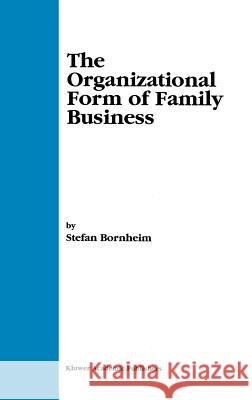
Stefan P. Bornheim; Stefan Bornhiem
The Organizational Form of Family Business Stefan P. Bornheim Stefan Bornhiem 9780792379393 Kluwer Academic Publishers - książkaWidoczna okładka, to zdjęcie poglądowe, a rzeczywista szata graficzna może różnić się od prezentowanej.

The Organizational Form of Family Business

ISBN-13: 9780792379393 / Angielski / Twarda / 2000 / 186 str.

Stefan P. Bornheim; Stefan Bornhiem
cena 603,81
(netto: 575,06 VAT:  5%)

Najniższa cena z 30 dni: 578,30
Termin realizacji zamówienia:
ok. 22 dni roboczych.

Darmowa dostawa!

The Organizational Form of Family Business attempts to develop an evolutionary family business theory, positioning family businesses as a distinct organizational form (based on conjectures from organizational ecology). An open and uninhibited playing field - achieved through utilizing a grounded theory methodology - heightens chances for observing precisely how family businesses behave.
An introductory chapter is followed by a literature review, beginning with a review of family business research. This is followed by a discussion of family business definitional issues, and accompanied by some data to show the economic importance of family business.
There follows a review of the research literature on grounded theory, its developments, and its epistemological and ontological assumptions in the light of contemporary philosophy of science. A literature review and historical outline of organizational ecology including the theoretical achievements is provided. Also, the comparison with the other main organizational theories, justifying the theory selection, is offered.


Kategorie:
Nauka, Ekonomia i biznes
Kategorie BISAC:
Business & Economics > Zarządzenie i techniki zarządzania
Business & Economics > Infrastructure
Wydawca:
Kluwer Academic Publishers
Język:
Angielski
ISBN-13:
9780792379393
Rok wydania:
2000
Wydanie:
2000
Ilość stron:
186
Waga:
1.03 kg
Wymiary:
23.5 x 15.5
Oprawa:
Twarda
Wolumenów:
01
Dodatkowe informacje:
Bibliografia
Wydanie ilustrowane

1. Introduction.- 1.1 Family Business.- 1.2 Grounded Theory.- 1.3 Organizational Ecology.- 1.4 The General Scope of this Research.- 1.5 Outlook.- 2. Literature Review.- 2.1 Family Business.- 2.1.1 Definitional issues.- 2.1.2 Statistics.- 2.1.3 Succession.- 2.1.4 International family business research.- 2.1.5 Entrepreneurship links.- 2.1.6 Strategy.- 2.1.7 Organizational behavior.- 2.1.8 Questions unanswered.- 2.2 Grounded Theory.- 2.2.1 Basic considerations.- 2.2.2 Some thoughts on the qualitative/quantitative dichotomy.- 2.2.3 Grounded theory in contrast to other methodological approaches.- 2.2.3.1 The inherent characteristics of qualitative research.- 2.2.3.2 The benefits of grounded theory.- 2.2.3.3 Triangulation.- 2.2.3.4 The use of cases and case studies.- 2.2.4 The hard core vs. the periphery.- 2.2.5 Some more philosophy of science.- 2.2.5.1 Sir Karl R. Popper.- 2.2.5.2 Thomas S. Kuhn.- 2.2.5.3 Paul K. Feyerabend.- 2.3 Organizational Ecology.- 2.3.1 Central themes.- 2.3.1.1 Adaptation and selection.- 2.3.1.2 Density dependence.- 2.3.1.3 Organizational foundings.- 2.3.1.4 Organizational mortality.- 2.3.1.5 Further categories of ecological research.- 2.3.2 Questions remaining.- 2.3.3 The fit of grounded theory and organizational ecology.- 2.4 The European Union.- 2.4.1 The institution and process of the European Union.- 2.4.2 Chronology of the Union.- 2.4.3 The history of the Union.- 2.4.4 The evolution of the European Union.- 2.4.5 The democratic foundations of the European Union.- 2.4.6 The single market in 1995.- 2.4.7 Small and medium-sized enterprises in the European Union.- 2.5 A Summary of Implications for this Research.- 3. Methodology.- 3.1 Formal Description.- 3.1.1 The procedure.- 3.1.2 The cases.- 3.2 Basic Grounded Theory Procedures.- 3.2.1 Theoretical sensitivity.- 3.2.2 The use of literature.- 3.2.3 Coding procedures in grounded theory.- 3.2.3.1 Open coding.- 3.2.3.2 Axial coding.- 3.2.3.3 Selective coding.- 3.3 The secondary data.- 3.3.1 The Interstratos project.- 3.3.2 The questionnaire.- 3.3.3 The data.- 3.3.4 Statistical techniques.- 3.3.5 Testing for assumption violations.- 3.3.5.1 Heteroskedasticity.- 3.3.5.2 Multi-Collinearity.- 3.3.6 Statistical procedures.- 3.4 The Utilization of Grounded Theory and Ecological Conjectures in Family Business.- 4. Results.- 4.1 Presentation of Cases.- 4.1.1 Austria (case A).- 4.1.2 Denmark (case D).- 4.1.3 Germany.- 4.1.3.1 Case G1.- 4.1.3.2 Case G2.- 4.1.3.3 Case G3.- 4.1.4 Sweden (case S1).- 4.1.5 Switzerland (case S2).- 4.2 The Model.- 4.3 The Core Elements as Found Embedded in the Case Data.- 4.4 The Statistical Analysis of the Interstratos Data.- 4.4.1 The hypotheses.- 4.4.2 Variables and proxy constructs.- 4.4.2.1 Hypotheses concerning the individual core elements.- 4.4.2.2 Hypotheses concerning the whole core model.- 4.4.3 Descriptive data set information.- 4.4.4 Results and presentation of the statistical analysis.- 4.4.4.1 1991 (IS91).- 4.4.4.2 1992 (IS92).- 4.4.4.3 1993 (IS93).- 4.4.4.4 1994 (IS94).- 4.4.4.5 1995 (IS95).- 4.4.4.6 Summary of significant results.- 5. Discussion.- 5.1 The Refined Model.- 5.1.1 Simplicity.- 5.1.2 Focus on core business.- 5.1.3 Dedication, enthusiasm and belief.- 5.1.4 Values and principles.- 5.1.5 Incentives and rewards.- 5.2 Validation of the Refined Model Through Interstratos.- 5.3 Caveats.- 5.4 Future Research.- 5.5 Summary and Concluding Questions.- 6. Bibliography.

Bornheim, Stefan P. Stefan P. Bornheim is Research Director and Head o... więcej >


Udostępnij

Facebook - konto krainaksiazek.pl


Opinie o Krainaksiazek.pl na Opineo.pl

Partner Mybenefit

Krainaksiazek.pl w programie rzetelna firma Krainaksiaze.pl - płatności przez paypal

Czytaj nas na:

Facebook - krainaksiazek.pl
  • książki na zamówienie
  • granty
  • książka na prezent
  • kontakt
  • pomoc
  • opinie
  • regulamin
  • polityka prywatności

Zobacz:

  • Księgarnia czeska

  • Wydawnictwo Książkowe Klimaty

1997-2026 DolnySlask.com Agencja Internetowa

© 1997-2022 krainaksiazek.pl
     
KONTAKT | REGULAMIN | POLITYKA PRYWATNOŚCI | USTAWIENIA PRYWATNOŚCI
Zobacz: Księgarnia Czeska | Wydawnictwo Książkowe Klimaty | Mapa strony | Lista autorów
KrainaKsiazek.PL - Księgarnia Internetowa

Polityka prywatnosci - link
Krainaksiazek.pl - płatnośc Przelewy24
Przechowalnia Przechowalnia






